Your Guide to UK Mobile Development Services
Your Guide to UK Mobile Development Services
For any UK business, a mobile app isn't just a 'nice-to-have' anymore—it's become an essential tool for connecting with customers and driving growth. So, what are mobile development services? Think of them as a professional partnership dedicated to designing, building, and maintaining these applications. This goes way beyond just writing code; it's about creating a powerful digital asset that's built specifically for your business.
Why a Mobile Strategy is a Must-Have
Commissioning an app is less like buying off-the-shelf software and more like building a bespoke commercial property. A generic solution is like renting a standard office space—it might do the job, but it's never a perfect fit. A custom-built app, on the other hand, is designed to align perfectly with your brand, your internal workflows, and what your customers actually want. It becomes a direct line to your audience, right there in their pockets.
The numbers back this up. The UK mobile app economy is absolutely booming, with projections showing it could hit £15 billion by the end of 2025. This massive surge is fuelled by the fact that nearly 90% of the UK population has a smartphone. It's a clear sign of the post-pandemic shift where businesses are doubling down on their digital-first strategies. You can find more on this in these UK mobile app development trends on bestechsols.co.uk.
What's Actually Included in Mobile App Services?
So, what does this partnership typically look like? Professional mobile development services cover the entire lifecycle, taking an idea from a rough concept to a polished product ready for the market. These services are vital for navigating the tricky parts of app creation and making sure your investment pays off.
A complete service package will almost always include:
- Strategy and Discovery: This is the foundation. It involves digging into market research, seeing what your competitors are doing, and nailing down your app's core purpose and who you're building it for.
- UI/UX Design: Here, we create the blueprints—wireframes, mockups, and prototypes. The goal is to make sure the app not only looks great but is also intuitive and effortless for your customers to use.
- Development and Coding: This is where the magic happens and the code gets written. Key decisions are made here, like whether to build separate native apps for iOS and Android or use a cross-platform framework like Flutter to do both at once.
- Testing and Quality Assurance: Before launch, the app is put through its paces. We test it rigorously across different devices and scenarios to squash any bugs and ensure a smooth, reliable experience for every user.
- Deployment and Support: This involves managing the submission process to the Apple App Store and Google Play Store, followed by the ongoing maintenance needed to keep the app secure, updated, and running perfectly.
When you engage a dedicated development partner, you're not just hiring coders. You're bringing on a team of strategists, designers, and engineers who are all committed to one thing: building an app that achieves your specific business goals, whether that's boosting sales, improving customer loyalty, or making your operations more efficient. That collaborative approach is what separates a functional app from a truly successful one.
Choosing Your Development Path: Native vs Flutter
One of the first big decisions you'll face when commissioning a new app is how it should be built. Think of it like this: you need to get a critical message to two different audiences, each speaking a completely different language.
You could hire two separate, native-speaking translators. This guarantees a perfect, nuanced translation for each group, but it also means double the cost, double the time, and double the management. This is native development in a nutshell—building one app specifically for iOS and another, completely separate one for Android.
But what if you hired a single, world-class linguist who speaks both languages fluently? They could craft one core message and deliver it flawlessly to both audiences at the same time. This is the magic of modern cross-platform development, and it’s precisely where Flutter shines.
The Native Approach Explained
Native development means writing code specifically for a single operating system. For Apple’s ecosystem, developers use languages like Swift or Objective-C. For Android, they’ll use Kotlin or Java.
This approach gives your app direct, unrestricted access to all the device's hardware and features—the camera, GPS, accelerometer, you name it. For years, this was seen as the only way to guarantee top-tier performance.
The trade-off, however, is huge. You’re looking at two separate development teams, two codebases to maintain, and often a budget that’s double what a cross-platform project would cost. Every new feature or simple bug fix has to be built, tested, and deployed twice, which can seriously slow you down.
The Flutter Advantage: A Single Codebase for All Platforms
Flutter, an open-source framework from Google, completely changes the game. It lets our developers write the code once and then deploy it as a fully native application on both iOS and Android.
And let’s be clear: this isn't a clunky web page pretending to be an app. Flutter compiles directly to native ARM machine code, which means the performance is buttery smooth, fast, and completely indistinguishable from an app built the "native" way. In fact, new benchmarks consistently put Flutter at the top for performance.
For your business, this single-codebase approach delivers some serious wins:
- Significant Cost Savings: By cutting out the need for two separate teams and codebases, businesses can slash their development and ongoing maintenance costs by up to 40%.
- Faster Time-to-Market: Building one app instead of two drastically shortens the development timeline. You can get your product in front of customers and start seeing a return much, much sooner.
- Perfect Brand Consistency: Flutter ensures your app’s user interface (UI) and user experience (UX) are identical on every device. This strengthens your brand and gives every user the same reliable, high-quality experience.
- Stunning User Interfaces: Flutter gives developers pixel-perfect control over the design, allowing us to create beautiful, expressive, and custom UIs that make your app stand out.
The conversation is no longer about compromising between reach and quality. With benchmarks proving its incredible performance, Flutter delivers native-level speed while giving you all the efficiencies of cross-platform development. It’s the smart, scalable choice for reaching your entire market without cutting corners.
This isn't just a small shift; it's reshaping the entire industry. The UK’s mobile app development platform market is projected to skyrocket from USD 1,232.9 million in 2025 to a staggering USD 10,000 million by 2035. This explosive growth is being fuelled by tools like Flutter that make seamless iOS-Android compatibility a reality. For UK businesses, this means a Flutter app isn’t just a launch strategy—it’s a sustainable, long-term asset. Check out the full report on the UK's booming app platform market on marketresearchfuture.com.
To make this choice clearer, let's break down the key differences.
Native vs Cross-Platform (Flutter): A Quick Comparison
| Feature | Native Development (iOS & Android) | Cross-Platform Development (Flutter) |
|---|---|---|
| Codebase | Two separate codebases (one for iOS, one for Android). | One single codebase for both platforms. |
| Cost | Significantly higher due to two teams and dual maintenance. | Up to 40% more cost-effective. |
| Development Speed | Slower. Features must be built and tested twice. | Much faster time-to-market. Build once, deploy everywhere. |
| Performance | Excellent, direct access to all native device features. | Excellent, top-tier performance. Compiles directly to native code. |
| UI/UX Consistency | Can be challenging to keep both apps perfectly aligned. | Perfectly consistent brand experience across all devices. |
| Team Size | Requires separate iOS and Android specialist teams. | One unified team of Flutter developers. |
| Maintenance | More complex and costly. Two apps to update and support. | Simpler and cheaper. Update one codebase. |
Ultimately, the table shows that while native development has its place for very specific, hardware-intensive applications, Flutter offers a far more strategic and efficient path for the vast majority of businesses today.
Why Flutter is the Modern Choice
Of course, other cross-platform frameworks exist. But Flutter has quickly become the go-to for savvy developers and businesses for a reason. Unlike older frameworks that use a 'bridge' to talk to native components (which creates performance bottlenecks), Flutter renders everything itself. This direct approach is the secret to its incredible speed and responsiveness, which recent benchmarks confirm.
If you want to dive deeper into the technicals, our guide comparing Flutter vs React Native to see which is best for your app is a great place to start.
Choosing Flutter means you’re investing your resources intelligently. You build one exceptional product, reach your entire audience from day one, and retain the agility to innovate and adapt quickly. It’s more than a tech choice; it’s a business strategy that sets you up for long-term success.
The App Development Journey from Idea to Launch
Turning that lightbulb moment into a polished, high-performing app on someone's phone is a real journey. It’s not some mystical black box of coding; it's a structured, collaborative process designed to bring a business vision to life. Let's walk through this lifecycle step by step, so you know exactly what’s happening behind the scenes when you partner with a mobile development services team.
Let’s imagine a UK startup we'll call "UrbanHarvest." They have a brilliant idea for an app that connects city dwellers with local allotment gardeners to buy fresh, surplus produce. The concept is solid, but how do they make it a reality? This is where the development journey kicks off.
Stage 1: Discovery and Strategy
Before anyone even thinks about writing a line of code, the most important work gets done. The discovery phase is all about getting on the same page. For UrbanHarvest, this means sitting down with our strategy team to nail down their core business goals. Is the main aim to make money, build a community, or just push sustainable living?
Together, we’d thrash out the key questions:
- Who are we building this for? We'd flesh out user personas, like "Busy Professional Chloe" who wants convenient, healthy food, and "Retired Gardener Arthur" who wants to sell his extra veg.
- What problem are we actually solving? The app must make it dead simple to find and buy hyper-local produce.
- What’s in the first version? For a Minimum Viable Product (MVP), we'd focus on the essentials: user profiles, a map-based search, simple messaging, and a secure payment system. Fancy stuff can wait.
This stage wraps up with a detailed project roadmap and a clear scope of work, making sure everyone is pulling in the same direction from day one.
Stage 2: UI and UX Design
With the strategy locked in, our attention turns to the user experience (UX) and user interface (UI). This is where we figure out the app's look, feel, and flow. It’s all about making it intuitive and, frankly, a joy to use.
Our designers would first sketch out wireframes for UrbanHarvest – the basic blueprints for each screen – to map out how a user moves through the app. From there, we build interactive prototypes that look and feel just like the real thing. This lets the UrbanHarvest team click through the entire app, test the journey, and give feedback long before any real development starts. It’s a massive time and money saver.
The goal here is simple: create a seamless experience. If a user has to stop and think about how to find a local gardener or buy a tomato, the design hasn't done its job. A great app should feel effortless.
Stage 3: Flutter Development and Engineering
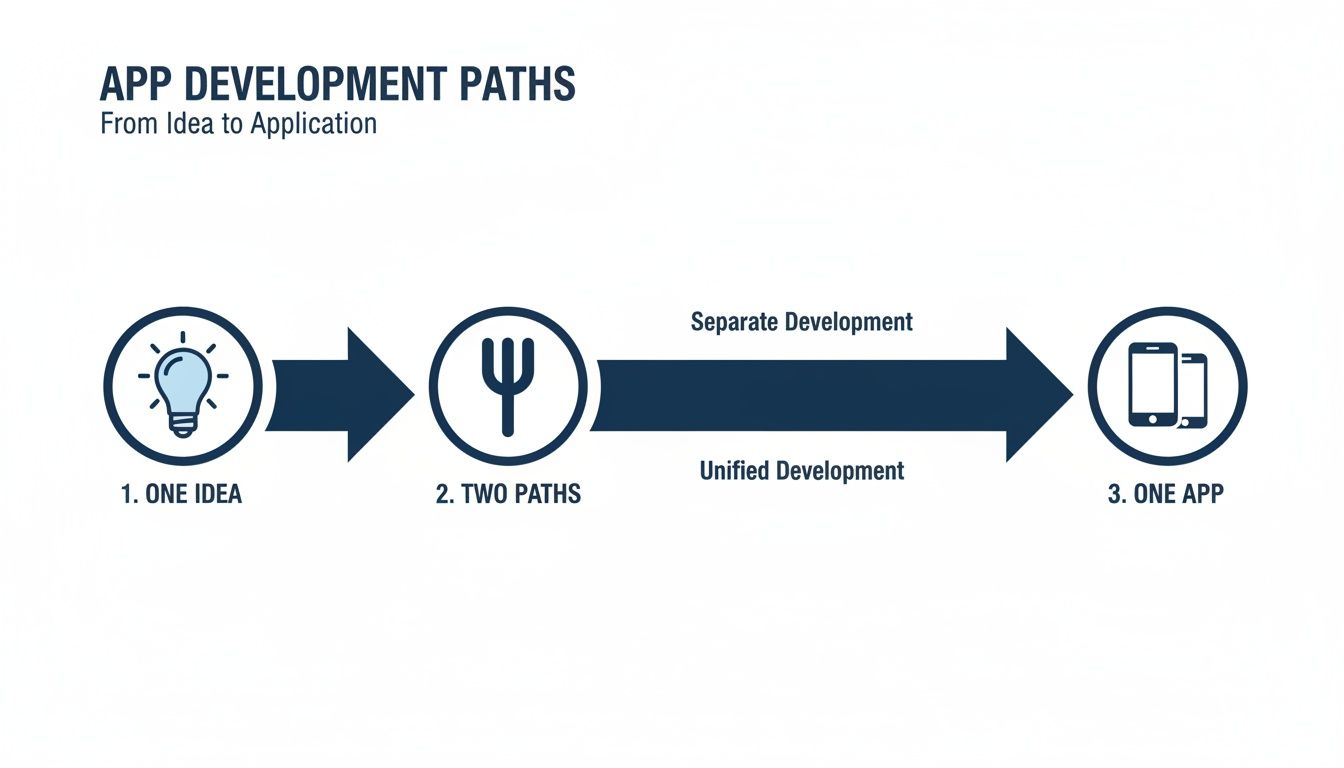
Now it’s time to bring the designs and plans to life. Our expert Flutter developers get to work, writing a single, clean codebase that will power the UrbanHarvest app on both iPhones and Android phones. No need to build it twice.
This is the beauty of a unified approach. You build it once, and it works everywhere.
We work in "sprints," which are short, focused development cycles that usually last one or two weeks. At the end of each sprint, we deliver a working slice of the app for the UrbanHarvest team to review. This agile way of working keeps everything transparent and means we can get continuous feedback and make adjustments as we go. You can read a full breakdown of this process in our article on the journey from concept to launch for app development in the UK.
Stage 4: Quality Assurance and Testing
A flawless user experience is completely non-negotiable. Before launch, our Quality Assurance (QA) team puts the UrbanHarvest app through its paces, testing every single aspect. This isn't just about squashing bugs; it's about making sure the app performs perfectly, no matter what.
Our testing is pretty exhaustive and includes:
- Functional Testing: Does every button, link, and feature do what it's supposed to?
- Performance Testing: What happens on a slow internet connection? Or when the phone's battery is low?
- Usability Testing: Is it genuinely easy for someone to pick up and use for the first time?
- Compatibility Testing: Does it look and work brilliantly on all the different screen sizes and OS versions out there?
This meticulous process ensures that what goes public is stable, reliable, and properly polished.
Stage 5: Deployment and Ongoing Support
Finally, launch day! We handle the entire submission process to the Apple App Store and Google Play Store, navigating all their guidelines and requirements to make sure it gets approved without a hitch. But our partnership doesn’t stop there. We provide ongoing support and maintenance to keep the app secure, updated for new operating systems, and running like a dream.
Of course, once your app is live, you need people to find it. A solid marketing strategy is vital. Thinking about how to get the word out is just as important as the build itself, so it’s worth looking into resources on topics like how to use a TikTok clip maker to create viral shorts fast to kickstart your promotion. The whole journey, from a simple idea to a thriving app, is a collaborative partnership designed for success.
Understanding App Development Costs in the UK
Let's get straight to the question on every business owner’s mind: how much does it actually cost to build an app? There’s no single price tag because the final investment is tied directly to what you want your app to do. Think of it like commissioning a building; a simple garden shed has a completely different cost and complexity than a multi-storey office block.
The same principle applies to apps. The price is shaped by a few key factors, like the complexity of the features you need, the intricacy of the user interface design, and whether the app needs to connect with third-party systems like payment gateways. Getting a clear picture of these elements is the first step towards a realistic budget.
This clarity helps you invest wisely and find a partnership model that aligns perfectly with your business goals.
What Influences the Price Tag?
Several core components determine the overall cost of a mobile development project. Understanding these variables helps you see exactly where your investment is going and how certain decisions can impact the final budget.
Here’s what really drives the cost:
- Feature Complexity: A basic app with simple user profiles and static content pages is far less expensive than one needing real-time GPS tracking, augmented reality, or complex backend algorithms. Every single feature adds development hours.
- Design and Animation: A standard, clean user interface is more straightforward to implement than a highly customised design with bespoke animations and intricate visual flourishes. The more unique the design, the more time a designer and developer need to spend on it.
- Platform Choice: As we’ve mentioned, building two separate native apps is the most expensive route. This is where choosing a cross-platform solution like Flutter can be a game-changer, drastically reducing costs by using a single codebase for both iOS and Android.
- Third-Party Integrations: Connecting your app to external services—like Stripe for payments or Google Maps for location data—requires skilled work to ensure everything communicates seamlessly and securely.
Realistic Cost Brackets in the UK
To help you start budgeting, here are some realistic cost brackets for app development here in the UK. Remember, these are estimates. A detailed, fixed quote always comes after a proper discovery phase. For a much deeper dive, you can explore our complete UK app pricing guide on the cost of app development.
The UK mobile app market is growing at an incredible rate, with revenues projected to jump from USD 14,205.3 million in 2024 to USD 32,860 million by 2030. This boom is fuelled by businesses investing in powerful mobile experiences.
To give you a ballpark figure, an app of moderate complexity typically costs between £25,000 and £70,000. However, Flutter's single-codebase efficiency can cut these costs by up to 40% compared to native development, making high-quality apps far more accessible for businesses of all sizes. You can read more about these market projections on grandviewresearch.com.
Estimated UK App Development Costs by Complexity
To give you a clearer idea, we've broken down some typical costs based on app complexity. This table should help you visualise where your project might fit and what kind of budget to anticipate.
| App Complexity | Typical Features | Estimated Cost Range (Flutter) | Estimated Timeline |
|---|---|---|---|
| Simple | Basic user login, static content pages, simple contact forms. | £15,000 - £30,000 | 2 - 3 Months |
| Medium | Social media integration, basic payment gateways, user profiles, push notifications. | £30,000 - £70,000 | 3 - 6 Months |
| Complex | Real-time features (chat, GPS), custom animations, advanced analytics, e-commerce functionality. | £70,000 - £150,000 | 6 - 9+ Months |
| Enterprise | Multiple third-party integrations, complex backend, offline capabilities, machine learning features. | £150,000+ | 9+ Months |
These figures show how Flutter makes sophisticated app development more affordable, allowing you to invest in what truly matters: creating a brilliant user experience.
Choosing Flutter isn't just a technical decision; it's a strategic financial one. It allows businesses to allocate budget towards creating more impactful features or marketing, rather than spending it on redundant coding for two separate platforms.
Choosing the Right Engagement Model
Beyond the raw cost, how you work with a development agency also matters. There are two main ways to structure a project, and each one is suited to different needs.
- Fixed Price: This model is perfect for projects with a very clear, well-defined scope. You agree on a set price for a specific list of features and deliverables. It gives you complete budget predictability but is less flexible if you need to make changes halfway through.
- Time & Materials (T&M): A far more flexible model, T&M is ideal for larger, more complex projects where the scope might evolve. You simply pay for the actual time and resources spent on development. It offers great adaptability and is perfect for agile workflows where features are built and refined in iterative cycles.
Choosing the right model is all about balancing your need for budget certainty with your project's potential for change and evolution. A good agency will walk you through both options and help you decide which approach is the best fit for your vision.
How To Choose The Right UK Development Partner

Picking the right development partner is probably the single biggest decision you’ll make for your project. Get it right, and you have a team that will champion your vision and guide you through the tricky bits. Get it wrong, and… well, let's not go there.
This isn’t about hiring a supplier; it’s about finding a long-term partner. The search can feel like a minefield, but if you know what to look for, you can cut through the noise and find an agency that genuinely clicks with what you’re trying to build.
A slick website or a smooth sales pitch doesn’t mean much. The real proof is in their work, their process, and their people. A great partner acts like your technical co-founder, helping you make smart decisions and keeping your business goals front and centre.
Look Beyond The Portfolio
Every agency will show you a portfolio packed with shiny screenshots. You need to dig deeper. Look for projects that feel relevant to your industry or the kind of app you have in mind. Have they tackled similar business problems before? Have they built anything with the sort of technical complexity yours will need?
Don’t just focus on what they built; find out how they built it. Their technical skill is everything.
When you're vetting a partner, their commitment to a modern, high-performance tech stack should be a top priority. An agency that has mastered a framework like Flutter shows they're focused on efficiency, quality, and making sure your investment is built to last.
This level of technical know-how is non-negotiable for any quality mobile development services provider.
Prioritise Technical Expertise in Flutter
In today's market, choosing a partner who really knows their stuff with a modern framework like Flutter gives you a massive advantage. It tells you the agency is thinking about the future and is serious about delivering top-tier performance and value. It’s no secret that Flutter's performance, confirmed by recent benchmarks, is at the very top.
A genuine Flutter expert will be able to:
- Show You The Goods: They should have a solid portfolio of high-quality Flutter apps on both the App Store and Google Play that you can actually download and try for yourself.
- Explain The 'Why': They won't just give you a generic sales pitch. They’ll be able to explain exactly why Flutter is the best choice for your project, linking its benefits directly to your specific features and long-term ambitions.
- Demonstrate Deep Knowledge: Their team should be comfortable talking about the nitty-gritty of the framework, from state management techniques to building custom, pixel-perfect UIs.
Don't settle for an agency that treats other frameworks as equals. A true specialist understands that Flutter’s superior performance and smoother development experience directly translates into a better, more polished final product for you.
Assess Their Process and Cultural Fit
How an agency works is just as crucial as what they build. You need a transparent, collaborative process to make the partnership work. Look for teams that use an agile methodology, giving you regular updates and pulling you into the decision-making loop every step of the way.
Client testimonials and case studies are goldmines for understanding their working style. Do previous clients rave about their communication and project management? Do they sound like they were true partners, or was it just a transactional service? Reading up on strategies for finding the right design agency can be surprisingly helpful here, as many of the same principles apply.
Finally, trust your gut. During those first few calls, get a feel for the cultural fit. Are they asking sharp questions about your business, or just waiting to talk about themselves? Do they seem genuinely excited by your idea? You'll be working with this team for months, so choosing people you connect with and trust will make the whole journey more successful—and a lot more enjoyable.
Common Questions About Mobile Development Services
Stepping into the world of app creation for the first time can feel a bit daunting. To clear things up, we’ve put together some straightforward answers to the most common questions we hear from UK businesses thinking about building an app.
How Long Does It Take to Develop a Mobile App in the UK?
There’s no magic number here—the timeline is tied directly to what you want the app to do. A simple app with a core set of features can often be designed, built, and launched in as little as 2-4 months.
But if you’re dreaming bigger, say an app with a custom backend, complex third-party integrations, or a really slick user interface, you're more likely looking at 6-9 months or even longer. A good development partner will always start with a detailed discovery phase to map everything out, giving you a realistic schedule from day one.
Why Should We Choose Flutter Over Two Native Apps?
Honestly, choosing Flutter is a smart business move. It’s far more cost-effective because one team builds from a single codebase for both iOS and Android. This can slash your development time and budget by up to 40%. It also means your app looks and feels the same on every device, which is great for your brand.
But here's the crucial part: you don't trade performance for efficiency. Modern benchmarks show that Flutter apps are not just as fast, but often faster, than their native counterparts. It is the definitive choice for businesses that want maximum impact without making compromises.
Your expertise is your business vision; our expertise is translating that into a brilliant, high-performing app. You don’t need to be a tech wizard to get started. A great development partner will be your guide, breaking down the jargon and working with you every step of the way.
What Is Included in Post-Launch Support?
Getting your app on the store isn't the finish line; it’s really just the beginning. Our post-launch support makes sure your app stays secure, fast, and works perfectly with the endless stream of OS updates from Apple and Google.
This usually includes:
- Regular health checks and performance monitoring.
- Timely security patches to keep your data safe.
- Quick bug fixes to ensure a smooth user experience.
Think of it as protecting your investment and keeping your users happy for the long haul.
Ready to bring your app idea to life? At App Developer UK, our expert Flutter developers build beautiful, high-performance mobile apps that help businesses grow. Get in touch today to talk about your project.