Mobile development london: Your Quick Guide to Costs and Agencies
Mobile development london: Your Quick Guide to Costs and Agencies
For any business trying to make its mark in London's global tech hub, a mobile app isn't just a nice-to-have; it's your direct line to customers in a fiercely competitive market. Investing in professional mobile development in London means building a powerful, engaging tool that genuinely drives growth, boosts customer loyalty, and gives you an edge over the competition.
Launching Your App in London's Tech Scene
So, you're ready to dive into the world of mobile development here in London. Let's get you started. For any startup or established business, an app is no longer just a digital asset—it’s a core part of your business strategy. It’s how you connect with users, handle transactions, and build a lasting brand in one of the most dynamic cities on the planet. This guide will break down everything you need to know, from mapping out project timelines to picking the right tech for the job.
But let's be clear: a successful launch in London's buzzing tech scene takes more than just a brilliant app. It demands a solid marketing plan before and after you go live. Nailing a comprehensive mobile app marketing strategy is the cornerstone of getting those crucial downloads, keeping users engaged, and ultimately, driving revenue.

Why Mobile Development Matters in London
London isn’t just a city; it's a massive ecosystem of innovation, finance, and culture all rolled into one. A mobile app gives your business a permanent spot in your customers' pockets, offering unmatched convenience and a direct line of communication. Just think about the advantages of building a mobile presence right here:
- Access to a Huge Market: You get to tap into a massive, tech-savvy population that’s always ready to try out new digital services.
- Competitive Edge: A polished, responsive app makes your brand stand out and offers a user experience that your rivals might be lacking.
- Increased Efficiency: You can automate processes, streamline customer service, and collect invaluable user data to make smarter business decisions.
A well-crafted mobile app acts as your 24/7 digital storefront. It’s always open, ready to serve customers, showcase products, and strengthen your brand identity. Think of it as an investment in continuous engagement and long-term growth.
Consider this guide your strategic roadmap. We'll explore why modern cross-platform development—especially with a high-performance framework like Flutter—offers a massive advantage for speed and efficiency. This is your plan for building a successful app that doesn't just launch, but truly captures attention and fuels growth in London’s fast-paced environment.
Why London Is the Epicentre of Mobile Innovation
London’s reputation as a global tech powerhouse isn't just a fancy label; it's a real, tangible engine for growth, especially for mobile-first businesses. If you're a startup or an established business thinking about launching an app, getting to grips with what makes this city tick is your first step to success. It’s a genuine melting pot of talent, investment, and a massively switched-on audience, making it the perfect launchpad for new ideas.
The sheer number of tech-savvy people in London—and right across the UK—means you’ve got a ready-made audience waiting. You don’t need to persuade people to use their phones here; they practically live on them. This creates the perfect conditions for businesses looking to solve problems, make life easier, or just entertain through a brilliant app. The bar for smooth, intuitive mobile experiences is high, and the companies that clear it can grab a big slice of the market, fast.
A Market Ready to Explode
The numbers behind the UK's mobile scene are seriously impressive. We’re not talking about slow, steady growth either. This is a market expanding at a breakneck pace, with massive potential for a return on your investment. Choosing mobile development in London means plugging into an economy that’s not just mature, but rocketing upwards.
Right now, the UK mobile app economy is valued at a massive USD 14,205.3 million in 2024. But get this: it’s forecast to more than double, hitting USD 32,860.0 million by 2030. That’s a compound annual growth rate (CAGR) of 15.4%. This kind of explosive growth is exactly why businesses are clamouring for expert app developers to build out their digital storefronts. You can dig into the full breakdown of the UK mobile application market on grandviewresearch.com.
What’s fuelling this? A smartphone penetration rate of nearly 90% across the UK, for starters. This makes mobile apps the most direct route to your customers. Industries like fintech, retail, and healthcare are already seeing incredible results from putting mobile first. As a telling sign of where the money is, the Apple Store currently pulls in a 69.36% revenue share, showing just how much purchasing power iOS users have in the UK.
The London Advantage for Startups and SMEs
While those figures look good for the whole of the UK, London itself has some unique perks that make it the standout choice for any app project. The city is a magnet for both cash and talent.
London’s unique ecosystem provides more than just access to customers. It offers a dense network of investors, world-class talent, and potential business partners, all within a few square miles. This creates a powerful multiplier effect for any new mobile venture.
Here’s a closer look at what makes London special:
- Access to Venture Capital: London is Europe’s number one city for tech investment. This makes it far easier for promising startups with a great app idea to find the funding they need to get off the ground and scale up.
- A World-Class Talent Pool: The city attracts the best developers, designers, and marketers from all over the globe. You’ll have no problem finding the right expertise to build a truly exceptional product.
- The Ultimate Testing Ground: With such a diverse, multicultural population, London is the perfect place to test and tweak your app. You can iron out the kinks here before taking your idea to the world stage.
At the end of the day, building your app in London is a strategic move. It's about placing your business right at the heart of a booming digital economy, surrounded by all the resources, talent, and opportunities you need to create something that truly wins.
Choosing Your Technology: The Flutter Advantage

Once you’ve decided to build an app, you’ll face what is arguably the most important technical decision of the entire project: choosing the technology that will power it. For any business serious about professional mobile development in London, this choice ripples through everything that follows, from your budget and launch date to the final user experience.
We’re big advocates for Google's Flutter framework, and for good reason. It’s not just a preference; it’s a strategic choice that gives our clients a serious competitive edge.
Think about the traditional way of building apps. It was like commissioning two identical houses, one for iOS Street and another for Android Avenue. You’d need two different construction crews, working from two separate sets of blueprints with entirely different tools. It was slow, wildly expensive, and you’d often end up with tiny, frustrating differences between the two houses.
Flutter completely flips that model on its head. It’s like having a single master blueprint and one highly skilled crew that builds both houses at the same time, with the same materials. This is the magic of its single codebase approach.
Flutter vs Traditional Native Development: A Comparison
To put it in perspective, let's break down how Flutter really stacks up against the old-school method of building separate native apps for iOS and Android. The differences are pretty stark.
| Feature | Flutter (Single Codebase) | Traditional Native (Dual Codebase) |
|---|---|---|
| Development Speed | Much faster. Write once, deploy everywhere. | Slow. Requires two separate development cycles. |
| Cost Efficiency | Significantly lower costs. One team, one project. | Higher costs. You're funding two distinct development streams. |
| Team Size | Smaller, more focused team needed. | Requires larger teams with separate iOS and Android specialists. |
| Code Maintenance | Simple. Update one codebase to fix bugs on both platforms. | Complex and time-consuming. Two codebases to manage and update. |
| UI Consistency | Perfect consistency across iOS and Android by default. | Difficult to achieve. Prone to minor visual inconsistencies. |
| Performance | Outstanding, native-level speed and responsiveness. | The gold standard for performance on their respective platforms. |
As you can see, the single codebase model isn't just a minor tweak—it's a fundamental improvement in how modern apps are built, delivering huge advantages in speed and cost without the performance trade-offs of older frameworks.
The Power of a Single Codebase
Writing code just once and having it run beautifully on both Apple and Android devices is more than a simple efficiency boost. In London's hyper-competitive market, speed is currency. A single codebase means your app can get into the hands of your users on both platforms far quicker than a competitor still wrestling with two separate native builds.
This unified approach naturally leads to major cost savings. You’re paying for one development stream, not two. Maintenance becomes simpler, updates can be rolled out to everyone simultaneously, and your team can spend its time building new features instead of juggling two sets of code.
The numbers back this up. The UK's mobile application platform market is on a steep upward curve, predicted to grow from USD 1,000.0 million in 2024 to an astonishing USD 10,000.0 million by 2035. This explosive growth is being fuelled by frameworks like Flutter, which enable businesses to slash their time-to-market and development costs by up to 50%. You can dig into more data on the growth of cross-platform frameworks in the UK on marketresearchfuture.com.
Performance That Truly Shines
For years, the knock against cross-platform tools was the performance trade-off. You got speed, but you sacrificed that slick, native feel. Flutter has completely rewritten that rulebook.
Unlike older frameworks that used a clumsy 'bridge' to talk to the phone’s native features, Flutter code compiles directly into the device's native language. The result is stunningly fast, smooth performance that feels just right.
It's not an exaggeration to say that recent benchmarks often put Flutter at the top for performance, even when compared to native development. For your users, this means an app that feels responsive and fluid, with buttery-smooth animations and no frustrating lag.
This level of performance isn't a "nice-to-have"; it's essential for keeping users happy and engaged. A sluggish app gets uninstalled. Flutter ensures your app feels premium and polished, no matter what device it’s on. You can dive deeper into our process in our guide to Flutter development.
Game-Changing Features for Faster Building
It’s not just the core architecture that makes Flutter special. It’s packed with features that genuinely speed up the whole development process. The most famous of these is Hot Reload.
This feature lets our developers see the changes they make to the code appear on the screen almost instantly—usually in under a second.
Imagine an artist who could see their brushstroke appear on the canvas the very moment they thought of it. That’s Hot Reload. It allows for rapid experimentation with the user interface, lightning-fast bug fixes, and a much more fluid, collaborative process between designers and developers. In a market as demanding as London's, that speed and flexibility are invaluable for getting every last detail perfect.
How to Hire the Right London Development Agency

Choosing the right technology is one thing, but picking the right development partner? That’s what will make or break your project. London’s tech scene is buzzing with talent, so finding an agency for mobile development in London that really gets your business goals takes a bit of homework. This isn't just about comparing quotes; it’s about finding a team that feels like an extension of your own.
The best agencies aren’t just order-takers who churn out code. They’re strategic partners. They’ll challenge your assumptions, come up with creative solutions, and genuinely care about your app’s success long after launch. A great partnership is built on open communication, a shared vision, and a collaborative vibe that turns a good idea into a brilliant product.
Dive Into Their Portfolio
The first port of call should always be an agency’s past work. A solid portfolio is more than a gallery of slick screenshots—it’s concrete proof of their technical chops, design eye, and ability to deliver apps that actually work well.
When you’re looking through their work, keep an eye out for high-performance Flutter apps. Better yet, can you download and try them out yourself? Pay attention to the user experience. Is it smooth? Intuitive? Bug-free? Getting your hands on their finished products will tell you far more than any sales pitch ever could.
A portfolio shouldn’t just show you what an agency can build, but how they build it. Look for case studies that explain the challenges they solved and the business results they delivered for their clients. It proves they’re focused on creating value, not just shipping code.
Communication Is Everything
Clear, consistent communication is the absolute foundation of a successful project. You can get a feel for an agency's style from your very first email or call. Are they quick to respond? Do they explain technical jargon in a way that makes sense?
A truly collaborative partner will have a clear process for updates, feedback, and approvals. You should never feel like you’re in the dark about where your project stands. They’ll likely use project management tools to give you visibility and set up regular check-ins to keep everyone on the same page. That kind of transparency builds trust and stops small misunderstandings from becoming big problems. Our guide on hiring UK mobile app development companies offers even more detail on what to look for.
Key Questions to Ask Any London Agency
Before you sign on the dotted line, you need to ask some direct questions to get a real sense of an agency's expertise, processes, and commitment. Having a checklist ready helps you compare your options fairly.
Here are a few essential questions to get the conversation started:
- Project Management: How do you run your development sprints? What tools do you use to track progress, and how much access will I have?
- Quality Assurance: What does your testing process involve? How do you manage bug tracking and fixes, both before and after the app goes live?
- Post-Launch Support: What kind of support and maintenance plans do you offer once the app is launched? How do you deal with urgent security patches or OS updates?
- Team Structure: Who will be my main point of contact? Will I have a direct line to the developers and designers working on my project?
Finding the right team is about more than just ticking boxes; it’s about building a relationship. The answers to these questions will reveal a lot about an agency’s professionalism and dedication. You can also broaden your search by checking out lists of the top mobile app development agencies to see how different firms stack up. At the end of the day, you’re looking for a partner who not only has the skills but also shares your passion for bringing your vision to life.
Understanding Project Timelines and Costs in London
"So, how much will it cost, and how long will it take?" It's the first question on everyone's mind, but there’s no simple, one-size-fits-all answer. Think of it like building a house: a small bungalow has a very different price tag and construction time than a sprawling mansion.
The good news is, by understanding the journey from a rough idea to a polished app, we can map out a realistic plan for your mobile development London project. No nasty surprises, just a clear, structured path forward.
The Typical App Development Lifecycle
Every high-quality app follows a methodical process. While the creative details change, the core stages are consistent for a reason—they work. Trying to rush through them is a classic false economy; a well-planned project always saves you time and money down the line.
Here’s a look at how a project typically unfolds:
- Discovery and Strategy (1-3 weeks): This is where we build the foundation. We'll sit down with you to pin down the app's real purpose, figure out who your target audience is, scope out the competition, and decide on the essential features for a knockout launch.
- UI/UX Design (2-5 weeks): Next, our designers get to work. They start with wireframes—the app's architectural blueprint—before creating beautiful, high-fidelity mockups. This stage is all about crafting an experience that feels intuitive and looks fantastic, so users want to stick around.
- Development and Coding (6-12+ weeks): This is where the magic happens and the designs spring to life. By using a modern framework like Flutter, our team can build your app for both iOS and Android from a single codebase, which really speeds things up.
- Testing and Quality Assurance (2-4 weeks): We're ruthless when it comes to testing. Our QA team hunts down bugs, checks performance on all sorts of devices, and makes sure the app is stable, secure, and ready for its big debut. This part is non-negotiable.
- Launch and Deployment (1 week): The home stretch! We handle the final submissions to the Apple App Store and Google Play Store, making sure every box is ticked according to their strict guidelines.
Factors That Shape Your Final Budget
The final price tag on your app comes down to one thing: complexity. A simple app with a few core functions is naturally going to be more affordable than a sophisticated enterprise solution packed with features.
These are the key factors that will influence the cost:
- Feature Complexity: This is the biggest driver. A basic informational app is straightforward. But if you want to add user accounts, payment gateways, real-time chat, or slick custom animations, that all adds to the development time.
- Third-Party Integrations: Does your app need to talk to other systems? Connecting with external APIs for things like Google Maps, Stripe for payments, or social media logins adds another layer of work.
- Custom Design Requirements: A totally unique, bespoke user interface will require more design and development hours than an app built using more standard, off-the-shelf components.
Think of your budget as a direct investment in time and expertise. More complex features simply require more senior developer hours to build, test, and perfect. This is why getting the project scope nailed down from day one is so important.
For a deeper dive into the numbers, our UK app pricing guide offers a much more detailed breakdown.
Estimated Costs and Timelines in London
To give you a clearer idea, we can group projects into a few broad categories. The table below provides a realistic snapshot of what you can expect to invest in London’s competitive development market.
Here’s a rough guide to get you started.
Estimated App Development Costs and Timelines in London
| App Complexity | Estimated Cost Range (GBP) | Estimated Timeline |
|---|---|---|
| Simple App (MVP) | £15,000 – £35,000 | 2 – 4 months |
| Medium Complexity | £35,000 – £80,000 | 4 – 7 months |
| Complex App | £80,000+ | 7+ months |
Remember, these figures are just a guide.
Starting with a Minimum Viable Product (MVP) is often the smartest move. It lets you launch with just the core, essential features, so you can start gathering real user feedback quickly and manage your initial investment. Once your app starts getting traction, you can reinvest and build out more advanced functionality.
Planning for Success After Your App Is Live
Launching your app on the App Store and Google Play isn't the finish line; it’s the starting block. The real work begins now. A successful mobile app is a living, breathing product that needs ongoing attention to stay relevant, secure, and effective in the fast-paced London market.
This means shifting your mindset from a one-time build to a long-term strategy of continuous improvement. The post-launch phase is all about listening to your users, understanding their behaviour, and making smart, data-driven decisions to keep your app growing and delivering value.
Maintaining Momentum After Launch
So, your app is live. Great! But the work of mobile development in London is far from over. To keep your application running smoothly and securely, you need a solid plan for ongoing maintenance.
This isn't just about fixing the odd bug. It involves several key activities:
- Performance Monitoring: Constantly tracking app speed, stability, and how much battery it's using to ensure a flawless user experience.
- Security Updates: Proactively patching vulnerabilities to protect your app and its users from emerging security threats.
- OS Compatibility: Regularly updating the app to ensure it works perfectly with the latest iOS and Android operating system updates. Nothing frustrates users more than an app that breaks after they update their phone.
Think of post-launch support as the routine servicing for a high-performance car. It’s not an optional extra; it's essential maintenance that prevents breakdowns, enhances performance, and protects your investment for the long haul.
This infographic lays out the typical journey, showing that the launch is just one key milestone in a much larger, ongoing process.
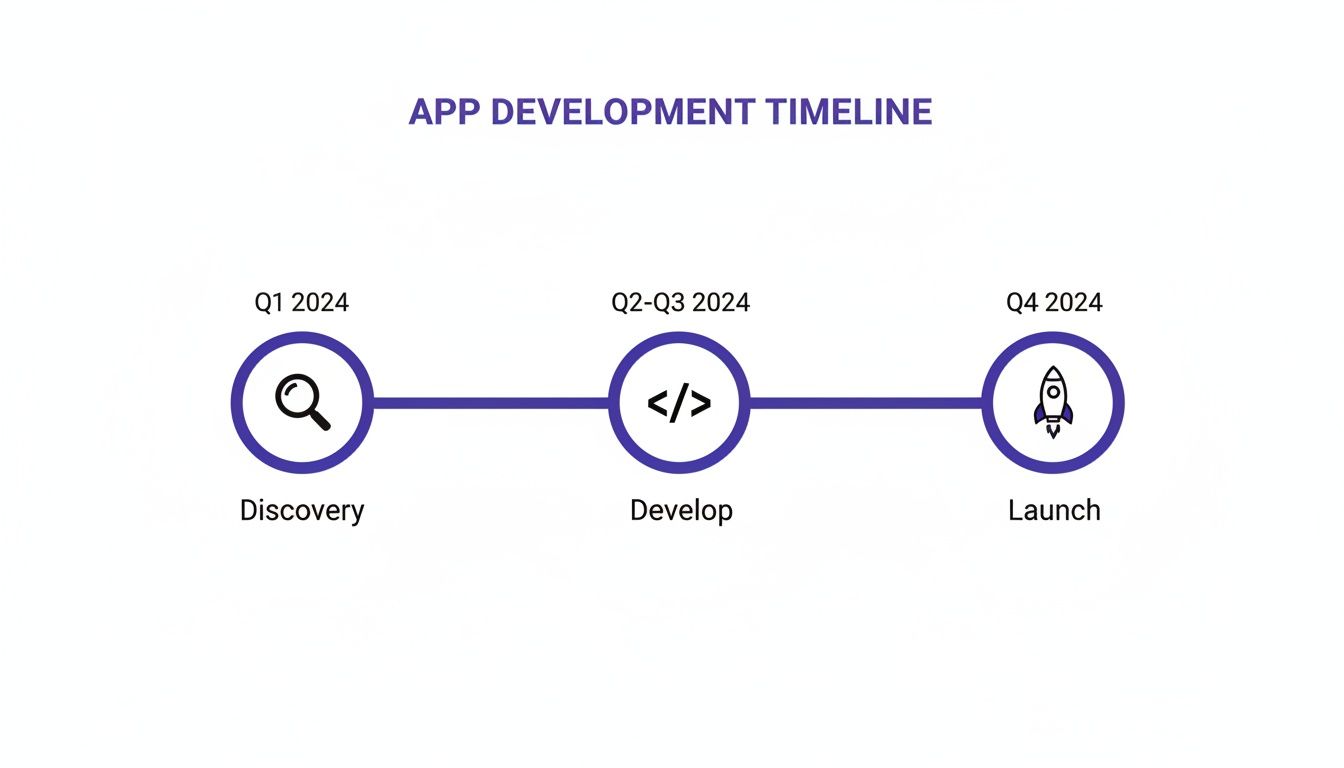
As you can see, development and discovery are continuous cycles. They feed into the app's evolution long after it first goes live.
Evolving Your App with User Feedback
The data you collect after launch is pure gold. App analytics and, most importantly, direct user feedback provide invaluable insights into what’s working and what isn’t. By digging into this information, you can build an iterative development cycle, constantly refining and improving your app based on how people are actually using it.
This is particularly crucial in the UK, where consumers are deeply engaged with their devices. With the UK mobile app market projected to hit USD 32.9 billion by 2030, a static app will quickly get left behind. Post-launch support and iterative updates are essential to capture this hyper-connected audience and capitalise on the 15%+ annual market growth. You can discover more insights about UK mobile app marketing trends on netclues.com.
Ultimately, this iterative approach transforms your app from a simple product into a sustainable, future-proof asset.
Got Questions About App Development in London? We've Got Answers
Stepping into the world of app development can feel a bit daunting, especially in a bustling hub like London. Lots of questions pop up. To cut through the noise, we've put together straight answers to the queries we hear most often from businesses just starting out.
What's the Best Tech to Build a New App On?
This is the big one, and the right answer usually boils down to getting the best balance of speed, cost, and a brilliant user experience. For a long time, the only way was to build two separate, native apps—one for iOS and one for Android. But things have moved on, and modern cross-platform tools are now a far better choice for most businesses.
We're big believers in Flutter, Google's toolkit for building apps. Why? Because it lets us build a single, beautiful app from one codebase that runs flawlessly on any device. This means a faster development cycle and serious cost savings, all without compromising on that smooth, responsive feel users expect. Frankly, the performance is so good that users will never know it wasn't built natively.
How Much Will It Cost to Build My App?
The cost of mobile development in London really depends on what you want your app to do. A simple Minimum Viable Product (MVP) with just the essential features could start from around £15,000. On the other hand, a complex app with bespoke features, lots of third-party integrations, and a sophisticated design could easily be £80,000 or more.
Think of it this way: your budget directly reflects the time and expertise needed to bring your idea to life. Things like payment systems, user accounts, and real-time data syncing all add to the development time, and therefore, the final price tag. The clearest way to get an accurate quote is to have a well-defined scope from the outset.
How Long Does It Take to Get an App Built?
Just like cost, the timeline is tied directly to your app's complexity. A pretty straightforward app can often be designed, built, and launched within 2 to 4 months. For projects with a bit more going on, a timeline of 4 to 7 months is a more realistic expectation.
Big, feature-heavy apps can easily take over 7 months to get right. It's important to remember that this timeline covers everything—from the initial strategy sessions and design mock-ups to thorough testing and getting it live in the app stores.
Do I Really Need Separate Apps for iOS and Android?
Thankfully, no. This is one of the biggest wins of using a framework like Flutter. Instead of running and paying for two separate development projects, we build from one unified codebase. That single codebase then gets compiled into a native app for both the Apple App Store and Google Play Store.
This doesn't just cut your development effort in half; it also guarantees your app looks, feels, and works identically across every device. No more inconsistencies.
What Happens After My App Is Launched?
The launch day is a huge milestone, but it's really just the start of the journey. To keep your app successful long-term, ongoing support and maintenance are absolutely vital.
A good agency will offer post-launch support that covers all the essentials. This includes keeping an eye on performance, rolling out security updates, and making sure your app stays compatible with the latest iOS and Android updates. This cycle of continuous improvement is what keeps your app secure, running smoothly, and delivering value to your users for years to come.
Ready to get your app idea off the ground? At App Developer UK, we specialise in building high-performance Flutter applications that help London businesses thrive. Get in touch today for a free, no-obligation chat and let's build something brilliant together.