A Guide to UK Mobile App Development Services
A Guide to UK Mobile App Development Services
When people talk about mobile app development services, they're really talking about an all-in-one partnership that takes a business idea and turns it into a real, working app that’s ready for the market. This isn't just about coding; it’s the whole journey, from the first sketch on a napkin to launching on the app stores and keeping things running smoothly afterwards. For any UK business, getting this right is the difference between a great investment and a costly mistake.
Your Blueprint for Digital Success
Think of building an app like you would a new flagship store. You wouldn't just hire a single bricklayer and hope for the best. You'd bring in a whole team of specialists—architects, builders, inspectors, and managers—to make sure the final building is stunning, functional, and built to last. A proper mobile app development service works in exactly the same way, providing the structure and expertise to guide your project from a rough concept to a polished digital product.
This partnership is much more than just writing lines of code. It's a strategic process where every decision, from the colour of a button to the underlying technology, is made with your business goals in mind. Just as an architect designs a building based on how people will use it, your development partner designs an app experience that meets your customers' needs and, ultimately, drives your company forward.
The Core Components of App Development
A full-service package brings together several critical roles, and each one is vital for success. They all work in sync, just like a well-run construction project. Understanding what each part of the team does helps you see exactly what you're investing in.
Here are the key players in the development process:
- The Architect (Strategy & UI/UX Design): This is where the blueprint is created. It starts with market research, figuring out who your users are, and mapping out how they'll move through the app. The outcome is an intuitive, engaging design that acts as the foundation for everything that follows.
- The Construction Crew (Coding & Development): This is where the designs are brought to life. Our team are experts in Flutter, a modern framework that lets us build high-performance apps for both iOS and Android from a single codebase. It’s a huge win for efficiency and ensures a consistent user experience on any device.
- The Quality Inspector (Testing & Assurance): Before you open the doors to customers, you need to check every last detail. This stage is all about hunting down and fixing bugs, making sure the app runs perfectly on different devices, and stress-testing it to handle real-world use.
- The Building Manager (Launch & Maintenance): Getting your app live on the Apple App Store and Google Play is a huge milestone, but it’s not the end of the job. Ongoing management means pushing out updates, monitoring performance, and adding new features to keep your users happy and your app secure.
A successful app is a strategic asset, not just a piece of software. It acts as a direct channel to your customers, a platform for sales, and a powerful tool for building brand loyalty.
When UK business leaders look at app development through this lens, it’s easier to grasp the full scope of the project and why choosing the right team is so important. You’re not just buying a product; you’re finding a partner to manage the entire lifecycle, ensuring your new digital property is built on a solid foundation and is ready for long-term growth.
The Six Phases of the App Development Lifecycle
Building a brilliant mobile app doesn’t just happen. It’s a deliberate, structured journey that turns a great idea into a polished product people will actually use. This path, known as the app development lifecycle, is our roadmap for turning complex projects into clear, manageable steps.
For any business leader, getting to grips with these six phases is crucial. It gives you the oversight you need to steer the project from a rough concept to a launch-ready app, ensuring there are no nasty surprises along the way. This methodical approach keeps risks low, budgets in check, and ultimately, delivers a high-quality app that hits your business goals.
Phase 1: Strategy and Discovery
Before we even think about code, we need a solid plan. The Strategy and Discovery phase is all about laying the groundwork. We dig deep to figure out exactly what the app should do, who it’s for, and what it needs to accomplish to be a success. This means proper market research, a close look at the competition, and nailing down what makes your app unique.
The main objective here is to validate the idea and set crystal-clear goals. We’ll pinpoint your target audience, define the essential features for a Minimum Viable Product (MVP), and map out the project's scope and budget. Getting this right from the start saves a lot of headaches and expensive changes down the line.
Phase 2: UI and UX Design
With a clear strategy locked in, we can focus on how the app will look and feel. This is where the user experience (UX) and user interface (UI) design come into play. First, our UX designers create wireframes and map out user journeys, making sure the app flows logically and is dead simple to use.
Next, the UI designers add the visual magic—the colours, fonts, and branding that bring it all to life. We then build interactive prototypes, which are essentially clickable versions of your app. This lets you get a real feel for the functionality before a single developer gets involved, ensuring the final design is exactly what you envisioned.
An app’s success hangs on more than just its features; it depends on how it makes users feel. A seamless and intuitive design is what separates a frustrating experience from one that builds loyalty and keeps users coming back.
Phase 3: App Development
This is where the magic really happens. In the development phase, our team takes the designs and blueprints and turns them into a fully functional app. Our developers get to work writing clean, efficient code, building the app’s architecture, setting up servers, and plugging in any necessary APIs.
As a specialist UK Flutter agency, we build apps for both iOS and Android from a single codebase. It’s a game-changer. This approach seriously speeds up development time and cuts down costs, all while delivering a consistent, slick experience across every device. The latest benchmarks consistently place Flutter at the top for performance, so you get a fast, responsive app without any compromises.
The infographic below shows how our dedicated teams—the Architect, Crew, and Inspector—collaborate to get the job done right.
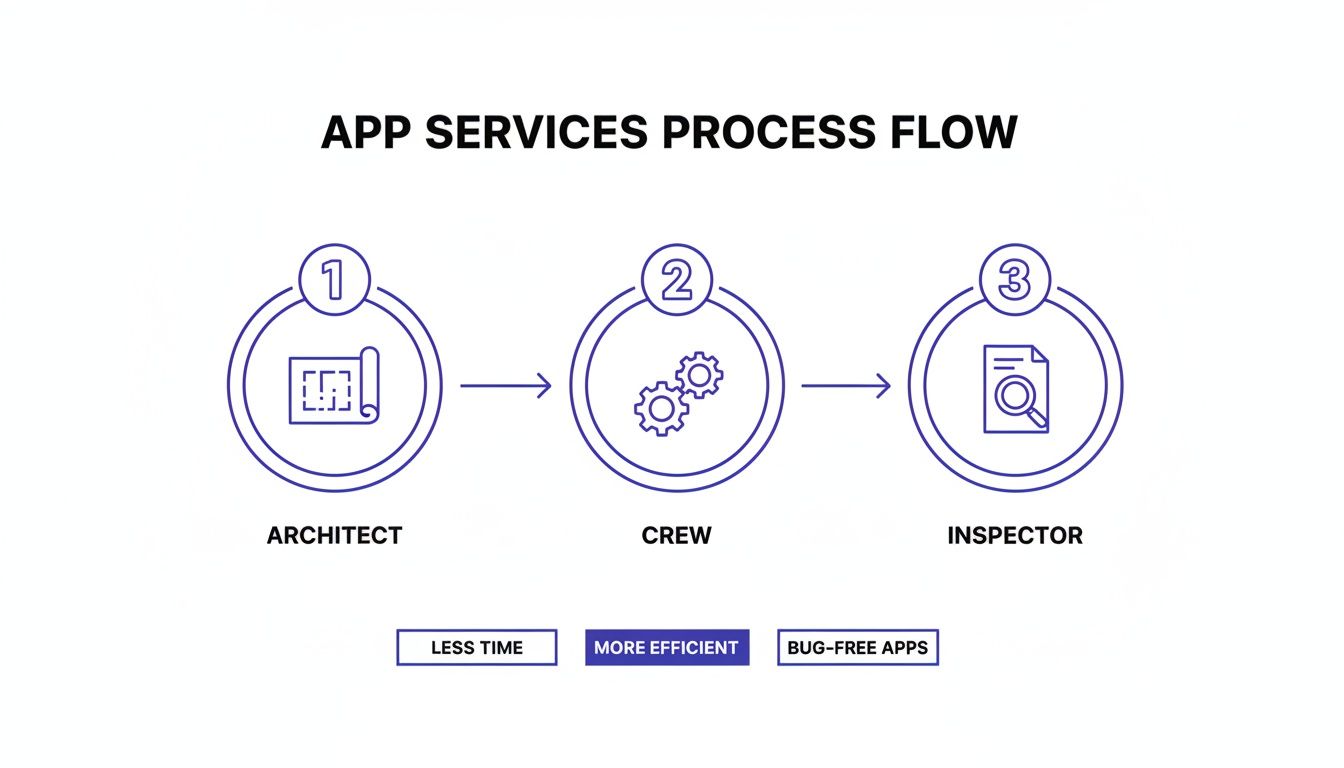
This structured, team-based approach means every stage, from initial blueprint to final checks, is geared towards creating a polished, bug-free app.
Phase 4: Quality Assurance Testing
Before your app meets its first user, it has to get through our testers. The Quality Assurance (QA) phase is all about hunting down and squashing bugs, performance glitches, and any usability quirks. Our QA team meticulously tests every feature on a whole range of devices and operating systems to make sure the app is stable, secure, and works exactly as it should. This thorough process ensures a smooth launch and a great first impression.
Phase 5: Deployment
Once the app has passed every test with flying colours, it’s time for the big launch. The deployment phase involves submitting the app to the Apple App Store and Google Play Store. This isn’t just a quick upload. It requires carefully crafting the store listings—descriptions, screenshots, promo videos—and making sure everything complies with each platform’s strict rules.
Phase 6: Post-Launch Support and Maintenance
The journey isn't over when the app goes live. In fact, it's just beginning. Post-launch support is vital for long-term success. This final phase is all about monitoring the app’s performance, listening to user feedback, and rolling out regular updates. To get the most out of each stage, it’s worth exploring these best practices for building better mobile apps.
Ongoing maintenance keeps your app compatible with new operating systems, fixes any bugs that pop up, and ensures it stays secure. The UK mobile app economy is thriving, projected to grow by over 15% annually and hit multi-billion-pound valuations by 2025. With smartphone usage at nearly 90% of the population, and people spending hours on their phones every day, keeping your app in top shape is essential to stay in the game.
Why We Believe Flutter Delivers Superior Results
In the competitive UK market, getting your app out there quickly, without compromising on quality or budget, is everything. This is precisely where Flutter, Google's modern development kit, completely changes the game. It lets us build beautiful, high-performance apps for both iOS and Android from a single codebase, offering a much smarter way to get to market.
Think about it this way: imagine you needed to build two identical houses, one for one street and another for the street over. Commissioning two separate teams would be a nightmare of doubled costs, wasted time, and inevitable inconsistencies. The old way of building separate 'native' apps for iOS and Android creates that exact headache.
Flutter fixes this. It uses one blueprint and one team to build a single, brilliant app that runs perfectly everywhere.
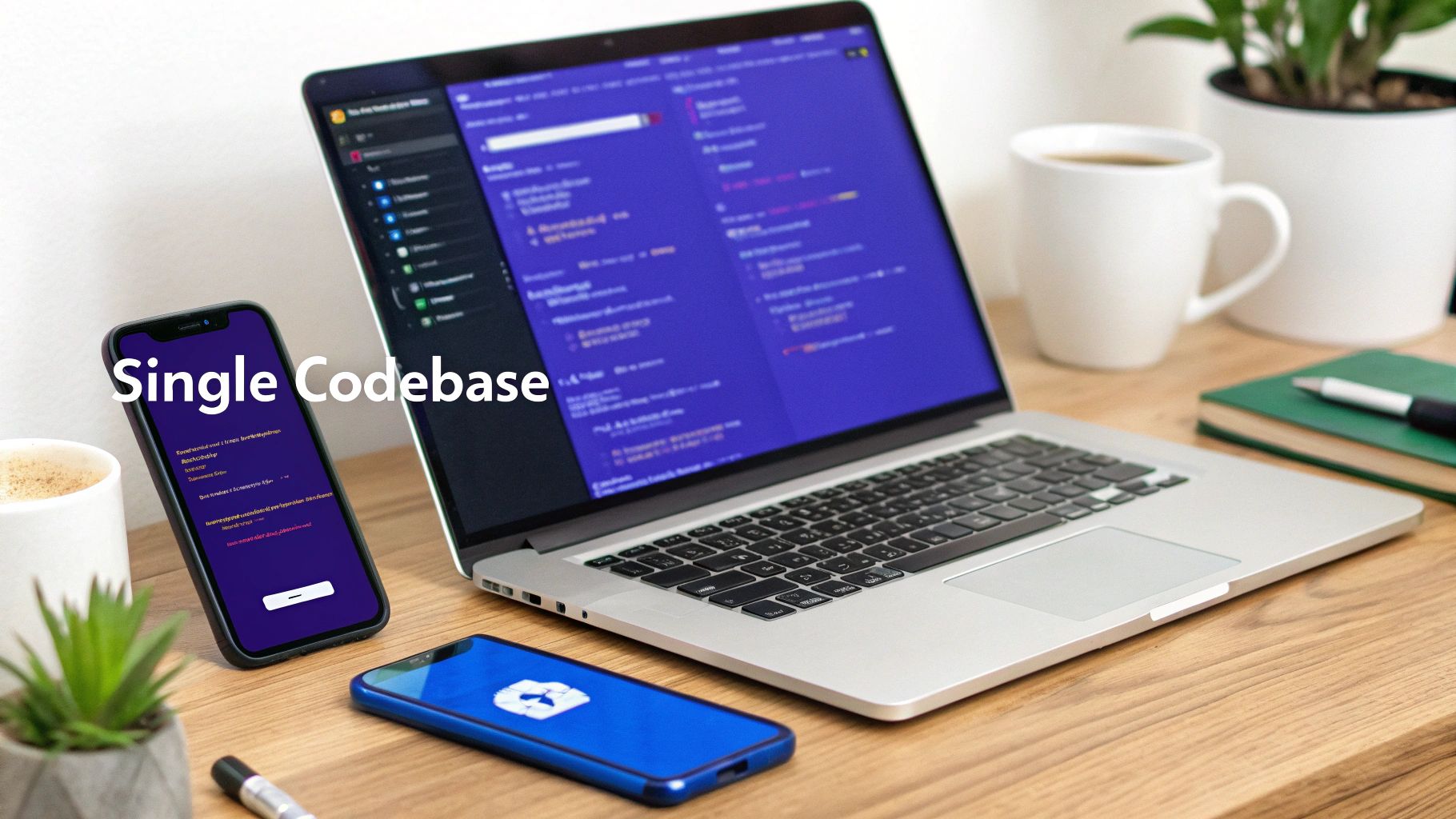
This single-codebase approach isn't just a technical detail; it delivers powerful advantages that directly impact your bottom line.
Dramatically Faster Time to Market
In business, speed is a serious competitive edge. With Flutter, development cycles are much shorter because we're not repeating every single step for two different platforms. We design, build, and test just once, then deploy to both the Apple App Store and Google Play at the same time.
Getting your app into your customers' hands faster means you can start gathering feedback, making money, and carving out your space in the market long before competitors who are still juggling two separate projects.
What's more, Flutter has a feature called "hot reload" that lets our developers see their code changes reflected in the app in under a second. This makes building interfaces, adding features, and squashing bugs incredibly fast, trimming down the overall project timeline.
The ability to launch on both iOS and Android at the same time is no longer a luxury—it's a strategic necessity. Flutter makes this simultaneous launch not just possible, but efficient and cost-effective.
Uncompromising Performance and Quality
There’s a common myth that choosing a cross-platform approach means you have to sacrifice performance. With older frameworks, there was some truth to that, but Flutter is a different beast entirely. In fact, the latest benchmarks consistently show Flutter apps performing at the top, often matching or even beating their native counterparts.
How does it do it? Flutter doesn't use clunky bridges to talk to the phone's native features. Instead, it compiles directly to native ARM code, giving it control over every single pixel on the screen. This direct rendering process results in a silky-smooth, responsive user experience with fluid animations and zero lag. For a deeper dive into the technical side, check out our comprehensive guide on Flutter development.
Significant Cost Savings and Higher ROI
By getting rid of the need for two separate teams and two codebases, the economic benefits of Flutter are undeniable. This efficiency translates into major cost savings, with businesses often slashing their development budget by 30-50% compared to native development.
And those savings aren't just a one-off. Ongoing maintenance, future updates, and new feature rollouts are also far more streamlined, as we only need to implement changes once. This leaner approach lowers the total cost of ownership over the app's entire life, freeing up money you can put back into marketing, user acquisition, and growth.
This approach is transforming the UK mobile app services market, which is projected to rocket from USD 1,232.9 million in 2025 to USD 10,000 million by 2035, growing at a 23.2% CAGR. You can learn more by reading the full mobile application development platform market research.
Understanding App Development Costs in the UK
It’s the first question on everyone’s mind: “So, what’s this going to cost me?” When it comes to building an app, there’s no single price tag. The honest answer is that the cost depends entirely on what you want your app to do. Think of it like building a house – a simple one-bedroom bungalow has a very different budget to a custom-built, multi-storey mansion.
To give you a clearer picture and help with your financial planning, we can break down projects into three common tiers. This isn’t about cutting corners; it’s about understanding where your investment goes and what you get for it. Each level represents a significant step up in features, backend complexity, and the time needed to build it right.
Categorising App Complexity
Getting your head around these tiers is the first step to setting a realistic budget.
- Simple Apps: These are your digital brochures or information hubs. Think of an app for a local festival that shows a map and schedule, or a restaurant app with a menu and contact form. They have fixed content, standard user interfaces, and the development is focused on delivering core information cleanly and effectively.
- Moderate Apps: Now we're talking about more dynamic features. This is where you’ll find e-commerce apps with payment systems, apps that need user accounts and profiles, or those that pull in data from other sources through APIs. They require a more involved backend system and solid security to handle personal data and transactions.
- Complex Apps: These are the heavy hitters. We’re talking about sophisticated projects like on-demand ride-sharing services, apps with real-time GPS tracking, custom AI features, or deep integrations with multiple third-party systems. They need powerful, custom-built logic and a robust backend that can handle thousands of users at once.
For any project to succeed, mastering software development cost estimation is a non-negotiable step for both the client and the development team. It sets clear, realistic expectations from day one.
The Flutter Advantage on Your Budget
This is where your choice of technology makes a massive difference to your bottom line. Traditionally, if you wanted an app on both iPhone and Android, you had to build it twice. That means two separate projects, two development teams, and nearly double the cost and time.
As specialist UK Flutter developers, we sidestep that entire problem.
By using a single codebase, we build your app once and deploy it beautifully on both iOS and Android. This isn't just about being efficient; it’s a direct and significant cost saving. You spend less on development hours, less on project management, and you get to market much, much faster.
Choosing Flutter isn't just a technical detail—it's a smart business move. It lets UK companies launch a premium app on both major platforms for a budget that would typically only cover a single native one.
A simple app in the UK can start from around £5,000-£20,000, with complex projects easily exceeding £70,000. Flutter introduces major savings here. A complex Flutter app often lands in the £70,000-£100,000+ range, which is a huge reduction compared to building two separate native apps that could cost double that.
To make this crystal clear, here’s a look at how the costs and timelines stack up.
Estimated App Development Costs and Timelines UK (Native vs Flutter)
This table breaks down the typical investment you can expect when comparing the traditional native approach (building two separate apps) with the modern, unified Flutter approach.
| App Complexity | Native (iOS + Android) Cost | Native Timeline | Flutter (Single Codebase) Cost | Flutter Timeline |
|---|---|---|---|---|
| Simple | £15,000 - £40,000+ | 3 - 5 Months | £10,000 - £25,000 | 2 - 3 Months |
| Moderate | £40,000 - £120,000+ | 5 - 9 Months | £25,000 - £70,000 | 4 - 6 Months |
| Complex | £120,000 - £250,000+ | 9+ Months | £70,000 - £150,000+ | 7+ Months |
Note: These are industry estimates. The final cost will always depend on your specific features, design complexity, and any third-party integrations.
The numbers don’t lie. Flutter offers a much smarter and more efficient path to launching your app without ever compromising on quality. You get a high-performance application that feels perfectly at home on any device, all while keeping your budget in check and getting to market weeks, or even months, ahead of schedule. For a deeper dive into the numbers, have a look at our complete UK app pricing guide.
How to Choose the Right Development Partner
Picking the right mobile app development partner is probably the single most important decision you'll make for your project. This isn't just about hiring a team to write code. You're choosing a strategic partner who will steer your vision, look after your investment, and ultimately define the quality of the final product you get. The right agency works like an extension of your own team, bringing both technical skill and sharp business sense to the table.
Your mission is to find a partner who not only gets your industry inside and out but also has the proven chops to deliver a high-performance app that's ready for the market. This means doing your homework and vetting them carefully on a few key points that separate the great agencies from the rest.

Evaluate Technical Expertise and Specialisation
First things first, you need a team with deep, specialised knowledge. In today's market, serious expertise in Flutter is a massive clue you're talking to a forward-thinking agency. As we've covered, Flutter's single codebase delivers superior performance, saves money, and keeps your brand consistent—benefits you only get if your developers are genuine experts.
Don't just take their word for it. Dig into their portfolio and look for high-quality Flutter apps. Ask them about their process, how they tackle platform-specific quirks, and what their experience is with the latest Flutter updates. A true specialist will be able to talk about this stuff fluently and with real confidence.
Scrutinise Their Portfolio and Case Studies
A portfolio is more than just a pretty gallery of past work; it's hard evidence of an agency's ability to get results. When you're looking through their projects, keep an eye out for things that match up with your own goals:
- Industry Relevance: Have they built apps in your sector before? If they have, they'll already have a head start on understanding your customers, common challenges, and how your market works.
- Complexity and Scale: Look for projects that feel as ambitious as your own vision. If you're planning a complex e-commerce app, an agency that's only built simple brochure-style apps probably isn't the right fit.
- User Experience: Download a few of their apps and actually use them. Are they easy to navigate? Are they fast? Do they look good? A polished user experience is a dead giveaway of an agency's attention to detail and design skill.
The best partnerships are built on a foundation of proven success and mutual understanding. A strong portfolio demonstrates not just what an agency can do, but how they think and solve problems for businesses like yours.
The Advantage of a UK-Based Agency
While you can hire talent from anywhere in the world, partnering with a UK-based agency has some very real, practical advantages. Clear communication is everything, and working with a team in your own time zone cuts out frustrating delays and makes for a much more collaborative, agile way of working.
On top of that, a local partner has a built-in understanding of the UK market and what makes British consumers tick. They'll be fully up to speed on crucial regulations like GDPR, making sure your app is compliant from day one. That local insight is invaluable for building an app that really connects with a UK audience. For a more detailed breakdown, our guide to hiring app developers in the UK has more valuable tips.
Essential Questions to Ask Potential Partners
To help you make a smart decision, here’s a checklist of crucial questions to throw at any agency you're considering. Their answers will tell you a lot about their process, how transparent they are, and whether they’re a good fit for the long haul.
- Can you walk me through your development process, from the initial discovery phase right through to post-launch support?
- How do you guarantee the performance and quality of the Flutter apps you build?
- Who will be my main point of contact, and how often can I expect to hear from them?
- How do you handle it if the project scope changes or we hit unexpected roadblocks during development?
- What, exactly, is included in your post-launch support and maintenance package?
By asking these questions and taking a hard look at their past work and expertise, you can confidently find a partner for your mobile app development services who won't just build your app, but will help drive your business forward.
Still Have Questions About App Development?
Making the decision to invest in a mobile app is a big one, and it's completely normal to have a few questions before you dive in. To give you some clarity and confidence, we’ve pulled together the most common queries we get from business leaders across the UK and answered them straight.
How Long Does It Really Take to Build a Mobile App?
This is usually the first thing people ask, and the honest answer is: it depends entirely on how complex your app is.
For a straightforward Minimum Viable Product (MVP) with just the essential features, you’re typically looking at 2-4 months. This is a great way to get to market quickly, test your idea, and start gathering real user feedback.
If you're planning something a bit more involved, like an e-commerce app or a platform with custom user profiles, it's best to budget for 4-8 months. For really complex projects—think bespoke backend systems, real-time data syncing, or AI features—it can easily take 9 months or more to get everything right.
This is where our focus on Flutter really gives our clients an edge. Because we build for both iOS and Android from a single codebase, we can often cut the total development time by as much as 40% compared to the old-school approach of building two separate native apps.
What Is the Difference Between Native and Cross-Platform Apps?
Getting your head around this is crucial for making a smart investment.
- Native Apps are built from the ground up for a single operating system. That means using Swift for Apple's iOS and Kotlin or Java for Google's Android. You get fantastic performance, but it’s essentially two separate projects, two teams, and two budgets to reach all your customers.
- Cross-Platform Apps are built using a modern framework like Flutter. We write the code once, and it runs beautifully on both iOS and Android. It’s a much more efficient, unified way of working.
There’s a common myth that cross-platform means you have to compromise on quality. That might have been true with older tech, but today’s benchmarks consistently show Flutter delivering a user experience that’s virtually indistinguishable from a native app. For most businesses, it hits the sweet spot between world-class performance, brand consistency, and cost-effectiveness.
Choosing a cross-platform solution like Flutter isn’t about settling for less. It's a strategic move to achieve more with your budget and get to market faster. It’s the modern, intelligent way to build an app.
What Happens After My App Is Launched?
The launch is a huge moment, but it's just the beginning of your app's journey, not the end. Our post-launch services are all about making sure your investment keeps delivering value and growing with your business.
Our ongoing partnership usually covers:
- Performance Monitoring: We keep a close eye on the analytics to see how people are actually using the app, spotting popular features and finding areas we can improve.
- Bug Fixes and OS Updates: We proactively squash any bugs that pop up and release regular updates to make sure your app works flawlessly on the latest versions of iOS and Android.
- Feature Enhancements: Using user feedback and your business goals as our guide, we strategically plan, build, and roll out new features to keep your app fresh, competitive, and valuable to your audience.
We put together support packages that are tailored to you, ensuring your app stays secure, functional, and perfectly aligned with where your business is heading.
Why Should I Choose a UK-Based Development Agency?
In a world where you can work with anyone, anywhere, partnering with a UK-based agency offers some powerful, real-world advantages that can make or break a project. It’s not just about being in the same country; it’s about shared context and a smoother process from start to finish.
First off, communication is just easier. Being in the same time zone means no frustrating delays and allows for quick, collaborative chats when they’re needed most. A shared cultural understanding means we "get" your business and your market without a long explanation.
Second, a UK team has a natural grasp of the local market, customer behaviours, and critical regulations like GDPR. This ensures your app is not only compliant from day one but also feels right for a British audience. Finally, a local partnership just feels more solid. It’s easier to build a trusting, transparent relationship when you can meet for a coffee and hash out a strategy face-to-face.
Ready to turn your app idea into a reality? At App Developer UK, we specialise in building high-performance Flutter apps that drive business growth. Let's discuss your project and discover how our expert mobile app development services can help you succeed.