Custom Mobile App Development for UK Businesses
Custom Mobile App Development for UK Businesses
Think of custom mobile app development like commissioning a bespoke suit instead of buying one off the rack. It’s the process of creating a unique mobile application from the ground up, designed to solve your specific business challenges and serve your target audience perfectly. This approach gives you a flawless fit for your operations, something a generic, template-based app could never do.
Why a Tailored App Is a Strategic Business Asset
In a market flooded with generic solutions, a custom-built app is no longer a luxury—it's a critical tool for standing out and driving growth. While off-the-shelf software might seem like a quick fix, it often forces you to bend your processes to fit its rigid limitations. Custom development flips that script entirely, creating a digital tool that is shaped around your business.
This means you get an application that slots neatly into your existing systems, automates your unique workflows, and offers an experience that truly clicks with your customers. The result is more than just another app; it’s a powerful, scalable asset that becomes a core part of your business strategy.
Gaining a True Competitive Advantage
A standard app can only ever help you keep pace. A custom app, on the other hand, is built to help you leapfrog the competition. It lets you introduce unique features, map out a superior user journey, and react to market shifts with real agility. Because the software is yours and yours alone, you own the intellectual property, giving you total control over its future.
For UK businesses aiming to make their mark, this level of control is essential. It empowers you to:
- Innovate Freely: Roll out features and services that competitors using template solutions simply can't copy.
- Enhance Operational Efficiency: Automate specific internal processes, slashing manual effort and cutting operational costs.
- Build Stronger Customer Relationships: Deliver a personalised experience that builds loyalty and boosts customer lifetime value.
A custom application is designed with one purpose in mind: to align perfectly with your business goals. It's not about fitting your business into a pre-made box; it's about building the box to fit your business.
Built for Scalability and Future Growth
One of the biggest traps of off-the-shelf software is its limited scalability. As your business grows, you'll likely find your app can’t handle the increased user load or accommodate the new features you need. A custom mobile app anticipates this growth right from the start.
By building on a solid, flexible foundation, a custom app can evolve right alongside your business. Whether you need to add new product lines, expand into new markets, or integrate with emerging tech, your application is ready to adapt. This forward-thinking approach ensures your investment continues to pay dividends for years to come, making it a sustainable solution for long-term success.
Choosing Your Path: Custom Apps vs. Off-The-Shelf Solutions
When it comes to business software, you’re faced with a classic build vs. buy dilemma. Do you go for a ready-made, off-the-shelf solution, or do you invest in custom mobile app development? Think of it as the difference between renting a generic office space and building a headquarters designed specifically for your company's needs.
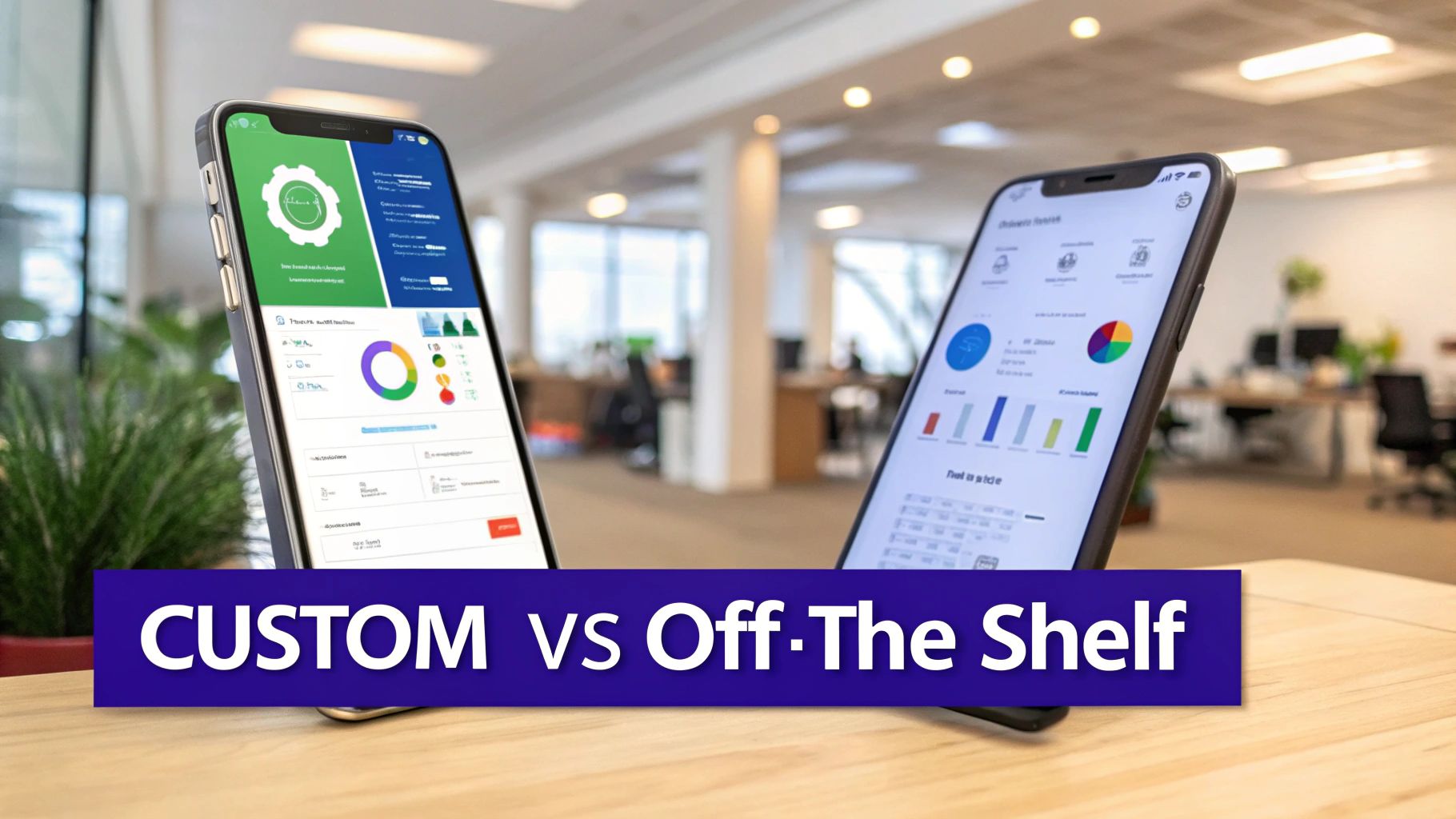
An off-the-shelf app can look tempting. It’s quick, the initial cost seems low, and you get instant functionality. But that convenience can come with a hidden price tag down the line. You’re essentially trying to fit your unique business processes into a rigid, one-size-fits-all box.
This approach often leads to operational friction, frustrating your team and compromising the customer experience. What starts as a quick win can quickly become a long-term handicap that stunts your growth.
Thinking Like an Investor, Not a Spender
It's vital to see custom app development as a strategic investment, not just another business expense. A custom-built app is crafted to fit your operations like a glove. It integrates seamlessly with your existing systems, mirrors your specific workflows, and is engineered to scale as your ambitions grow.
This route gives you total ownership and control. You're no longer at the mercy of a third-party provider's feature roadmap or update schedule. Instead, you can adapt and innovate at your own pace, responding to market changes with a speed and precision that builds a real competitive advantage.
The numbers back this up. The UK mobile app development market has ballooned to an impressive £28.3 billion valuation, with a strong 12.9% annual growth over the last five years. This boom is driven by over 71.5 million smartphone users and rising daily mobile use, creating the perfect environment for custom apps to thrive. You can dig deeper into the data on the mobile app market growth in the UK to see these trends for yourself.
A Head-to-Head Comparison for UK Businesses
To make a truly informed choice, it helps to put these two options side-by-side. The initial cost is just one piece of the puzzle; you also need to consider long-term value, scalability, and what each path means for your brand.
Here’s a straightforward comparison to help you weigh the pros and cons.
Custom Development vs. Off-The-Shelf Apps: A Comparison for UK Businesses
| Feature | Custom Mobile App | Off-The-Shelf Solution |
|---|---|---|
| Initial Cost | Higher upfront investment. | Lower initial cost, often subscription-based. |
| Long-Term ROI | High, as it’s a depreciable asset that drives efficiency and revenue. | Lower, with ongoing subscription fees and potential hidden costs. |
| Scalability | Built to grow with your business, handling increased users and features. | Limited scalability, often requiring costly upgrades or a complete switch. |
| Customisation | Fully customisable to meet your exact business needs and branding. | Minimal to no customisation, forcing you to adapt to its features. |
| Integration | Designed to integrate perfectly with your existing software and systems. | Integration can be difficult, clunky, or require expensive workarounds. |
| Competitive Edge | Provides unique features and a superior user experience to stand out. | Offers the same generic features as your competitors. |
| Ownership | You own the intellectual property and have full control over the app. | You are licensing the software and are dependent on the vendor. |
While the promise of a cheap, fast solution is appealing, its limitations often lead to greater costs in the long run. These costs show up as lost efficiency, missed opportunities, and the eventual headache of migrating to a better system once your business outgrows the off-the-shelf app.
A custom app is not just a piece of software; it's a foundational business asset. It is an investment in efficiency, customer satisfaction, and the long-term, sustainable growth of your company.
Ultimately, the right choice depends on your ambition. If you just want to keep up with the market, a generic solution might be enough. But if you’re aiming to lead, innovate, and build a truly resilient business, custom mobile app development gives you the power and flexibility to make that vision a reality.
The Custom App Development Journey From Idea to Launch
Building a powerful, high-performing app doesn't happen by accident; it's the result of a disciplined, collaborative journey. Think of it like constructing a precision-engineered machine—every single stage has to be meticulously planned and executed to guarantee it all works perfectly in the end. This structured process keeps things transparent, makes sure we're always aligned with your business goals, and ultimately delivers a product that your users will genuinely love.
We follow a proven, five-stage roadmap designed to turn a brilliant idea into a market-ready reality. It’s all about efficiency, quality, and performance, ensuring your investment starts generating real business value from day one.
Phase 1: Discovery and Strategy
Before anyone even thinks about writing a line of code, we need to dive deep into your vision. The discovery and strategy phase is the foundation for everything that follows, where we line up our technical expertise with your commercial goals. It's like creating the architectural blueprint for a building; it ensures everyone is working from the same plan, towards the same objective.
During this critical phase, we work together to:
- Define Core Objectives: What specific problem is this app going to solve for your users? Are you aiming to increase sales, make your operations more efficient, or boost customer engagement? We need a clear target.
- Analyse the Market: We carry out thorough research into your competitors and target audience. Understanding what's already out there—what works, what doesn't, and where the gaps are—allows us to position your app for maximum impact.
- Create a Product Roadmap: We'll outline the essential features for a Minimum Viable Product (MVP) and map out a phased plan for future updates. This agile approach gets your app to market faster while ensuring it’s built on a solid, scalable foundation.
Phase 2: User Experience and User Interface Design
With a solid strategy in place, the focus shifts to crafting an experience that feels intuitive and looks fantastic. As we get into the design stage, it's really important to grasp the roles of User Experience (UX) and User Interface (UI). They're often mentioned in the same breath, but they are two distinct disciplines that work hand-in-hand. For a deeper dive, it's worth understanding the core differences between UX and UI, as this knowledge is key to appreciating the entire design process.
User Experience (UX) design is the science of making your app feel logical and effortless. It involves mapping out the entire customer journey with wireframes and user flows, ensuring every tap and swipe is smooth and intuitive. A great UX means people can do what they need to do without any friction or confusion.
User Interface (UI) design is the art that brings that functional skeleton to life. This is where we focus on the look and feel—from colour palettes and typography to icons and animations. A compelling UI doesn't just reflect your brand; it creates an emotional connection with your users, making the app a genuine pleasure to use.
Phase 3: Development with Flutter
This is where the vision starts to become a tangible, functional reality. Our development phase is built around Flutter, Google's powerful software development kit. We've chosen Flutter because it offers a massive advantage for UK businesses: the ability to build beautiful, high-performance apps for both iOS and Android from a single codebase.
Flutter is not just a choice; it's a strategic decision. It allows us to build natively compiled applications that deliver exceptional performance, identical to apps built specifically for one platform. New benchmarks consistently place Flutter at the top for performance, dispelling any myths about cross-platform limitations.
This single-codebase approach dramatically speeds up development timelines and cuts costs—often by 30-40%—compared to building two separate native apps. For you, that means getting to market faster and making your budget go further, all without compromising on quality or speed.
Phase 4: Rigorous Testing and Quality Assurance
A flawless user experience is non-negotiable. Before your app is ready for the world, it goes through an exhaustive testing and quality assurance (QA) process. Our dedicated QA team meticulously puts every feature through its paces across a huge range of devices and operating systems.
This stage includes:
- Functional Testing: Making sure every button, form, and feature works exactly as it should.
- Performance Testing: Checking for speed, responsiveness, and how it affects battery life.
- Security Testing: Proactively identifying and patching any potential vulnerabilities to keep user data safe.
Phase 5: Deployment and Launch
The final step is getting your app out there. We handle the entire submission process for both the Apple App Store and Google Play Store, navigating their complex guidelines to ensure a smooth and successful approval. But our partnership doesn’t stop at launch. To see how this all comes together, check out our guide on moving from concept to launch in the UK app development scene.
Understanding Costs and Timelines for Custom App Development
So, you’re thinking about a custom app. Brilliant. But let's get straight to the two questions every business asks: "What will it cost?" and "When will it be ready?"
There’s no single price tag. Just like building a house, the final cost depends entirely on what you want to build. Are you after a sleek, minimalist bungalow or a sprawling, feature-rich mansion? The scope of your vision for custom mobile app development is what really shapes the budget and the timeline.
The main things that move the needle are the app's complexity, the number of features you need, how polished the design is, and how many other systems it needs to talk to. A straightforward app with a few core functions will naturally be quicker and cheaper to build than a complex platform with live data feeds, payment gateways, and custom backend systems. This is exactly why a proper discovery phase is so crucial—it turns vague ideas into a solid plan with predictable costs.
Key Factors That Shape Your Investment
Before you can get a realistic quote, it's worth understanding what actually goes into the final cost and timeline. Getting your head around these elements will help you budget properly and set sensible expectations for the journey ahead.
Here are the big-ticket items that determine the scale of your investment:
- Feature Complexity: A feature is never just a button. Adding a payment system, for example, is a whole different ball game to creating a simple 'About Us' page. The more complex the logic behind each feature, the more development hours it racks up.
- Design and Animation: A clean, simple user interface is relatively quick to put together. But if you're after custom animations, slick transitions, and a highly stylised look, that all adds to the design and development time.
- Platform and Device Support: Making sure your app looks and works perfectly on every type of smartphone, tablet, and operating system version requires a lot of testing and fine-tuning. Our Flutter-first approach makes this much easier, but it’s still a key factor.
- Backend Infrastructure: If your app needs to handle user accounts, process payments, or sync data between devices, it needs a solid backend server and database. The complexity of this behind-the-scenes architecture is a major part of the overall cost.
This visual guide breaks down the typical journey from that first spark of an idea to a fully launched application, showing you every step along the way.
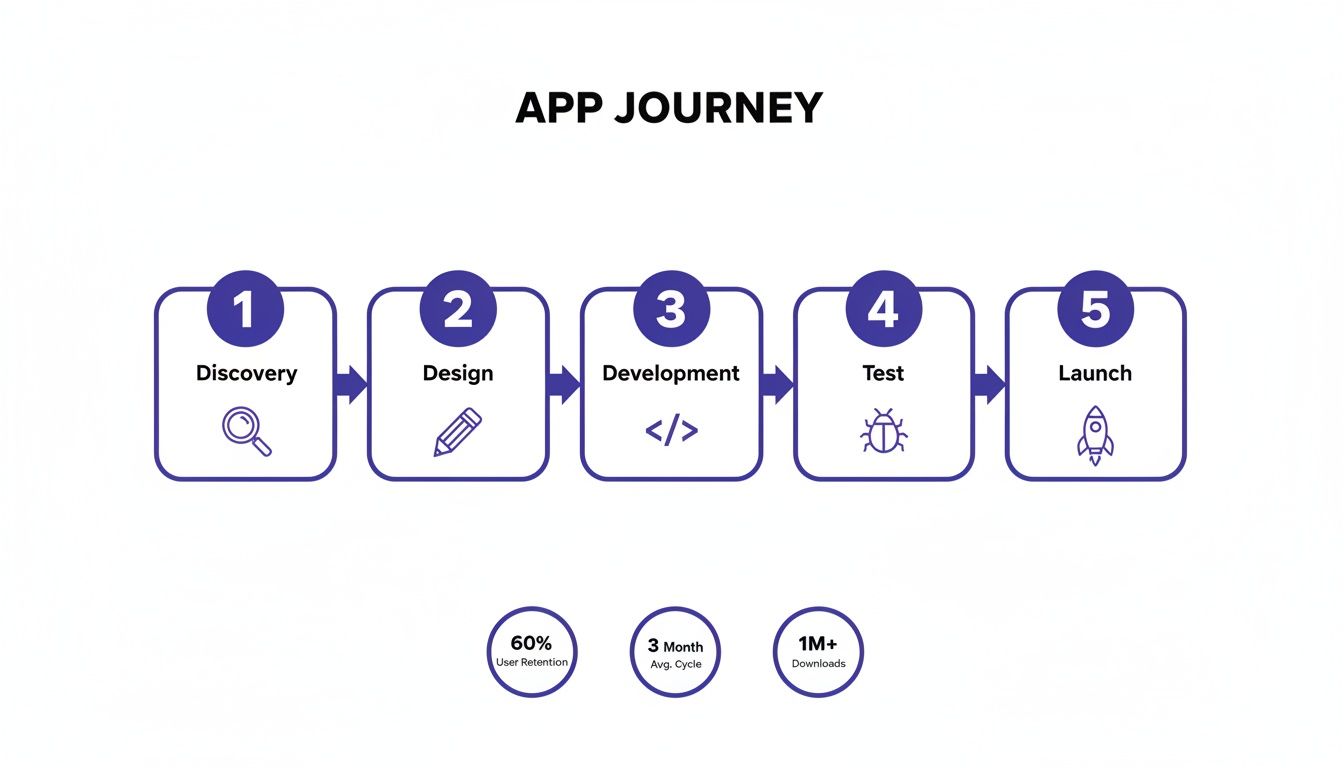
As you can see, the coding is just one piece of a much larger, carefully structured process designed to deliver quality and hit your business goals.
Realistic Cost and Timeline Brackets in the UK
To put some real numbers on it, custom mobile app development costs in the UK can vary wildly. But this is where cross-platform tools like Flutter really shine, making custom apps more accessible for many businesses.
Simple apps can start from around £12,000–£25,000, usually taking between 150–300 hours of work. At the other end of the scale, complex enterprise-level apps can climb from £70,000 to over £250,000, needing 800–1,500+ hours to complete.
The good news? Flutter can seriously reduce these figures by using one codebase for both iOS and Android, often making development 20-30% more affordable than building two separate native apps. If you want to dive deeper into how project size affects the price, there are some great resources out there on decoding app development costs.
Our focus on Flutter is a strategic choice designed to give you the best possible return on investment. By getting rid of the need for two separate development teams, we can deliver a premium app with native performance for both iOS and Android, but at a fraction of the traditional cost and in a much shorter timeframe.
For an even more detailed look, check out our guide to UK app development cost breakdown. To give you a clearer idea, here's a table showing some common app types with estimated costs and timelines when built using Flutter.
Estimated UK Custom App Development Costs and Timelines Using Flutter
This table provides a rough guide to what you can expect based on your project's complexity. Flutter's efficiency helps keep these figures competitive without compromising on quality or performance.
| App Complexity | Example Features | Estimated Cost (Flutter) | Estimated Timeline |
|---|---|---|---|
| Simple | Basic user profiles, static content, contact forms, simple navigation. | £12,000 – £25,000 | 2–3 Months |
| Medium | API integrations, push notifications, social media login, basic payment gateway. | £25,000 – £70,000 | 3–6 Months |
| Complex | Real-time data sync, custom animations, advanced analytics, e-commerce, offline mode. | £70,000 – £150,000 | 6–9 Months |
| Enterprise | Custom backend, multiple third-party integrations, HIPAA/GDPR compliance, AI features. | £150,000+ | 9+ Months |
Remember, these are just ballpark figures. The final cost will always depend on your specific requirements, but this should give you a solid starting point for planning your budget and timeline.
Measuring the Return on Investment of Your Custom App
It’s tempting to see a custom app as just another line item on the budget, but that’s the wrong way to look at it. Think of it as a strategic investment. The real value of custom mobile app development isn't about chasing vanity metrics like download counts. It's about tracking tangible business outcomes that actually hit your bottom line.
To get a true sense of its worth, you need to dig deeper and focus on the key performance indicators (KPIs) that tell the real story. When you shift your mindset from cost to value, the initial investment suddenly makes a lot more sense. A well-built app isn’t a sunk cost; it's a hard-working asset that can generate revenue, cut operational fat, and build the kind of customer loyalty that lasts.
Looking Beyond Vanity Metrics
It's easy to get swept up in the excitement of high download numbers, but they don’t tell you much on their own. A million downloads means nothing if people open the app once and never come back. If you really want to understand your return on investment (ROI), you have to look at the metrics that show genuine user engagement and business impact.
These are the KPIs that actually matter:
- User Engagement Rates: This is about how often people are actually using your app. We’re talking daily active users (DAU), monthly active users (MAU), and how long they stick around during each session. High engagement is a clear sign your app is genuinely useful and has become part of your customers' routine.
- Customer Lifetime Value (CLV): A great app should encourage repeat business. It’s a tool for increasing the total amount of money a customer spends with you over their entire relationship with your brand. Tracking CLV shows you exactly how the app is building more profitable, long-term connections.
- Conversion Rates: A "conversion" can be anything from a completed sale to a submitted form or a booked appointment. This metric tells you how good your app is at turning casual users into active, paying customers.
Calculating Tangible Business Value
The ROI of a custom app really comes from two places: making you more money and saving you money. By tracking specific results in both of these areas, you can build a rock-solid financial case for your app's value. It’s a two-sided coin, and both sides make your business stronger.
When you get a clear handle on these financial drivers, you stop seeing your app as just a piece of software. You start seeing it for what it is: a core engine for business growth.
The most successful apps are those designed with clear business goals from the very start. They aren't just tools for customers; they are strategic instruments for increasing efficiency, driving sales, and outperforming the competition.
Real-World Examples of App ROI
Let's get practical. Seeing how other businesses have squeezed value out of their apps can help you picture what’s possible for your own.
Scenario 1: Driving Revenue in E-commerce An online clothing retailer decides to build a custom app to create a more direct sales channel. They start using targeted push notifications to announce flash sales and new arrivals to specific customer groups. The result? A 30% increase in conversion rates from app users compared to their mobile website. Within six months, the app becomes their most profitable sales channel.
Scenario 2: Slashing Costs in Operations A UK-based logistics company develops an internal app for its delivery drivers. The app completely automates their route planning, digitalises proof-of-delivery, and streamlines all communication with the head office. This one move slashes administrative paperwork by a staggering 90% and cuts fuel costs by 15% thanks to smarter routes, saving the company thousands of pounds every single month.
In both of these cases, the value is clear, measurable, and directly linked to what the app was built to do. That’s the power of a custom solution designed to solve a specific business problem.
How to Choose the Right UK App Development Partner
Picking the right development partner is just as critical as the app idea itself. You’re not just hiring coders; you’re bringing on a strategic ally who needs to get your business vision and translate it into a digital product that works. For any UK business investing in custom mobile app development, this relationship is the bedrock of the project’s success.

Think of the ideal agency as an extension of your own team. They should bring the technical firepower, of course, but also strategic guidance and a genuine commitment to where you want to go long-term. Their focus should stretch well beyond launch day, with a clear plan for support, maintenance, and future growth.
Evaluating Potential Partners
When you’re vetting agencies, you need to look past the slick sales pitch and dig into the substance of their work. A flashy portfolio is a decent start, but what you really need is proof they know their way around the right technology. Given its performance and cost-saving benefits, an agency that’s mastered Flutter has a serious advantage. In fact, new benchmarks are constantly confirming its superior performance, making it the top choice for modern apps.
Transparency is another massive factor. A reliable partner will have a straightforward, well-defined way of managing projects. They should be able to walk you through exactly how they’ll communicate, handle inevitable scope changes, and keep you in the loop every step of the way.
Your development partner should be invested in your business outcomes, not just their billable hours. The best partnerships are built on a shared understanding of success, where the agency’s goal is to deliver a product that generates real, measurable value for your business.
Critical Questions to Ask
To cut through the noise and find the perfect fit, you have to ask sharp, targeted questions that reveal what an agency is really about. As you start having those conversations, use this checklist to guide you. For more advice, it’s worth reading up on hiring UK mobile app development companies to make sure you’ve covered all your bases.
Your Vetting Checklist:
- Flutter Expertise: "Can you show me some case studies of complex, high-performance Flutter apps you’ve built for businesses like ours?"
- Business Acumen: "How will you make sure the app’s features are directly tied to our business objectives and ROI goals?"
- Project Management: "What’s your process for managing projects, and how often can we expect updates?"
- Long-Term Support: "What do your post-launch support and maintenance packages actually include to keep our app secure and performing well?"
The answers you get will tell you everything you need to know about their technical skills, strategic thinking, and whether they’re truly committed to a long-term partnership. Getting this choice right means securing a team that will champion your project from a rough concept all the way to lasting success.
Your Custom App Development Questions, Answered
Stepping into the world of custom mobile app development can feel like there's a lot to learn. It's only natural to have questions. Here are some straightforward answers to the queries we hear most often from UK businesses, designed to give you clarity and confidence.
Why Do You Recommend Flutter Over Other Frameworks?
Put simply, Flutter delivers incredible, near-native performance. Many other frameworks need a sort of 'translator' to talk to the phone's native features, which can create frustrating little delays. Flutter skips that step entirely by compiling directly into the device's native code.
The result is a noticeably faster, smoother app for your users.
It's not just a hunch; new benchmarks consistently show Flutter leading the pack on performance. Plus, its famous 'hot reload' feature is a game-changer for us during development. It lets our team see changes instantly, which dramatically cuts down the time it takes to build and refine your app. For you, that means getting a high-quality app into the hands of both iOS and Android users, faster and more efficiently.
The single codebase is the other huge win. We write the code once, and it runs beautifully everywhere. This guarantees your app looks and feels the same on every device, protecting the consistency and integrity of your brand.
How Long Does It Take to Build a Custom Mobile App?
The timeline for any custom app project is shaped by its complexity and the features you need. No two apps are the same, but we can give you a general idea to help with your planning.
- A Minimum Viable Product (MVP) with just the core, essential features can often be designed, built, and launched in 8-12 weeks.
- A more polished app with a completely custom UI, integrations with other software, and a more complex backend usually takes around 4-6 months.
- For enterprise-level apps with advanced security, multiple complex integrations, and large-scale infrastructure, you could be looking at 9 months or more.
Our discovery phase at the start of every project is designed to take the guesswork out of it. We'll work closely with you to map everything out and give you a precise, reliable timeline you can count on.
What Happens After My App Is Launched?
Think of the launch as the beginning, not the end. A great app is a living product that needs to grow and adapt along with your business and your users' expectations. That’s why we offer ongoing support and maintenance packages.
These plans ensure your app stays secure, runs smoothly, and remains fully compatible with the latest OS updates from Apple and Google. Our partnership includes performance monitoring, bug fixes, security patches, and helping you plan for future features based on real user feedback and analytics.
Can I Add New Features to My App Later On?
Absolutely! That’s one of the best things about building custom. We design every app with a flexible, modular foundation specifically for future growth. This structure makes it simple to add new features, plug into new services, or handle a growing number of users down the line.
We often suggest launching with a focused MVP to get to market quickly. From there, we can iteratively add new functionality based on how real people are using the app. This agile approach means you're always investing in features your customers genuinely want and will actually use.
Ready to build a high-performance app that delivers real business results? The team at App Developer UK specialises in creating stunning, custom Flutter applications for UK businesses. Start your project today.