A Guide to Software Development AI for UK Businesses
A Guide to Software Development AI for UK Businesses
Picture this: your development team gets a new, intelligent assistant. It's the kind that handles all the tedious jobs, spots errors before they even become problems, and even sparks new creative ideas. This isn't science fiction anymore; it's the reality of software development AI today.
This guide is about cutting through the buzzwords. We'll show you how AI has become a practical, powerful toolkit that's fundamentally changing how high-performance mobile apps are built right here in the UK.
The New Era of Software Development AI
At its heart, software development AI is about using artificial intelligence to help out with—and sometimes automate—tasks across the entire software development lifecycle (SDLC). It’s not here to replace developers. Instead, it’s about augmenting their skills, freeing them up to focus on the creative, strategic work that really adds value.
Think of it as a seasoned co-pilot sitting next to your developer. Instead of painstakingly writing code line by line, they can now direct the AI to handle routine stuff, generate boilerplate code, or even suggest the best way to tackle a complex problem. This teamwork leads to apps being built faster, more reliably, and far more efficiently.
How AI is Reshaping Development Workflows
The arrival of AI is already having a huge impact on how modern applications are built. This shift is especially clear in the UK, where the AI sector is absolutely booming.
Recent data is staggering, showing the UK's AI sector has grown by 85% to 5,800 companies between 2023 and 2025. This explosion is driven by developers adopting AI tools, pushing the sector's revenue to a massive £23.9 billion and growing 150 times faster than the rest of the UK economy.
This isn't some abstract trend; it’s a hands-on change with real, tangible benefits:
- Accelerated Coding: AI tools can spit out code snippets, functions, or even entire modules from a simple plain-English prompt.
- Smarter Debugging: AI algorithms can scan code to pinpoint potential bugs, security holes, and performance drains before they cause chaos.
- Enhanced Testing: AI-powered automated tests can mimic a huge range of user actions, making sure apps are rock-solid and reliable when they launch.
- Data-Driven Insights: AI can chew through user data to guide feature development, helping businesses build apps that people actually want to use.
In this new era, it's all about the human-AI partnership. Developers set the strategy and provide the creative vision, while AI handles the heavy lifting of execution. The result? A complete transformation in the speed and quality of software delivery.
As Flutter specialists, we see incredible potential in mixing AI's brainpower with Flutter's brilliant cross-platform performance. The framework is perfectly poised to build the next generation of intelligent apps.
For a deeper dive into how this is changing the game, the Software Development AI: A Practical Transformation Guide is a great read. Now, let’s explore how we use these tools to deliver genuine business value for our UK clients.
What Are the Real Business Benefits of AI in Development?
Bringing AI into your development process is about more than just slick tech—it’s about gaining a serious, measurable edge over the competition. For businesses here in the UK, using AI in software development isn't a fad. It’s about hitting tangible goals that directly boost the bottom line. The perks are felt right across the project, from the first sketch to launch day and all the updates that follow.
The most obvious win is a massive speed boost. Think about cutting weeks, or even months, off your project timeline. That's what happens when AI takes over the repetitive, soul-crushing tasks. Our Flutter developers are no longer stuck writing boilerplate code or manually setting up standard components. AI assistants knock out that foundational work in seconds, freeing up our team to focus on what really matters: solving tough problems and building the unique features that make your app a success.
Get to Market in Record Time
This speed isn't just a nice-to-have; it's a strategic weapon. In a crowded market, being the first to launch can be everything. Faster development cycles mean you can get your app out there, see what users think, and roll out new features long before your rivals even have a beta.
- Quick-fire Prototyping: AI can spin up a working prototype almost instantly, letting you and your stakeholders see and test ideas right at the start.
- Automated Code Generation: From basic functions to entire data models, AI writes clean code, slashing the time spent on manual typing.
- Smoother Workflows: AI tools slot right into the development environment, cutting out the friction that slows projects down.
All this speed leads straight to a better return on your investment. You can start earning revenue and grabbing market share that much sooner.
Build Rock-Solid, Reliable Apps
Of course, speed is pointless if the final product is a buggy mess. The good news is, AI improves quality too. Humans make mistakes—it's just part of building something complex. AI-powered testing tools act like a tireless quality inspector, catching problems that a manual check might easily miss.
By methodically scanning code for bugs, security holes, and performance issues, AI makes sure the app you launch is solid, secure, and dependable from day one. This proactive approach stops costly post-launch fixes in their tracks and protects your brand’s reputation.
For instance, an AI can run through thousands of user scenarios and edge cases, stress-testing your app with a level of detail that would be impossible for a human team. It means your app has been put through its paces before a single customer downloads it, leading to a much smoother experience for everyone. This is absolutely critical for frameworks like Flutter, where snappy performance is non-negotiable.
Make Decisions Based on Data, Not Guesses
Perhaps the most powerful benefit is how AI turns mountains of raw data into smart business decisions. AI analytics tools can sift through huge volumes of user behaviour data, revealing exactly how people are using your app.
This shifts your product strategy from guesswork to a data-driven plan. Instead of building features you think users want, you can see precisely what they love, where they get stuck, and what they’re crying out for.
- User Behaviour Analysis: Find out which features are a hit and which ones are gathering dust.
- Predictive Insights: AI can spot emerging trends and predict what users will want next, keeping you one step ahead.
- Personalisation Engines: Create tailored experiences for individual users to boost engagement and keep them coming back.
When you add it all up—the speed, the quality, and the insights—you get a much lower total cost of ownership. Projects get done faster with fewer resources, expensive mistakes are caught early, and you only invest in features that you know will deliver real value. It’s an intelligent way to make sure every penny you spend on software development counts.
Practical AI Use Cases in Flutter Development
Let’s move beyond the theory. This is where software development AI really starts to get exciting—connecting abstract ideas to the smart, tangible features you can build directly into a mobile app. With Flutter as our foundation, we can craft user experiences that feel intuitive, personal, and genuinely useful. The framework’s incredible performance is what truly unlocks the potential of these AI-driven features.
Flutter's secret weapon is its ability to render directly to the screen without a slow, clunky bridge. This gives it a massive speed advantage, which is absolutely critical for AI applications that are often doing some heavy lifting in the background. New benchmarks consistently show Flutter at the top for performance, making it the clear choice for building responsive, intelligent apps that leave the competition in the dust.
Let's look at some real-world examples.
Building Intelligent Recommendation Engines
For any e-commerce or content-driven app, personalisation is the name of the game. A generic, one-size-fits-all experience just doesn't cut it anymore. This is where AI-powered recommendation engines shine, and they’re a perfect match for Flutter’s capabilities.
Imagine an e-commerce app that does more than just show you what’s popular. Instead, it learns from every single tap, search, and purchase a user makes. Using machine learning models, the app can analyse this behaviour in real time to get a feel for individual tastes.
This allows it to:
- Suggest Relevant Products: Put items in front of users that they’re highly likely to be interested in, which naturally boosts conversion rates.
- Personalise the User Journey: Customise the entire shopping experience, from the homepage to special offers, making each user feel valued.
- Predict Future Needs: Anticipate what a customer might want next, creating brilliant opportunities for proactive engagement.
The result? An app that feels less like a catalogue and more like a personal shopper, building loyalty and driving sales.
Integrating Sophisticated Voice Controls and Chatbots
Natural Language Processing (NLP) is another area where AI is completely changing mobile apps. It’s the magic that lets machines understand and respond to human language, and its uses are almost endless.
With Flutter, we can seamlessly build in sophisticated NLP features to create more natural and accessible user interfaces. This isn't just about adding a search bar; it's about creating genuine conversational experiences.
For instance, we could build a smart home app where users control their lights and thermostat with simple voice commands. Or, we could create an in-app customer service chatbot that understands complex questions, provides instant answers, and knows when to pass a tricky issue to a human agent. This doesn’t just make for a better user experience—it also frees up your support team to focus on what matters most.
Unlocking Insights with Predictive Analytics
What if your app could figure out what your users need before they even realise it themselves? That's the power of predictive analytics. By digging into historical data and spotting patterns, AI models can forecast future trends and behaviours with surprising accuracy.
In a Flutter app, this could look like a few different things:
- Proactive Notifications: A travel app could predict when a user is thinking about their next holiday and send a perfectly timed, personalised offer.
- Dynamic Content: A news app could learn a user's reading habits and start surfacing articles it predicts they'll find fascinating.
- Churn Prevention: An app can spot users who are at risk of leaving and automatically trigger a targeted campaign to win them back.
By using predictive analytics, you shift from being reactive to proactive, building a stickier product that keeps people coming back.
Enabling Advanced Computer Vision Features
Computer vision gives an app the ability to "see" and make sense of the world through the device's camera. Flutter's high-performance engine makes it an excellent platform for building apps that need to process images and video in real time.
Think of a retail app that lets you snap a picture of a coat you see on the street and instantly find similar items in the store's catalogue. Another powerful example is augmented reality (AR), where digital information is layered over the real world. This could be anything from an app that lets you virtually "try out" a new sofa in your living room to an interactive museum guide. These are the kinds of impressive features that make an app truly stand out from the crowd.
If you're interested in a deeper dive, our practical guide on AI development in Flutter provides more detailed insights into making these ideas a reality.
Integrating AI into Your Mobile App Architecture
So, how does an intelligent feature actually get inside your mobile app? It’s a great question, and getting it right is about more than just plugging in some code. It’s a fundamental architectural decision that shapes everything from your app’s speed and responsiveness to how it handles user data. This is where the real craft of software development ai comes into play.
The core choice boils down to two main paths: running AI on the device itself, or running it in the cloud.
Think of on-device AI as having a powerful calculator built right into your pocket. It's incredibly fast, works even when you're offline, and keeps all your data completely private because nothing ever leaves your phone. This makes it perfect for tasks that need an instant response, like applying a photo filter in real-time or getting predictive text suggestions as you type.
Cloud-based AI, on the other hand, is like having a remote supercomputer on speed dial. It can chew through enormously complex jobs, like training a sophisticated recommendation engine or analysing huge mountains of data. It needs an internet connection, of course, but its raw power unlocks capabilities that would be simply impossible to run on a mobile device alone.
Making the Right Architectural Choice
As Flutter specialists, we don't just pick one and hope for the best. Our team strategically decides which approach—or combination of both—makes the most sense for what your app needs to do. We’re always balancing the user experience against things like data security and your budget to land on the optimal solution.
There really is no one-size-fits-all answer here. For instance, an app that needs to work perfectly on the London Underground and handle sensitive information would lean heavily towards on-device processing. But a feature that needs to learn from a global user base to get smarter over time? That’s a natural fit for the cloud. Often, the smartest solution is a hybrid model that gives you the best of both worlds.
This decision tree gives you a good idea of how different AI use cases often map to specific architectural choices, helping to guide that initial strategy.
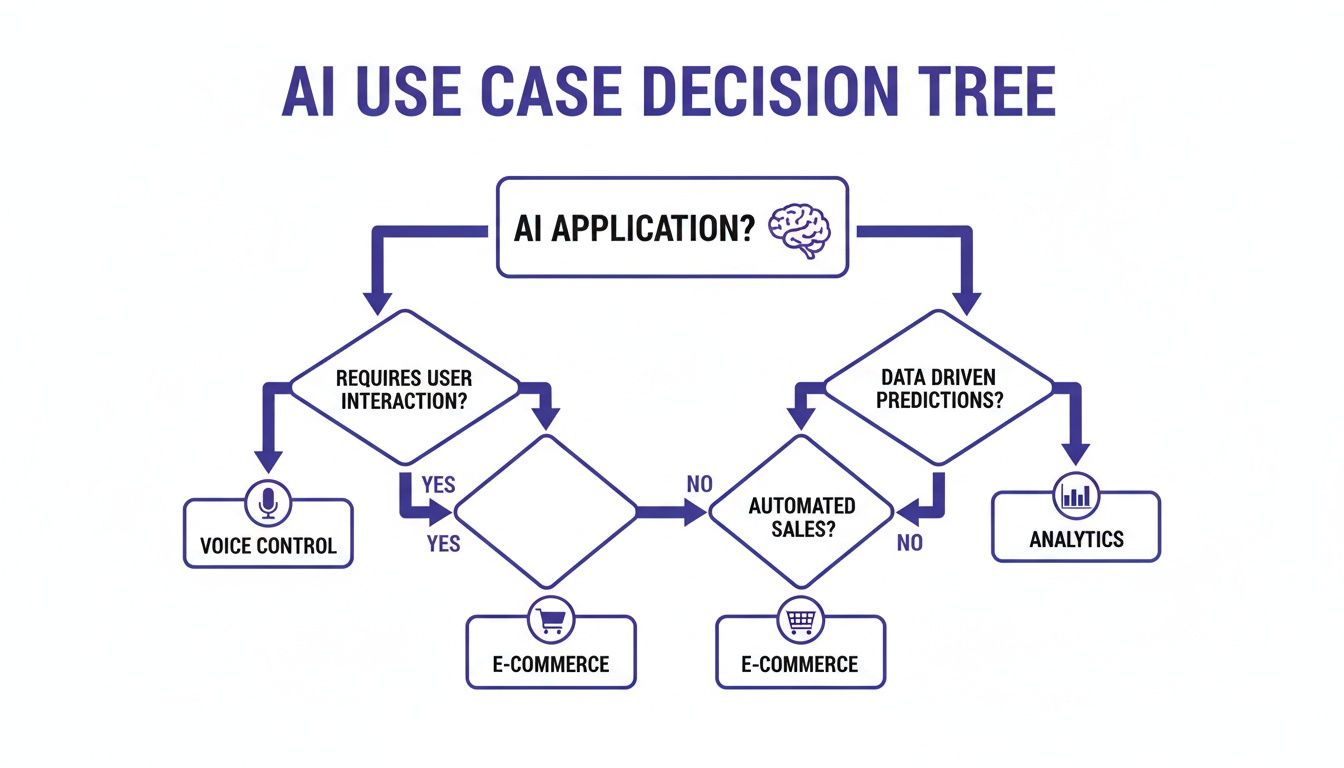
As the diagram shows, the process is always driven by the user's goal, whether that’s getting a personalised recommendation, using their voice to control the app, or something else entirely.
Seamless Integration with Modern Frameworks
The good news is that modern tools have made these complex integrations far more manageable than they used to be. Frameworks like TensorFlow Lite are built specifically to run machine learning models efficiently on mobile devices, and they work brilliantly with Flutter. This is how we build apps that are both incredibly smart and exceptionally smooth.
For any business looking to get into this space, having expert guidance from providers of AI engineering services can be a massive help in navigating these technical decisions. Getting the foundations right ensures the architecture supports your business goals from day one.
The real goal is to make the AI feel completely invisible. The tech should work so smoothly that all the user notices is a fast, responsive, and genuinely helpful app. This is one area where Flutter’s brilliant performance gives us a real edge over other frameworks.
This approach is becoming central to the software development scene here in the UK, where the AI and machine learning market is forecasted to hit a massive £63.6 billion by 2030. That growth is largely driven by cloud-based solutions, which are expected to grab 65% of the market share by 2025.
For a clearer picture of how these architectural pieces fit together, have a look at our simple guide on what software architecture is and how it works.
Navigating the Common Challenges of AI Implementation
Adopting AI in software development gives you a powerful advantage, but any successful project needs a clear-eyed view of the potential hurdles. Getting a handle on these challenges upfront is the key to managing them and making sure your investment pays off.
The journey begins and ends with data. An AI model is only as smart as the data it’s trained on; poor quality, biased, or not enough data will always lead to a poor quality, unreliable AI. This "garbage in, garbage out" principle is the single biggest risk in any AI project.
Ensuring Data Quality and Privacy
Our first job is always to build a rock-solid data foundation. This means rigorously cleaning, organising, and validating datasets to get rid of biases and inaccuracies. It also means strict adherence to UK data privacy regulations like GDPR, ensuring all data handling is secure, transparent, and completely compliant.
- Data Cleansing: We put processes in place to spot and fix errors or inconsistencies in your data before it ever touches the AI model.
- Bias Mitigation: We actively hunt for and address potential biases in training data to ensure the AI makes fair and equitable decisions.
- GDPR Compliance: Every step is designed to meet the UK’s stringent data protection standards, building trust with your users right from the start.
This meticulous approach is non-negotiable for building AI that is both effective and trustworthy.
Demystifying the Black Box Problem
Another common worry is the "black box" nature of some AI models, where it’s not always clear how they reach their decisions. This lack of transparency can be a major barrier for businesses that need to explain why an AI-driven decision was made, especially in regulated industries.
We tackle this by prioritising transparent and explainable AI (XAI) techniques. Our strategy involves choosing models that allow for clear interpretation and using tools that help visualise how an AI reaches its conclusions. This turns a mysterious black box into a clear, understandable process.
Maintaining this clarity is crucial for accountability and for making the model better over time. It also gives you the confidence to trust what the AI is telling you.
The Need for Continuous Improvement
Launching an AI model isn't the finish line; it’s just the beginning. The world is constantly changing, and a model that was incredibly accurate six months ago can quickly lose its edge if it isn't retrained with fresh data. This is known as model drift.
In a competitive market like the UK, home to 715,000 businesses in the software development industry, staying ahead is everything. We build ongoing monitoring and retraining cycles into our projects to ensure your AI maintains peak performance and adapts to new trends and user behaviours. This proactive maintenance is vital for long-term success, especially as OECD projections show AI could significantly boost UK labour productivity in the next decade. You can learn more about the UK software development industry's growth on IBISWorld.
By anticipating these challenges—data quality, transparency, and maintenance—we de-risk your investment and deliver an intelligent solution that’s built to last.
Working With App Developer UK on Your Next Big Idea

Getting into AI in software development isn't just about having the right tech skills. It's about finding a partner who genuinely gets what you're trying to achieve. Here at App Developer UK, we start every project the same way: by listening. We make it our business to understand your business goals inside and out before we even think about writing code.
That genuine partnership is what really makes the difference. We're not interested in quick fixes; we're here to build smart solutions that give you a real, lasting edge in the market. You’ll find our process is open, flexible, and always laser-focused on delivering practical value for UK businesses, from ambitious startups to established market leaders.
Deep Expertise in High-Performance Flutter Apps
There's a good reason we specialise in Flutter. When you're building AI-driven apps, performance is non-negotiable. Time and again, new benchmarks show that Flutter is at the top of the hill for creating slick, natively compiled apps that feel right at home on any platform. Its underlying architecture is simply better suited for the heavy lifting and real-time data crunching that AI features demand.
Our team's deep expertise with the Flutter framework means we build apps that are not just clever but also incredibly fast and responsive. We know how to sidestep the performance bottlenecks that often trip up other cross-platform tools, so your users get a perfectly smooth experience every single time.
Choosing the right tech is half the battle won. We pair our strategic business insight with Flutter’s raw performance to build AI-powered apps that are engineered to stand out.
Our Proven Process for Intelligent Solutions
Turning a great idea into a market-leading app takes more than just good intentions; it requires a clear, structured plan. Our end-to-end service walks you through every stage, ensuring nothing is left to chance.
Here’s how we make it happen:
- Bespoke Architecture Design: We’ll design a scalable and solid app architecture tailored to your AI needs, whether it's running on-device, in the cloud, or a smart mix of both.
- Agile Development Sprints: Our agile approach keeps you in the loop and allows us to adapt on the fly, making sure the project always aligns with your business goals.
- Rigorous AI-Driven Testing: We use sophisticated AI testing tools to hunt down and squash bugs with surgical precision, guaranteeing a rock-solid final product.
- Sustainable, Long-Term Support: Our job isn't done when the app goes live. We stick around to provide ongoing support, keeping your app in peak condition and ready for whatever comes next.
Why not start a conversation with us? Let the team at App Developer UK show you how we can turn your vision for an AI-powered mobile app into a genuine success story.
Got Questions About AI in App Development?
If you're weighing up a new project, the world of AI in software development can seem a bit murky. It’s only natural to have questions. Let's clear the air and tackle some of the most common queries we hear from business owners.
Will AI Make Our Current Developers Redundant?
Absolutely not. Think of AI as a powerful sidekick for your development team, not a replacement. It’s brilliant at handling the grunt work – the repetitive, time-consuming tasks like churning out boilerplate code or running thousands of tests.
This frees up your developers to do what they do best: focus on the tricky, creative, and strategic parts of your project. It's about giving your skilled team a superpower, letting them solve bigger problems, innovate faster, and build the features that actually matter to your customers. The future isn't AI or humans; it's humans working hand-in-hand with AI.
Is AI Integration Too Expensive for a Small or Medium-Sized Business?
It’s far more accessible than you might think. While there's an initial investment, the long-term payoff is often huge. When AI tools help slash development timelines, that directly translates to lower project costs.
On top of that, AI is fantastic at spotting bugs and security holes early in the process. Catching those issues before launch saves a small fortune in post-launch fixes. Thanks to modern cloud platforms and powerful open-source tools, you don’t need a massive enterprise budget to add smart features to your app anymore.
Why Is Flutter Such a Good Fit for AI-Powered Apps?
Performance. Pure and simple. Flutter is built from the ground up for speed, which is non-negotiable when you’re running complex AI and machine learning models on a phone. Time and again, new benchmarks show Flutter leading the pack in performance, making it the smart choice for sophisticated, AI-driven apps.
Because Flutter draws directly to the screen from a single codebase, the user experience on both iOS and Android is incredibly fluid and responsive. This holds true even when the app is handling heavy lifting like real-time image recognition or predictive analytics. That performance edge means we can build genuinely intelligent apps without ever compromising on speed or quality.
Flutter's unmatched performance is the key to unlocking the full potential of on-device AI. It ensures that even the most complex computations feel instantaneous to the user, providing a seamless experience that other frameworks struggle to match.
How Can We Be Sure the AI We Use Is Ethical and Unbiased?
This is a massive priority for us and sits at the core of our development philosophy. Building ethical AI isn't an afterthought; it starts with the data. We are absolutely committed to using high-quality, diverse, and meticulously cleaned data to train our models. After all, an AI is only as fair as the data it learns from.
Our process is built on a few key pillars:
- Rigorous Bias Testing: We proactively hunt for and neutralise any inherent biases in a model's decision-making process.
- Built-in Transparency: We build in ways to understand why the AI is making its decisions, avoiding the "black box" problem.
- Full GDPR Compliance: Every piece of data is handled in strict accordance with UK data privacy regulations.
Building user trust is everything. An ethical, transparent approach isn't just good practice; it's fundamental to the long-term success of any project involving AI.
Ready to build a smarter, faster, and more effective mobile application? The team at App Developer UK is here to help you bring your vision to life with high-performance Flutter apps. Get in touch with us to start the conversation.