Unlocking App Quality A Guide to Software Testing Basics
Unlocking App Quality A Guide to Software Testing Basics
At its core, software testing is about making sure an app does what it's supposed to do. It’s the process of methodically checking that everything works correctly, is secure, and gives users a great experience. You're essentially hunting down and fixing bugs before your users ever see them.
Why App Success Starts with Solid Testing
Think of building a premium app like constructing a skyscraper. You wouldn't pour concrete without first inspecting the steel framework and foundation, would you? Software testing is that exact same quality inspection, making sure your app is stable, secure, and truly ready for your audience. It's less about technical jargon and more about a core business strategy.
A proactive testing approach isn't an expense; it's a vital investment. It safeguards your brand's reputation by catching embarrassing bugs and crashes that frustrate users and lead to a flood of negative reviews. Ultimately, it’s how you deliver a product that delights people from the very first tap.
The Business Case for Quality Assurance
Skipping proper testing can have serious consequences, from users abandoning your app in droves to direct financial loss. A well-organised testing strategy acts as a safety net. It confirms that every single feature—from a simple button to a complex payment gateway—functions exactly as you planned. This process builds confidence not just for your users, but for your internal teams and stakeholders too.
Quality is never an accident; it is always the result of intelligent effort. A commitment to rigorous testing is what separates market-leading apps from the ones that fail to gain traction.
This guide will map out your journey, starting with the fundamental concepts and moving all the way to applying them in the real world. We'll pay special attention to Flutter development, showing how modern frameworks make it easier than ever to build high-performance, reliable apps. To see just how far-reaching this is, you can explore the importance of Quality Assurance in digital analytics and its impact beyond just the codebase.
The demand for these skills is undeniable. In the UK, the software testing services market is on track to hit approximately £1.3 billion in 2025. This explosive growth shows a clear, consistent need for specialised quality assurance across every industry imaginable. Getting this right is key, and if you're looking to build out your team, you might find our guide on hiring a quality assurance engineer particularly useful.
The Four Levels of Software Testing Explained
To really get your head around software testing, it helps to think of it like building a car. You wouldn’t assemble the entire vehicle, cross your fingers, and then check if the engine starts. That would be madness. Instead, you check every single component at each stage of the build.
This layered approach is exactly how we ensure quality in software. It's a structured process broken down into four distinct levels, each building on the last. It’s the bedrock of good development, guaranteeing that by the end, you have a reliable and user-friendly mobile app, not a clunker that breaks down on its first trip.
Level 1: Unit Testing
First up, we have Unit Testing. This is the most granular level of testing, where developers inspect the smallest, most isolated snippets of code, known as "units." In our car analogy, this is like checking every individual spark plug, bolt, and wire. The whole point is to make sure each tiny component does its job perfectly on its own before it’s connected to anything else.
For a mobile app, a unit could be a single function. Imagine a function that validates an email address format or one that calculates the total in a shopping basket. Developers write tiny, automated tests to confirm that the validateEmail() function correctly accepts valid emails and rejects dodgy ones. Catching bugs here, right at the source, is a massive win—it makes them infinitely easier and cheaper to fix.
Level 2: Integration Testing
Once we know the individual units are solid, we move on to Integration Testing. As the name suggests, this is all about checking how different parts of the code work together. Back to our car: this is where you connect the engine to the transmission and make sure they communicate smoothly. You're no longer testing parts in isolation; you're testing the connections between them.
A classic example in a mobile app is the login process. This single action involves several units working in harmony: the user interface where you type your details, the bit of logic that validates the password, and the component that talks to the server to authenticate you. Integration testing makes sure data flows correctly between them all and that they play nicely together.
Level 3: System Testing
With all the components integrated and talking to each other, it's time for System Testing. This is the first time we test the app as a complete, unified whole. It’s like taking the fully assembled car for its first proper road test—checking the steering, brakes, and acceleration all at once to see how it handles in the real world.
System testing validates the entire app against its original requirements. Testers will run through every feature from end-to-end, like registering a new account, browsing products, adding them to a basket, and completing a purchase. This holistic view ensures the app functions as a cohesive system and meets all the business and technical goals.
The infographic below shows how these layers stack up to deliver a successful app.
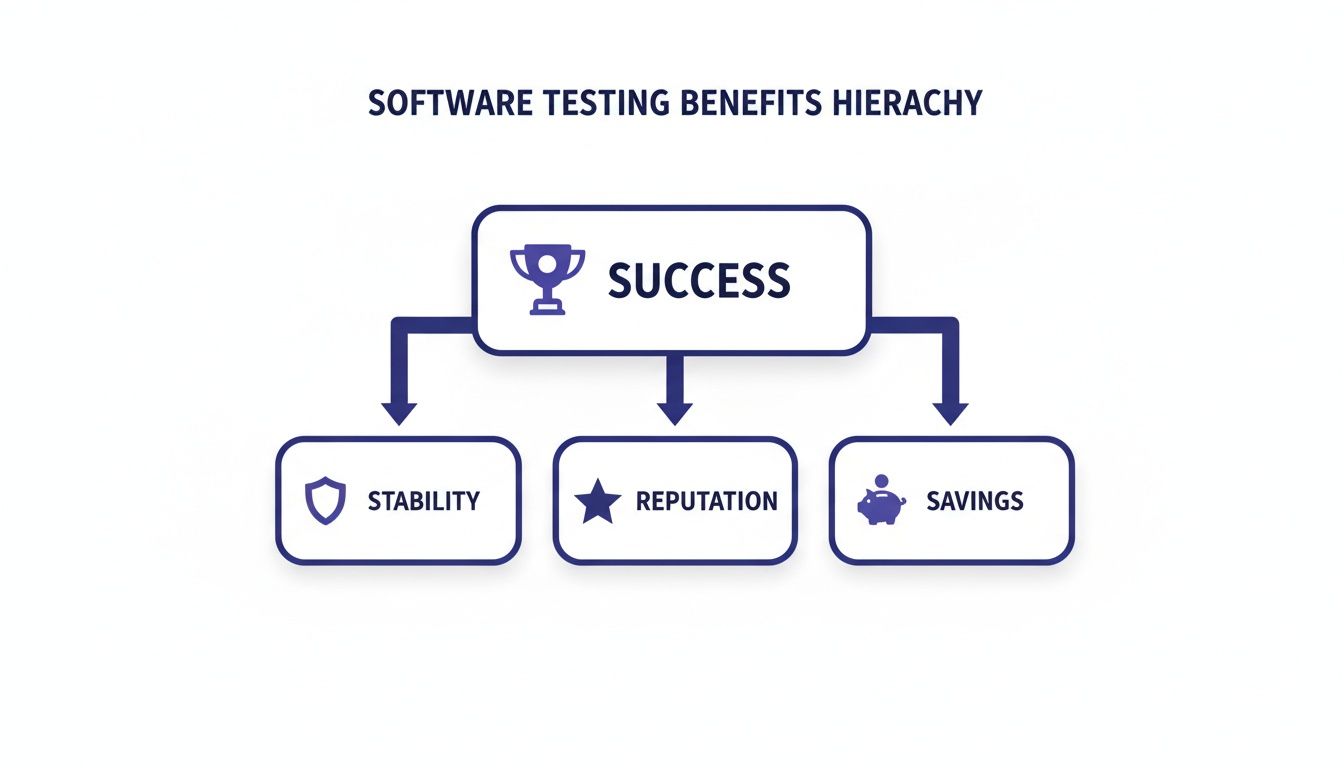
As you can see, a successful app is built on stability, a strong reputation, and cost savings—all direct results of a thorough testing process.
To make this even clearer, here’s a simple breakdown of the four testing levels using our car analogy.
A Simple Analogy for the Four Testing Levels
| Testing Level | What It Checks | Car Assembly Analogy |
|---|---|---|
| Unit Testing | The smallest, individual pieces of code. | Checking each nut, bolt, and wire works correctly on its own. |
| Integration Testing | How different code modules interact. | Connecting the engine to the transmission to see if they work together. |
| System Testing | The complete, fully built application. | Taking the finished car for its first full road test. |
| User Acceptance Testing | If the app meets the end user's needs. | Letting the customer take the car for a final test drive before buying. |
This table neatly sums up how each stage validates a different aspect of the project, from the tiniest component to the final user experience.
Level 4: User Acceptance Testing
Finally, we arrive at User Acceptance Testing (UAT). This is the last hurdle before your app goes live. At this stage, real end-users or the client get their hands on the software to confirm it meets their needs and expectations in a real-world setting. In our car analogy, this is the moment the customer takes the car for a spin and gives you the thumbs-up.
UAT isn't about finding technical bugs; it's about validating that the app solves the right problem for the user in an intuitive way. It answers the critical question: "Does this app provide the value we intended?"
This final check is crucial. It ensures the product is not only technically sound but is genuinely ready for its audience, delivering a smooth and valuable experience from day one.
Right, so you know the different types of tests. That’s the easy part. The real trick is knowing how to use them without grinding your development process to a halt. A smart mobile app testing strategy isn't about throwing every test you can think of at your app—that’s just a recipe for wasted time and money.
It’s about being deliberate. You need to move away from a chaotic, "test-everything-all-the-time" mindset and towards a structured, intelligent plan. The goal here is simple: build a framework that makes your app solid where it counts, giving you the confidence to ship new releases without sleepless nights.
The Testing Pyramid: Your Blueprint for Sanity
One of the best models for structuring your testing is the Testing Pyramid. It’s a simple but incredibly powerful way to visualise where you should focus your efforts.
Think of a pyramid with three layers. The wide, sturdy base is built from hundreds of small, lightning-fast Unit Tests. This is your foundation. Getting this right means all the individual building blocks of your code are working perfectly before you even start putting them together.
The middle layer is for Integration Tests. There are fewer of these, and their job is to check that different parts of your app play nicely with each other. At the very top, the smallest part of the pyramid, sit a handful of big, comprehensive End-to-End (UI) Tests. These are slow, brittle, and expensive to run, so you save them only for the most critical user journeys. This structure forces you to put most of your effort into the fast, cheap, and reliable tests at the bottom.
Focus Your Firepower with Risk-Based Testing
Let’s be honest: not all features are created equal. A bug in the "About Us" screen is a minor annoyance. A bug in your payment flow? That’s a five-alarm fire. This is exactly where risk-based testing comes into play. It’s a pragmatic approach that channels your most intense testing efforts towards the parts of your app that can cause the most damage if they break.
A smart testing strategy doesn't treat every feature the same. It focuses resources where they'll have the biggest impact—on high-risk areas like user logins or in-app purchases—to protect your revenue and your reputation.
To get this right, you need to put on your detective hat and identify the potential risks. Start by asking a few key questions:
- Which features are absolutely critical for the user? A broken login screen makes the entire app useless.
- What functionality is tied directly to making money? The checkout process has to be bulletproof.
- Which parts of the app have the most complex logic? Complexity is where bugs love to hide.
- What code has been changed recently? Freshly written code is always the most likely to have defects.
Answering these questions helps you build a priority list. High-risk features get the full treatment—unit, integration, and UI tests. Low-risk features might just get a quick check. This targeted approach ensures your most important workflows are rock-solid, delivering a secure and reliable experience that keeps users happy and protects your bottom line.
Using Automation and CI/CD to Accelerate Development
Imagine having a tireless robot that runs thousands of checks on your app every single time a developer pushes a single line of new code. That’s the magic of automated testing. It's not just a buzzword; it’s a cornerstone of modern development that fundamentally changes the speed and reliability of your entire project.
Instead of your senior testers manually plodding through the same login screen checks for the hundredth time, automation takes care of all the repetitive, predictable tasks. This is a game-changer. It frees up your human experts to do what they do best: creative, exploratory testing that a machine could never replicate. They can dive into complex user journeys, poke holes in the app’s logic, and uncover those subtle, unexpected bugs that automated scripts would just fly past.
The Power of CI/CD Pipelines
Automated testing really comes alive when you plug it into a Continuous Integration and Continuous Deployment (CI/CD) pipeline. Think of a CI/CD pipeline as the automated assembly line for your software. It’s a predefined process where every code change automatically kicks off a chain of events: building the app, running all the automated tests, and getting it ready for release.
This combination—automation and CI/CD—creates an incredibly fast feedback loop. Developers find out almost instantly if a recent change broke something, allowing them to fix it on the spot while the code is still fresh in their minds. This stops tiny issues from spiralling into huge, expensive problems down the line.
A well-oiled CI/CD pipeline isn't just a technical nicety; it's a massive competitive advantage. It lets your team build, test, and release new features with remarkable speed and confidence, making sure your app consistently meets user expectations.
For development teams, connecting project management tools with these automated workflows is the next logical step. You can take this even further by mastering Jira workflow automation to build rule-based logic for all those repetitive administrative tasks. Tying development directly to project tracking streamlines everything from the first line of code to the final deployment.
Meeting Modern Market Demands
Let's be clear: adopting these practices isn't optional anymore. It's what the market expects. The demand for specialist testing skills in the UK is soaring, with some estimates pointing to a 25% year-over-year increase that’s creating a major skills gap.
This reality has pushed businesses to embrace automation, and it means development agencies must have these capabilities to even be in the running for new projects. By embracing robust automation and CI/CD, you’re not just speeding up development. You're building your product on a solid foundation of quality, ensuring it's ready to compete and win.
Specialised Testing for High-Stakes UK Industries
For most apps, a standard testing routine gets the job done. But if you’re operating in a high-stakes UK industry like FinTech or healthcare, the rulebook gets a lot thicker. Here, testing isn’t just about making sure things work—it’s about security, compliance, and maintaining unbreakable user trust.
A single slip-up isn’t just an inconvenience; it can lead to devastating regulatory penalties, data breaches, and a damaged reputation that’s incredibly difficult to repair. This is where testing stops being a simple quality check and becomes a rigorous, specialised discipline.
Apps handling sensitive financial data or confidential patient information need an approach that goes far beyond checking if a button works correctly. The entire focus shifts to proving the app is tough, secure against modern threats, and fully compliant with UK-specific regulations like GDPR and FCA guidelines.
Critical Testing for Regulated Apps
To properly protect both users and the business, a few types of testing are completely non-negotiable. These checks are designed to make sure the application is robust enough for the demanding UK market.
- Security Testing: This isn’t a single test, but a comprehensive, simulated assault on your app's defences. We act like the bad guys, trying to find vulnerabilities in everything from the login screen to the database, ensuring sensitive user data is locked down tight.
- Performance Testing: What happens when thousands of users try to log in all at once during a market spike? Performance and load testing answer that exact question, making sure the app stays stable and responsive even under extreme pressure.
- Compliance Testing: This is all about ticking the right legal and regulatory boxes. It involves a deep audit of how the app handles data, its privacy controls, and accessibility features to steer clear of eye-watering fines.
In high-stakes sectors, testing is your primary line of defence. It’s the process that proves your application is not just functional but also a secure and trustworthy fortress for your users' most sensitive information.
This intense demand for quality is especially true in the financial world. The financial services sector accounts for roughly 31% of the entire UK software testing market, a figure that represents an estimated £370.7 million in 2025. This massive investment is driven by the absolute need for reliability in banking and insurance apps, where compliance and security are everything. To get a better sense of this landscape, you can explore the full findings on financial services testing.
Navigating these complex requirements isn't something you can just wing; it demands real expertise. As a UK-based Flutter agency, we live and breathe the specific challenges and regulatory pressures businesses here face. Our specialised testing strategies are built to ensure your high-stakes application is not only successful but also safe, secure, and fully compliant from day one.
How We Master Quality with Flutter Testing

As a UK-based Flutter agency, we don’t just build apps; we engineer them for excellence. We made a conscious decision to specialise in Flutter, not just for its gorgeous UIs and cross-platform muscle, but for its outstanding, integrated testing suite. This ecosystem is designed for quality from the ground up. It lets us deliver apps that are not only fast but also exceptionally reliable.
Flutter gives us a comprehensive testing framework that covers all the software testing basics you could need. Unlike other frameworks that often feel like you’re bolting on third-party tools as an afterthought, Flutter’s capabilities are baked right in. The result is a seamless, efficient process that ensures every single component of an app is robust.
The Flutter Testing Advantage
Flutter's unique structure allows us to test everything from the smallest UI widget to complex, full-application user journeys. And the best part? It’s all managed through a unified toolkit that speeds up our quality assurance process without ever cutting corners.
The framework breaks testing down into three core types:
- Widget Tests: These are brilliant. They let us test individual UI components in isolation, making sure every button, form, and animation behaves exactly as intended, no matter the device.
- Integration Tests: This is where we verify that different parts of the app—like services and UI screens—work together flawlessly. We use these to simulate real user interactions and catch issues before they ever reach your customers.
- Unit Tests: Absolutely essential for validating the business logic. These tests check individual functions and methods to ensure the app's core mechanics are completely sound.
For our clients, this all translates to faster development cycles, lower costs, and a much higher-quality final product. New benchmarks consistently put Flutter at the top for performance, a direct result of its superior architecture and meticulous testing capabilities.
This integrated approach is also a perfect fit for modern development practices. You can learn more about how continuous integration for Flutter apps automates this entire process, guaranteeing quality with every single code change. By mastering Flutter's powerful tools, we build apps that truly stand out for their stability and exceptional performance.
Common Questions About Software Testing
When you're wading into the world of software testing, a lot of practical questions pop up. Business leaders, in particular, often ask us how much testing is really enough, or where the line is between automating a test and just doing it manually. Let's tackle some of the most common queries we hear.
How Much Testing Do We Actually Need?
The short answer? It all comes down to risk.
Think about it: a feature like your payment gateway is high-stakes. If it breaks, you lose money and customer trust. That needs intensive, multi-layered testing. On the other hand, a simple "About Us" page is pretty low-risk. A quick check to make sure it loads correctly is probably all it needs. The trick is to take a risk-based approach, putting your time and energy where it will most protect your users and your business.
When Should We Choose Automation?
Automation is your best friend for tasks that are repetitive, predictable, and need to be run over and over again. Regression testing is the classic example – it’s a workhorse that saves a ton of time and reliably catches new bugs that creep in after code changes.
But don't throw out manual testing just yet. It's still absolutely essential for exploratory checks, getting a real human's take on usability, and finding those weird, subtle issues that only human intuition can uncover.
The smartest strategy is a balanced one. Let automation handle the heavy lifting of repetitive checks. This frees up your expert testers to do what they do best: explore the complex corners of the app and provide invaluable, human-centric feedback.
Can We Just Skip Testing to Launch Faster?
Skipping testing to save time is a classic false economy. It might feel like you're speeding up the launch, but you'll pay for it later – usually in the form of emergency bug fixes, angry users, and a damaged reputation.
A proper testing process catches problems early, back when they’re cheap and easy to fix. This doesn't just lead to a smoother launch; it ensures you're putting a stable, professional product out into the world.
Ready to build a high-quality, reliable app that your users will love? App Developer UK specialises in creating top-tier mobile applications with robust, integrated testing from day one. Contact us to learn how we can bring your vision to life.