Your Guide to a Modern Application Development Course
Your Guide to a Modern Application Development Course
Thinking about jumping into an application development course? It’s probably the most direct way to land a high-demand career in the UK’s booming tech scene. A good course is designed to take you from a complete beginner to a job-ready professional, giving you the skills to build apps people actually want to use. It’s a serious first step into a valuable, future-proof craft.
What To Expect From Your App Development Journey
Let’s get one thing straight: an application development course is so much more than a bunch of coding tutorials. Think of it less like learning a new spoken language and more like an architectural apprenticeship. You’re not just learning how to lay bricks (write code); you’re learning how to design, plan, and build a complete, functional, and even beautiful structure (your app).
The best modern courses have moved way beyond just teaching syntax. They teach you how to think like a developer. That means learning how to spot a problem, dream up a solution, and then actually bring that idea to life with technology. It's about mastering the whole process, from that initial spark of an idea right through to launching on an app store.
The Core Pillars of a Great Course
A well-structured course gives you a clear roadmap, guiding you from one milestone to the next. While the exact details might change, every quality programme is built on the same foundational principles. Before you even start, it’s worth getting your head around the entire process; checking out a guide on the mobile app development lifecycle will give you a fantastic head start.
Your training should cover these key areas:
- Problem-Solving: This is all about learning to break down massive, complex challenges into small, manageable tasks you can actually code.
- User-Centric Design: You'll learn how to build interfaces that feel intuitive, are accessible to everyone, and are genuinely enjoyable to use.
- Technical Implementation: This is the nitty-gritty of writing clean, efficient code that not only works now but can also grow and scale in the future.
- Testing and Deployment: Finally, you’ll learn how to make sure your app is bug-free, secure, and successfully launched for the world to see.
A truly effective application development course doesn't just teach you how to code. It teaches you how to build solutions. The distinction is crucial, as employers in the UK are looking for developers who can create genuine business value, not just write lines of code.
This holistic approach is what separates a certified pro from a hobbyist. It gets you ready to join a real development team, contribute to big projects, and build a portfolio that shows you can deliver top-quality applications from start to finish. This guide will walk you through everything else you need to know before you pick your specialisation and get started.
Choosing Your Development Specialisation
So, you’re ready to dive into an application development course. Fantastic. But right at the start, you'll hit a fork in the road. You need to pick a specialisation, and this decision will shape pretty much everything that comes next—the languages you'll learn, the projects you can build, and even the companies you'll end up working for.
Think of it like choosing how you want to travel. You wouldn't take a sports car on a rugged off-road trail, and you wouldn't enter a Formula 1 race in a lorry. In the same way, different apps are built for different environments, and each demands its own unique set of tools and skills.
Let's break down the main paths you can take.
Comparing Application Development Paths
This table gives you a quick, side-by-side look at the major specialisations. It’s designed to help you see where your interests and career goals might fit best.
| Development Path | Primary Technologies | Best For | Key Advantage |
|---|---|---|---|
| Native Mobile | Swift (iOS), Kotlin (Android) | High-performance apps needing deep hardware integration. | Maximum performance and access to all device features. |
| Cross-Platform Mobile (Flutter) | Dart | Building for both iOS & Android from a single codebase. | Unbeatable efficiency, cost-effectiveness, and speed. |
| Web Application | HTML, CSS, JavaScript | Apps that need to be accessible on any device via a browser. | Universal access without needing an app store install. |
| Backend | Python, Node.js, Java, Go | The 'engine room'—databases, servers, and app logic. | Powering the core functionality that all apps rely on. |
Each path leads to a different kind of expertise. While backend is all about the unseen infrastructure, native and cross-platform focus on the user-facing experience, just in very different ways.
Native iOS and Android Development
This is the old-school, traditional route. Native development means you build an app exclusively for a single operating system—using Swift for Apple’s iOS or Kotlin for Google’s Android. It's like getting a bespoke suit made; it fits the platform perfectly. This approach gives you unfiltered access to every single feature on the device, from the camera to the GPS, squeezing out every last drop of performance.
But there's a huge catch. If you want your app on both iPhones and Android phones, you have to build, manage, and pay for two completely separate apps. That means double the work, double the cost, and two separate teams. While the performance is top-notch, this inefficiency makes it a tough sell for most new projects today.
This flowchart helps to visualise the journey you’re about to embark on.
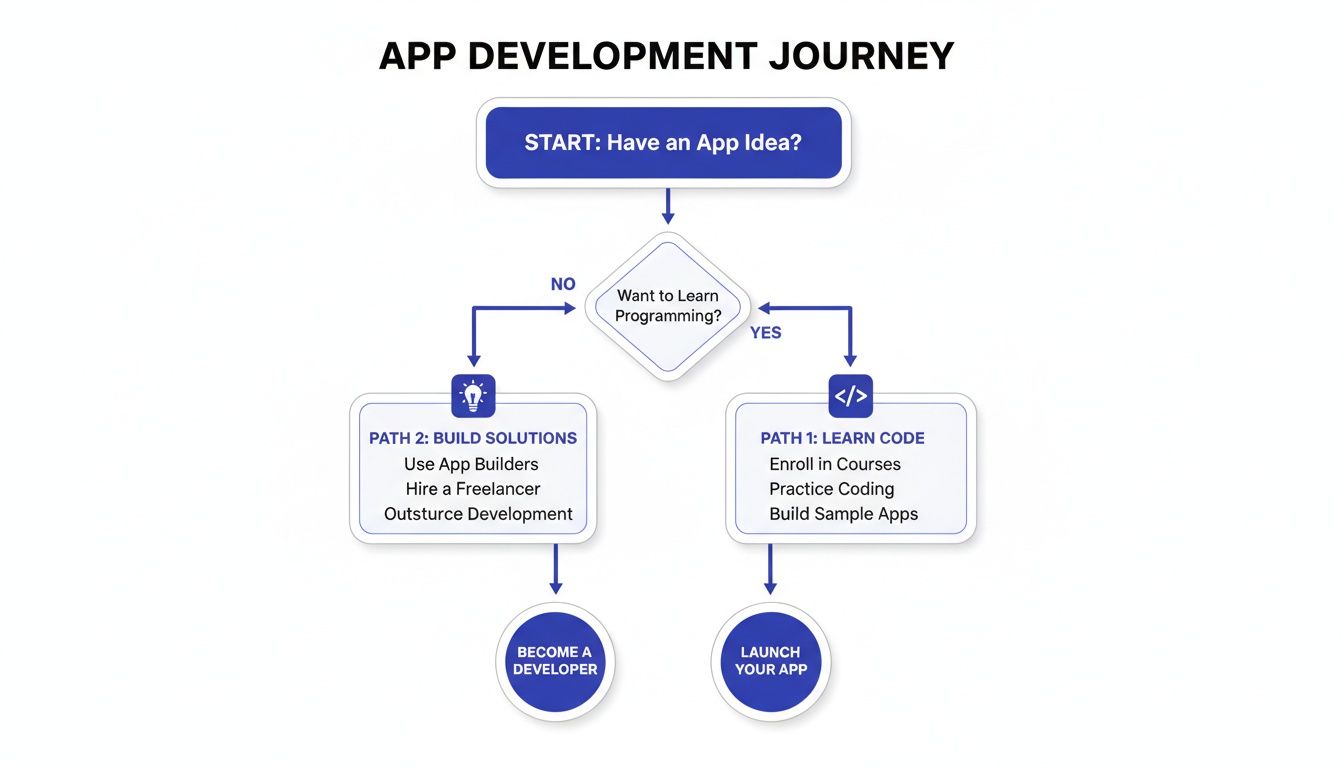
As you can see, that initial decision—whether you want to learn code or focus on building solutions—sends you down very different tracks.
Web and Backend Applications
Another major path is web application development. These aren't the apps you find in an app store. Instead, they run directly inside a web browser like Chrome or Safari and are built with technologies like HTML, CSS, and JavaScript. Their biggest advantage is accessibility—they just work, no matter if you're on a desktop, tablet, or phone. No download required.
Working hand-in-hand with web apps is backend development. This is the engine room. Backend developers build and maintain everything that happens on the server: databases, user accounts, security, and all the core logic that makes an app actually do something. It’s less about what the user sees and more about building the solid foundation everything runs on. To get a real sense of what’s involved, our guide on what backend development is and how it works breaks it all down.
The Modern Choice: Cross-Platform with Flutter
For most modern app development needs, cross-platform is the smartest way to go, and Flutter is leading the charge. It’s a game-changer. With Flutter, you write your code just once, and it compiles into a true native app for iOS, Android, the web, and even desktop computers.
Think of it this way: native development forces you to build two separate cars from scratch, one for each road. Flutter lets you build one high-performance, all-terrain vehicle that excels everywhere, saving immense time and resources without compromising on quality.
It's not just about saving time, either. Flutter compiles directly to native machine code, which means you get incredibly smooth animations and a snappy, responsive user experience that feels completely at home on any device. For developers and businesses here in the UK, choosing a Flutter-focused application development course is a direct investment in the most efficient and powerful technology on the market. It’s the practical choice for building brilliant apps for the biggest possible audience.
As you weigh up these different paths, it can also be useful to look at foundational courses like an Access to Higher Education Diploma in Computer Science. Programmes like this give you a solid grounding in the core principles behind all software, helping you make a much more informed decision about which specialisation is right for you.
The Essential Syllabus For A Modern Developer
Choosing the right application development course is a huge step for your career. But with so many options out there, how do you know which one will actually get you job-ready for the UK’s tech scene? A top-tier syllabus isn’t just a checklist of buzzwords; it's a structured path that builds your skills layer by layer, just like a recipe where every single step matters.
The journey has to start with the absolute basics. You wouldn't build a house on a shaky foundation, and app development is no different. Any course worth its salt must kick off with the core principles of programming—getting you to think in terms of logic, variables, functions, and control structures. For today's cross-platform world, that usually means getting to grips with a language like Dart, the engine that powers Flutter.
Core Programming Fundamentals
Before you can even think about designing slick interfaces or building cool features, you need to master the building blocks of code. This is the non-negotiable first stage of any serious course. It's where you learn how to give a computer instructions, starting with simple commands and moving up to more complex logical operations.
This foundational stage should cover:
- Variables and Data Types: Understanding how to store different kinds of information, like text, numbers, and true/false values.
- Control Flow: Learning how to make your code smart by using
if-elsestatements for decisions and loops to repeat actions. - Functions: Writing clean, reusable chunks of code that perform specific tasks. This keeps your projects tidy and much easier to manage.
- Object-Oriented Programming (OOP): Getting your head around concepts like classes and objects. This is crucial for building apps with frameworks like Flutter, as it helps you create code that's scalable and easy to maintain.
Designing User-Centric Interfaces and Experiences
Once you’ve got a handle on the programming fundamentals, the focus pivots from just making the app work to making it a joy to use. This is where UI (User Interface) and UX (User Experience) design principles come into play. An app can be a technical masterpiece, but if users find it confusing or ugly, they'll delete it in a heartbeat. A great application development course dedicates serious time to this.
The difference between a good app and a great app often comes down to its user experience. A syllabus that skips over UI/UX is teaching you how to build an engine without teaching you how to design the car around it.
You'll learn about layout, colour theory, typography, and how to create intuitive navigation that guides the user through the app without them having to think. With a framework like Flutter, you have incredible control over the look and feel, making it possible to build pixel-perfect interfaces that look and feel native on every device.
This screenshot from Flutter's official website shows just how capable the framework is at building beautiful, natively compiled apps for mobile, web, and desktop from just one codebase.
This visual really drives home Flutter's main selling point: one codebase, multiple platforms. It’s a game-changing skill for any modern developer to have in their toolkit.
Connecting Your App to the World
These days, apps don't live in a bubble. They need to save user data, pull information from the internet, and talk to other services. That's why modules on database management and API integration are absolutely essential. You’ll learn how to hook your app up to a backend, letting it store information in a database and pull it back out when needed.
Then you'll dive into APIs (Application Programming Interfaces), which are basically the doors that let your app communicate with other services. This is how your app can integrate a map, process a payment, or let users log in with their social media account. Mastering APIs unlocks a whole new world of functionality for your projects.
Finally, no modern developer can survive without version control. A course must teach you how to use Git, the industry-standard tool for tracking changes to your code. Think of it as a time machine for your project; it lets you collaborate with other developers, roll back mistakes, and manage complex projects without descending into chaos. A syllabus that doesn't include Git is simply incomplete.
From Theory To Reality With Real World Projects
An application development course is only as good as the practical skills it teaches you. Sure, classroom theory and coding exercises are essential for building a foundation, but the real learning—the kind that actually sticks—happens when you start building something tangible. It’s the moment you connect abstract concepts to real-world problems, moving from just learning syntax to solving things for actual users.
This jump from theory to reality is what turns knowledge into genuine capability. Think of it like this: it’s the difference between knowing all the ingredients for a cake and actually baking one that people can't wait to eat. By getting your hands dirty with real projects, you solidify your understanding and start building a professional portfolio—your most valuable asset when you begin looking for work in the UK.
Structuring Your First Projects
When you're just starting, the best approach is to follow a structured path that slowly ramps up the complexity. Trust me, diving headfirst into a massive project is a surefire recipe for frustration. Instead, focus on building a series of small, well-defined apps, with each one teaching you a new set of skills. This way, you build momentum and confidence with every finished project.
Here’s a practical progression of project ideas that works wonders for beginners:
- Project 1: The Digital Business Card: This is a simple, single-screen app that displays your professional details. It’s perfect for learning the absolute basics of layout, widgets, and static content. Think of it as your "Hello, World!" but with a practical, portfolio-ready twist.
- Project 2: The To-Do List App: A classic for a reason. This project forces you to get comfortable with managing state (adding, deleting, and updating items), handling user input, and saving data locally on the device.
- Project 3: The Simple API Client: Pick a free public API (like a weather forecast or a movie database) and build an app that fetches and displays its data. This is your first real step into the world of asynchronous programming and connecting your app to the wider internet.
Building a project isn't just a technical exercise; it's a simulation of the entire development lifecycle. You'll learn to plan features, manage your time, debug those infuriating unexpected issues, and, most importantly, deliver a finished product.
Connecting Code to Business Reality
As you get more comfortable, it’s crucial to start thinking about how your coding choices affect real-world costs and project timelines. Efficient code isn't just about speed; it's about saving money. In the competitive UK market, businesses are desperate for developers who can build high-quality apps without letting the budget spiral out of control.
Understanding these economic realities is a pragmatic skill that will really set you apart. For instance, the cost of developing mobile applications in the UK can vary massively based on complexity. A moderately complex app, like a local taxi or food delivery service, might cost between £21,000 and £52,000 and take 4-6 months to build. More intricate projects, such as an NFT marketplace, can demand £53,000 to £75,000 over 6-9 months. This context shows precisely why frameworks like Flutter are so valuable—their ability to build for multiple platforms from a single codebase directly translates into lower costs and faster delivery for businesses.
Building Your Professional Portfolio
Your portfolio is your professional story. It’s a curated collection of your best work that shows potential employers what you can do far more effectively than any CV ever could. A strong portfolio doesn't just show what you can build; it shows how you think and solve problems.
Here’s how to create a portfolio that gets you noticed:
- Showcase 3-5 Polished Projects: Quality over quantity is everything. It's far better to have a few excellent, fully functional apps than a dozen half-finished ones.
- Create a Professional
README.mdfor Each Project: On platforms like GitHub, theREADMEfile is your chance to sell your project. Describe the problem it solves, the technologies you used, and any tough challenges you overcame. - Include Live Demos or Screencasts: Don't make recruiters download and run your code. Give them a link to a live web version (which is incredibly easy with Flutter!) or record a short video showing off the app's features.
- Write a Case Study: For your best project, write a short blog post or case study. Detail your process from the initial idea to the final product. This proves you have a deep understanding of the entire development lifecycle and can communicate your work like a professional.
How To Pick The Right Application Development Course
With so many courses on the market, choosing the right application development course can feel overwhelming. You’ve got everything from intense online bootcamps to traditional university degrees, and they all promise to give you the skills for a successful career. So, how do you cut through the noise and find one that actually lines up with your goals?
Making the right call is more important than ever. The demand for digital skills in the UK is booming. Participation in digital skills courses in further education has jumped by 9.7%, from 43,240 learners in 2023/24 to 47,410 in the 2024/25 academic year. This isn't just a number; it shows how valuable these skills are becoming. You can dig into the numbers yourself in the official government statistics on further education and skills.
This massive demand means more courses are popping up, but they're not all created equal. Picking the wrong one is a mistake that costs you both time and money.
Your Course Evaluation Checklist
Before you sign up for anything, you need to do your homework. Think of this as a checklist to make sure the programme you’re considering is solid, relevant, and will give you a real return on your investment.
- Who’s Teaching? Look for instructors who are more than just academics. You want people who are actually in the trenches, building apps for a living. Real-world experience, especially with modern tools like Flutter, is priceless.
- What’s on the Syllabus? Does the curriculum cover the essentials we talked about earlier—fundamentals, UI/UX, API integration, version control? More importantly, is it focused on the technologies that are in demand in the UK right now?
- Is it Hands-On? Theory is one thing, but building is everything. A good course should be built around real-world projects. Your portfolio is your ticket to a job, and the course should help you create it.
- What Support Do You Get? What happens when you hit a wall at 2 AM? Check if the course offers solid support, like one-on-one mentoring, active community forums, or regular Q&A sessions.
Comparing Course Formats
The way you learn is just as important as what you learn. The format you choose will shape your entire experience, and what works for one person might not work for you.
| Course Format | Pros | Cons | Best For |
|---|---|---|---|
| Online Bootcamp | Intense, fast-paced, and totally career-focused. Usually more affordable. | Can be a real grind and might skim over deeper computer science theory. | Career-changers who need to get job-ready, fast. |
| University Degree | Gives you a deep theoretical foundation and a well-recognised qualification. | Can be slow, expensive, and sometimes teaches outdated tech. | Anyone looking for that traditional, in-depth academic grounding. |
| Self-Paced Online | Total flexibility to learn whenever you want, wherever you want. | Takes serious self-discipline; you're on your own without structured support. | Highly motivated people who need to fit learning around a busy life. |
The best application development course isn't the most expensive one or the one with the flashiest marketing. It’s the one that fits you—your learning style, your career goals, and your life. A bootcamp could be a game-changer for one person, while a degree is the right path for another.
A Quick Word for UK Businesses Upskilling Their Teams
If you’re a UK business looking to train your team, you’ve got an extra layer to think about. The goal is to find a training partner whose expertise plugs directly into your company’s tech stack and long-term plans.
If you’re aiming to build high-performance, cost-effective apps, then training focused on Flutter is a very smart move. Look for a provider with a track record of delivering real Flutter projects—like our team at AppDeveloper.uk. This ensures your team learns practical skills they can use on the job tomorrow, not just abstract theory.
To get you started, we’ve put together a list of the top application development courses in the UK to help you find the perfect fit.
Why Flutter Is A Game Changer For UK Developers
Picking a technology to specialise in can shape your entire career. For anyone taking an application development course in the UK right now, Flutter represents a massive opportunity. It’s not just another framework to add to the list; it’s a strategic choice that directly tackles the biggest headaches for businesses: speed, cost, and quality.
Put simply, Flutter changes the whole equation for building apps.

Unlike many cross-platform tools you might have heard of, Flutter compiles its code directly into the native language of the phone's processor (ARM machine code). This is a big deal. It means there’s no clunky JavaScript 'bridge' needed to talk to the device's hardware. The result? Genuinely smooth animations and a snappy, responsive feel that’s completely at home on both iOS and Android.
Time and again, new performance benchmarks show Flutter leading the pack, making it the go-to for apps that simply can't afford to feel sluggish.
Unmatched Development Speed And Efficiency
One of Flutter's most loved features is something called Hot Reload. This lets developers see code changes appear on the screen in less than a second, all without restarting the app and losing their place.
Imagine tweaking a button’s colour or fixing a layout bug and seeing the result instantly. It’s a huge productivity boost, cutting down on the frustrating wait times that plague other development cycles. This speed lets UK businesses get their ideas to market so much faster. For you, the developer, it just means less waiting and more creating.
By building for iOS, Android, and even the web from a single codebase, Flutter drastically cuts down development time and cost. What once needed multiple specialist teams can now be handled by a single, efficient team delivering a consistent, high-quality experience everywhere.
Real-World Success And High Demand In The UK
Flutter isn't just theory; it’s already powering successful UK-based apps in a fiercely competitive market. From fintech startups in London to massive retail brands in Manchester, companies are choosing Flutter to get ahead. Its power to deliver beautiful, high-performance apps on a tight schedule is hard to ignore.
For anyone finishing an application development course, this translates into one thing: serious demand for your skills. A quick search on any UK job board will show a growing number of roles crying out for Flutter expertise. Businesses get the value it brings, and they are actively looking for developers who can deliver on its promise.
Of course, the debate between frameworks is always lively. If you're weighing your options, our detailed comparison of Flutter vs React Native for your app is a great place to understand the nitty-gritty differences.
Ultimately, choosing to focus on Flutter is more than learning a new tool. It’s an investment in a skillset that’s perfectly tuned to what the modern UK tech industry needs right now.
Got Questions About App Development Courses? We Have Answers
Choosing to dive into an application development course is a big step, and it's smart to have questions. Let's clear up some of the most common queries to help you move forward with confidence.
How Long Does It Take to Become a Job-Ready Developer?
This really depends on how you approach it. If you go all-in with an intensive, full-time bootcamp, you could be ready for your first junior role in as little as 3-6 months. It's a sprint, but it's effective.
On the other hand, a part-time course or a university degree is more of a marathon, typically taking anywhere from 1-3 years. The real key isn't just the timeline; it's consistency. Your goal isn't just to learn the theory but to build a killer portfolio that shows UK employers you can actually build things.
What Are the Most Important Skills to Look for in a Syllabus?
Forget just the programming language for a second. The best courses teach you how to think like a developer. When you're scanning a curriculum, make sure these non-negotiables are front and centre:
- Version Control (Git): This is the absolute bedrock of teamwork in software. You simply can't work on a professional team without it.
- API Integration: Modern apps don't live in a bubble. This is the skill of plugging your app into other services to pull in data and add powerful features.
- UI/UX Principles: It’s not enough to build an app that works; you need to build one that people genuinely enjoy using.
- Project-Based Learning: Theory is one thing, but getting your hands dirty building real, working applications is where the learning truly sticks.
Is It Necessary to Have a Computer Science Degree?
Honestly? No. While a formal degree gives you a solid grasp of theory, the tech industry is refreshingly pragmatic. What gets you hired are your practical skills and a portfolio that proves you can apply them.
Many of the UK's most successful developers are bootcamp grads or entirely self-taught. A great course cuts to the chase, giving you the specific, hands-on skills that companies are looking for right now.
The most important prerequisite isn't a piece of paper. It's a genuine curiosity for solving problems and a real desire to build things. A great course will take that raw enthusiasm and shape it into a professional skillset.
The UK's reputation for top-tier tech education is only growing. As of January 2025, international interest in UK undergraduate courses, including computer science, jumped by 2.7%, with 118,800 applicants. This just goes to show the recognised quality of UK-based tech training. You can dig into the numbers in the latest UCAS applicant data.
Ready to turn your app idea into a reality with a team that lives and breathes high-performance development? At App Developer UK, we specialise in building stunning, efficient Flutter applications that deliver real business results. Contact us today to discuss your project.