UK App Development Cost Breakdown A Practical Guide
UK App Development Cost Breakdown A Practical Guide
So, you're thinking about building a mobile app. The first question that almost always comes up is, "How much is this going to cost?"
In the UK, the price tag can swing from around £20,000 for a simple, no-frills app to well over £150,000 for something complex and packed with features. The final figure on your invoice really boils down to three things: the complexity of what you're building, the polish of the design, and the technology stack powering it all.
Your Quick Guide To UK App Development Costs

Trying to pin down a budget for a new app can feel a bit like trying to hit a moving target. Before we dive into the nitty-gritty, it helps to get a bird's-eye view. The golden rule is straightforward: more features, more custom design, and more development time all mean a higher cost.
This is where clever choices in technology can make a huge difference. For example, building your app with a cross-platform framework like Flutter means you can launch on both iOS and Android from one single codebase. That’s a game-changer, and it’s a far more budget-friendly route than paying to build two separate native apps from scratch – a massive win we’ll circle back to later.
Estimated App Development Costs in the UK by Complexity
To give you a clearer picture, let's break down the typical cost brackets. This table gives you a quick, at-a-glance idea of the investment needed for different types of apps, helping you set realistic expectations from the get-go.
| App Complexity Level | Typical Cost Range (GBP) | Common Features |
|---|---|---|
| Simple App | £20,000 - £40,000 | Basic user login, simple static content screens, standard UI components, no backend integration. |
| Mid-Range App | £40,000 - £80,000 | Custom UI/UX, API integrations, user profiles, simple e-commerce or booking features, backend server. |
| Complex App | £80,000 - £150,000+ | Advanced features (AI, real-time sync), multiple third-party integrations, high security, bespoke animations. |
These estimates give you a solid baseline for planning your project's finances.
The demand for great mobile experiences is only getting bigger. The UK's mobile app development market is on track to hit a massive £28.3 billion in 2025, growing at a healthy clip of 12.9% each year.
This rapid growth is exactly why smart, efficient development using frameworks like Flutter has become so popular. It allows businesses to reach the widest possible audience without blowing the budget. You can dig deeper into these market trends and their impact on app development costs to see the full picture.
The Core Factors That Drive Your App Budget
To get your head around the final cost of developing an app, it helps to think of it like commissioning a custom-built car. A basic model will get you from A to B, no problem. But the final price tag really starts to take shape when you get into the options. Add a more powerful engine, a bespoke leather interior, and a top-of-the-line navigation system, and the investment naturally climbs. Building an app works in much the same way.
The final bill isn't just one lump sum; it’s the sum of all the choices and complexities you build into the project. Every feature, design flourish, and technical decision directly impacts the hours needed to bring it to life, and that’s what shapes your budget. Let’s unpack the core factors that determine where your money really goes.
Platform Choice: iOS, Android, Or Both?
One of the first big decisions you’ll face is where your app is going to live. Will it be on Apple's App Store (for iOS users) or Google's Play Store (for Android users)? Or do you need to be on both? This choice has a massive impact on your costs.
Traditionally, launching on both platforms meant building two completely separate, native applications. This approach literally doubles the work, needing two distinct teams with different skills—one for Swift or Objective-C on iOS, and another for Kotlin or Java on Android. As you can probably guess, this is by far the most expensive route.
This is where cross-platform development, especially with a framework like Flutter, completely changes the game. Flutter lets us build your app from a single codebase that runs beautifully and natively on both iOS and Android. This efficiency doesn't come at the cost of quality; in fact, new benchmarks consistently show Flutter at the top of the pile for performance.
By choosing Flutter, you can slash development time and costs—often by as much as 30-40%—without sacrificing the slick look, feel, and speed of a native app. It’s simply the most cost-effective way to reach your entire mobile audience from day one.
UI/UX Design Complexity
How your app looks (User Interface or UI) and how it feels to use (User Experience or UX) is absolutely critical for getting people to stick around. UI covers the visual stuff—the buttons, the colours, the layouts. UX is all about the overall interaction—is it intuitive and delightful, or clunky and frustrating?
A simple, template-based design that uses standard operating system elements is your most affordable option. But an app that truly hooks users often needs a bit more:
- Custom Illustrations & Animations: Bespoke graphics and smooth, fluid transitions make your app feel polished and unique.
- Complex User Journeys: If your app has different user roles (like a buyer, a seller, and an admin), it will need more screens and logic designed for each one.
- Brand-Centric Design: Creating a visual identity that is completely your own, rather than just skinning a generic template.
A more intricate and custom UI/UX requires more time from specialist designers to map out wireframes, build prototypes, and polish every detail. This directly adds to the project’s cost, but it's an investment worth making. A poor user experience is one of the biggest reasons apps fail.
Backend Infrastructure
Think of the backend as the engine room of your app. It’s the part users never see, but it’s responsible for all the heavy lifting behind the scenes. This includes the server, the database, and the Application Programming Interfaces (APIs) that let the app talk to the server.
A very simple app, like a basic calculator or an offline guide, might not need a complex backend at all. But most apps today do. The cost of your backend will grow with its complexity:
- User Management: Systems for handling sign-ups, logins, user profiles, and different permission levels.
- Data Storage: A secure place to store and retrieve user data, product catalogues, or other content.
- Server Logic: The brains of the operation, responsible for running calculations, processing payments, or managing business rules.
A robust, scalable, and secure backend is a huge part of any serious app project. The more data it has to manage and the more tasks it needs to perform, the more it will contribute to the development cost.
Third-Party Integrations
Hardly any apps work in complete isolation. Most need to connect with other services to deliver their full functionality. Each of these connections to an external service is a third-party integration, and each one adds time and cost to the development process.
Some common examples include:
- Payment Gateways: Plugging into services like Stripe or PayPal to handle transactions.
- Social Media APIs: Letting users sign in with their Facebook or Google accounts.
- Mapping Services: Using Google Maps or Mapbox to power location-based features.
- Communication Tools: Integrating SMS alerts via Twilio or sending push notifications.
Every API has its own set of rules and documentation, and developers need time to implement these connections securely and make sure they're reliable. Getting a clear picture of what you need is crucial for managing your budget effectively. You can dive deeper into the nuts and bolts of software cost estimation, development time, and project timelines to get a better handle on these dependencies.
Breaking Down The Costs Of The App Development Lifecycle
Building a great mobile app is a journey, not a sprint. Your total investment isn't a single lump sum but is spread across several critical stages of what we call the app development lifecycle. Getting your head around this process is the secret to managing your budget and seeing where the real value is created in your app development cost breakdown.
Think of it like building a house. You wouldn't just start laying bricks without a detailed architectural blueprint, would you? The early stages of app development are exactly that – the foundation work. Cutting corners here to save a few quid upfront almost always leads to massive, painful expenses down the line.
This timeline gives you a clearer picture of how a typical budget gets split across the main phases of a project.
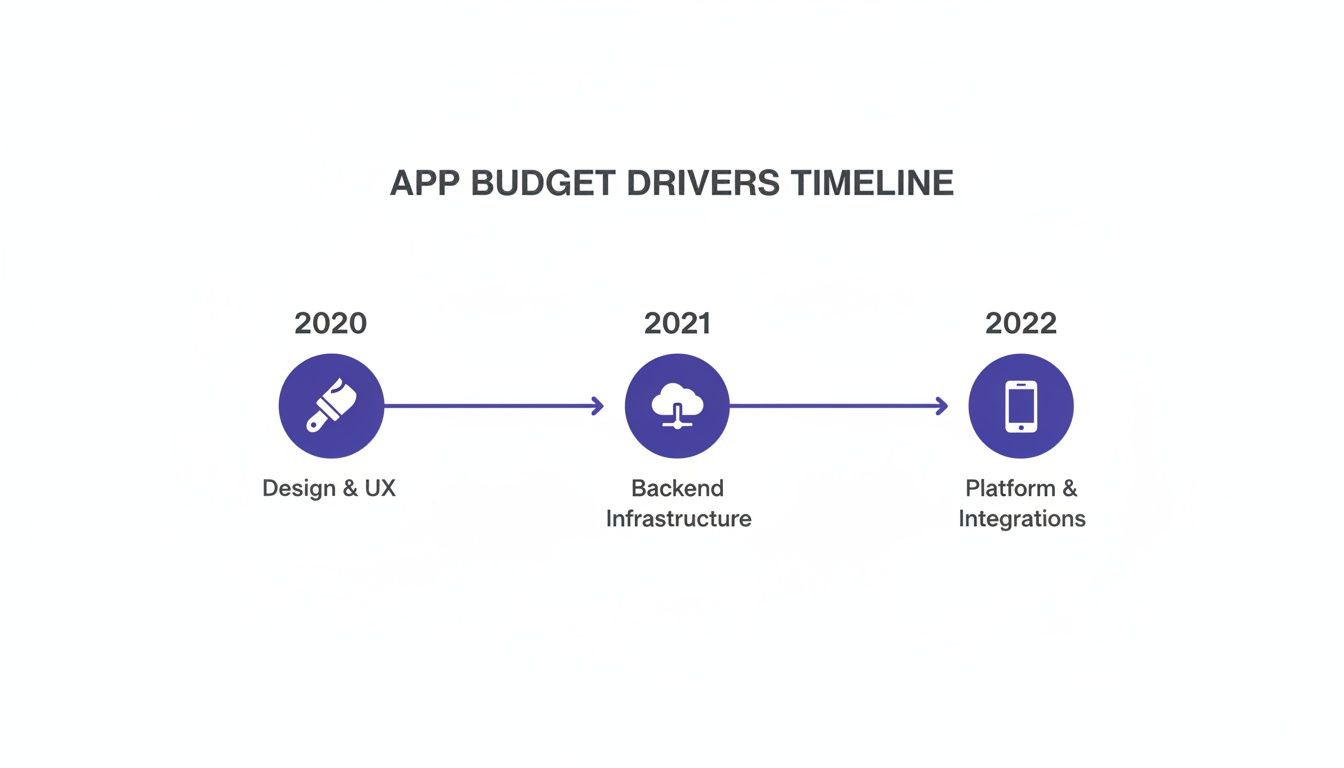
As you can see, while the actual coding takes up the biggest slice of the pie, a huge amount of work goes into design and backend architecture first. This is what makes sure the final product actually works and that people will love using it.
Phase 1: Discovery And Strategy
This is the blueprint phase, and honestly, it’s the most important one for keeping your budget under control. Before a single line of code gets written, we're talking deep-dive workshops, market research, competitor analysis, and nailing down your target audience and core features. It's all about making sure your business goals and the technical reality are perfectly aligned.
The aim here is simple: create a detailed project roadmap and a crystal-clear definition of the product. Investing properly at this point massively cuts the risk of expensive changes and U-turns halfway through the project. A solid strategy means everyone is building the right app from day one.
Phase 2: UI/UX Design
Once the strategy is locked in, we shift focus to how the app will look and feel. This is so much more than just picking colours and fonts; it's about crafting an intuitive and engaging journey for your users. This stage involves creating wireframes (the basic screen layouts), mockups (the visual designs), and interactive prototypes you can actually click through.
A brilliant user experience is what separates an app that people use every day from one they forget in a week. This stage ensures your app isn't just functional but is genuinely a delight to use – something that's absolutely essential for keeping users around and getting those glowing reviews.
Phase 3: Development And Coding
Right, this is the heavy lifting. It's the most intensive and costly phase, where our developers take all the designs and strategy documents and turn them into a real, working app. This part is split into two key areas:
- Frontend Development: This is everything the user sees and touches. As a Flutter agency, this is where we work our magic, building a single, high-performance codebase that runs like a dream on both iOS and Android.
- Backend Development: This is the engine under the bonnet. It involves building the server, database, and APIs that power all the app's features, like user accounts, storing data, and making everything tick.
The complexity of your features and any third-party integrations will be the biggest factor driving the time and cost here. You can see how all these stages fit together in our guide explaining the UK mobile app development process.
Phase 4: Testing And Quality Assurance
Before you even think about launching, your app needs to be put through its paces. We carry out rigorous testing to hunt down and squash bugs, fix performance issues, and iron out any usability quirks. This Quality Assurance (QA) process makes sure the app works flawlessly on different devices, screen sizes, and operating systems.
This phase is all about protecting your brand’s reputation. A buggy launch can kill an app before it's even started, leading to terrible reviews and a flood of uninstalls. QA is a non-negotiable part of the budget.
Phase 5: Deployment And Maintenance
The final hurdle is getting the app ready for launch and submitting it to the Apple App Store and Google Play Store. But the job isn't done when you hit 'publish'. Post-launch maintenance is an ongoing cost, typically around 15-20% of the initial development budget each year. This covers things like server hosting, fixing any new bugs that pop up, and releasing updates for new versions of iOS and Android.
It's also worth remembering that keeping project documentation up-to-date is a real, ongoing cost. You can learn more about the costly impact of documentation drift and why staying on top of it is crucial for managing your app's budget over the long term.
Real-World App Budget Examples For UK Businesses
Theory is one thing, but seeing how the numbers stack up in the real world is another. To make sense of the costs, let's break down a few common app projects you'd find here in the UK. This will give you a much clearer picture of how features, timelines, and budgets come together.
Across the UK market, app development costs can swing wildly, from as little as £10,000 to well over £250,000. A simple app with a focused feature set typically lands in the £20,000 to £40,000 range. For something more complex, like an e-commerce platform or a delivery service, you should be budgeting between £40,000 and £100,000. If you're a startup just looking to test an idea, a Minimum Viable Product (MVP) is a smart move, often costing between £15,000 and £40,000. You can dig deeper into UK app development pricing data to see how these figures break down.
Now, let's get practical with a few examples.
Example 1: The Local Service Booking App
Picture a local business—maybe a hairdresser, a personal trainer, or a dog groomer—that’s tired of managing appointments over the phone. They need a straightforward app that lets clients book slots, check out services, and get reminders.
- Key Features: User profiles and login, a calendar showing available times, a list of services, a simple booking system, and push notifications for appointment reminders.
- Technology Choice: Flutter is a no-brainer here. It allows for a cost-effective build that works beautifully on both iOS and Android from day one. The backend can be kept lean, focused purely on managing bookings and user info.
- Estimated Timeline: Around 8-12 weeks.
- Estimated Cost Range: £20,000 - £35,000. This budget gets them a polished, professional tool that solves a real business problem without any unnecessary bells and whistles.
Example 2: The SMB E-commerce App
Next up, think of a growing online retailer in the UK. Their mobile website is fine, but they want to build loyalty and offer a slicker shopping experience with a dedicated app. This means adding more sophisticated features to handle products and secure payments.
- Key Features: All the basics from the first example, plus a full product catalogue with search and filters, a shopping cart, secure payment gateway integration (like Stripe), order history, and wishlists.
- Technology Choice: Again, Flutter is perfect. It offers a single codebase that delivers a high-performance, native feel on every device—which is crucial for a smooth e-commerce experience.
- Estimated Timeline: Roughly 16-24 weeks.
- Estimated Cost Range: £45,000 - £75,000. The jump in price covers the complexity of payment integrations, tougher security measures, and the more powerful backend needed to manage products and orders.
By focusing on a core set of high-value features, businesses can create a powerful app without overspending. For instance, our work on the SleepRelax meditation app demonstrates how a polished user experience can be achieved within a focused project scope.
Example 3: The On-Demand Delivery Startup App
Finally, let's tackle a much more ambitious project: an on-demand delivery app for a startup trying to shake up the local market. This isn't just one app; it's a whole system with three parts: one for the customer, one for the delivery driver, and an admin panel for running the show.
- Key Features: Real-time GPS tracking, separate apps for customers and drivers (each with their own logic), an order management system, driver-customer chat, and a detailed admin dashboard for analytics and operational control.
- Technology Choice: The sheer complexity makes Flutter an even bigger win. It allows the team to efficiently build both the customer and driver apps from a single codebase, saving huge amounts of time and money.
- Estimated Timeline: 6-9 months.
- Estimated Cost Range: £80,000 - £150,000+. This budget is essential for building the complicated backend, multiple user apps, and the real-time features that are make-or-break for any on-demand service.
Cost Comparison of Different App Types in the UK
To help you visualise where your project might fit, here’s a table comparing the three examples we've just walked through. It provides a quick look at how features, timelines, and costs scale with complexity.
| App Type | Example Features | Estimated Timeline | Estimated Cost Range (GBP) |
|---|---|---|---|
| Simple Service App | User Login, Service List, Booking Calendar, Push Notifications | 8-12 Weeks | £20,000 - £35,000 |
| SMB E-commerce App | Product Catalogue, Shopping Cart, Secure Payments, Order History | 16-24 Weeks | £45,000 - £75,000 |
| On-Demand Delivery App | Real-Time GPS, Separate User/Driver Apps, Admin Panel, In-App Chat | 6-9 Months | £80,000 - £150,000+ |
As you can see, the scope of your app has the biggest impact on the final cost. By understanding these real-world scenarios, you can better align your expectations and budget for success.
How Flutter Reduces Your App Development Costs
Understanding what drives your budget is one thing, but making smart choices to keep those costs in check is what really matters. A massive part of any modern app development cost breakdown is the technology you choose to build with. This decision has a huge and direct impact on your final bill.
For UK businesses that want to reach everyone without spending a fortune, cross-platform development is the way to go. And when it comes to the different technologies available, Google's Flutter framework is a clear winner, not just for its efficiency but for its incredible performance.
The Power Of A Single Codebase
The single biggest way Flutter cuts down your development budget is by getting rid of the need to build two separate apps. The old way of doing things meant having two different development teams writing code in two separate languages—like Swift for iOS and Kotlin for Android—just to launch on both platforms.
That approach is slow, clunky, and basically doubles a huge chunk of your development costs. Flutter turns that whole idea on its head.
By using Flutter, we build your app from one single, unified codebase that works perfectly on both iOS and Android. This simple change can slash development time and costs by up to 40% compared to building natively, all without sacrificing quality.
What this means for you is a stunning, high-performance app on both major platforms, delivered for a fraction of the cost and in much less time. You stop paying for the same work to be done twice and start investing in a smarter, more efficient process from day one.
Unmatched Performance And Quality
Of course, saving money doesn't mean much if the app feels cheap or slow. This is where Flutter really stands out from the crowd. Unlike some older cross-platform tools that can feel laggy or disconnected, Flutter apps are known for being incredibly fast and smooth.
Recent tests consistently show Flutter at the top of the performance charts, delivering a silky-smooth, 60-frames-per-second user experience that feels just like a native application. It achieves this by talking directly to the device's hardware, avoiding the performance issues that can slow down other frameworks.
With Flutter, you get all the cost benefits of a single codebase with none of the usual performance compromises. If you want to see how this technology can work for you, exploring Flutter app development services for UK businesses is a great next step.
Other Smart Cost-Saving Strategies
Choosing the right tech is a massive step, but there are other practical ways to manage your app development budget. When you combine these tactics with Flutter's built-in efficiency, you create a powerful plan for a successful launch that doesn't break the bank.
- Launch a Minimum Viable Product (MVP): Don't try to build every feature you've ever dreamt of right away. An MVP focuses only on the core functions needed to solve your users' main problem. It lets you get to market quickly, collect real feedback, and prove your concept with a much smaller initial investment.
- Prioritise Must-Have Features: Before a single line of code is written, split your feature list into three simple categories: 'must-haves', 'should-haves', and 'nice-to-haves'. By concentrating only on the must-haves for version one, you avoid burning cash on features users might not even care about.
- Phase Your Development: You don't need to build everything at once. A phased approach lets you roll out new features over time. This makes your cash flow much more manageable by breaking the total cost into smaller chunks, and it allows you to adjust your plans based on what real users are doing in the app.
Pairing these smart strategies with the natural cost-effectiveness and top-tier performance of Flutter allows you to launch a powerful, market-ready app without needing an enterprise-level budget. It's simply a more strategic way to invest in your mobile future.
Your Top Questions About App Development Costs, Answered
To wrap things up, let's tackle some of the most common questions we hear from UK businesses. These are the practical, real-world concerns that pop up when you start planning your budget, and getting clear answers now will help you move forward with confidence.
How Much Does It Cost To Maintain An App In The UK?
This is a big one, and it’s often overlooked in the initial excitement of building something new. Think of your app like a car; you can't just buy it and expect it to run forever without any servicing.
As a solid rule of thumb, you should budget around 15-20% of your initial development cost for annual maintenance. So, if your app cost £50,000 to build, you’re looking at an ongoing investment of roughly £7,500 to £10,000 per year. This covers the essentials: server hosting, squashing bugs that pop up, monitoring performance, and, crucially, updating the app to stay compatible with new iOS and Android versions.
Skipping maintenance isn’t really an option if you’re serious about success. It’s the quickest way to get bad reviews, open yourself up to security risks, and eventually watch your app become obsolete. It’s a vital investment in your app’s long-term health.
Is It Cheaper To Hire A Freelancer Or An Agency In The UK?
On paper, a freelancer's hourly rate might look more appealing, but it’s a bit of a false economy. For most serious business projects, a UK-based development agency almost always provides better long-term value and less risk.
When you partner with an agency, you’re not just getting a coder. You get a whole, synchronised team—a project manager keeping everything on track, UI/UX designers crafting the user journey, multiple developers building the features, and QA testers making sure it all works perfectly. It’s a well-oiled machine.
Going the freelance route often means you become the project manager, trying to coordinate separate individuals who may have never worked together. This can easily lead to miscommunication, delays, and a disjointed final product. For anything beyond a very simple prototype, an agency's structured process and collective expertise will save you headaches and costly mistakes down the line, making it the more cost-effective choice in the end.
Why Are UK App Development Costs Higher Than In Other Regions?
It really comes down to the old saying: you get what you pay for. App development costs in the UK reflect the incredibly high calibre of talent here, along with our rigorous quality standards and the general cost of operating in a major global tech hub.
UK developers are seasoned professionals, often with deep expertise in complex fields like fintech and healthcare where things like GDPR compliance aren't just buzzwords—they're legally essential.
When you invest in a UK agency, you are paying for reliability, clear communication in your time zone, legal protections under UK law, and a deep, nuanced understanding of the local market and user expectations.
While offshoring can look tempting financially, the hidden costs can bite back hard. Time zone differences, language barriers, and cultural misunderstandings can stall progress, while lower code quality often leads to expensive and time-consuming rework. Suddenly, that initial saving doesn't look so attractive.
Does Adding AI Features Significantly Increase App Cost?
In a word, yes. Bringing Artificial Intelligence (AI) or Machine Learning (ML) into your app definitely ramps up the complexity and the budget. You’re no longer in the realm of standard app development; you need specialist developers with a very particular set of skills.
The cost jump depends entirely on how ambitious the feature is. For instance, building a simple product recommendation engine is a world away from creating a sophisticated chatbot that can understand and respond to users in real-time. The latter requires complex algorithms and huge amounts of data to 'train' the AI model.
The whole process involves collecting data, training and testing the models, and then integrating them smoothly into the app. It adds significant time and expertise to the project. But while the upfront cost is higher, the right AI feature can give you a massive competitive edge and deliver a fantastic return on investment through things like personalisation and automation.
Ready to get a precise cost breakdown for your app idea? The team at App Developer UK specialises in building high-performance Flutter apps that deliver exceptional value. Contact us today for a free consultation.