Your Guide to a Program Developer Course for App Success
Your Guide to a Program Developer Course for App Success
So, what exactly is a program developer course? Think of it less as a stuffy classroom lecture and more as a hands-on, structured training programme. The goal is to take someone from a complete beginner to a job-ready professional, armed with the practical skills to actually build software and mobile apps that work in the real world. It's not just about learning to write code; it's a comprehensive apprenticeship in digital craftsmanship.
Decoding the Modern Developer Workshop
For business owners in the UK, the best way to understand a program developer course is to picture it as a modern workshop for a master craftsman. The aim isn't just to teach someone how to follow instructions—in this case, tapping out lines of code. That's just one piece of the puzzle.
Instead, a high-quality course teaches the entire craft. Students get to grips with their materials (like programming languages such as Dart), the fundamental principles of solid construction (software architecture), and how to build something people genuinely want to use (user experience design). This holistic approach is what separates a basic coder from a true developer who can solve genuine business problems.
Beyond Code: The Craft of Building Apps
The real difference is in the outcome. A graduate doesn’t just walk away with a head full of theory; they leave with a portfolio of real projects that prove they can deliver. They understand the entire development lifecycle, from sketching out an initial idea to launching a finished product on the Google Play Store or Apple App Store. This is the foundation you need to understand when looking to hire the right talent or upskill your existing team.
A top-tier course is designed to create value-creators. These are people trained in specific, high-demand technologies. A course focused on Flutter, for example, is incredibly valuable in today's market.
Flutter is a game-changing framework that lets developers build beautiful, high-performance applications for mobile, web, and desktop—all from a single codebase. New benchmarks consistently show Flutter leading the pack in performance, making it a brilliant choice for businesses that want efficiency without cutting corners on quality.
This sharp focus ensures graduates aren't just ready for any job, but for the right job. They're equipped to build the fast, reliable, and visually stunning applications that today’s users expect. By understanding what a great program developer course provides, you're in a much better position to spot the candidates who have the skills to really drive your business forward.
What a Modern Developer Learns

To really see the value a course graduate brings to your business, you need to look under the bonnet of a modern program developer course. It’s not just a random collection of tech topics; it’s a carefully planned journey. It starts with the absolute basics and builds up to tackling complex, real-world problems, giving developers a toolkit that will directly boost your business.
The whole process starts with a solid programming foundation. This isn't about teaching someone to copy and paste code from the internet. It's about making sure they genuinely understand how software thinks and works.
The Foundation: Programming Fundamentals
Before a developer can build anything great, they have to learn the language of creation. For today’s high-performance apps, that language is Dart. Created by Google, Dart is optimised for building slick, fast apps that run on any platform, which makes it the ideal place to start.
This first stage is all about the core concepts that are true for any programming language:
- Variables and Data Types: This is the basic grammar—understanding how to store information, whether it’s a customer’s name or the price of an item in your shop.
- Control Flow: Learning how the code makes decisions using logic (if this, then that) and repeats certain actions when needed (loops).
- Object-Oriented Programming (OOP): This is a huge one. OOP is a way of thinking that helps developers build software that’s easy to scale and maintain. It lets them model real-world things in their code, breaking down massive systems into smaller, reusable bits.
Alongside the coding, students get to grips with Git, the undisputed industry standard for version control. Think of Git like a time machine for a software project. It lets teams work together without tripping over each other, tracks every single change, and makes it easy to rewind if something goes wrong. For any professional team, knowing Git is non-negotiable.
Building for Mobile with Flutter
Once they’ve nailed the fundamentals, the course dives into its main event: mobile app development using Flutter. This is where the real business advantage clicks into place. Flutter isn’t just another tool; it’s a framework that lets a developer build beautiful, high-performance apps for both iOS and Android from a single codebase.
Recent performance benchmarks have consistently placed Flutter at the top, delivering a smoother and more responsive user experience than alternatives. For a UK business, this means you are not compromising on quality when you choose efficiency.
That single-codebase approach is a complete game-changer. Instead of needing two separate teams—one for iOS and another for Android—a single Flutter developer can build, launch, and maintain the app for both. This can slash development time and costs, helping you get your product in front of customers faster and more affordably.
From Code to a Live Application
But a great developer course doesn't stop when the app looks pretty. The final modules focus on turning that app into a fully functioning product that’s connected, reliable, and ready for the real world.
This involves a few crucial steps:
- API Integration: Learning how to plug the app into other services. This could be anything from a payment system or a mapping service to your company’s own database, allowing the app to pull in and show live information.
- Robust Testing: Developers are taught how to hunt down and squash bugs before your users find them. This involves different types of testing, from checking tiny bits of code (unit testing) to making sure the whole app works together perfectly (integration testing).
- Deployment: The final hurdle is getting the app onto the Apple App Store and Google Play Store. This means preparing all the right assets, ticking all the boxes for each platform’s guidelines, and managing the release itself.
By covering this entire lifecycle, the course makes sure its graduates aren’t just coders. They are complete product builders, ready to deliver real value from day one.
How to Choose the Right Developer Course
Picking the right program developer course is a massive decision for any business, whether you're trying to upskill your existing team or figure out if a new hire has the right credentials. This choice is even more critical in the UK’s booming tech sector. We’re looking at around 715,000 businesses in software development by 2025 and a market valued at an eye-watering £490 billion—the pressure to find developers with genuinely useful, up-to-date skills has never been greater. Find out more about the growth of the UK software industry on ibisworld.com.
A good course isn't just an expense; it's a strategic investment in your company's future. It gives your team the firepower to build competitive, high-performance apps. To get it right, you need to look past the slick marketing and focus on what the course actually delivers.
Scrutinise the Syllabus for Future-Proof Skills
First things first, you need to get forensic with the course curriculum. A modern syllabus should be packed with technologies that give you a clear business advantage. When it comes to mobile development, that means a heavy emphasis on Flutter.
Look for a syllabus that puts these front and centre:
- A rock-solid foundation in Dart: This is the language that makes Flutter tick. Without a deep understanding here, developers simply can't build efficient, clean apps. It's non-negotiable.
- Comprehensive Flutter UI development: The course must go beyond the basics, teaching students how to build complex, responsive, and beautiful user interfaces from the ground up.
- Advanced state management techniques: This is what separates a simple app from a scalable one. Proper state management is crucial for handling complex data without the app becoming slow, buggy, and impossible to maintain.
- API integration and backend communication: Real-world apps need to talk to other services. Developers have to be skilled in connecting their apps to external data sources.
A syllabus that dedicates most of its time to Flutter is sending a clear signal. It shows a commitment to a technology that delivers incredible performance and cross-platform efficiency. If a course treats Flutter like an afterthought, walk away. It should be the headline act.
Assess Instructors for Real-World Experience
The person teaching the course is just as important as the content. Academic qualifications are fine, but they’re not the whole story. You need to know: has the instructor ever actually built and launched a successful app in a real business environment?
Look for teachers with verifiable industry experience. Have they worked for proper tech companies? Can they show you a portfolio of apps they've shipped? An instructor who has dealt with real deadlines, difficult client feedback, and messy deployment issues brings a level of wisdom you just can’t get from a textbook. That practical knowledge is what turns a student into a genuine problem-solver.
Prioritise Project-Based Learning and Portfolios
Knowing the theory is one thing, but being able to apply it is what really counts. The best way to judge a course is by how much it focuses on project-based learning. A top-tier programme will make students build several complete apps from scratch, finishing with a major capstone project that showcases all their skills.
When you're evaluating a course—or a candidate who's taken one—always ask to see their portfolio. A strong portfolio is proof of more than just coding ability. It demonstrates creativity, problem-solving instincts, and an understanding of what makes a great user experience. The quality and polish of those projects tell you everything you need to know about the quality of the course.
Understand the Value of Certifications and Cost
In the UK tech scene, a certification from a well-respected programme acts as a reliable stamp of approval. It confirms that a developer has gone through a structured curriculum and has been tested on their ability to build working applications. It's not a replacement for a great portfolio, but it's a strong signal of competence.
Finally, you need to stop thinking about cost and start thinking about investment. A cheap course that teaches outdated tech or only scratches the surface is a false economy. The right training builds a sharp, capable team that can tackle your business challenges head-on and deliver a massive return on investment. As you weigh your options, knowing how to compare online course platforms can guide you toward the best program developer course for your team's needs.
Look, finishing a program developer course is more than just getting a certificate. It’s about creating a skilled professional who can bring real, tangible value to your business. Graduates from top-tier programmes don't just know theory; they’re ready to deliver practical results that hit the bottom line.
Think about it this way: a graduate skilled in Flutter isn't just someone who writes code. They write clean, efficient, and easy-to-maintain Dart code—the very foundation of a high-performance app. They've been trained to hunt down tricky bugs, slot into agile teams, and grasp the entire journey of an app, from a rough idea on a whiteboard to a polished product in the app store.
Translating Skills Into Key Job Roles
This practical training prepares graduates to step confidently into several crucial roles that fuel business growth. Each position uses the skills learned in the course to build the kind of fast, reliable, and engaging apps that keep customers coming back and drive revenue.
Investing in this talent has never been more important. The UK app development scene is booming, expected to hit a market size of £28.3 billion by 2025. This massive growth means the demand for developers who can create brilliant mobile experiences is off the charts. You can read more about the UK app development industry's remarkable growth on marketingtechnews.net.
Here are the main roles a course graduate is ready to take on:
- Mobile App Developer: The most direct career path. Their day-to-day involves designing, building, and looking after mobile apps for both iOS and Android using their Flutter expertise.
- Cross-Platform Engineer: These developers specialise in the "build once, run everywhere" philosophy. They use Flutter to create one single codebase for an app that works flawlessly across different devices, which saves a huge amount of time and money.
- UI/UX Developer: With a solid grasp of Flutter's rich library of widgets, this developer focuses on crafting beautiful and intuitive user interfaces. They make sure the app isn't just functional but is genuinely a pleasure to use.
A graduate from a Flutter-focused programme is more than just a coder; they are a problem-solver trained to think about efficiency, performance, and user satisfaction. This mindset is crucial for creating products that users love and that achieve your business goals.
How These Roles Drive Business Success
Each of these roles directly helps your company solve specific business problems and succeed. The right developer doesn't just build software; they build solutions that make your operations smoother and your customer relationships stronger.
The table below breaks down exactly how these roles deliver value.
Developer Roles and Their Key Business Impact
| Developer Role | Core Responsibilities | Primary Business Value |
|---|---|---|
| Mobile App Developer | Designs, builds, and maintains high-quality mobile applications for iOS and Android using a framework like Flutter. | Gets your product to market faster on both major platforms simultaneously, giving you a crucial competitive edge and reducing initial development costs. |
| Cross-Platform Engineer | Creates and manages a single codebase that powers the application across multiple devices and operating systems. | Ensures a consistent user experience and brand identity on every device. This also makes updates and bug fixes quicker and more reliable, lowering long-term maintenance overheads. |
| UI/UX Developer | Focuses on the visual design and interactive elements of the app, ensuring it is intuitive, engaging, and easy to navigate. | Directly boosts user retention and conversion rates. A beautifully designed, easy-to-use app encourages repeat engagement and turns users into loyal customers. |
In short, these professionals are trained to build products that not only work well but also deliver a fantastic return on investment.
For instance, a Mobile App Developer who knows Flutter can launch your app on both the Apple App Store and Google Play at the same time. That speed is a massive advantage, letting you reach a wider audience much faster than competitors building separate native apps. The efficiency of Flutter often translates to lower development costs, too, freeing up budget for marketing or other vital areas.
A great Cross-Platform Engineer guarantees your brand feels the same no matter what device a customer is using. That consistency builds trust. And by managing just one codebase, they can roll out updates and fix bugs far more efficiently, which is a huge win for long-term maintenance costs.
Finally, a talented UI/UX Developer has a direct line to your user retention and conversion numbers. An app that’s a joy to use is one people will come back to again and again. Their work turns a simple tool into an experience, which is what really makes you stand out in a crowded market.
Of course, knowing what you need is only half the battle. Our comprehensive guide to hiring app developers in the UK can give you the insights needed to build out your team. By hiring or training developers with these modern skills, you’re not just filling a seat—you’re investing in the future growth of your business.
A Practical Flutter Developer Roadmap
So, how does someone actually go from a complete beginner to a hireable Flutter developer? It helps to have a clear roadmap. Think of it less as a dry checklist and more as a journey of building skills, where each new piece of knowledge slots neatly on top of the last.
For any business looking at training providers, a well-structured roadmap like this is a great way to gauge the quality of a program developer course.
This visual timeline gives you a bird's-eye view of how a comprehensive Flutter course typically unfolds over four distinct stages.
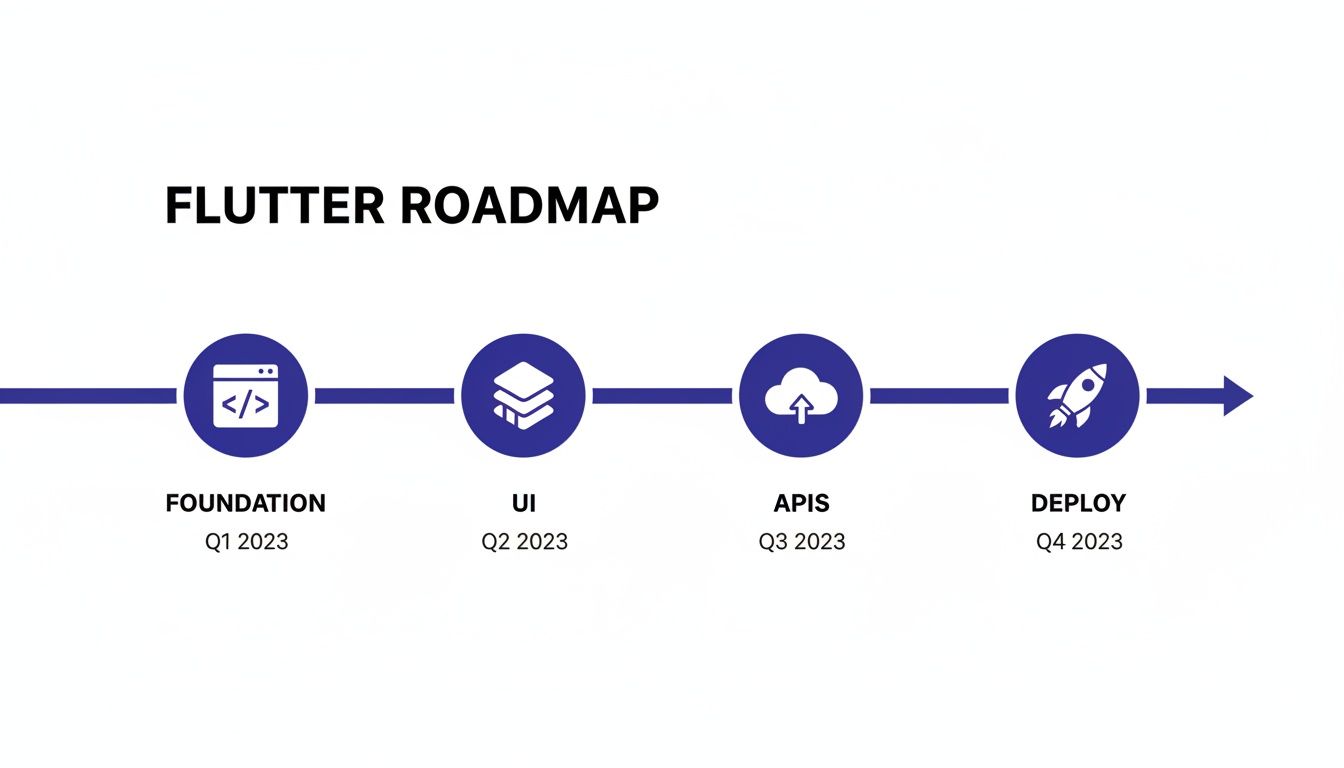
As you can see, it all starts with getting the coding foundations right before moving logically towards launching a real, functional app.
Weeks 1-4: Building a Foundation in Dart
Every great Flutter app is built on one thing: the Dart programming language. Before you can even think about crafting beautiful user interfaces, you have to get to grips with the logic that makes everything tick.
This first month is all about those core programming principles. Trainees will dig into variables, data types, control flow, and the essentials of object-oriented programming. This is where they learn to think like a developer—breaking down big, messy problems into small, logical steps.
Weeks 5-8: Crafting Interfaces with Flutter Widgets
Once the Dart foundation is solid, it's time to bring in Flutter. This is where the visual magic starts to happen. Learners get a deep dive into Flutter’s incredible widget system, learning how to piece together everything from simple buttons and text boxes to complex, multi-screen layouts.
A few key skills they'll pick up here include:
- Declarative UI: Getting their head around Flutter's modern approach to building interfaces that are not just beautiful but also seriously fast.
- Stateful vs. Stateless Widgets: Understanding the critical difference between static UI elements and dynamic ones that change based on user interaction.
- Layout and Navigation: Mastering how to build apps that look fantastic on any device and let users move around intuitively.
For businesses still weighing up their options, a good Flutter vs. React Native comparison often makes the decision clearer, showcasing why Flutter’s superior performance and efficiency make it the top choice for UK companies.
Weeks 9-12: Managing State and Integrating APIs
An app that looks great is one thing, but an app that can handle real data is where the real value lies. This more advanced phase tackles two of the most important parts of building a proper, dynamic application: state management and API integration.
Here, trainees learn solid techniques for managing all the data flowing through the app. This ensures the UI always shows the right information without becoming slow or buggy. They’ll also learn how to plug their app into external servers and online services, allowing them to pull in live data, handle user logins, and create truly interactive experiences.
Weeks 13-16: Testing, Deployment, and a Capstone Project
The final stretch is all about polish and professionalism. It's about transforming a development project into a product that’s ready for the real world. This means writing automated tests to squash bugs before they reach users and learning the ropes of getting an app published on the Apple App Store and Google Play Store. For a closer look at what that involves, our Flutter guide for iPhone app programming breaks it down.
The whole roadmap leads to one thing: a capstone project. This is where learners put everything together to build a complete, portfolio-ready application from scratch. It’s the final proof that they have the practical, hands-on skills to start delivering value from day one.
Got Questions About Developer Courses? We’ve Got Answers.
Jumping into the world of developer training can feel like wading through a swamp of technical jargon and contradictory advice. Whether you're a business owner wanting to forge a top-tier team or an aspiring developer trying to chart your course, you've probably got some very practical questions. This section is here to give you clear, straightforward answers to help you make the right call on investing in a program developer course.
We'll cut through the fluff and tackle the most common queries, showing why getting skilled up in modern tech like Flutter is a game-changer.
How Long Does a Typical Program Developer Course Take?
The time it takes to complete a developer course really depends on its pace and structure, which is a massive consideration for both businesses and individuals trying to plan ahead.
You've got the full-time, immersive programmes—often called bootcamps—which are designed for lightning-fast skill building. These typically last 12 to 16 weeks and are geared towards getting fresh talent job-ready in the shortest time possible.
Then there are the part-time options. These are brilliant for upskilling your current employees without pulling them away from their day jobs. These courses offer a lot more flexibility and usually run anywhere from 6 to 12 months. For businesses, the key thing isn't just the total duration; it's whether the course hammers home practical, project-based work that builds real-world competence quickly.
Is a University Degree Still a Must-Have for Developers?
Absolutely not. A traditional university degree is no longer the only ticket into the UK's tech scene. These days, everyone from nimble startups to major corporations cares more about proven skills and a solid portfolio of projects than they do about formal qualifications. A quality program developer course is built specifically to deliver those job-ready skills needed to create effective apps.
For anyone in charge of hiring, this is great news. It means the talent pool is bigger and more diverse than ever.
The real focus should be on a candidate’s ability to solve problems and show you their work in a portfolio. This is the whole point of a good developer course—it gives you a reliable benchmark of what that person can actually do for your business.
This modern mindset allows companies to find skilled people who can hit the ground running from day one, no matter their educational background.
Why Should We Bother Hiring a Flutter Developer?
Bringing a developer skilled in Flutter on board gives your business a serious competitive edge, and you'll see the impact directly on your bottom line and your launch schedule.
The biggest win is efficiency. Flutter lets you build beautiful, high-performance apps for both iOS and Android from a single codebase. This can slash development time and costs by almost half compared to the old way of building two separate native apps.
Second, the performance is incredible. Flutter apps compile directly to native code, which means users get a smooth, slick, and responsive experience that keeps them coming back. The latest benchmarks consistently put Flutter at the top for performance, so you're getting a superior experience without any trade-offs.
Finally, Flutter’s rich set of customisable UI tools lets you create unique, on-brand designs that make your app pop in a crowded market. For any UK business, that means getting to market faster, with lower development costs, and a better digital product that your users will actually enjoy using.
What’s the Best Way to Onboard a Junior Developer?
A solid, supportive onboarding plan is the difference between a promising new hire becoming a productive team member or a failed experiment. Just throwing a junior developer in at the deep end is a recipe for disaster.
Here are a few essential steps to get it right:
- Assign a Mentor: Pair your new starter with a senior developer. This person can guide them through your codebase, your workflows, and how you do things. That personal guidance is pure gold for getting them up to speed.
- Start with Small Wins: Give them small, clearly defined tasks to begin with. This helps them build confidence and get to know the project without feeling completely swamped.
- Encourage Teamwork: Use practices like pair programming, where two developers share a workstation. It’s a brilliant way to share knowledge, build team spirit, and help the new hire soak up skills from more experienced colleagues.
Graduates from a good program developer course will already know their way around agile methods and tools like Git, so they’re ready to slot into a collaborative team. A thoughtful onboarding process just makes sure you unlock their full potential that much faster.
Ready to build a high-performance mobile app that drives your business forward? At App Developer UK, our expert team specialises in creating stunning, natively compiled applications with Flutter. We build solutions that are not only beautiful but also fast, reliable, and tailored to your specific goals.