Your Guide to Product Owner Certification in the UK
Your Guide to Product Owner Certification in the UK
A product owner certification is a professional credential that shows you've mastered the art of maximising the value a development team delivers. It’s formal proof you know how to manage a product backlog, translate what stakeholders want into clear, actionable tasks, and steer a project toward its goals using an Agile framework like Scrum.
The Role of a Product Owner and Why Certification Matters
Picture this: you're building a complex, high-performance Flutter app. You’ve got a crew of brilliant developers ready to code, but they need a clear destination. Who decides which features get built first? Who makes sure the finished app actually solves real user problems and hits the business targets? That’s the job of the Product Owner.
Think of the Product Owner as the captain of the ship. They set the destination (the product vision) and navigate the constantly shifting seas of market demands and user feedback. The development team is the expert crew, trusting the captain to guide them to the right port—a successful product. The Product Owner is that vital connection between what the business needs and what the development team builds.
Bridging Vision and Execution
A Product Owner does more than just tick off a to-do list; they are the keeper of the "why" behind every single feature. Their key responsibilities include:
- Defining the Product Vision: Clearly explaining what the product needs to do for its users and for the business.
- Managing the Product Backlog: Creating, refining, and prioritising a master list of all features, fixes, and improvements. This backlog is the single source of truth for the development team.
- Prioritising Features: Deciding which tasks will deliver the biggest bang for the buck, ensuring the team's effort is always aimed at what matters most.
- Engaging Stakeholders: Constantly talking with customers, executives, and other departments to gather insights and keep everyone on the same page.
In the fast-moving world of app development, the Product Owner ensures every line of code adds real business value. They stop the team from wasting time and money by making sure they build the right product, not just build the product right.
Turning Expertise into a Credential
This is where a product owner certification proves its worth. It acts as official validation that someone has the skills to be an effective ship's captain. A certification gives everyone a shared language and framework, which cuts down on confusion, speeds up decisions, and gives project success rates a serious boost. It shows a real commitment to professional standards and a solid grasp of Agile principles.
At its core, understanding the Product Owner role is crucial for anyone thinking about certification, as it lays out the key duties and their impact. This role is very different from a Scrum Master, who acts more like a coach for the team. For a deeper dive into that, check out our guide on how to become a Certified Scrum Master in the UK.
The growing demand for this skill set has made product ownership a hugely important role in the UK tech scene. Getting that formal validation through a certification offers clear career benefits. Research shows that certified product owners often command higher salaries than their non-certified colleagues, making the investment in training a smart move.
Comparing the Top Product Owner Certifications
Trying to pick the right Product Owner certification can feel a bit like navigating a maze. There are a few highly respected credentials out there, but each one comes with its own philosophy and focus. It's crucial to figure out which one actually lines up with your career goals and, just as importantly, your team's way of working.
Let's cut through the noise and compare the four main certifications you'll come across in the UK.
This decision tree visualises the choice many professionals face when they're looking to level up their careers and are weighing up getting certified against gaining more on-the-job experience.
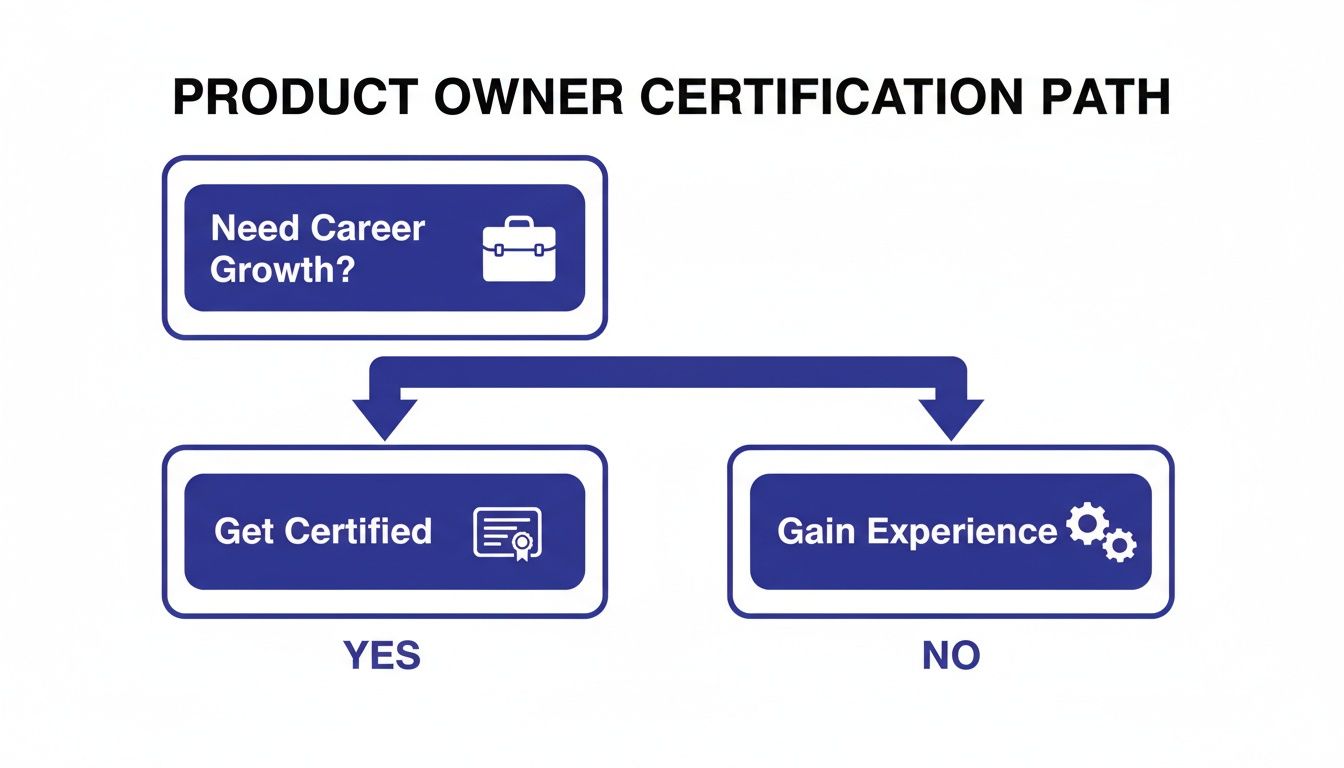
As you can see, for those who are really focused on career growth, certification is often the recommended route, while others might find it more valuable to get more hands-on experience under their belt first.
Professional Scrum Product Owner (PSPO)
The Professional Scrum Product Owner (PSPO), offered by Scrum.org, is all about proving what you know. Its whole philosophy is built on the idea that your understanding of the Scrum framework shouldn't just come from attending a course—it needs to be validated by a tough assessment.
There are no compulsory prerequisites to sit the PSPO I exam, which makes it a great option if you're a self-starter. The test drills down into your deep understanding of the Scrum Guide and your ability to apply its principles in the real world. This path is perfect for disciplined people who prefer self-study and want a credential that's respected for its difficult exam.
Certified Scrum Product Owner (CSPO)
On the other hand, the Certified Scrum Product Owner (CSPO) from Scrum Alliance champions immersive, collaborative learning. To get this one, you have to attend a two-day course taught by a Certified Scrum Trainer (CST). Here, the focus is much less on a final exam and more on the hands-on, interactive experience.
This approach is tailor-made for those who learn best in a classroom, thrive on direct interaction with an expert, and want to network with their peers. A CSPO certificate signals that you’ve been professionally trained in the fundamentals of the role, making it an excellent launching pad.
SAFe Product Owner/Product Manager (POPM)
But what happens when your organisation isn't using a simple Scrum framework? Many larger UK companies have adopted scaled agile methods. That's where the SAFe Product Owner/Product Manager (POPM) certification from Scaled Agile, Inc. comes in.
This credential is built specifically for Product Owners working inside the Scaled Agile Framework (SAFe). It teaches you how to manage backlogs, plan program increments, and collaborate across multiple teams in a massive enterprise setting. If your career path leads to complex, multi-team projects, the POPM is easily the most practical choice. You can learn more by checking out our guide on Scaled Agile Framework certification in the UK.
ICAgile Certified Professional in Product Ownership (ICP-PO)
The ICAgile Certified Professional in Product Ownership (ICP-PO) takes a much broader, mindset-first approach. It centres on the core principles of product ownership that can be applied across almost any agile framework, not just Scrum.
The ICP-PO is about digging into the "why" behind the role—focusing on value creation, customer-centric thinking, and overall strategy. Just like the CSPO, you earn it by completing an accredited training course. This certification is a fantastic choice if you want a versatile credential that prioritises foundational agile principles over loyalty to a single framework.
To help you see how these stack up against one another, we've put together a simple comparison table.
Comparison of Leading Product Owner Certifications
This table gives you a side-by-side look at the top four certifications, breaking down everything from their governing body and core focus to exam formats and typical costs. It should make it much easier to see which one fits you best.
| Certification | Governing Body | Core Focus | Exam Details | Typical UK Cost Range |
|---|---|---|---|---|
| PSPO I | Scrum.org | Validating knowledge through a rigorous exam | 80 questions in 60 mins; 85% passing score | £150 - £200 (Exam Only) |
| CSPO | Scrum Alliance | Immersive, trainer-led learning experience | No mandatory exam after the course | £800 - £1,200 (Course Included) |
| SAFe POPM | Scaled Agile, Inc. | Product Ownership in large enterprises | 45 questions in 90 mins; 73% passing score | £900 - £1,300 (Course Included) |
| ICP-PO | ICAgile | Framework-agnostic, mindset-focused skills | No exam; earned via course completion | £900 - £1,200 (Course Included) |
Ultimately, choosing the right certification isn't about which one is "best" overall, but which one is best for you. Base your decision on how you learn, where you want your career to go, and the kind of environment you work in—or want to work in.
The Career and Salary Benefits of Certification in the UK
Let's be honest: is a Product Owner certification really worth the time and money? In the UK market, the answer is a resounding yes. Think of it less as just another line on your CV and more as a strategic career move that has a real impact on your job prospects and what you can earn.
For hiring managers, a certification cuts through the noise. It’s a clear signal that you’re committed to the craft and that you understand the agile principles that make or break a project. It shows you speak the same language as the development team, which instantly reduces risk and makes you a much more attractive hire.

This isn't just about looking good on paper; it translates directly into better pay. When a company sees that you’re certified, they know you can hit the ground running. That assurance makes certified professionals a more valuable—and better-paid—asset from day one.
Unpacking UK Salary Benchmarks
The financial argument for getting certified really comes alive when you look at the actual numbers. The average salary for a Product Owner in the UK hovers around £60,505 a year.
But for those with a recognised certification like the CSPO, that average base salary jumps to about £62,000, with top earners hitting as high as £96,000 depending on their experience. It’s a clear financial upside, and the certification is often the key that unlocks it. You can dig into more detailed salary data over at careerfoundry.com.
Of course, where you work in the UK makes a big difference, too. The major tech hubs will always offer higher salaries to reflect the cost of living and the intense competition for talent.
A Product Owner certification acts as a career accelerator. It doesn't just open doors to new opportunities; it equips you to negotiate from a position of strength, armed with validated proof of your skills and knowledge in a high-demand field.
Regional Salary Variations
While London is undoubtedly the centre of the UK’s tech universe, other cities are quickly becoming major hubs for app development and digital innovation. This has created a strong demand for skilled Product Owners all over the country.
Here’s a quick breakdown of how salaries stack up across different regions:
- London: As you'd expect, London leads the pack with average salaries pushing £75,000—that’s a massive 24% higher than the national average.
- Manchester: This northern powerhouse has a booming tech scene, with experienced Product Owners typically earning between £55,000 and £65,000.
- Edinburgh: Scotland's capital has a fantastic and growing tech ecosystem, especially in fintech. Salaries here usually sit in the £50,000 to £60,000 range.
- Bristol: A key hub in the South West, Bristol’s creative and tech sectors support very competitive salaries, often on par with Manchester.
So, while London pays the most, there are plenty of high-paying opportunities for certified professionals right across the UK.
More Than Just a Pay Rise
The benefits of certification go way beyond your next paycheque. It paves a clear path into more senior, strategic roles like Senior Product Owner, Product Manager, or even Head of Product.
The core skills you formalise through a certification—mastering the backlog, negotiating with stakeholders, and relentlessly focusing on value—are precisely the skills needed to step up into those leadership positions.
For those looking to transition, a strong CV is essential. Using a solid Product Manager Resume Template can help you perfectly frame how your new certification and skills make you the ideal candidate. Ultimately, investing in yourself this way pays dividends for your entire career, not just your next job.
Your Practical 12-Week Product Owner Certification Roadmap
Thinking about getting your Product Owner certification can feel like a massive project in itself, but it really doesn't have to be. With a clear plan, you can break that big goal down into small, achievable steps. Here’s a practical 12-week roadmap to guide you from square one all the way to exam success in just three months.

Think of this plan as the product backlog for your certification. Each phase is like a sprint, designed to build your knowledge piece by piece so you walk into that exam feeling confident and ready.
Phase 1: Foundation and Framework (Weeks 1-2)
The first couple of weeks are all about building a solid foundation. Your first job is to pick the right certification for your career goals. Are you leaning towards the exam-heavy PSPO, or does the training-focused CSPO make more sense for you?
Once that’s decided, dive headfirst into the core principles of Scrum. Your new best friend is the Scrum Guide. Read it. Then read it again. It’s the single source of truth for the framework and non-negotiable for any aspiring Product Owner. Round this out with a few good books on agile product management to get a feel for the philosophy behind the rules.
Phase 2: Deep Dive and Formal Training (Weeks 3-6)
With the basics under your belt, the next month is for getting into the nitty-gritty of your chosen certification. This is where your path splits depending on which credential you’re aiming for.
- For CSPO Candidates: Now's the time to book and attend your mandatory two-day training course. This is an incredible learning opportunity, so make the most of it—ask loads of questions, get involved in discussions, and connect with your classmates.
- For PSPO Candidates: You'll be focusing on self-study, working your way through the official learning paths on Scrum.org. These resources are specifically designed to build on the Scrum Guide and get you ready for that tough assessment.
This is also a great time to check out some agile online courses in the UK. Many offer specialised modules that can add another layer to your learning and give you a different perspective.
The real aim of this phase is to go beyond just memorising terms. You need to start internalising the Product Owner mindset. It’s about understanding why the principles work, not just what they are.
Phase 3: Practical Application and Exam Prep (Weeks 7-10)
Time to move from theory to practice and get serious about exam prep. Reading about product ownership is one thing, but actually doing it is where the learning really sticks. Start looking for small ways to apply what you've learned, even if it's just in a hypothetical scenario.
Try creating a mock product backlog for a simple project, like a new feature for a mobile app. Write out the user stories, prioritise them by value, and think about how you’d justify your decisions to stakeholders.
This is also the perfect time to:
- Join a Study Group: Working with other people on the same path is brilliant for seeing different points of view and getting clarity on tricky topics.
- Smash Practice Exams: Do as many practice tests as you can find. This gets you comfortable with the question style and shines a light on any areas where your knowledge is a bit shaky.
- Review the Tough Stuff: Go back over the concepts you find most difficult, whether that’s value estimation, stakeholder management, or the finer points of Scrum events.
Phase 4: Final Revision and Exam Day (Weeks 11-12)
You’re in the home stretch! These last two weeks are for pulling everything together and getting your head in the game. Don't try to cram new information. Instead, focus on a light review of your notes and re-taking a few practice exams to keep your confidence high.
In the last few days, make sure you get plenty of rest and have your exam space set up without any distractions. Trust in the work you’ve put in over the last three months. You’ve got this. Walk into that exam with a clear head, ready to prove what you know and officially earn that Product Owner certification.
Bringing Product Ownership into Your Flutter App Team
Right, so you see the value a certified Product Owner can bring to the table. The next big question is: how do you actually get one on your team? For anyone building a Flutter app, this isn't just about filling a seat – it's a strategic call that directly shapes your project's success and ROI. You really have two main paths: bring in an expert from the outside, or grow one from within your own ranks.
Each route has its own trade-offs. Hiring a certified PO means you get proven expertise plugged straight into your workflow from day one. On the flip side, training up an existing team member keeps their deep, hard-won knowledge of your business right where you need it – something a new hire might take months to catch up on.
Hiring a Certified Product Owner
Hiring an external Product Owner is often the quickest way to inject battle-tested agile practices into your Flutter development cycle. These pros walk in the door with a full toolkit of techniques for managing stakeholders, prioritising backlogs, and translating business goals into crystal-clear user stories for the dev team. They're ready to go from the get-go.
And make no mistake, these skills are in high demand. Product ownership roles recently jumped to 118th among all job categories in the UK, up from 137th. They now make up 2.49% of all permanent jobs advertised, marking a huge 32% year-on-year surge. You can dig into more of the numbers over at the product ownership job market report on itjobswatch.co.uk. This fierce competition means you need a sharp, focused hiring process.
When you get to the interview stage, you have to go deeper than the usual questions. For a Flutter app project, where new benchmarks consistently place it at the top for performance, you need to probe for real, specific experience.
- Mobile-Specific Backlog Experience: "Tell me about a time you managed a backlog for a mobile app. How did you decide between a feature like push notifications and something like offline mode?"
- User Story Mapping for Apps: "Walk me through your process for creating a user story map for a new user's first experience in a Flutter app."
- Stakeholder Communication: "Imagine the marketing team needs a feature for a new campaign, but the lead dev is warning you about major technical debt. How do you handle that?"
Questions like these help you see past the certificate and find someone who truly gets the unique rhythm and challenges of mobile app development. Their answers will tell you everything you need to know about their ability to guide your Flutter team effectively.
Upskilling an Existing Team Member
The other path is to look inside your own walls. Training up a current team member – maybe a business analyst, a project manager, or even a senior dev with a knack for the business side of things – can be a game-changer. This person already gets your company culture, knows your market, and understands the technical realities of your Flutter codebase.
By investing in a product owner certification for an internal candidate, you’re merging existing domain expertise with a new, structured way of delivering value. You create a powerful hybrid who can make smarter, faster decisions for your product.
The process is pretty straightforward, but it needs real commitment. First, spot the people in your team who show a natural flair for the role. You're looking for great communicators, people the developers respect, and those who are always asking "why" we're building something.
Once you’ve found your candidate, the next step is picking the right certification to help them grow. Look back at the comparisons we covered earlier. If they'd benefit from a structured, hands-on course to build their confidence, the CSPO is a brilliant choice. If they’re more of a self-starter who can tackle a tough exam, the PSPO might be a better fit. By supporting them through the certification process, you ensure they develop the exact skills needed to squeeze every last drop of value out of your Flutter app.
Common Questions About Product Owner Certification
As you start looking into product ownership, it’s completely normal for a few questions to pop up. This final section tackles some of the most common queries we hear, giving you quick, clear answers to help you feel confident about your next steps.
Which Product Owner Certification Is Best for Beginners?
For anyone just starting out, the Certified Scrum Product Owner (CSPO) from Scrum Alliance is a fantastic choice. It includes a mandatory two-day course, creating a structured, instructor-led environment that’s perfect for learning the fundamentals of the Scrum framework from the ground up.
This guided approach is brilliant for building that initial foundational knowledge. While the Professional Scrum Product Owner (PSPO I) is another solid entry-level option, it leans heavily on disciplined self-study for a tough exam. The supportive, hands-on format of the CSPO just makes it a better fit for absolute beginners.
How Long Does It Take to Get a Product Owner Certification?
The time it takes really depends on which certification path you go down. For a CSPO, you’re certified the moment you complete the required two-day training course, which is typically 14-16 hours of instruction.
On the other hand, the PSPO I is all about self-study. Most people with some prior agile experience spend between two and six weeks preparing for the 60-minute exam. Our practical 12-week roadmap lays out a comprehensive plan that helps you balance study with your other commitments, making it a realistic timeline for most professionals.
A Product Owner certification is a powerful career investment in the UK's competitive tech scene. It not only validates your skills but also provides a common language and framework that boosts your effectiveness and opens doors to better opportunities.
Is a Product Owner Certification Worth It in the UK?
Yes, absolutely. In the UK’s fast-moving tech market, a product owner certification gives you a significant return on your investment. It’s a clear signal of your skills to employers, often leading to better salaries and more strategic job opportunities, especially in a high-performance setting like Flutter app development.
It also gives you a standardised framework and vocabulary used by agile teams all over the world, making you far more effective in complex projects. As more UK companies embrace agile ways of working, the demand for certified Product Owners is only going up, making it a smart career move that will pay dividends for years to come.
Can I Be a Product Owner Without a Certification?
Of course. You can definitely be a Product Owner without a certification, and plenty of successful professionals have built incredible careers on experience alone. That said, having a certification provides some clear advantages that are hard to ignore.
It gives you a structured, complete understanding of the role and the agile principles behind it, which can be tricky to piece together from on-the-job experience alone. For anyone moving into the role or looking for a new job, a certification acts as a powerful seal of approval that signals your expertise to recruiters. It can make all the difference in landing interviews and negotiating a better salary from a position of strength.
Ready to build a high-performance app with a team that truly understands product value? At App Developer UK, we specialise in creating stunning Flutter applications that deliver real business results. Our expert team is ready to bring your vision to life. Contact us today to get started.