Hire mobile developer: Your UK Guide to Finding Top Talent
Hire mobile developer: Your UK Guide to Finding Top Talent
Right, before you even think about posting a job ad for a mobile developer, you need a solid game plan. Jumping the gun and hiring without a clear vision is a classic, and expensive, mistake. You need to map out your app's core purpose, who it's for, what it absolutely must do, and the tech that will bring it all to life.
Get this blueprint right, and you’ll find a developer who’s a perfect fit. Get it wrong, and you could end up with a beautifully built app that nobody wants or needs.
Defining Your Project Before You Hire
Let's be honest, the hiring part is exciting, but it's not the first step. The real groundwork happens now. A well-defined plan isn't just a document; it's your project's North Star. It guides every decision and ensures that the developer you bring on board is building the right thing from day one.
Start by asking the most important question: What problem does my app actually solve? If you can’t answer that in a single, clear sentence, stop and figure it out. Once you have that, think about your ideal user. What are their frustrations? What do they need? This isn't just fluff—it directly shapes the features and feel of your app.
Pinpointing Core Features and Scope
With the "why" and "who" sorted, it's time for the "what." It’s incredibly tempting to cram every cool idea you've ever had into your app. Don't. This is called feature creep, and it’s a project killer. It bloats your app, confuses users, and drains your budget.
Instead, focus on the absolute essentials. What’s the minimum set of features needed to solve that core problem you identified?
This approach is known as building a Minimum Viable Product (MVP). An MVP has just enough functionality to be valuable to your first users, allowing you to gather real-world feedback to guide what you build next. It’s the smartest way to build something people actually want. If you need some inspiration, check out these brilliant minimum viable product examples to inspire you in 2025.
Choosing Your Technology Stack
The final piece of your pre-hiring puzzle is the tech. This choice will impact everything from your budget and timeline to long-term maintenance. You've got two main paths: go native (building separate apps for iOS with Swift and Android with Kotlin) or choose a cross-platform solution that lets you build for both from one codebase.
This decision tree can help you visualise the choice.
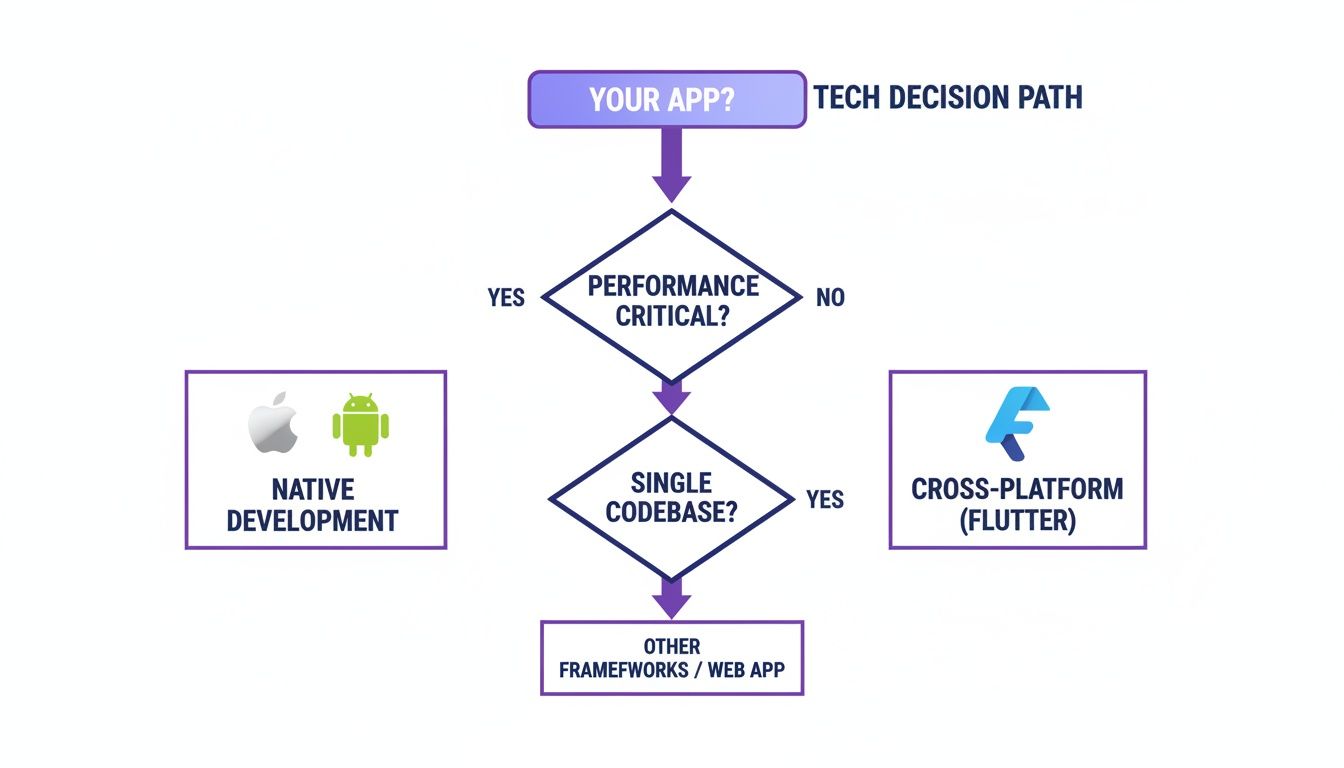
As you can see, if you're aiming for efficiency and want to reach both iOS and Android users without doubling your workload, a cross-platform framework is the way to go. While native development has its place, it means managing two separate teams, two codebases, and often, two budgets.
For most projects today, a modern cross-platform framework like Flutter is simply the smarter business decision. The performance is incredible—recent benchmarks consistently place Flutter at the top, delivering an experience that feels completely native. By building with Flutter, you get your app to market faster, and you significantly cut down on development and maintenance costs. You're not cutting corners; you're making a strategic choice for speed, efficiency, and quality.
How to Budget for a Mobile Developer in the UK
Before you even think about hiring a mobile developer, you need to get real about the numbers. A proper budget isn't just a salary figure plucked out of the air. It’s a full financial plan that covers everything from recruitment fees and benefits to the gear they'll need and the ongoing costs to keep them happy in a fiercely competitive UK market.
Getting this sorted from the start saves you from nasty financial shocks down the line and puts you in a strong position to make an offer someone great will actually accept.
The first thing to realise is that developer costs vary wildly. A few key factors will heavily sway the final figure, and understanding them is crucial for forecasting accurately.
Key Factors Influencing Developer Costs
Three main things will shape your budget: the developer's experience, where they're based, and the specific tech stack you need. Each one plays a huge part in what you'll end up paying.
- Experience Level: This is the big one. A junior developer will need a lot of hand-holding. A mid-level developer can get on with things independently. A senior developer, on the other hand, is the one making architectural calls and mentoring the rest of the team. Their pay packets reflect that difference in value and autonomy.
- Geographic Location: The UK has a few major tech hubs, but London is still king when it comes to salaries. The higher cost of living and the sheer competition for talent keep prices high. You might find slightly lower salary expectations in places like Manchester, Bristol, or Edinburgh, but the gap is definitely closing as remote work becomes the norm.
- Technology Specialisation: If you need someone with niche or in-demand skills, expect to pay a premium. Developers with solid experience in modern, efficient frameworks like Flutter are hot property right now. Why? Because they can build for both iOS and Android from a single codebase, which is a massive win for businesses. That demand naturally pushes up their market rate.
Building a Realistic Salary Budget
So, what should you actually expect to pay? When UK companies look to hire a mobile developer, the numbers can be all over the place.
On average, the base salary for a Mobile Applications Developer in the UK is around £42,500. But that's just an average – the real range spans from £24,000 for a junior right up to £85,000 or more for a seasoned pro.
Entry-level roles tend to start around the £24,204 mark, with early-career developers quickly jumping into the low £30,000s. That initial growth curve is steep.
Just remember, the salary is only one piece of the puzzle. For a permanent, in-house hire, you've got to add National Insurance contributions, a pension scheme, and potentially hefty recruitment agency fees – often 15-20% of the first year's salary. And don't forget overheads like a decent laptop and software licences.
Beyond Salary: The Total Cost of an App
The developer's pay is a massive chunk of the budget, but it's not the whole story. The cost of hiring a developer and the total cost to build, launch, and maintain an app are two very different things.
To get a complete picture of what your project might cost from the initial idea all the way to launch day and beyond, have a look at our UK app pricing guide. It breaks down the full spectrum of expenses you should be planning for. This makes sure your budget isn't just about hiring a person, but about setting the entire product up for success.
Where to Find and Attract Top Mobile Talent

Knowing you need to hire a mobile developer is the easy part. The real challenge? Finding them in a market that's more crowded and competitive than ever. Relying on just one or two job boards won’t cut it anymore, especially since the best talent often isn't even looking for a new role.
To really get noticed, you need to think like a marketer and cast a wide net across all the places where developers actually spend their time. That means looking beyond the obvious professional networks and into niche tech communities. This multi-channel approach is your best bet for making a connection with the right person.
Creating a Standout Job Description
Your job description is your first, and maybe only, chance to make an impression. Don't just list a dry set of technical skills. Instead, sell the role by telling a story. What exciting problem are you trying to solve? What kind of impact will this app have? You need to get candidates genuinely excited about your mission.
Be sure to highlight the details that developers actually care about:
- The Tech Stack: Be upfront about the tools you use. Mentioning a modern, high-performance framework like Flutter signals that you’re serious about quality. Good developers want to work with good tech.
- Company Culture: What's it really like to work on your team? Talk about your values, your stance on work-life balance, and any unique perks that set you apart.
- Growth Opportunities: Spell out how this role will challenge them and what they'll have the chance to learn. The most ambitious developers are always looking for more than just a payslip.
You’re not just trying to fill a vacancy; you're inviting someone to join you on a journey. Your job description needs to capture the energy and potential of your project if you want to attract people who are ready to invest themselves in its success.
Sourcing Channels Beyond the Obvious
LinkedIn is a great starting point, but don't let your search end there. Platforms like Stack Overflow Jobs are absolute goldmines for finding developers who are deeply engaged in their craft. GitHub is another fantastic resource, as it lets you see a developer's actual work and contributions to open-source projects.
If you're open to looking further afield, going global can massively expand your options. Dipping into a comprehensive guide to offshore mobile development can give you the lay of the land and open up a much larger talent pool.
Attracting Passive Candidates
Here’s the thing: the most skilled and experienced developers are often happily employed and not actively scrolling through job boards. To get their attention, you need a different strategy. It’s important to realise just how competitive the UK developer market is. Surveys consistently show that around 75% of UK developers are in formal employment, a figure that’s quite high compared to other countries.
This means you’re not just hiring; you're competing. A great salary helps, but it’s often not the deciding factor. To tempt a top-tier developer to make a move, you need to offer something more compelling. Flexible remote or hybrid work options, genuinely challenging projects, and clear pathways for career growth are the kinds of things that can make all the difference.
How to Interview and Vet Flutter Developers
So, you've got a pile of promising CVs. Now for the hard part: figuring out who really knows their stuff. To successfully hire a mobile developer with genuine Flutter expertise, you need to go way beyond a generic tech quiz. A proper vetting process digs into their real-world skills, their problem-solving mindset, and how they’ll fit into your project.
Start with their portfolio and CV, but look with a critical eye. Flashy screenshots don’t mean much. Are their apps actually live on the App Store or Google Play? Shipping a real app proves they can handle the entire lifecycle, not just build a prototype. Pay special attention to their Flutter-specific projects—how complex are they? Do they feel polished?
Beyond the CV Screening
A CV only gives you a glimpse. You need a process that efficiently filters candidates before you sink hours into full interviews. A multi-stage approach is your best friend here.
- The Quick Sanity Check (15-20 mins): This is a brief initial call to make sure their experience actually lines up with what you need. Ask about their most relevant Flutter project, what they did on it, and why they’re interested. It’s a simple way to weed out anyone who is obviously not a fit.
- A Proper Portfolio Deep-Dive: Look for signs they truly understand the Flutter framework. Do their apps show they know how to handle state management with something like Provider, BLoC, or Riverpod? Do the UIs feel snappy and natural on both iOS and Android? A great Flutter dev builds an app that doesn't feel like a cross-platform compromise.
- The Code Quality Check: If they’ve got public repos on GitHub, it’s a goldmine. Take a look. Clean, well-commented Dart code and a logical project structure are massive green flags. This is your chance for a direct insight into their professional standards without even having to ask.
The Technical Interview and Assessment
This is where you separate the wheat from the chaff. The aim isn't to stump them with obscure trivia; it's to see how they think. A practical, hands-on test tells you far more than any theoretical exam.
Give them a small, clearly defined coding challenge that mirrors the kind of work they’ll actually be doing for you. For example, ask them to build a simple screen that pulls data from a public API and displays it in a list. Set a clear deadline—a few hours or a day is perfectly reasonable.
When you get their submission back, you’re looking for a few key things:
- Code Quality: Is the Dart code clean, easy to read, and efficient?
- Architectural Choices: How did they structure everything? Did they use a clear state management approach?
- Problem-Solving: Did they think about edge cases, like what happens if the network request fails?
- Testing: Did they bother to include any unit or widget tests? Knowing how to test is non-negotiable for serious projects. For a deeper look at this, check out our developer's guide to the basics of testing in Flutter.
The best candidates won't just tick the boxes. They'll make thoughtful decisions and be able to explain why they made them. How they articulate their reasoning is often more revealing than the code itself.
Key Interview Questions for Flutter Developers
Once you're confident in their technical skills, you need to dig into their experience and problem-solving approach. A good conversation will tell you more than a simple coding test ever could. Here are some questions I've found to be incredibly revealing.
| Question Category | Example Question | What to Look For in the Answer |
|---|---|---|
| State Management | "Describe a complex state management challenge you've faced in a Flutter app. Which solution did you choose and why?" | Do they mention specific libraries (BLoC, Riverpod, Provider)? Can they explain the trade-offs and justify their choice for that particular scenario? |
| Performance | "How would you diagnose and fix a Flutter app that has janky animations or a slow frame rate?" | Look for mentions of Flutter DevTools, profiling, understanding build methods, and strategies like using const constructors or breaking down large widgets. |
| Architecture | "What's your preferred architectural pattern for a new Flutter project (e.g., MVVM, Clean Architecture) and why?" | A good answer shows they think about scalability, testability, and separation of concerns. They should have a reasoned opinion, not just name-drop a pattern. |
| Platform Integration | "Can you give an example of when you had to write platform-specific code using platform channels or Pigeon?" | This reveals if they have experience with native integration. Look for a clear explanation of the problem and the solution they implemented for iOS and/or Android. |
| Problem Solving | "Tell me about a time a package or dependency caused a major issue in your project. How did you resolve it?" | This assesses their debugging skills, resourcefulness (checking GitHub issues, documentation), and ability to handle unexpected problems. |
These questions aren't about getting a "correct" answer. They're about starting a conversation to understand how a developer thinks, solves problems, and learns from their experiences.
The Culture-Fit Interview and Red Flags
Technical chops are only half of it. The final stage is all about making sure this person will be a productive and positive member of your team. Ask behavioural questions to get a feel for their communication style, how they handle feedback, and whether they’re a team player.
Keep your eyes open for red flags throughout the entire process. Vague answers about what they specifically contributed to past projects are a huge one. If they start blaming former colleagues or employers for failures, that suggests a lack of accountability. An inability to clearly explain their technical decisions is another major warning sign.
Ultimately, the right hire is someone who is not only skilled but who you'll genuinely want to work with every day.
Making an Offer and Onboarding Your New Hire
You’ve done the hard work. After a meticulous search and some tough interviews, you've found the perfect developer. But don’t celebrate just yet. The final steps—making a compelling offer and delivering a smooth onboarding—are just as critical as the interviews themselves. If you drag your feet or fumble the process now, you risk losing your top choice to a competitor who moves faster.
The first move is to put together an offer that meets the realities of today's market. Trying to hire a mobile developer in the UK right now means you’re competing for highly sought-after skills. You need a package that’s not just financially attractive but also speaks to their career goals and desire for a good work-life balance.
Crafting a Competitive Offer
A great offer is more than just a salary figure; it's a complete package. While money is always a key factor, experienced developers are looking at the bigger picture.
Here’s what you should be thinking about:
- Financials: Lay out the base salary, any bonus structures you have in place, and your pension contributions.
- Benefits: Be specific about healthcare, holiday allowance, and any other perks that make your company a great place to work.
- Flexibility: Clearly state your policy on remote or hybrid working. For many developers, this is a non-negotiable.
- Growth: What opportunities are there for professional development? Mention training budgets, conference attendance, or career progression paths.
The UK hiring market has seen some serious wage growth lately, especially for specialised tech skills. Reports are showing developer pay hitting record levels, particularly for roles touching on AI or requiring advanced Flutter expertise. In fact, mobile developer compensation has jumped by 24–27% year-on-year in recent periods. It’s essential your offer reflects this. To get a feel for the landscape, check out the latest trends in UK developer pay driven by AI skills.
My advice? Pick up the phone and extend the offer verbally first. It’s a great way to gauge their initial reaction, add a personal touch, and clear up any immediate questions before the formal contract goes out.
The Onboarding Checklist
Once they’ve said yes, a structured onboarding process is your best friend. It’s the difference between a new hire hitting the ground running and one who feels lost and demotivated. A chaotic first week is a massive waste of everyone's time. The goal is simple: make them feel welcome, equipped, and productive from day one.
Here’s a practical checklist I’ve used time and again:
- Get the Paperwork Done Early: Have the employment contract, NDAs, and any other forms ready to be signed well before their first day.
- Set Up Their Toolkit: There's nothing worse than starting a new job and not being able to do anything. Make sure their laptop is configured, software is installed, and they have access to all the essentials: your project management tool (Jira, for example), communication channels like Slack, and source code repos like GitHub or Bitbucket.
- Plan Their First Week: Don't leave it to chance. A simple schedule with introductions to key team members, a walkthrough of the project architecture, and an overview of your coding standards goes a long way.
- Assign a Buddy: Pair them up with an experienced member of the team. This gives them a go-to person for all those small questions they might be hesitant to ask in a group setting.
- Give Them an Early Win: Start them off with a small, manageable first task. Fixing a minor bug or adding a small feature helps them get familiar with the codebase and your workflow. More importantly, it gives them a confidence boost right out of the gate.
Common Questions About Hiring Mobile Developers
Even with a solid plan, a few questions always pop up when you’re looking to hire a mobile developer. Getting clear, straightforward answers can make the difference between a smooth hiring process and a stressful one. Here are some of the most common queries we see from businesses in the UK.
How Long Does It Typically Take to Hire a Mobile Developer in the UK?
This is a classic "it depends" question, but I can give you some realistic timeframes. The timeline can vary quite a bit depending on what you need and who you're looking for.
If you're after a freelancer or contractor for a specific project, you could find someone and get them started within one to three weeks. The process is generally quicker because the scope is well-defined and the commitment is shorter.
For a permanent, in-house position, the process is naturally longer. You should budget for around four to eight weeks from posting the job description to the candidate signing on the dotted line. This window gives you enough time for proper sourcing, a few interview stages, a technical assessment, and the final negotiations without rushing things.
The market for experienced Flutter developers is incredibly competitive right now. A slow, drawn-out hiring process is one of the fastest ways to lose your top candidate to another company that moves more decisively.
What Is the Key Difference Between Junior, Mid-Level, and Senior Developers?
Understanding the experience levels is crucial for matching the right person to your project's complexity. It’s not just about years in the industry; it’s really about capability and autonomy.
Here’s how I break it down:
- Junior Developer (0-2 years): Needs regular supervision and works best on clearly defined, smaller tasks. They are still learning the ropes and are brilliant for supporting a larger team and handling specific feature components.
- Mid-Level Developer (2-5 years): This is where independence kicks in. They can tackle features from start to finish, understand the entire development lifecycle, and can contribute meaningfully to architectural discussions.
- Senior Developer (5+ years): A senior developer brings deep technical knowledge and takes ownership of the app's architecture. They don’t just write code; they mentor other developers, anticipate technical challenges, and align the project's technical direction with your business goals.
Should I Prioritise a Developer with Strong UI/UX Skills?
For almost any mobile app, the answer is a resounding yes. A developer who has a good eye for user interface (UI) design and a solid grasp of user experience (UX) principles is an enormous asset.
Think of it this way: even if you have a dedicated designer, a developer who can implement those designs pixel-perfectly and offer practical feedback on usability will elevate the final product. They can spot potential interaction issues that look fine on a static design but feel clunky in a real app.
For any app that will be used directly by customers, this is non-negotiable. When you review their portfolio, don't just look for apps that work—look for apps that are intuitive, polished, and genuinely enjoyable to use. That's the mark of a developer who cares about the end user.
At App Developer UK, we specialise in building high-performance, beautiful mobile applications with Flutter. If you're ready to hire a team that understands both the technical and business sides of app development, let's talk. Find out how our expert UK-based team can bring your vision to life.