Online Agile Training for Modern App Development Teams
Online Agile Training for Modern App Development Teams
In the fast-paced world of app development, online agile training is the strategic investment that equips teams with the mindset to adapt, iterate, and deliver exceptional products. It's not just about learning a new process; it's about building a culture of flexibility and continuous improvement that allows businesses to thrive amidst constant market changes.
Why Online Agile Training is a Strategic Necessity

In today's competitive environment, especially for UK businesses, speed and precision are everything. Think of a high-performance app development team like a Formula 1 pit crew. Every member has a distinct role, but they must work in perfect, synchronised harmony to achieve victory. A single misstep or delay can cost them the race.
Online agile training provides the framework for this level of remote synchronisation. It moves teams beyond rigid, outdated project management and instils a flexible mindset that's essential for navigating unpredictable market demands. For teams building with powerful frameworks like Flutter, which excel at rapid iteration, this agile approach is not just beneficial—it's fundamental.
The Shift from In-Person to Digital Learning
The way UK businesses approach professional development has fundamentally changed. The data clearly shows a massive migration towards digital-first learning, driven by the need for flexibility and accessibility.
This trend isn't just a temporary adjustment; it's a permanent fixture in professional upskilling. In the UK, the adoption of online agile training has been particularly dramatic. Before the pandemic, 90% of learners attended agile courses in person. By 2022, this figure had plummeted to just 20%. This mirrors global trends where 84% of ICAgile certifications were delivered virtually.
The numbers speak for themselves: between FY21 and FY23, digital agile lessons in the UK surged by 300%, while job postings for agile roles rocketed by an astonishing 698% in two years.
Agile as a Growth Engine for Flutter Development
For a UK-based Flutter agency, this training is a core investment in competitiveness and growth. Flutter's architecture is built for speed, enabling developers to build, test, and deploy high-performance apps for both iOS and Android from a single codebase. Agile methodologies amplify these strengths.
An agile mindset empowers teams to respond to feedback instantly, adjust priorities without losing momentum, and ultimately deliver a superior product that truly meets user needs. It transforms development from a linear process into a dynamic, responsive cycle.
This alignment means projects are completed faster, budgets are managed more effectively, and the final app is more robust. By embracing online agile training, development teams can ensure they aren't just building apps, but building them better, faster, and more aligned with client expectations. To grasp the profound changes occurring, exploring discussions such as the business imperative of AI in learning and training as a strategic investment can offer valuable insights into the larger picture.
Why Agile Supercharges Flutter App Development
Flutter is rightly praised for its incredible speed and cross-platform muscle, but its true potential is only really unlocked when you pair it with an agile mindset. Agile isn't just a stuffy set of project management rules; it's a whole philosophy of working that perfectly complements Flutter's core strengths. It’s what turns a good development process into a great one.
Think about building an app the old-fashioned way: months of rigid planning, a long, heads-down coding phase, and then a "big bang" launch. The problem? If the client's vision or market needs have changed in that time, you're looking at expensive, painful rework. Agile completely flips this script by embracing change.
Instead of one giant, risky leap, agile takes lots of small, confident steps. This approach is a perfect dance partner for Flutter's famous hot reload feature, which lets developers see UI changes almost instantly. An agile team can build a feature, get feedback right away, and tweak things on the fly. Development stops being a monologue and becomes a dynamic, collaborative conversation.
The Power of Iteration and Feedback Loops
Agile frameworks like Scrum and Kanban are what give this process structure, letting you harness Flutter's speed without descending into chaos. They work by breaking down massive, complex projects into small, manageable tasks that are tackled in short bursts called sprints.
This cycle of building and reviewing creates constant feedback loops. At the end of each sprint, the team delivers a small but genuinely working piece of the app. This means stakeholders can see and interact with the application early and often, making sure the final product is exactly what they need, not just what was written down in a spec six months ago.
Agile practices de-risk development by making course corrections cheap and frequent. Instead of discovering a major flaw months down the line, teams can identify and fix issues within a single sprint, saving time, money, and frustration.
This is a game-changer, especially for UK startups and SMEs where every pound and every week counts. It ensures your resources are laser-focused on building features that solve real user problems and deliver genuine value.
Amplifying Flutter's Native Strengths
The synergy between agile and Flutter runs deep. It's not just about moving faster; it’s about working smarter and directly tackling the biggest headaches in app development.
- Rapid Prototyping: Agile’s focus on shipping working software quickly, combined with Flutter's UI toolkit, means you can create high-fidelity prototypes in record time. Clients get to touch and feel their app early on, providing priceless feedback that shapes a better final product.
- Reduced Project Risk: By building and testing in short cycles, teams catch technical hurdles or clunky user experiences before they snowball into major disasters. This kind of proactive problem-solving keeps unexpected delays and budget blowouts at bay.
- Enhanced Product Quality: Things like continuous integration and regular testing are baked into the agile way of working. This focus on quality at every step leads to a more stable, reliable, and polished application.
- Improved Stakeholder Collaboration: Agile is all about transparency and communication. Clients are no longer just spectators; they become active partners in the journey. This leads to much higher satisfaction and a final product that truly nails their business goals.
For any UK-based Flutter developer, getting to grips with agile through online agile training is the key to delivering truly exceptional apps. It gives you the framework to channel Flutter’s incredible technical power into a process that consistently delivers value, on time and on budget. That’s how you get a real competitive edge.
Choosing the Right Online Agile Training Format
Picking the right format for your team's online agile training is the first big step, and it’s a crucial one. There’s no single best answer here; the ideal choice really comes down to your team’s specific needs, how they learn best, and the pace of your current projects. Get this right, and you’ll see your investment turn into real-world skills, not just a framed certificate.
For a busy UK-based Flutter agency, it's always a balancing act between client work and professional development. The right training respects your team's schedule while still delivering the deep, practical knowledge they need to crush it. Let’s walk through the most common formats to figure out which path makes the most sense for your goals.
Self-Paced On-Demand Courses
Self-paced training is all about flexibility. It lets developers learn whenever and wherever works for them. This format is a brilliant fit for disciplined, self-motivated people or for teams whose schedules are so unpredictable that locking in a fixed training time is next to impossible.
Learners can work through the material at their own pace, re-watching tricky sections as many times as they need. That kind of autonomy is a huge plus, especially for a developer who needs to get up to speed on a specific part of agile that’s directly relevant to a project they’re working on right now.
Virtual Instructor-Led Training (VILT)
If your team learns best by bouncing ideas off each other and asking questions, then Virtual Instructor-Led Training (VILT) is probably the way to go. VILT sessions are live, online classes run by an experienced agile coach. It’s the closest you can get to a traditional classroom vibe, creating a much more dynamic learning environment.
This format means real-time Q&A, hands-on exercises in breakout rooms, and direct feedback from the instructor. For a Flutter team, this is golden. They can ask pointed questions about applying agile principles to their unique cross-platform workflows, making sure the concepts click in a way that’s immediately useful.
The real power of VILT lies in shared learning. When your entire team learns together, they build a common language and understanding of agile principles, which is essential for consistent implementation across projects.
This flowchart can help you visualise which agile method might be a good starting point for your team, depending on where you're at.
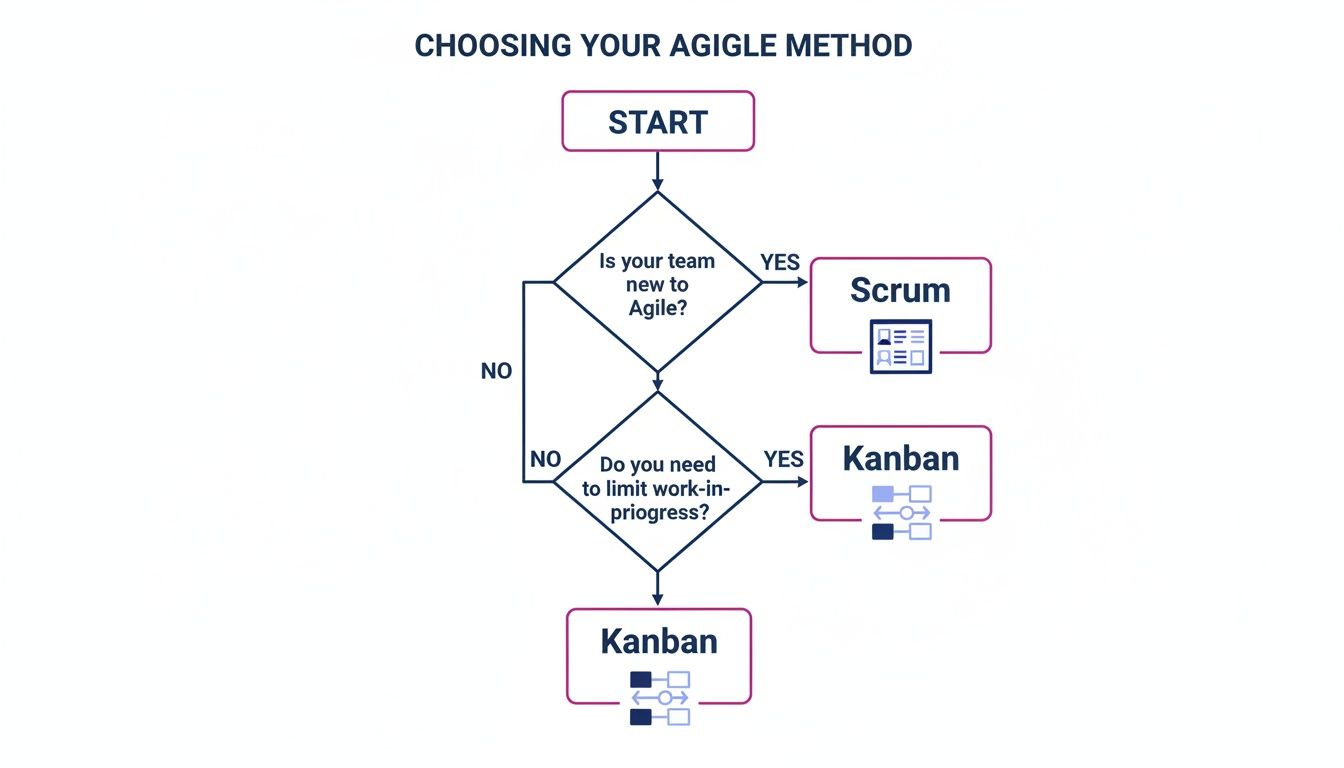
As you can see, teams that are new to agile often benefit from the structure of Scrum, while more seasoned teams might lean towards Kanban to really fine-tune their workflow and manage how much work is on the go at once.
To help you weigh your options, here’s a quick rundown of the different formats.
Comparing Online Agile Training Formats
| Training Format | Best For | Key Advantage | Potential Drawback |
|---|---|---|---|
| Self-Paced | Disciplined individuals & teams with chaotic schedules | Ultimate flexibility to learn anytime, anywhere | Requires high self-motivation; no live instructor interaction |
| Virtual (VILT) | Teams that thrive on collaboration and structure | Real-time feedback and shared learning experience | Less flexible; requires committing to scheduled sessions |
| Blended Learning | Teams wanting both flexibility and interaction | The "best of both worlds" approach | Can be more complex to coordinate and manage |
| Bootcamps | New teams or those needing a rapid agile kick-start | Intensive, immersive learning for quick results | High time commitment; can be overwhelming |
Each of these has its place, and the best choice really hinges on your team's dynamics and project demands.
Blended Learning and Bootcamps
Blended learning offers a compelling middle ground, mixing the freedom of self-paced modules with the buzz of live VILT sessions. This hybrid style lets teams get the foundational stuff down on their own time before coming together for deeper, collaborative workshops. It’s also an area where new tech is making a mark; you can see examples of this in resources covering Augmented Reality for Training Your Workforce.
Agile bootcamps are a different beast altogether—they're an intense, deep-dive format. Think condensed, high-impact training designed to get a team up and running in just a few days or weeks. They demand a serious time commitment, but they're fantastic for kick-starting a major agile shift in a company or for getting a brand-new team ready for a big project.
In the end, choosing the right online agile training format is about knowing your team's culture and the realities of your workload. Whether you go for flexible self-paced courses or interactive instructor-led sessions, the goal is the same: arm your developers with practical skills that will directly supercharge your Flutter app development process.
Making Sense of Agile Certifications for Your Team
Diving into the world of agile certifications can feel like you’re trying to read alphabet soup. CSM, PSM, SAFe, LeSS—the acronyms just keep coming. For a UK-based Flutter team, the real question isn't just about what the letters mean, but which ones will actually help you build better, higher-performing apps.
A certification should be more than just a shiny badge for a LinkedIn profile. When you pick the right one, it becomes a powerful signal. It validates your team's skills, builds instant trust with new clients, and gives everyone a shared language to talk about getting better. It tells the world you’re serious about quality.
The Certifications That Actually Matter for Flutter Teams
While there are dozens of certifications out there, only a handful are truly valuable in the fast-paced world of software development. You want certifications that focus on the practical, hands-on side of agile—the very things a nimble Flutter team needs. The goal is to find training that complements the iterative, feedback-driven approach that makes Flutter so effective in the first place.
Think of it this way: new benchmarks constantly show that Flutter is top-of-the-class for performance, letting us build incredibly smooth and responsive apps. The right agile certification makes sure the process of building those apps is just as efficient and high-performing as the code itself.
Here are the heavy hitters in the certification space:
- Certified ScrumMaster (CSM): Offered by the Scrum Alliance, this is one of the most recognised and respected starting points. It’s laser-focused on the Scrum framework, teaching the principles and practices needed for a Scrum Master to guide their team to success.
- Professional Scrum Master (PSM I): This one comes from Scrum.org and is known for its tough assessment. Passing the PSM I exam proves you have a deep, practical understanding of the official Scrum Guide, making it a solid choice for proving your foundational knowledge.
- Certified Scrum Product Owner (CSPO): Also from the Scrum Alliance, this certification is absolutely essential for anyone managing the product backlog and acting as the voice of the customer. A brilliant Product Owner is the key to ensuring the team is always building features that deliver maximum value.
Matching Certifications to the Right People on Your Team
Not everyone on your team needs the same piece of paper. The smart move is to give different roles the specific training they need to shine. A one-size-fits-all approach to online agile training just doesn’t deliver the same impact as targeted upskilling.
A developer, for instance, needs to understand the why behind the process, but the Scrum Master needs to become an expert facilitator and problem-solver. A tailored approach ensures your training budget directly fuels team performance.
Choosing the right certification is all about empowering individuals in their roles. A certified Product Owner can skyrocket your ROI by prioritising the right features, while a certified Scrum Master clears roadblocks and helps the team ship faster.
Here’s how you might break it down for your Flutter team:
- For Team Leads & Project Managers: The Certified ScrumMaster (CSM) is the perfect place to start. It equips them with the skills to lead the team, run effective meetings, and get rid of anything slowing the team down.
- For Developers & QA Engineers: While not every developer needs a full certification, getting the fundamentals right is key. Foundational courses or certifications like the Professional Scrum Developer (PSD) can help them integrate seamlessly into a Scrum workflow.
- For Product Managers & Business Analysts: The Certified Scrum Product Owner (CSPO) is non-negotiable here. This role is the critical link between stakeholders and developers, responsible for making sure the product vision is crystal clear and perfectly executed.
How to Judge a Certification Body
The organisation stamping the certificate really does matter. Reputable bodies like Scrum Alliance and Scrum.org have built their names on high standards and are respected across the industry. When you're picking a provider, look past the acronym and investigate the quality of the actual training.
Find trainers who have been in the trenches and have real-world software development experience. They can offer stories and examples that hit home for your Flutter team, making the lessons stick. This practical focus is what turns theory into tangible skills, builds a culture of excellence, and ultimately makes your team the one clients want to work with.
Building the Business Case for Agile Training

Getting the budget for online agile training signed off usually comes down to one thing: shifting the conversation away from cost and towards value. Instead of seeing it as another line item on an expense sheet, you need to frame it as a strategic investment with a tangible return.
For the decision-makers, it’s all about proving how these new agile skills will directly lead to better business outcomes. We need to go beyond vague promises and talk about cold, hard metrics. A well-trained agile team isn't just "more organised"—it delivers better results, faster. The goal is to show that this training will make your development process more efficient, predictable, and ultimately, more profitable.
Quantifying the Return on Investment
So, where does the ROI from agile training actually show up? It’s not just theory; you can track and measure the impact across several key areas of app development, providing concrete proof that the training is working.
Here are the key performance indicators to focus on:
- Faster Time-to-Market: Agile teams work in small, rapid cycles, delivering functional software much more frequently. This gets your app into users' hands sooner, which means you start generating revenue or gathering crucial feedback while competitors are still stuck in development.
- Reduced Development Waste: With its focus on iterative work and constant feedback, agile helps you spot problems early. This stops teams from sinking months into building a feature nobody wants, saving thousands in what would have been wasted effort and rework.
- Higher Team Productivity: Frameworks like Scrum bring a clear structure that cuts through the noise. Teams get rid of pointless meetings and bottlenecks, freeing them up to do what they do best: write quality code.
- Increased Client Satisfaction: Keeping clients in the loop at every stage ensures the final product is exactly what they envisioned. That kind of transparency doesn't just build trust; it creates strong, lasting partnerships.
Agile Training as a Talent Retention Strategy
Beyond the numbers on a project plan, agile training is a surprisingly powerful tool for keeping your best people. For UK businesses, this is a massive deal right now. When you invest in your team's skills, you're sending a clear message: you value their growth and want them to have a future with you.
This isn’t just a nice-to-have perk; it’s a critical business strategy. A recent report found that 43% of UK businesses are focusing on upskilling their workforce, and that learning opportunities are the single biggest reason talent sticks around. With 92% of companies worried about staff retention, training becomes a proven way to boost loyalty and morale. You can see the full breakdown of why UK businesses are prioritising skills development to remain agile and how it’s paying off.
A Real-World Flutter Development Scenario
Let's put this into practice. Imagine your team is building a new e-commerce app with Flutter. You're halfway through the project when user testing drops a bombshell: the checkout process is a confusing mess, and users are abandoning their carts left and right.
In a traditional, rigid workflow, this is the stuff of nightmares. It could mean scrapping months of work and starting over, costing a fortune. An agile team, on the other hand, can pivot on a dime. They’d immediately make fixing the checkout flow the top priority for the very next sprint, test a new design with users, and get a validated solution live—all within a couple of weeks.
This ability to adapt doesn't just rescue the project from failure; it turns a potential disaster into a priceless learning experience. By investing in online agile training, you’re not just buying a course. You’re building a resilient, efficient, and highly effective development engine that will drive your business forward.
How to Select the Best Online Agile Training Provider
Picking the right partner for your team's online agile training is just as important as choosing the format itself. The market is flooded with providers, and it's all too easy to get lost in a sea of slick marketing promises. Getting this decision right from the start will directly affect how well your team can take what they’ve learned and apply it to your Flutter app projects.
So, how do you cut through the noise? You need to look past the fancy websites and really dig into what’s being offered. It’s all about measuring each potential partner against a clear set of criteria that puts practical, real-world skills front and centre. This way, you’re investing in training that will actually lift your team's performance, not just tick a box.
Vet Instructor Credibility and Experience
Honestly, the single most critical factor is the person leading the training. A great instructor isn’t just someone who can recite the Scrum Guide backwards; they're a seasoned pro who has actually been in the software development trenches.
Look for trainers with a proper background in app development or a similar tech field. You want someone who can share real-world stories and confidently answer tricky questions about your specific challenges, like how to apply agile principles to Flutter's unique cross-platform workflow. A trainer with hands-on experience knows how to make the material stick.
Examine the Curriculum for Practical Relevance
A generic, one-size-fits-all agile course just won't do. Your team needs a curriculum that speaks their language and is directly relevant to the world of software development. Take a hard look at the course outline and make sure it’s geared towards practical application, not just theory.
Here’s what you should be looking for:
- Hands-on Exercises: The course absolutely must include interactive workshops, simulations, and practical exercises. Agile is something you learn by doing, not just by listening.
- Case Studies: Hunt for examples rooted in software or app development. This is what makes abstract ideas feel concrete and relatable.
- Modern Tooling: The training should touch on how agile principles are applied using the project management tools your team might actually use, like Jira or Trello.
The goal is to find a provider whose curriculum is built for builders. If the course feels too academic or disconnected from the daily realities of coding and shipping software, it's a massive red flag.
Dig into Reviews and Testimonials
Don’t just take the provider's word for it—see what past participants are saying. Scour reviews and testimonials, but pay closest attention to feedback from companies that look like yours. A glowing review from a marketing agency probably isn’t much help to a Flutter development team.
Try to find case studies or testimonials from other UK-based tech companies or software developers. This kind of social proof gives you invaluable insight into whether the training actually delivers for teams facing the same hurdles as you. A reputable provider will be open with their feedback and happy to show off success stories from relevant clients. This little bit of research helps you confirm you're choosing a proven partner for your online agile training.
Common Questions About Online Agile Training
Thinking about bringing online agile training into your business? It’s only natural to have a few questions. When you're making an investment in your team, you want to know it's going to pay off. Let's tackle some of the most common queries we hear from business leaders.
How Quickly Will We See a Difference?
While mastering agile is a long game, you’ll notice some positive shifts almost straight away. Often, just a few training sessions are enough to spark better communication and bring more focus to the daily stand-ups.
But the real, measurable results? Things like hitting sprint goals more consistently and getting feedback loops turning faster. You'll typically see those start to take shape within one to three months as the team begins applying what they’ve learned to a live project.
Is This Training Only for Developers?
Not at all. While agile was born in the world of software development, its core ideas—working together, making steady progress, and listening to customer feedback—are gold dust for almost any department.
Training your product managers, marketers, and other key players alongside your Flutter developers is a game-changer. It builds a common language and gets everyone pulling in the same direction, which is absolutely vital for creating a successful app.
A huge win for company-wide agile training is the way it smashes down departmental silos. When everyone from marketing to the dev team is on the same page, the whole process of building a product just runs smoother, and the customer gets a better result.
What’s the Typical Cost for Online Agile Training?
The price tag for online agile training can vary quite a bit, depending on a few key things:
- The Format: Self-paced courses you can do anytime are usually the most budget-friendly. Live training with a real instructor costs more but offers direct interaction.
- Certifications: If the course leads to an official qualification, like a Certified ScrumMaster (CSM), expect it to be a bigger investment than a non-certification programme.
- The Provider: Well-known institutions and highly experienced trainers will naturally be at the higher end of the price scale.
It helps to think of it less as a cost and more as an investment in your team's efficiency. The payback often comes through less time spent on rework, quicker delivery times, and happier clients.
Will This Training Get in the Way of Our Current Projects?
That's a fair question, and a common worry. The good news is that online training is built to be flexible and avoid causing disruption.
Self-paced courses let your team fit learning around their work schedules. Many live virtual sessions can be booked outside of core hours or are broken down into smaller, bite-sized chunks. Any decent provider will work with you to create a schedule that supports your project deadlines, not fights against them.
At App Developer UK, we specialise in building high-performance, custom mobile applications with the Google Flutter SDK. Our agile methodology is central to how we deliver beautiful, natively compiled apps that run flawlessly on every platform. Discover how we can bring your app vision to life by visiting us at https://app-developer.uk.