How Much Does an App Development Cost in the UK
How Much Does an App Development Cost in the UK
So, you have a brilliant idea for an app. Fantastic. But right after the lightbulb moment, the big, practical question always follows: how much is this going to cost?
In the UK, the answer can be anything from £20,000 for a simple, focused app to well over £250,000 for a complex platform with all the bells and whistles. There’s no one-size-fits-all price tag because your final investment is tied directly to your vision—the scope of the project, the intricacy of the design, and the tech needed to make it all work.
Your Quick Guide to UK App Development Costs
Trying to set a budget for a new app can feel a bit like guesswork. The truth is, the cost is simply a reflection of the time and expertise required to build it.
Think of it like building a house. A straightforward one-bedroom bungalow has a completely different budget and timeline than a multi-storey mansion with a pool and custom smart home automation. App development is no different. Every feature, every screen, and every third-party connection adds to the final build.
A First Look at Your Potential Investment
To give you a clearer starting point, we can break down app projects into three broad categories based on their complexity. This helps set some realistic financial goalposts before we get into the nitty-gritty of what drives those numbers up.
The UK's app development scene is booming, with industry revenue expected to hit £32.3 billion by 2026. This isn't just a fleeting trend; it shows a massive, sustained demand for quality mobile apps across every sector imaginable. You can learn more about these UK app development industry trends on ibisworld.com.
This visual gives you a quick snapshot of the typical entry-level costs for each category in the UK market.
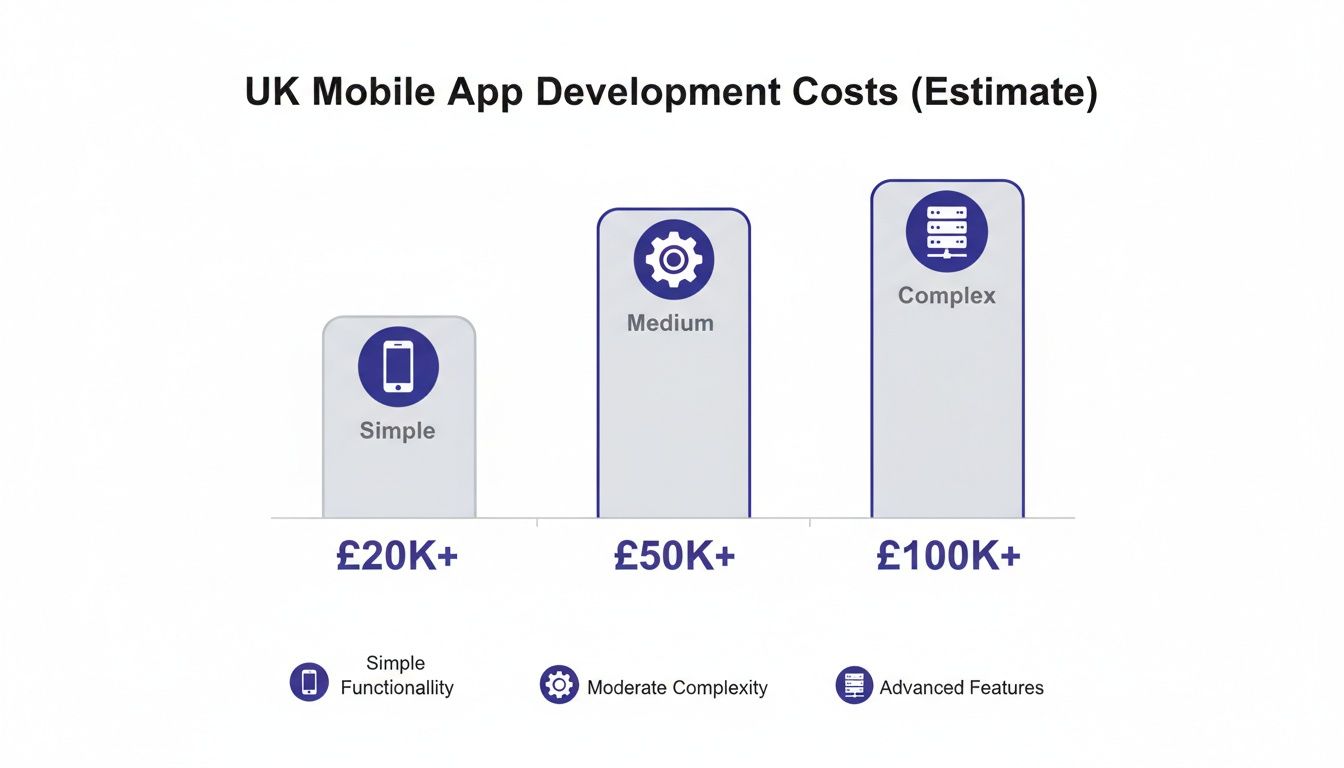
As you can see, the investment climbs steeply as you add more sophisticated features. A simple app might just be a handful of informational screens. In contrast, a complex one could involve live data streams, custom user profiles, powerful backend servers, and top-tier security. This gives you a baseline idea of where your project might land before we dive deeper into the specific cost drivers.
The Core Factors Driving Your App's Final Cost
Ever wondered why one app might cost £20,000 while another soars past £200,000? It’s not some secret formula. The final price tag is a straightforward calculation based on the time, talent, and tech needed to bring your idea into the world. Getting your head around these core drivers is the first step to building a realistic budget and a solid project plan.
Think of it like buying a car. Asking "how much does an app cost?" is like asking "how much does a car cost?". A basic runaround will get you from A to B, no problem. But a luxury sports car with a bespoke interior, precision engineering, and all the latest tech is in a completely different league, with a price to match. The exact same principle applies to app development.

So, let's break down the main components that shape your app's final bill.
Platform Choice: The Universal Key vs. Separate Keys
One of the first big decisions you’ll face is where your app will live. Do you need it on iPhones (iOS), Android devices, or both? This choice has a massive impact on your budget right from the start.
- Native Development: This is the old-school approach, like having a separate, custom-made key for every single door. You build one app specifically for iOS and a completely separate one for Android. While this can offer tight integration with a device’s hardware, it's far more expensive and time-consuming because you’re essentially bankrolling two full development projects.
- Cross-Platform with Flutter: This is the modern, smarter way. Using a framework like Google’s Flutter, we build your app from a single codebase. It's like creating one universal master key that opens both the iOS and Android doors flawlessly. This approach dramatically cuts down development time—and therefore, the cost—without sacrificing the slick, native performance users have come to expect.
For most startups and even established businesses, choosing a cross-platform solution like Flutter is the smartest financial move. It gets you a wider reach for a smaller initial investment. To dive deeper, check out our guide on choosing between native and web app strategies.
The Intricacy of UI and UX Design
How your app looks (UI - User Interface) and how it feels to use (UX - User Experience) isn't just about making things pretty. It’s absolutely fundamental to its success. An app that’s clunky or confusing will get deleted in a heartbeat.
A simple design using standard, off-the-shelf components is friendlier on the wallet. But if you're picturing custom animations, slick screen transitions, or a highly stylised look that screams your brand, the design process naturally becomes more involved. This means more hours for our designers and developers to create that seamless, engaging experience, which is reflected in the cost.
Good design isn’t an expense; it’s a direct investment in keeping your users around. Studies show a well-designed UI can boost conversion rates by up to 200%, while a stellar UX can push that figure as high as 400%.
Feature Complexity and Backend Infrastructure
This is where the bulk of the cost really lies. Every single feature you add to your app—every button, every function—requires development time. A simple contact form might be quick to build, but more sophisticated features can add significant hours to the project timeline.
Let's look at some common features and their different levels of complexity:
- User Accounts: A basic email and password login is straightforward. Want to add social logins like Google or Apple? That adds a layer of work. Need a full system with multi-factor authentication, editable user profiles, and different permission levels? The complexity (and cost) ramps up again.
- Payment Gateways: Integrating a standard payment processor like Stripe is a common task. But if you need a completely custom checkout flow, subscription management, or a system that handles split payments, that requires far more intricate development.
- Third-Party Integrations: Does your app need to talk to other services? Pulling in data from an API like Google Maps, connecting to your company’s CRM, or syncing with a custom database all demand specialist work to make sure data flows securely and reliably.
And running everything behind the scenes is the backend—the engine that powers your app. This is all the servers, databases, and APIs that store data, handle requests, and make things happen. A simple app might only need a minimal backend. But an app built for thousands of users, real-time data syncing, and complex business logic needs a robust, scalable infrastructure. That, right there, is a major cost factor in any app budget.
Real-World App Cost Examples by Industry
Abstract figures are a good starting point, but to really get a feel for how much an app costs to build, you need to look at real-world examples. After all, the features needed for a simple online shop are worlds apart from what a high-security banking app demands.
Every industry has its own set of rules and customer expectations, and these directly shape the final budget. Let's step away from the theory and break down what actually goes into building apps in some of the UK's busiest sectors. By looking at the core features for each, you'll get a much clearer picture of where your own project might land.
E-commerce and Retail Apps
Think of an e-commerce app as your digital storefront. Its main job is to make buying from you as smooth and enjoyable as possible. While that sounds straightforward, the features required to create that seamless shopping experience can quickly stack up.
The main cost drivers for any e-commerce app usually boil down to these essentials:
- Product Catalogues: A system to showcase your products with great images, descriptions, and pricing.
- User Profiles and Login: This lets customers save their details, check order history, and build wishlists.
- Shopping Cart and Checkout: A secure, intuitive process for adding items and paying. This has to be flawless.
- Payment Gateway Integration: Securely connecting to services like Stripe or PayPal to handle the money side of things.
- Order Management System: A back-end system for your team to track and fulfil all the orders coming in.
For a well-built e-commerce app with these core features, you should realistically budget between £25,000 and £65,000. If you're dreaming bigger with features like AI-powered personal recommendations or augmented reality "try-on" tools, you'll be looking at the higher end of that scale, or beyond.
Social Media and Networking Apps
Building the next big social platform is a huge undertaking, and the technical side of things reflects that ambition. These apps live or die based on user engagement, meaning they have to be incredibly fast, reliable, and packed with features that keep people scrolling, posting, and coming back for more.
The development cost is largely driven by the need for a powerful back-end that can juggle thousands of users at once, handle real-time chats, and store a mountain of user-generated content.
The core features almost always include:
- User Profiles: Customisable profiles with photos, bios, and activity feeds.
- Content Creation and Sharing: The ability for users to post text, images, or videos.
- Real-Time Messaging: An instant chat feature for DMs or group conversations.
- News Feeds and Algorithms: A dynamic feed that surfaces relevant content to each user.
- Notifications: Push notifications to alert users about new likes, comments, and messages.
A social media app with this kind of functionality typically requires an investment of £35,000 to £95,000. The cost climbs depending on how complex your content algorithm is and whether you need sophisticated tools for content moderation.
Fintech and Insurtech Apps
When you’re dealing with people's money, there is simply no room for error. Fintech and insurance apps demand the absolute highest levels of security, reliability, and regulatory compliance. This makes them some of the most complex and expensive projects to get off the ground.
In the UK market, pricing patterns are distinct across industries. E-commerce app development generally costs £23,500 to £65,000, whereas high-security fintech applications can range from £35,500 to £100,000. Premium categories like insurance and social media apps can reach costs of £40,000 to £110,000 and £34,000 to £94,000 respectively, while education apps are more accessible, from £21,500 to £50,000. Discover more insights about UK app development costs by industry at ptiwebtech.co.uk.
The strict requirements for data protection and financial regulations are massive cost drivers. You're not just building features; you're building a fortress.
Essential features for a fintech app include:
- Bank-Level Security: Multi-factor authentication, end-to-end encryption, and biometric logins are non-negotiable.
- Secure Data Storage: Full compliance with regulations like GDPR and PCI DSS for handling sensitive financial data.
- Transaction Processing: A flawless system for processing payments, transfers, or other financial actions.
- Third-Party API Integrations: Securely connecting to banks, financial data providers, or credit agencies.
- Admin Dashboard: A powerful back-end for your team to manage users, transactions, and compliance reports.
Given how critical these features are, a secure and compliant fintech app will typically start at £40,000 and can easily sail past £110,000, depending on the complexity of its financial operations and the number of integrations needed.
How Flutter Delivers More Value for Your Budget
When you’re planning an app, one of the most important decisions you'll make is choosing the right technology. It’s a choice that directly impacts the final answer to "how much does an app development cost?". This is where a smart business strategy meets powerful, modern tech. By choosing Google's Flutter framework, you're not just picking a development tool; you're making a savvy financial decision that delivers exceptional quality without the inflated price tag.
The magic of Flutter is all in its single codebase. Think about it: instead of building two separate apps from the ground up—one for iOS and another for Android—our team writes the code just once. That single, elegant codebase is then compiled to run beautifully and natively on both iPhones and Android devices, and even on the web. It's the ultimate "build once, deploy everywhere" approach.
This efficiency is a game-changer. It dramatically cuts down on development hours, which is the single biggest factor driving your overall budget. You aren't paying for two separate development teams or doubling the project timeline. You're investing in one streamlined process that gets your app in front of your entire audience.
The Single Codebase Advantage
The financial benefits of a single codebase are immediate and clear. For businesses wanting to reach both iOS and Android users (which is most of them!), cross-platform apps built in the UK typically range from £11,000 to £100,000 or more. In contrast, building two separate native apps would require a much higher investment, often between £30,000 and £125,000. Flutter makes top-tier cross-platform development much more accessible.
But this isn't just about saving money on the initial build. The long-term savings are just as significant. When it's time to add a new feature, fix a bug, or push out an update, we only need to update one set of code, not two. This makes ongoing maintenance faster, simpler, and far more affordable down the line.
Accelerated Development with Hot Reload
One of Flutter's most celebrated features is something developers call 'Hot Reload'. In traditional development, a developer might change a single line of code and then have to wait several minutes for the entire app to recompile just to see the result. It's a slow, painstaking process that quickly eats up time and inflates costs.
Hot Reload changes the game completely.
With Flutter, our developers can make changes to the code and see them reflected on the test screen in under a second. This instant feedback loop allows for rapid experimentation, faster bug fixing, and quicker design tweaks. It's like having a fast-forward button for the entire development cycle.
This incredible speed translates directly into budget savings. Faster development means fewer billable hours, allowing us to build, test, and perfect your app in a fraction of the time it would take with older methods.
Uncompromised Performance and Quality
In the past, cross-platform tools sometimes came with a trade-off. The apps could feel a little sluggish or not quite "native." That's simply not the case anymore. Flutter compiles directly to native code, communicating with the device's hardware without any clumsy middleman. The result is breathtaking performance that is indistinguishable from a truly native app.
Here’s what that means for your budget and your users:
- No Performance Compromise: You get all the cost-saving benefits without sacrificing the speed and responsiveness your users demand. Recent benchmarks consistently place Flutter at the top for performance, outclassing other cross-platform frameworks.
- Pixel-Perfect UI: Flutter gives us complete control over every pixel on the screen. This means we can create stunning, custom user interfaces that look and feel consistent across all devices, reinforcing your brand identity without the extra cost of designing for two separate platforms.
- Future-Proof Technology: Backed by Google, Flutter is constantly evolving and has a massive, active community behind it. Choosing Flutter means you're investing in a robust platform that will be supported and updated for years to come.
Ultimately, opting for Flutter is more than a technical choice; it’s a business one. It allows us to deliver a superior, high-performance app that reaches the widest possible audience, all while keeping your budget lean and maximising your return on investment. If you're exploring how to get the most value from your app development budget, learn more about our Flutter app development services for UK businesses.
Beyond the Launch: Understanding the Hidden Costs of Your App
Getting your app live on the App Store and Google Play is a massive milestone, but it's crucial to understand that this isn't the finish line. Far from it. The launch is really just the beginning of your app's financial journey. So many first-time app owners get caught out by the ongoing operational costs, which are absolutely vital for the app's long-term health and success.
Thinking of your app budget as a one-and-done payment is like buying a car and then completely forgetting to budget for petrol, insurance, or its yearly MOT. The initial development cost gets you on the road, for sure, but the recurring expenses are what keep you driving smoothly. These costs aren't a surprise; they're predictable, and planning for them from day one is the secret to sustainable growth.
The Non-Negotiable Cost of Maintenance
Your app doesn't exist in a bubble. The moment it launches, it’s interacting with a technological world that is constantly changing. Apple and Google roll out major operating system updates every single year, and your app must be updated to stay compatible. If you neglect this, it's a surefire way to watch your app break, leading to a flood of negative reviews and users deleting it for good.
But maintenance isn't just about playing nice with new operating systems; it’s about security and performance. Regular updates are essential to:
- Patch Security Vulnerabilities: You have a responsibility to protect your users' data from new and emerging threats.
- Fix Bugs: No app is perfect at launch. Updates allow you to squash any issues that crop up once real people start using it.
- Improve Performance: Ensure the app stays fast, snappy, and responsive, especially on the latest devices.
- Enhance Features: You can gradually add new functionality based on what your users are telling you they want.
As a solid rule of thumb, you should plan for ongoing maintenance to cost around 15-25% of the initial development spend, per year. So, for a £50,000 app, that means setting aside between £7,500 and £12,500 annually. This isn't an optional extra; it's the cost of keeping your app alive and thriving.
Server Hosting and Third-Party Services
Beyond the code itself, your app relies on a whole network of services to function properly, and these all come with their own recurring fees. Think of these as the operational costs that keep the lights on behind the scenes.
First up, there's server hosting. All your app's data—user profiles, content, images, you name it—needs a place to live. That place is a server that has to be fast, secure, and always online. As your user base grows, so will your data storage and processing needs, which directly translates to a higher hosting bill. As you map out your app's future, don't overlook these expenses; a proper understanding the real cost of cloud computing can save you from some nasty surprise bills down the line.
On top of that, most modern apps integrate with third-party APIs (Application Programming Interfaces) to provide specific features. These often work on a subscription or pay-as-you-go model. Common examples include:
- Payment Gateways: Services like Stripe for processing in-app purchases.
- Mapping Services: Using Google Maps for any location-based features.
- Push Notifications: Tools for sending alerts and updates to your users.
- Analytics Tools: Platforms to track user behaviour and make smarter decisions.
Each of these adds a small, recurring cost that all contributes to your app's total cost of ownership. According to UK industry data, hosting and infrastructure costs alone typically run from £1,000 to £15,000 per year, depending on the scale and complexity of your operation. Factoring these "hidden" costs into your business plan from the very start is just smart financial planning.
Choosing Your Ideal UK App Development Partner
The final piece of the puzzle in answering "how much does an app development cost?" comes down to who you choose to build it. This isn't just about finding someone to write code; it's about picking a partner who gets your vision and has the technical chops to make it a reality. Your choice here will echo through your budget, timeline, and ultimately, the success of your app.
Here in the UK, you're looking at two main paths: hiring freelance developers or partnering with an established agency. Freelancers can dangle some pretty attractive lower hourly rates, which is tempting if you're watching every penny. The catch? You often become the de facto project manager, trying to coordinate different people and carrying all the risk if someone drops off the map.
An agency, on the other hand, is a different beast entirely. You get a whole, coordinated team in one package. We're talking project managers, UI/UX designers, developers, and testers who are already used to working together. This integrated setup minimises risk, keeps communication clear, and delivers a much more polished final product.
Key Questions to Ask Potential Partners
Don't just look at the price tag. A truly great partner will be transparent, know their stuff, and be genuinely excited about what you're trying to build. You need to go into those initial chats armed with the right questions to see if they're the real deal.
Here’s a quick checklist to get you started:
- Can I see your portfolio? Don't just glance at it. Look for apps they’ve built that feel similar to yours, whether in industry or complexity.
- What's your development process? A professional agency will have a clear, structured way of working, usually following Agile principles. It shouldn't be a mystery.
- How will we communicate? Nail this down from the start. Ask about regular meetings, how you'll get updates, and who your main point of contact will be.
- What's your experience with Flutter? If you're aiming for a cost-effective, high-performance app, you need a team with real, demonstrable Flutter expertise. Ask to see examples.
- How do you handle scope changes? Ideas evolve. A good partner won't panic when you have a new one; they'll have a clear process for handling changes without blowing up the budget.
Think of choosing a partner less like hiring a contractor and more like starting a business relationship. The right team will feel like an extension of your own, offering genuine strategic advice and working with you to solve problems. Their success should be tied to yours.
Getting this choice right is absolutely critical. For a much deeper dive, have a look at our complete guide to hiring app developers in the UK to make sure you find the perfect match.
Common Questions About App Development Costs
To wrap things up, let's tackle some of the most frequent questions we get from clients when they're trying to budget for a new app. Getting straight answers to these final details can give you the confidence to plan your project properly, so you know exactly what to expect.
How Long Does a Detailed Quote Take?
A proper, accurate quote isn’t just a number pulled from thin air; it’s the result of a collaborative discovery process. You should expect this to take between one and two weeks. During this time, we'll work closely with you to really get under the skin of your goals, map out user journeys, and define the core features your app needs to actually succeed.
To give you the most precise estimate possible, we need a crystal-clear picture of what you want to build. This initial investment of time is crucial—it heads off misunderstandings down the line and makes sure the final quote truly reflects the project's scope, saving you from nasty surprises later on.
Is a Fixed Price or Hourly Rate Better?
Choosing the right pricing model really comes down to the nature of your project. Each has its place, and the best choice is the one that fits your specific needs.
- Fixed Price: This is perfect for smaller projects where the scope is nailed down and unlikely to change. If you know exactly what you want, a fixed price gives you that all-important budget certainty.
- Hourly Rate (Time & Materials): This model offers far more flexibility, which is why it’s a much better fit for larger, more complex projects where requirements might evolve. It’s the foundation of an agile approach, letting us make adjustments and improvements as we go.
For most modern app builds, an agile, hourly-based approach delivers the best value by a long shot. It lets the project adapt to user feedback and new ideas without being handcuffed to a rigid, upfront plan.
Can I Add More Features Later On?
Absolutely! In fact, we strongly recommend it. Trying to build every single feature you can dream of from day one is a common and very costly mistake. The smartest way to build an app is to launch with a Minimum Viable Product (MVP).
An MVP isn't a half-finished app; it’s a lean, focused version that solves a core problem for your audience. It has just the essential features needed to launch, get real feedback from actual users, and prove your idea works in the market.
This agile strategy is incredibly cost-effective. It gets you to market faster with a smaller initial investment. You can then use the data and revenue from your MVP to make smart, informed decisions about which new features to build next, ensuring your app grows in the direction your users actually want it to.
Ready to get a clear, detailed cost for your app idea? The team at App Developer UK is here to help you navigate every step. We specialise in building high-performance Flutter apps that deliver exceptional value for your budget.