Top 12 UI UX Design Courses for UK Flutter Developers
Top 12 UI UX Design Courses for UK Flutter Developers
In the UK's competitive app market, a high-performing Flutter application is only half the battle. Users demand intuitive, engaging, and visually appealing interfaces. Without a strong foundation in user interface (UI) and user experience (UX) design, even the most technically brilliant app can fail to gain traction, leading to poor user retention and missed business opportunities. This is where targeted training becomes a critical investment for any development team.
This guide is organised to help you find the best UI/UX design courses for your specific needs, whether you're a startup, an established SME, or an in-house Flutter development team. We move beyond generic descriptions to provide a detailed breakdown of what each course truly offers. You'll find practical insights, curriculum highlights focused on mobile app design, and honest assessments of each programme's strengths and limitations. To truly understand why UI/UX design training is crucial for Flutter developers, consider the benefits of investing in interactive video for training, which significantly boosts engagement and retention.
We have analysed a curated selection of top-tier courses, evaluating them on factors like cost, duration, certification, and suitability for different skill levels. Each entry includes direct links and key details to simplify your decision-making process. The goal is straightforward: to equip your team with the design skills needed to build Flutter apps that not only perform flawlessly but also deliver an exceptional user experience that sets you apart from the competition.
1. Coursera – Google UX Design Professional Certificate
Coursera stands out in the online learning landscape, primarily due to its partnership with industry giants like Google. The Google UX Design Professional Certificate is a flagship programme, meticulously structured for individuals aiming to enter the UX field without prior experience. It provides a comprehensive, job-ready curriculum that covers the entire design process, from empathising with users and defining pain points to ideating solutions and creating prototypes in tools like Figma and Adobe XD. This certificate’s strong brand recognition makes it a valuable credential for aspiring designers.
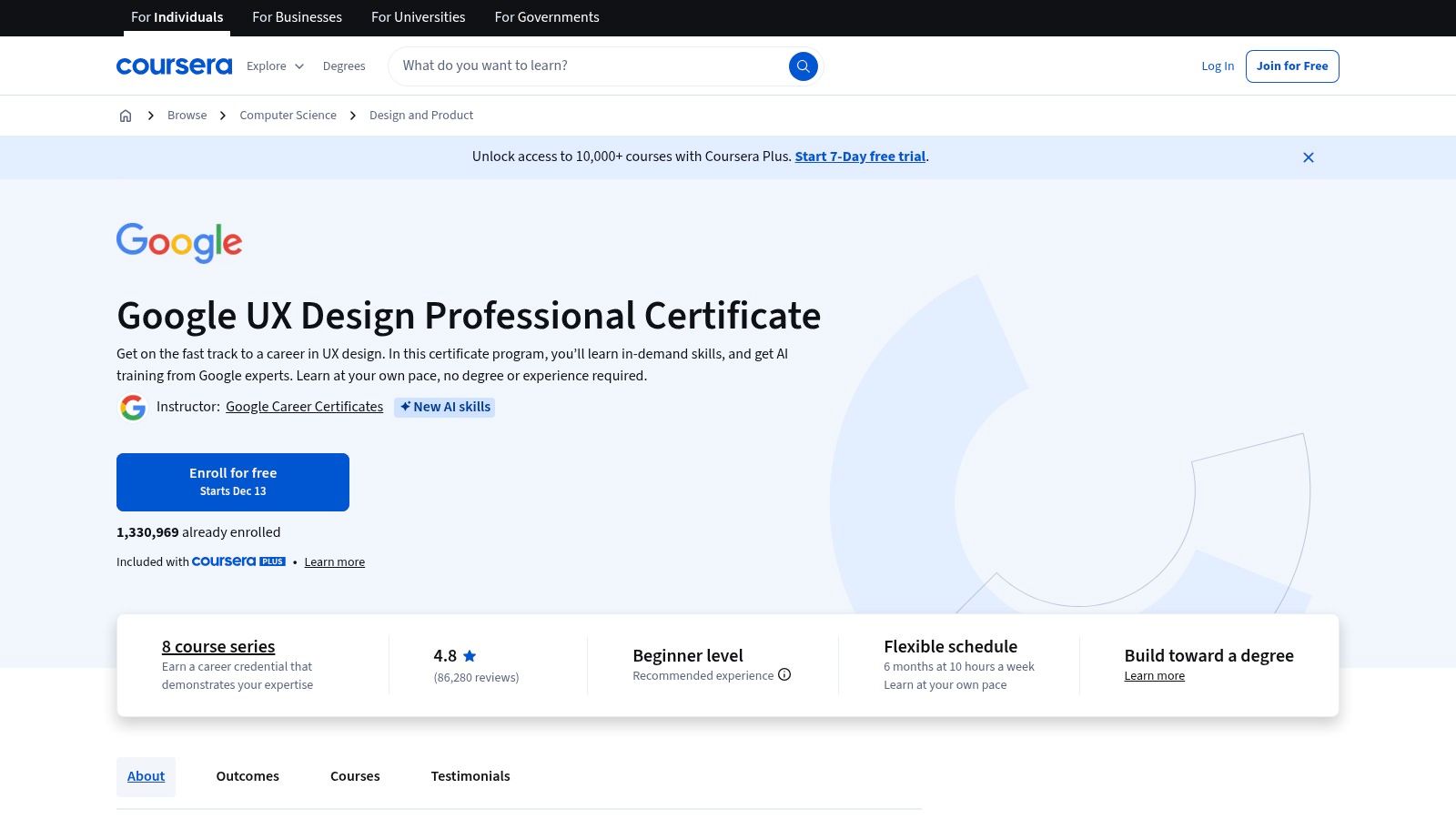
The course is designed to be completed in under six months at a flexible pace, making it ideal for working professionals. For development teams, especially those using frameworks like Flutter, having designers with this foundational knowledge ensures a shared understanding of user-centred design principles. This alignment is crucial for building intuitive mobile applications that perform exceptionally well.
One of the certificate’s key strengths is its practical focus. Learners complete three end-to-end projects, creating a professional portfolio to showcase to potential employers. This hands-on approach is invaluable for startups and SMEs who need designers capable of contributing immediately. The platform's subscription model, typically around £40 per month, provides access to the programme, with financial aid available. To get the most from this platform, it's wise to explore some of the top UI/UX design courses available on Coursera to ensure it aligns with your specific career goals.
| Feature Summary | Details |
|---|---|
| Level | Beginner (No prior experience required) |
| Duration | Approx. 6 months (at 10 hours/week) |
| Cost | Subscription-based (Coursera Plus or monthly fee, financial aid available) |
| Certification | Professional Certificate from Google |
| Pros | Strong industry recognition, hands-on portfolio projects, comprehensive curriculum from Google experts, fully flexible and self-paced. |
| Cons | Subscription costs can accumulate if you learn slowly; mentor support can be less personalised compared to dedicated bootcamps. |
| Best For | Career changers, in-house developers wanting to understand UX, and startups needing to establish a solid design foundation for their mobile products. |
2. FutureLearn
FutureLearn, a UK-based platform, distinguishes itself by offering accessible UI/UX design courses from established British institutions and industry partners. It provides a flexible learning model that is well-suited for professionals looking to upskill without committing to a long-term programme. The platform offers a range of short courses and more in-depth "Microcredentials" that cover specific areas of user experience and interface design, from initial user research to digital prototyping. This makes it an excellent choice for targeted, credible learning.

The platform’s structure is particularly beneficial for SMEs and development teams that need to quickly build foundational design skills. For a team building a high-performance Flutter application, a short, focused course on mobile UI principles from FutureLearn can provide immediate, actionable insights. This approach ensures designers and developers share a common language and can collaborate effectively to create intuitive user journeys.
FutureLearn’s pricing model is transparent, offering free access to most course materials for a limited time, with options to pay a one-off fee for ongoing access and a certificate, or subscribe to "Unlimited" for access to a vast catalogue of courses. This flexibility allows businesses to manage training budgets effectively. To see how it compares to other platforms, exploring some of the top online UX design courses in the UK can provide valuable context for making an informed choice.
| Feature Summary | Details |
|---|---|
| Level | Beginner to Intermediate |
| Duration | Varies (short courses typically 2-6 weeks) |
| Cost | Free limited access, one-off course upgrades (approx. £30-£70), or Unlimited subscription (£27.99/month). |
| Certification | Digital Certificate of Achievement upon paid completion. |
| Pros | Courses from credible UK institutions, transparent and flexible pricing, good for targeted, quick upskilling. |
| Cons | Short courses may lack the depth of a full bootcamp; community engagement can be less active than in cohort-based programmes. |
| Best For | Professionals needing specific skills, UK-based learners, and development teams seeking cost-effective, foundational UI/UX training for mobile apps. |
3. UX Design Institute
The UX Design Institute occupies a unique space by bridging the gap between online courses and formal university education. It offers a Professional Diploma in UX Design that is credit-rated by Glasgow Caledonian University, providing a level of academic validation that many other online programmes lack. This structure is ideal for those seeking a highly credible, industry-recognised qualification to anchor their design career. The curriculum is comprehensive, guiding learners through the entire UX workflow from user research and analysis to prototyping and validation, ensuring they build a robust portfolio.
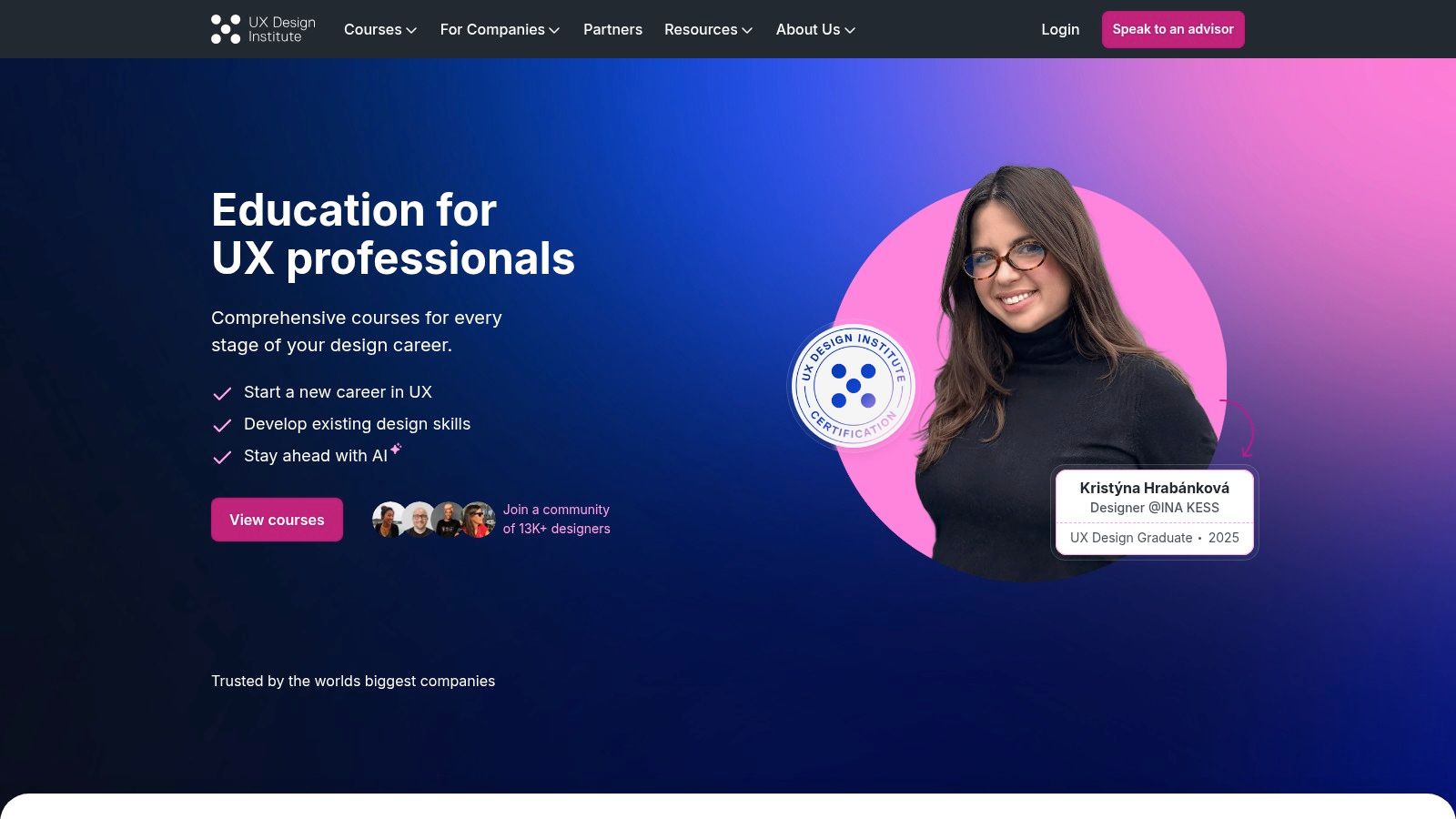
The course operates on a cohort-based model, blending self-paced learning with scheduled live webinars and mentor support. This approach cultivates a sense of community and provides valuable networking opportunities, which can be a significant advantage over fully asynchronous courses. For development teams, particularly those building high-performance mobile apps with Flutter, designers trained at this level bring a structured, research-driven methodology. This ensures that the app’s architecture is built on a solid foundation of user needs, leading to more intuitive and successful products.
While the price point is higher than many subscription-based platforms, the investment reflects the university-backed accreditation and personalised support. The emphasis on creating a real-world portfolio piece makes its graduates highly employable, appealing to SMEs and startups who need designers capable of owning the UX process from day one. It is a standout choice among ui ux design courses for those prioritising academic rigour and demonstrable skills.
| Feature Summary | Details |
|---|---|
| Level | Beginner to Intermediate |
| Duration | 6 months (Professional Diploma in UX Design) |
| Cost | Upfront fee (approx. £2,750), with payment plans available |
| Certification | University credit-rated Professional Diploma |
| Pros | University credit-rating adds significant credibility, strong portfolio focus, structured curriculum with mentor support, recognised by major employers. |
| Cons | Higher one-time cost compared to subscriptions; fixed cohort start dates offer less flexibility than on-demand courses. |
| Best For | Individuals seeking a credible, academically-backed qualification, career changers needing a structured path, and businesses investing in upskilling their design teams. |
4. General Assembly
General Assembly (GA) offers a different approach to learning, focusing on intensive, cohort-based bootcamps designed to fast-track a career change. Their User Experience Design Bootcamp is a respected programme available in full-time immersive or part-time formats, both online and at their London campus. GA’s strength lies in its structured, instructor-led environment and a strong emphasis on real-world projects, preparing students for the rigours of a professional design role from day one. This makes it an excellent choice for those who thrive in a collaborative, classroom-style setting.
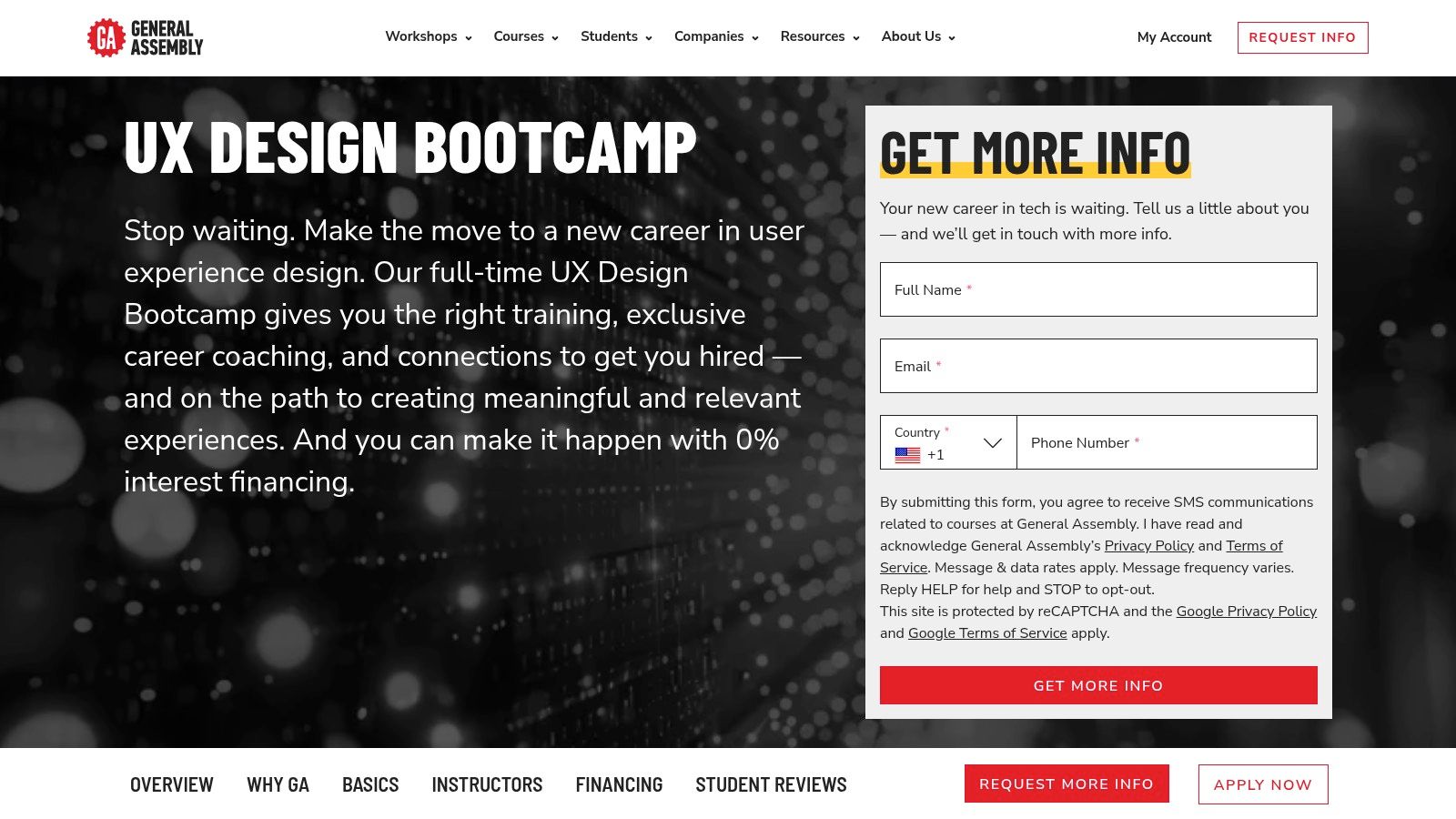
The curriculum is project-driven, ensuring that graduates leave with a robust portfolio. For businesses, particularly SMEs and startups building high-performance mobile apps with frameworks like Flutter, hiring a GA graduate can mean bringing on a designer who is already accustomed to collaborative workflows and tight deadlines. The bootcamp's focus on the entire UX process, from research to high-fidelity prototyping, ensures designers can integrate seamlessly into agile development teams.
GA’s significant investment is justified by its extensive career support, which includes dedicated coaching, portfolio reviews, and access to a vast employer network. They offer transparent tuition fees with UK-specific financing options like EdAid or instalment plans, making one of the most comprehensive ui ux design courses more accessible. While the time commitment is substantial, the structured support system and community provide a powerful launchpad into the design industry.
| Feature Summary | Details |
|---|---|
| Level | Beginner to Intermediate (Designed for career changers) |
| Duration | 12 weeks (Full-time) or 24 weeks (Part-time) |
| Cost | Premium (£11,000+), with financing and instalment plans available |
| Certification | General Assembly Certificate of Completion |
| Pros | Immersive, cohort-based learning; extensive career services and employer network; strong London presence; project-based curriculum. |
| Cons | Significant financial and time investment required; intensive pace can be demanding; success is heavily dependent on individual effort. |
| Best For | Individuals committed to a rapid career change, businesses seeking well-rounded junior designers, and anyone who prefers a structured, instructor-led environment. |
5. BrainStation
BrainStation offers a distinct, bootcamp-style approach to learning, blending live instruction with practical, portfolio-driven projects. Its User Experience Design Certificate is designed for professionals seeking intensive, hands-on training that fits around a work schedule. With options for evening and weekend cohorts, both online and at their London campus, it provides a structured yet flexible environment. This model is particularly effective for those who thrive on direct interaction with instructors and peers, offering a more collaborative experience than purely self-paced courses.
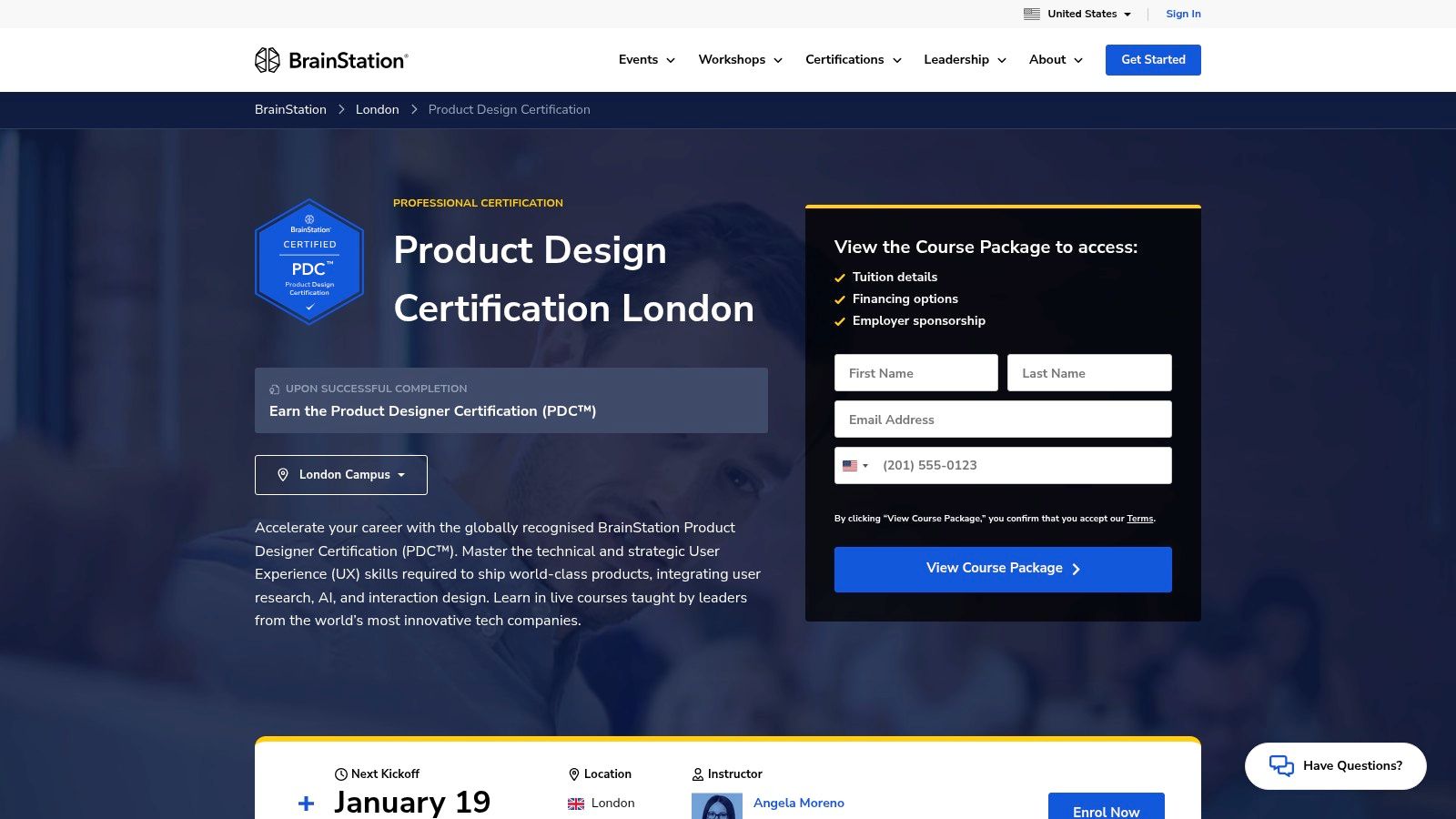
The curriculum is project-based, ensuring that learners graduate with tangible work to showcase. This hands-on methodology is highly beneficial for development teams, especially those building high-performance mobile apps with Flutter. A designer trained at BrainStation will have practical experience in creating user flows and prototypes, enabling smoother collaboration and faster iteration cycles. The emphasis on community, with local events and networking opportunities, also adds significant value for SMEs and startups looking to connect with emerging design talent.
While the tuition is at a premium, BrainStation's live, expert-led instruction provides a level of engagement and immediate feedback that justifies the investment for many. These UI/UX design courses are structured to rapidly upskill individuals, making them valuable assets for companies that need designers who can integrate quickly into an agile workflow. The focus on real-world skills ensures graduates can deliver immediate impact.
| Feature Summary | Details |
|---|---|
| Level | Beginner to Intermediate |
| Duration | Typically 5-10 weeks (Part-time) |
| Cost | Premium (Full pricing typically available upon course package inquiry) |
| Certification | Certificate of Completion |
| Pros | Live instruction from industry experts, flexible evening/weekend schedule, strong focus on building a practical portfolio, active local community. |
| Cons | Higher tuition cost compared to self-paced platforms; shorter course duration may require additional self-study for deep mastery of complex topics. |
| Best For | Working professionals needing a structured schedule, businesses investing in employee upskilling, and anyone who prefers a live, collaborative classroom environment. |
6. The School of UX
The School of UX offers a distinct, highly practical approach to learning, focusing on intensive, hands-on workshops. Based in London but also offering live online classes, it is designed for those who want to acquire tangible skills quickly. Its short courses, ranging from one to five days, are perfect for professionals looking to upskill in specific areas like Figma, user research, or UI design without committing to a lengthy programme. This format makes it an excellent choice for businesses needing to train their teams efficiently.
The school’s model is particularly beneficial for in-house development teams, such as those working with Flutter, who need to rapidly integrate UI/UX best practices into their workflow. The small-group setting ensures personalised attention from industry-expert instructors, fostering a collaborative learning environment. This direct engagement helps bridge the gap between theoretical knowledge and practical application, a crucial step for building high-performing mobile apps.
A major advantage for UK residents is the availability of government-funded Skills Bootcamps. These multi-week, part-time courses provide a deeper dive into UI/UX design and offer a potential route into the industry with no upfront cost for eligible learners. While the short courses provide focused training, the bootcamps offer a more comprehensive pathway, complete with portfolio-building projects. This flexibility caters to a wide range of career goals and budgets, making it one of the most accessible ui ux design courses for practical skill acquisition.
| Feature Summary | Details |
|---|---|
| Level | Beginner to Intermediate |
| Duration | Intensive 1–5 day workshops or 10-week part-time Skills Bootcamps |
| Cost | Varies by course (£399+ for short courses); funded places available for eligible UK residents via Skills Bootcamps |
| Certification | Certificate of Completion |
| Pros | Highly practical, hands-on learning in small groups; short, intensive format is great for upskilling; government funding available for UK learners. |
| Cons | Short courses may lack depth on complex research topics; funded places are competitive and have strict eligibility criteria. |
| Best For | Professionals needing rapid upskilling, UK residents seeking funded training, and development teams wanting practical, focused UI/UX workshops. |
7. Imperial College Business School – Professional Certificate in UI and UX Design
For those seeking a credential from a world-renowned academic institution, Imperial College Business School offers a premium route into the design field. The Professional Certificate in UI and UX Design is an executive education programme structured for working professionals who require a formal, university-backed qualification. This 24-week online course provides a comprehensive curriculum that covers the entire design lifecycle, from user research and strategy to wireframing and high-fidelity prototyping, making it one of the most distinguished UI/UX design courses available.
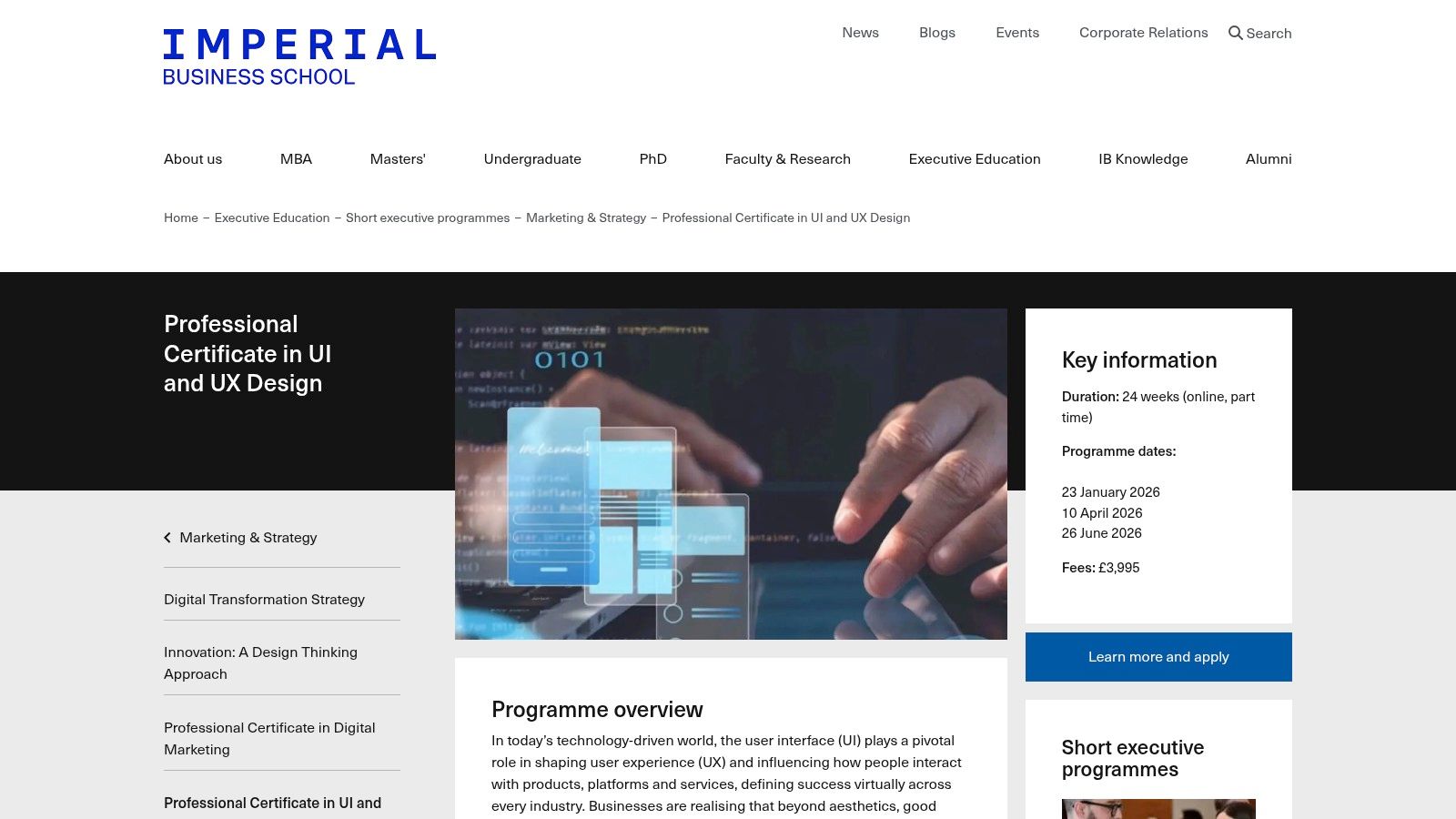
The programme operates on a cohort-based model, which provides a clear, structured schedule that helps maintain momentum and accountability. This is particularly beneficial for businesses investing in their teams, as it ensures employees complete the training within a defined timeframe. For development teams, especially those building high-performance Flutter applications, having designers with this level of structured training ensures a deep understanding of strategic design principles that align with sophisticated business goals.
While the course carries a premium price tag of £3,995, the value lies in its brand recognition and the credibility of an Imperial College certificate. This investment can be a significant differentiator for independent designers or a strategic upskilling move for in-house teams. The curriculum is designed to equip learners with the skills needed to tackle complex design challenges immediately. For more insights into local training options, you can explore this guide to a UI/UX design course in the UK.
| Feature Summary | Details |
|---|---|
| Level | Beginner to Intermediate (Designed for professionals) |
| Duration | 24 weeks (Part-time, online) |
| Cost | Premium fee (£3,995) |
| Certification | Professional Certificate from Imperial College Business School |
| Pros | Highly credible UK university brand, structured cohort-based learning, comprehensive executive-level curriculum. |
| Cons | Significant financial investment, fixed schedule may not suit everyone, less flexibility than self-paced options. |
| Best For | Professionals seeking a prestigious credential, companies investing in employee upskilling, and designers wanting a structured, university-led programme. |
Visit Imperial College Business School
8. LinkedIn Learning
LinkedIn Learning leverages its professional network to offer a vast and accessible library of courses, making it an excellent resource for continuous professional development in UI/UX. The platform excels at providing bite-sized, on-demand video tutorials and curated learning paths covering everything from UX foundations and research to specific tool mastery in Figma or Adobe XD. Its key advantage is the seamless integration with your LinkedIn profile, allowing you to showcase completed certificates directly to your professional network and potential employers.

The subscription-based model provides an affordable way for professionals to stay current with evolving design trends and software. For development teams, particularly those building high-performance Flutter applications, LinkedIn Learning serves as a fantastic supplementary tool. Developers can quickly upskill on specific design principles or tools, fostering better collaboration with the design team and ensuring a shared vocabulary, which is vital for efficient project delivery.
The platform is ideal for those who prefer self-directed learning and want to fill specific knowledge gaps rather than commit to a lengthy, structured programme. To maximise its value, it's best to create a personal learning plan and schedule regular time for study. While it may not provide the same depth or a formal qualification as a dedicated bootcamp, its flexibility and breadth of content make it an indispensable tool for ongoing skill enhancement in the fast-paced world of UI/UX design.
| Feature Summary | Details |
|---|---|
| Level | Beginner to Advanced (Varies by course) |
| Duration | Self-paced (Courses range from under 1 hour to 20+ hours) |
| Cost | Subscription-based (Monthly or annual plan, often available with LinkedIn Premium) |
| Certification | Certificate of Completion (Shareable on LinkedIn profile) |
| Pros | Massive library of courses, seamless profile integration, flexible bite-sized learning, excellent for tool-specific skills and refreshers. |
| Cons | Lacks the depth and formal recognition of a dedicated certificate programme; quality can vary between instructors; requires self-discipline. |
| Best For | Professionals needing to upskill, teams seeking supplementary training resources, and designers wanting to master specific software or techniques. |
9. Udemy
Udemy is a vast online learning marketplace that distinguishes itself through sheer volume and accessibility. Unlike subscription platforms, Udemy operates on a one-time purchase model, granting lifetime access to individual courses. This makes it an incredibly cost-effective option for developers, designers, and businesses looking to fill specific skill gaps without a long-term financial commitment. The platform hosts a colossal library of ui ux design courses, covering everything from foundational theory and UX research to mastering specific tools like Figma or Adobe XD.
The primary advantage of Udemy lies in its targeted learning approach. For a development team using Flutter, an in-house developer can quickly acquire specific skills, such as mobile prototyping or user journey mapping, by purchasing a highly-rated, specialised course for a low price during one of Udemy's frequent sales. This flexibility allows businesses to upskill their teams in a targeted and budget-friendly manner. The user review and rating system is crucial for navigating the platform, helping you vet course quality before committing.
While it lacks the formal, structured career support of dedicated bootcamps, Udemy excels at providing practical, focused knowledge. Many courses include downloadable resources and hands-on projects, enabling learners to apply concepts immediately. For startups and SMEs, this is an excellent way to introduce design principles to technical teams, fostering a more user-centric culture without significant investment. The key is to carefully read reviews and check instructor credentials to find the hidden gems.
| Feature Summary | Details |
|---|---|
| Level | All levels (Beginner to Advanced) |
| Duration | Varies by course (from a few hours to 50+ hours) |
| Cost | One-time purchase per course (often heavily discounted) |
| Certification | Certificate of Completion per course |
| Pros | Extremely affordable during sales, lifetime access, huge variety of specialised topics, great for learning specific tools or filling skill gaps. |
| Cons | Quality is highly variable between instructors, requires careful vetting, lacks formal career services or deep mentor support. |
| Best For | Developers needing specific design skills, budget-conscious learners, and businesses wanting to provide flexible, self-paced training on niche topics. |
10. OpenLearn (The Open University)
OpenLearn, the free learning platform from The Open University, offers an excellent, no-risk entry point into the world of user experience. Unlike dedicated bootcamps, it provides university-authored content, such as its popular course, ‘An introduction to interaction design’. This makes it an ideal resource for individuals or teams wanting to grasp the foundational, academic principles of user-centred design before committing to more intensive, paid UI/UX design courses. It’s a perfect way to test the waters and build a theoretical baseline.
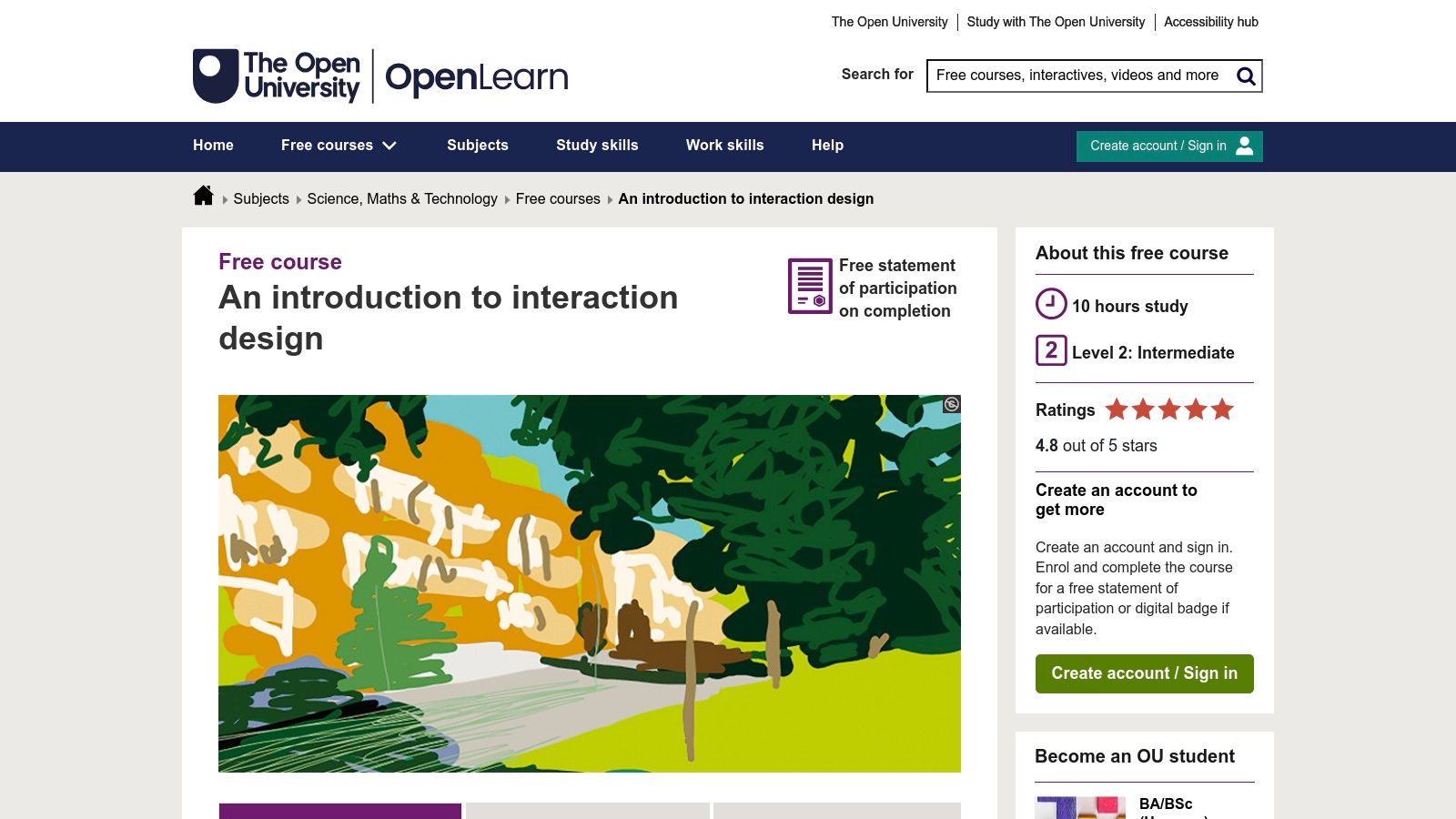
The platform is entirely self-paced, allowing learners to access materials and study whenever it suits them, which is a significant advantage for busy professionals. For development teams, particularly those building high-performance Flutter apps, these foundational modules can introduce crucial concepts like usability and accessibility. This shared knowledge helps bridge the gap between development and design, fostering a more collaborative and effective product creation process from the start.
While OpenLearn doesn’t offer formal qualifications or direct job placement support, it provides a free statement of participation upon completion, which can supplement a CV. Its primary value lies in its accessibility and the credibility of its source. For startups or SMEs on a tight budget, it serves as a valuable, cost-free training tool to upskill team members in the core theories that underpin exceptional user interface and experience design, complementing more practical, tool-focused training later on.
| Feature Summary | Details |
|---|---|
| Level | Beginner |
| Duration | Self-paced (e.g., the interaction design course is approx. 8 hours total) |
| Cost | 100% Free |
| Certification | Free Statement of Participation |
| Pros | Completely free access to trusted academic content, ideal for exploring an interest in UX, great supplement to other paid courses, no time pressure. |
| Cons | Lacks portfolio-building projects, no formal qualification or job support, content is more theoretical than practical. |
| Best For | Absolute beginners, developers wanting a theoretical UX introduction, and businesses seeking a no-cost way to introduce design principles to teams. |
11. Nielsen Norman Group (NN/g)
The Nielsen Norman Group (NN/g) is a world-renowned authority in user experience, offering courses grounded in decades of rigorous research. Unlike self-paced online platforms, NN/g provides intensive, live training events (both online and in-person) for professionals looking to deepen their expertise. Their approach is modular; practitioners can select individual one-day courses on highly specific topics and accumulate credits towards a prestigious UX Certification or UX Master Certification. This model is ideal for experienced designers or managers seeking authoritative knowledge in specialised areas like UX research or interaction design.
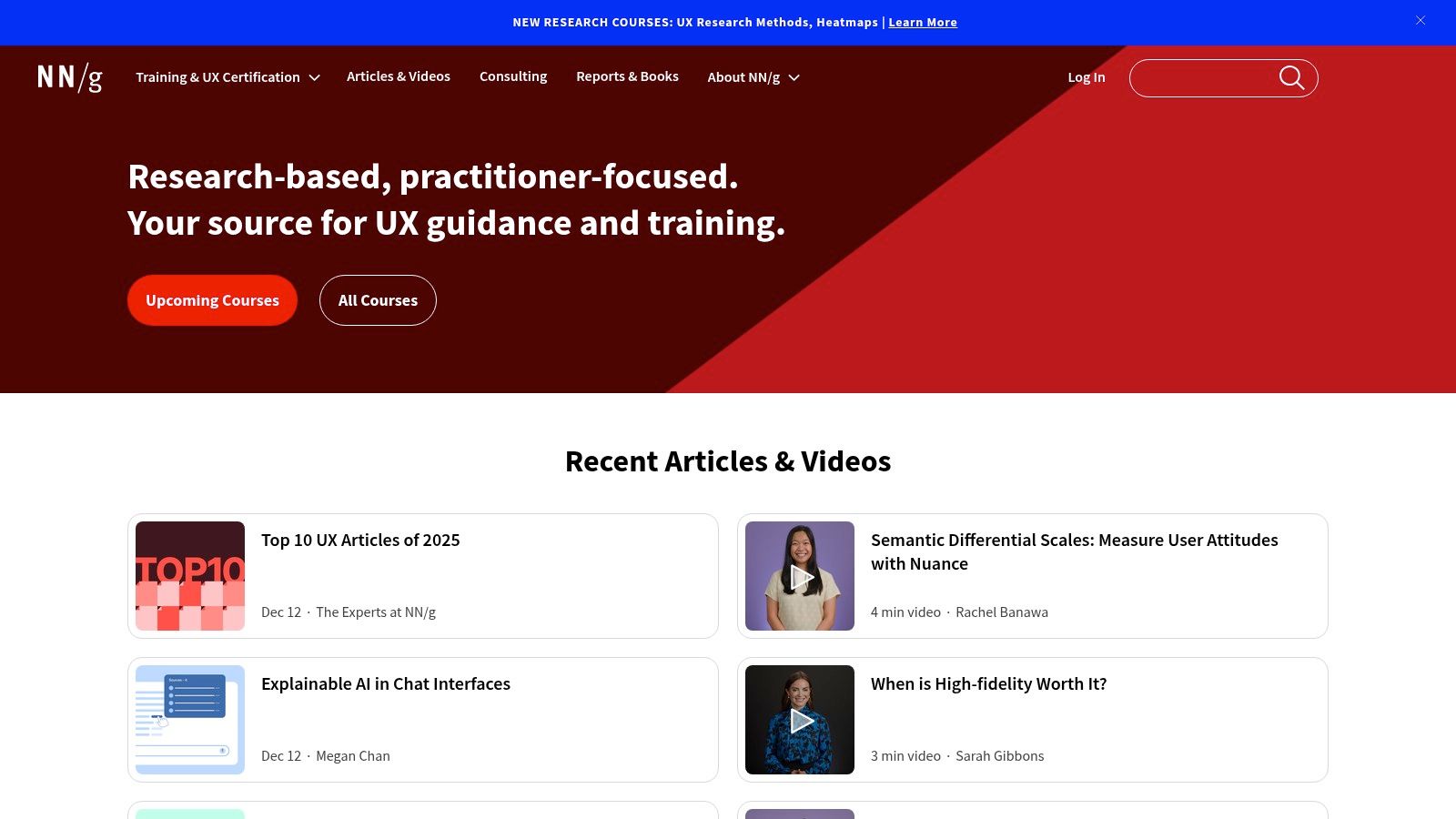
For businesses, particularly those with established design teams, sending key personnel to NN/g events can elevate the entire organisation's UX maturity. A designer armed with NN/g’s research-backed principles can bring immense value to a Flutter development workflow, ensuring that every user interaction is based on proven usability heuristics rather than guesswork. This level of expertise helps prevent costly design errors and builds a foundation for a truly user-centric product.
The primary strength of NN/g is the depth and credibility of its content, delivered by leading figures in the UX industry. However, its premium pricing and intensive format make it less suitable for absolute beginners. These ui ux design courses are an investment in high-level professional development rather than an entry-level training programme. Participants are expected to apply the concepts learned and build their portfolios independently, as the courses focus on theory and methodology over practical tool-based projects.
| Feature Summary | Details |
|---|---|
| Level | Intermediate to Advanced (Best for practising professionals) |
| Duration | 1-2 days per course; certification requires 5-15 courses |
| Cost | Premium per-course pricing; significant investment for full certification |
| Certification | UX Certification & UX Master Certification |
| Pros | Unparalleled industry authority, deep research-backed content, prestigious certification for experienced professionals, live expert instruction. |
| Cons | Very expensive compared to other options; does not include portfolio-building projects; intense, short format requires self-directed application. |
| Best For | Senior designers, UX managers, and development leads looking to master specific UX disciplines and gain an authoritative credential. |
12. Reed Courses
Reed Courses functions as a comprehensive UK-based marketplace, aggregating thousands of ui ux design courses from a wide array of training providers. It’s less a single, unified programme and more of a vast library, making it an excellent resource for finding specialised or introductory courses at budget-friendly price points. The platform is particularly useful for individuals or teams looking to dip their toes into a specific area of UX, such as UX writing or mobile prototyping, without committing to a lengthy, expensive certificate.
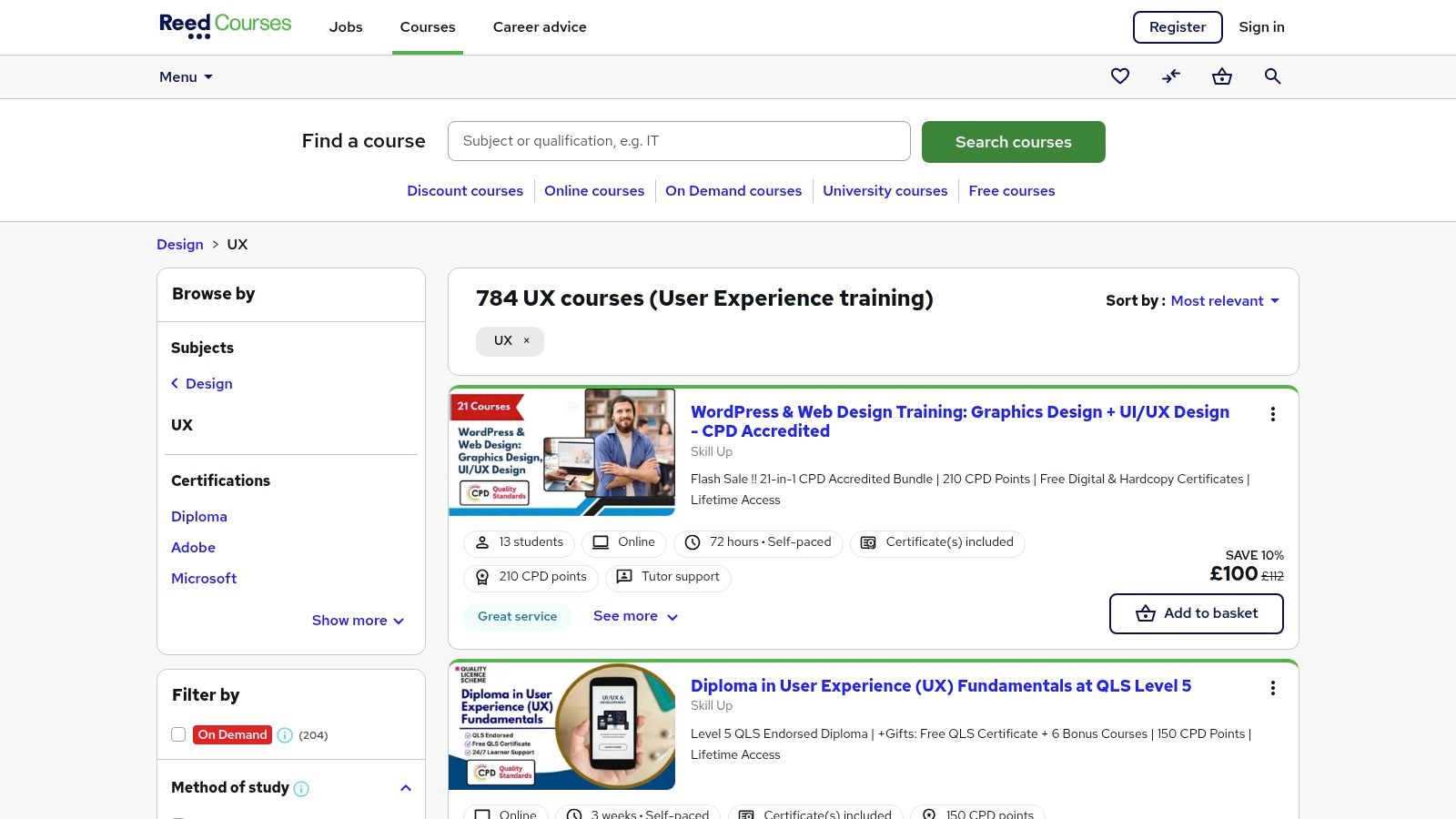
The primary advantage of Reed is the sheer variety and affordability, with prices clearly listed in GBP and frequent discounts available. For a startup or an SME, this means you can fund targeted upskilling for your team in a cost-effective manner. For instance, a Flutter developer could quickly complete a short course on mobile-first design principles to better inform their technical decisions, leading to more user-centric and performant applications without a significant time investment.
However, the marketplace model means quality can vary significantly between providers. Certificates are often CPD-accredited rather than being from globally recognised institutions. It’s crucial to read reviews and research the specific course provider before purchasing. Reed excels as a starting point for exploration or for plugging specific knowledge gaps, offering a low-risk way to explore niche UI/UX topics and enhance your team’s skills one step at a time.
| Feature Summary | Details |
|---|---|
| Level | All levels (Beginner to Advanced, varies by provider) |
| Duration | Varies widely from a few hours to several months |
| Cost | Ranges from under £20 for short courses to several hundred pounds; frequent sales and discounts. |
| Certification | Varies by provider; many offer CPD (Continuing Professional Development) or QLS (Quality Licence Scheme) endorsed certificates. |
| Pros | Huge variety of affordable options, UK-centric pricing, easy to find niche topics, ideal for quick upskilling or exploring interests before a major commitment. |
| Cons | Quality and depth vary dramatically between courses, accreditation is often not from major industry or academic bodies, requires careful vetting of providers. |
| Best For | Individuals testing the waters of UI/UX, professionals seeking CPD points, and businesses needing to provide low-cost, targeted training on specific design skills. |
12-Provider UI/UX Design Courses Comparison
| Provider | Core features ✨ | Quality ★ / Standout 🏆 | Best for 👥 | Price / Value 💰 |
|---|---|---|---|---|
| Coursera – Google UX Design Professional Certificate | 8-course portfolio program, self‑paced mobile + projects ✨ | ★★★★, 🏆 Google-branded credential | 👥 Entry-level jobseekers & portfolio builders | 💰 Mid — subscription or individual enrollment |
| FutureLearn | UK university partners, free‑to‑try + upgrade paths ✨ | ★★★ | 👥 Quick UK‑oriented upskilling | 💰 Low–Mid — pay-per-course or Unlimited |
| UX Design Institute | Credit‑rated diploma, mentorship & cohort projects ✨ | ★★★★☆, 🏆 Academic credit | 👥 Career-switchers & employer-focused applicants | 💰 High — premium diploma pricing |
| General Assembly | Cohort bootcamps, career services & employer events ✨ | ★★★★ | 👥 Intensive career changers | 💰 High — bootcamp tuition (financing available) |
| BrainStation | Evening/weekend cohorts, live instruction + portfolio ✨ | ★★★★ | 👥 Working professionals seeking portfolio boost | 💰 High — short intensive programs |
| The School of UX | Hands-on 1–5 day workshops, Skills Bootcamps (funded) ✨ | ★★★★ | 👥 Practical learners & eligible UK residents | 💰 Low–Mid — short course fees; funded places possible |
| Imperial College Business School – Professional Certificate | 24‑week part‑time, university‑backed executive format ✨ | ★★★★☆, 🏆 University credibility | 👥 Mid‑to‑senior professionals | 💰 £3,995 — premium executive pricing |
| LinkedIn Learning | Bite‑size courses & learning paths, LinkedIn certs ✨ | ★★★ | 👥 Busy pros for ongoing refreshers | 💰 Low — subscription (monthly/annual) |
| Udemy | Huge topic range, one‑time purchase with lifetime access ✨ | ★★★ | 👥 Self-directed learners targeting specific skills | 💰 Very Low — frequent discounts |
| OpenLearn (The Open University) | Free university-authored introductions & materials ✨ | ★★★ | 👥 Beginners testing UX interest | 💰 Free — statement of participation |
| Nielsen Norman Group (NN/g) | Research‑led short courses toward UX Certification ✨ | ★★★★★, 🏆 Industry authority | 👥 Experienced practitioners & specialists | 💰 High — premium per-course fees |
| Reed Courses | UK marketplace with filters (price, CPD, level) ✨ | ★★★ | 👥 Budget learners sampling niche topics | 💰 Low — many affordable CPD options |
Choosing the Right UI/UX Course for Your Flutter Development Team
Navigating the vast landscape of ui ux design courses can feel overwhelming, but this extensive review has hopefully illuminated the path forward. We've analysed a diverse range of providers, from the university-backed credentials of Coursera and Imperial College to the industry-focused bootcamps at General Assembly and the specialised, expert-led training from Nielsen Norman Group. The key takeaway is that the "best" course is entirely subjective; it hinges on your team's specific context, existing skill set, and ultimate business objectives.
For a startup or SME just beginning to integrate formal design processes into their Flutter development workflow, a foundational and comprehensive programme like the Google UX Design Professional Certificate on Coursera offers an unparalleled blend of structure, credibility, and affordability. It provides the common language and core principles necessary to align developers and fledgling designers, ensuring everyone is building from the same user-centric blueprint. Conversely, for an established in-house team looking to refine specific skills, targeted courses on Udemy or LinkedIn Learning can provide a more cost-effective and flexible solution for continuous professional development.
A Strategic Framework for Your Decision
Before committing to a course, it’s vital to conduct an internal needs analysis. Your decision-making process should be guided by several critical factors:
- Skill Gaps vs. Foundational Knowledge: Are you trying to teach your Flutter developers the fundamentals of user research and wireframing, or are you upskilling a junior designer in advanced prototyping and interaction design? A broad-spectrum certificate differs greatly from a specialised masterclass.
- Budget and Time Commitment: Consider the total investment. This includes not only the course fees but also the productive hours your team will spend learning instead of working on active projects. Intensive, full-time bootcamps like those from BrainStation offer rapid transformation but require significant operational commitment, whereas self-paced options from FutureLearn or OpenLearn allow for greater flexibility.
- Application to Flutter: How easily can the course's teachings be translated into your Flutter development environment? While most principles are universal, look for courses that emphasise mobile-first design, component-based systems, and prototyping tools that mimic the interactive, widget-based nature of Flutter. This ensures the theoretical knowledge has immediate practical application.
- Learning Culture and Support: Evaluate the support structures offered. Does your team thrive in a collaborative, instructor-led environment, or do they prefer autonomous, self-directed learning? Providers like the UX Design Institute offer strong mentorship, which can be invaluable for ensuring concepts are properly understood and applied. For organisations building their own internal training, exploring expert online course design strategies can provide crucial insights into creating engaging and effective learning experiences that stick.
Ultimately, investing in UI/UX education is an investment in the quality and market success of your digital products. A well-designed, intuitive user experience is no longer a luxury; it is a core differentiator, especially in the competitive app marketplace. For teams building with Flutter, this investment is amplified. The framework’s remarkable capability for creating beautiful, high-performance interfaces can only be fully realised when guided by a deep understanding of user needs and design best practices. By carefully selecting the right ui ux design courses, you empower your team to not just build functional applications, but to craft exceptional experiences that delight users and drive business growth.
Ready to transform your UI/UX insights into a stunning, high-performance mobile application? The team at App Developer UK specialises in leveraging the power of Flutter to build beautiful, natively compiled applications for mobile, web, and desktop from a single codebase. Contact App Developer UK today to see how our expert developers can bring your user-centric vision to life.