The Ultimate Guide to Hiring a Quality Assurance Engineer
The Ultimate Guide to Hiring a Quality Assurance Engineer
Picture this: you’ve just launched your shiny new mobile app. But instead of rave reviews, you’re hit with a tidal wave of one-star ratings. Users are complaining about constant crashes, annoying bugs, and a user interface that’s impossible to figure out.
A skilled Quality Assurance Engineer is the professional who prevents this exact nightmare. They’re the guardian of your product's quality and, by extension, your brand's reputation, right from the very beginning.
Why a QA Engineer Is Your Product's Best Insurance Policy

Too many businesses see quality assurance as just a final checkbox to tick off before launch—a quick bug hunt. That reactive approach isn’t just inefficient; it’s expensive. A great QA engineer doesn't just find problems; they stop them from ever cropping up in the first place.
Think of them as an architect reviewing the blueprints before a single brick is laid. They dig into the requirements, spot potential weak points, and make sure the whole development process is built on a solid foundation of quality. It’s this proactive mindset that really makes the difference.
Beyond Finding Bugs to Building Trust
The role of a QA engineer goes so much deeper than just testing code. They are the ultimate champion for your end-user, making sure every feature is intuitive, reliable, and works flawlessly. This obsessive attention to detail has a direct, positive impact on your bottom line.
When defects are caught early in the development cycle, you save countless hours of pricey rework that would otherwise be needed after launch. In fact, studies show that fixing a bug in production can cost up to 30 times more than fixing it during the design or development phase.
A proactive QA process isn't an expense; it's an investment in customer loyalty and brand integrity. By ensuring a seamless user experience, a QA engineer directly contributes to higher user retention, better reviews, and a stronger competitive position in the crowded UK app market.
This whole process is about creating a constant cycle of feedback and improvement. A huge part of the value a QA engineer brings is their role in mastering the product feedback loop, turning user insights into tangible, continuous quality improvements.
Your Competitive Advantage in the UK Market
In today's fast-moving world, where user expectations are sky-high, a single bad experience can send customers straight to your competition. A dedicated quality assurance engineer gives you a crucial competitive edge.
They ensure your Flutter app isn't just functional, but delivers the kind of exceptional performance that users now demand. This commitment to quality leads to some serious wins:
- Increased User Satisfaction: A smooth, bug-free app means happier users and more of those coveted positive app store ratings.
- Enhanced Brand Reputation: When you consistently deliver high-quality products, you build trust and position your company as a reliable leader in your field.
- Faster, Safer Releases: With robust testing processes in place, you can roll out new features with confidence, knowing they won’t break what’s already working.
At the end of the day, bringing a quality assurance engineer into your team is the best insurance policy for your digital product. It protects your investment and sets you up for long-term success.
A Day in the Life of a Modern QA Engineer
Forget the old stereotype of someone just clicking around looking for bugs. A modern QA engineer’s day is a dynamic mix of strategy, careful execution, and crystal-clear communication. Their entire focus is on protecting the app's integrity from the inside out.
Think of them as the ultimate advocate for your users. They're there to ensure every tap, swipe, and interaction feels smooth, reliable, and completely intuitive. This mission starts long before the first line of code for a new feature is even tested, kicking off with comprehensive test plans that map out the entire quality strategy.
From Planning to Precise Execution
Once the high-level plan is in place, it's time to get into the details. The QA engineer gets to work writing detailed test cases – essentially, step-by-step scripts that confirm a specific feature works exactly as it should. These scripts form the foundation for both manual and automated testing.
For instance, a simple login screen might have test cases for valid credentials, handling wrong passwords, and making sure the "forgot password" link actually goes somewhere useful. This level of detail ensures every possible user journey is explored, preventing those frustrating dead ends that can kill a user's experience.
The actual testing is a balancing act, blending two essential approaches.
Manual vs Automated Testing: A Strategic Comparison
Deciding when to use a human touch and when to let the machines do the heavy lifting is a key part of a QA engineer's strategy. It's not about one being "better" than the other; it's about using the right tool for the right job to get the best possible coverage.
| Aspect | Manual Testing | Automated Testing |
|---|---|---|
| Best For | Exploratory testing, usability checks, and situations requiring human intuition and adaptability. | Repetitive tasks, regression testing, performance checks, and data-driven validation. |
| Human Element | High. A real person interacts with the app, discovering nuanced UX flaws and visual glitches. | Low. Scripts follow pre-defined paths and logic, which is great for consistency but lacks creativity. |
| Speed & Efficiency | Slower for repetitive tasks but faster for quick, one-off checks or exploring a new feature. | Extremely fast for running hundreds of tests overnight. Requires upfront time to write the scripts. |
| Cost | Can have a higher long-term cost for regression testing due to the time commitment. | Higher initial setup cost for tools and script development, but much cheaper to run in the long run. |
| Strategic Use | Perfect for ensuring a new feature feels right, is easy to navigate, and looks good on different devices. | Essential for creating a safety net to ensure new code doesn't break existing, critical features. |
Ultimately, a great QA process uses a smart combination of both. Manual testing finds the human-centric problems, while automated testing ensures the app remains stable and reliable as it evolves.
The Art of Defect Management and Communication
Finding a bug is just step one. A huge part of a QA engineer’s day is spent on defect tracking and reporting. When an issue is found, it needs to be logged meticulously in a system like Jira.
And it’s not just about flagging that something is broken. One of the most critical skills is knowing how to write bug reports that get fixed instead of being pushed to the bottom of the pile. A great bug report gives developers everything they need: clear steps to reproduce the issue, screenshots, and details about the environment. This turns a vague problem into a solvable puzzle.
The goal of a QA Engineer isn't just to report problems, but to provide developers with all the information they need to solve them efficiently. Clear, concise communication is the bridge between identifying a defect and deploying a fix.
Finally, their work isn't just about functionality. A QA engineer also handles non-functional tests, like load and performance testing. They'll simulate thousands of users hitting your app at once to find bottlenecks and ensure it stays fast and responsive under pressure. It's a proactive step that prevents crashes and slowdowns when you can least afford them.
The Winning Combination: Technical Chops and People Skills
When you're hiring a top-tier quality assurance engineer, you’re looking for a unique blend of skills. The technical expertise gives them the "what" and "how" of testing, but it’s the soft skills that provide the all-important "why." You can't have one without the other; it leads to a quality process that’s missing half the picture.
A great QA engineer isn't just a technician. They’re a hybrid professional who can dive deep into a complex automation script in the morning, then pivot to lead a collaborative bug-triage meeting in the afternoon. This ability to wear two hats is what separates the good from the great, ensuring quality is baked into both the code and the team’s culture.
Essential Technical Foundations
The technical skill set is the bedrock. It’s what allows a QA engineer to properly validate your application from the inside out. For a company building Flutter apps, a few technical skills are completely non-negotiable.
First off, proficiency in programming languages is a must, especially for building solid automation suites. While languages like Python and Java have been the go-to for frameworks like Selenium for years, a deep understanding of Dart is a massive advantage for testing Flutter apps. It means the engineer can work hand-in-glove with your developers, writing far more efficient tests using Flutter's own native testing libraries.
Beyond the code itself, a quality assurance engineer needs to be comfortable with a specific set of tools and platforms.
- Mobile Platform Expertise: They need to know the ins and outs of both iOS and Android platform guidelines to spot those tricky, platform-specific bugs.
- Debugging Tools: Getting hands-on with tools like Xcode for iOS and Android Studio's debugger for Android is crucial for digging in and finding the root cause of complex problems.
- Version Control Systems: Fluency in Git is absolutely essential for managing test code, collaborating with the development team, and slotting tests into the CI/CD pipeline.
This technical knowledge is what enables them to build and maintain a testing framework that’s as robust as the application it's meant to protect.
The Non-Negotiable Soft Skills
If the technical skills are the engine, then the soft skills are the steering wheel and the GPS. They guide the whole quality process, making sure it’s heading in the right direction so that everyone arrives at the same destination: a high-quality product.
An almost obsessive attention to detail is probably the most famous trait of a good QA engineer. These are the people who spot the single-pixel misalignment that everyone else misses, or notice that fractional delay in an animation that just feels off to the user. This meticulous approach ensures nothing important slips through the cracks.
But just finding problems isn’t enough. You need strong analytical and problem-solving skills to figure out why a bug is happening in the first place. A great QA engineer doesn’t just log a ticket saying "the button is broken." They investigate the conditions, replicate the issue reliably, and give developers a clear puzzle to solve instead of a vague mystery.
A QA engineer's greatest value is realised when they act as a bridge between the technology and the user. Their technical skills let them understand the system, while their communication and empathy let them champion a better user experience.
Finally, crystal-clear communication and a collaborative spirit tie everything together. A quality assurance engineer has to translate complex technical defects into simple, actionable bug reports. They need to work constructively with developers, project managers, and designers, building a shared sense of ownership over quality instead of creating an adversarial "us vs. them" dynamic. This teamwork turns QA from a simple checkpoint into a powerful engine for making the product better every single day.
Mastering Quality Assurance For Flutter Apps
When you're building a Flutter app, a one-size-fits-all approach to quality assurance just won’t do. Flutter is a different beast altogether, celebrated for its buttery-smooth performance and stunning UIs. Recent benchmarks confirm its place at the top for performance, making it a leading choice for high-quality apps. To do it justice, you need a QA engineer who gets what makes it tick.
A specialist in Flutter QA ensures your app isn't merely functional; they make sure it delivers that snappy, native feel users love. They go beyond generic testing checklists, using strategies built specifically for the Flutter ecosystem. This isn't just a nice-to-have – it's essential for creating a reliable, polished product that stands out.
The Flutter Testing Pyramid
Any seasoned QA engineer will tell you that Flutter testing isn't a random collection of checks. It’s structured, and that structure is known as the testing pyramid. Think of it as a blueprint for a smart, fast, and cost-effective testing strategy that focuses energy where it matters most.
Each layer of the pyramid has a specific job:
- Unit Tests: These are the foundation, the wide base of the pyramid. A QA engineer uses them to check the smallest, most isolated pieces of your code—a single function, method, or class. For instance, they might test a function that calculates a discount to ensure it always returns the correct value. They’re quick, simple, and brilliant for catching logic errors early.
- Widget Tests: Moving up a layer, we have widget tests. These are all about checking individual Flutter widgets. The goal is to verify that a widget’s UI looks right and behaves as it should when a user interacts with it. A classic example is testing that tapping a button correctly triggers an action, like displaying a new piece of text on the screen.
- Integration Tests: At the very top, the narrowest part of the pyramid, are integration tests. These are the big-picture tests. They make sure different parts of your app work together seamlessly, often covering an entire user journey from start to finish. An integration test could simulate a user logging in, browsing products, adding one to their basket, and successfully checking out.
By leaning heavily on unit and widget tests, a good QA engineer can squash the vast majority of bugs quickly and cheaply. Integration tests are used more selectively to confirm the whole system hangs together perfectly, making the entire process both thorough and efficient.
Leveraging Flutter's Unique Strengths
A QA engineer who truly knows their way around Flutter doesn't just understand the testing pyramid; they know how to turn the framework's unique features into a testing superpower.
One of the biggest game-changers is Flutter's 'hot reload' capability. This lets them inject updated code into a running app and see the changes instantly, without needing a full restart. For a QA engineer, this is gold. It means they can test bug fixes and UI tweaks in real-time, massively shortening the feedback loop with developers.
A solid grasp of the Dart language is also non-negotiable. All Flutter tests are written in Dart, so an engineer who is fluent can write cleaner, more efficient, and easier-to-maintain test scripts. This expertise is what elevates a standard testing process into a high-impact quality assurance strategy that slots right into your development workflow. It’s also vital for building solid test automation that plugs into your pipeline. To see how this fits into the bigger picture, you can explore our guide on what is continuous integration for Flutter apps to understand the complete development lifecycle.
The following chart breaks down the mix of technical and soft skills that make for a first-class quality assurance engineer.
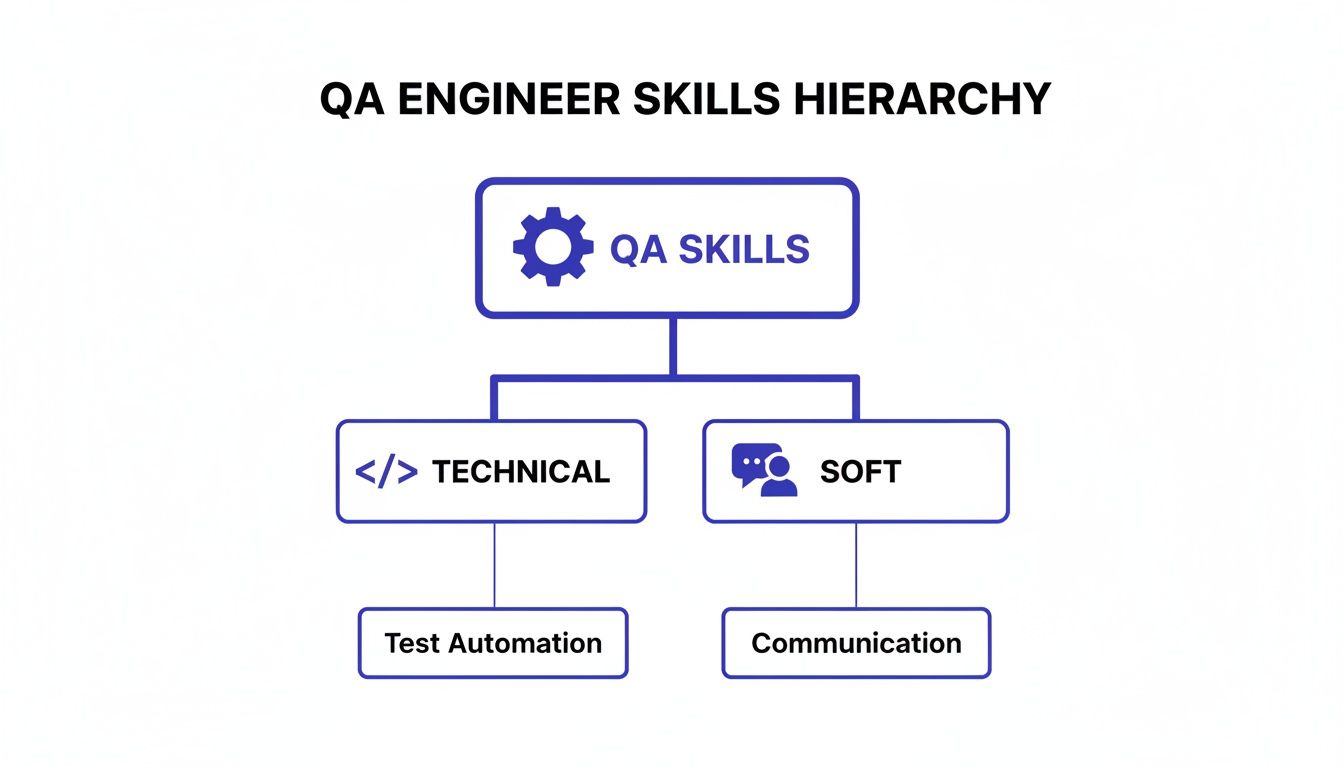
As you can see, success in this role is a balancing act, requiring a mastery of the technical side of testing and the people skills needed to work effectively with the rest of the team.
Your Actionable Guide to Hiring a QA Engineer in the UK
Bringing the right quality assurance engineer onto your team is a game-changer. It’s a strategic move that pays dividends long before your app even thinks about launching. This isn’t just about filling a seat; it’s about finding a partner in quality, someone who will champion your user’s experience and fiercely protect your product.
A structured approach is your best bet for attracting candidates who have the exact skills your project demands.
Before you even dream of writing a job description, you need to get crystal clear on what you actually need. Nailing this down from the start makes the whole hiring process smoother and far more effective. It also ensures you’re talking to people who are a genuine fit for your team and tech stack, which is especially vital for specialised roles like a Flutter QA engineer.
The Pre-Hiring Checklist
Take a moment to hash out these questions internally. Your answers will form the backbone of your job description and interview process.
- Project Stage: Are you right at the beginning, needing someone to build a QA strategy from the ground up? Or are you bringing someone in to whip an existing app into shape? The answer dictates whether you need a strategist or a hands-on fixer.
- Automation Needs: What’s the end goal for test automation? Are you looking for a pioneer to build a framework from scratch, or someone to take the reins of an existing setup?
- Manual Testing Scope: How much manual and exploratory testing will be involved? This is non-negotiable for catching the subtle user experience quirks that automated scripts always miss.
- Team Integration: How will this person slot in with your developers and project managers? A great QA engineer should be a bridge-builder, not a roadblock.
Once you’ve got this internal alignment, you’re ready to craft a job description that genuinely speaks to the right people.
Flutter QA Engineer Job Description Template
A great job description does more than just list tasks—it sells the vision and your company culture. Here’s a template you can adapt, specifically tailored for a Flutter role.
Job Title: Quality Assurance Engineer (Flutter)
About Us: A short, punchy intro to your company. What's your mission? Why is it a great place to work? Keep it genuine.
The Role: We’re looking for a meticulous and proactive QA Engineer to take full ownership of the quality of our cutting-edge Flutter applications. You’ll be at the heart of the entire testing lifecycle, from creating test plans to executing both manual and automated tests. Your work will directly shape the stability, performance, and user experience of our app, ensuring we deliver something truly flawless.
Key Responsibilities:
- Develop and execute comprehensive test plans and test cases.
- Design, build, and maintain automated test scripts for our Flutter app using Dart and relevant frameworks.
- Perform thorough manual, regression, and exploratory testing to hunt down bugs and UX issues.
- Clearly document and track defects in our issue-tracking system (e.g., Jira).
- Collaborate closely with developers and product managers, making sure quality is baked into the process, not bolted on at the end.
Required Skills:
- Proven experience as a QA Engineer, with a strong focus on mobile applications.
- A solid grasp of QA methodologies and the software development lifecycle.
- Hands-on experience with mobile test automation frameworks.
- Excellent problem-solving skills and an almost obsessive eye for detail.
- Strong communication skills and a truly collaborative mindset.
Desirable Skills:
- Direct experience testing Flutter applications.
- Proficiency with the Dart programming language.
- Familiarity with CI/CD pipelines and tools.
Insightful Interview Questions
The interview is where you get to see beyond the CV. These questions are designed to probe both their technical know-how and their whole philosophy on quality.
- Walk me through your process for creating a test plan for a new Flutter feature. (This assesses their strategic thinking).
- How do you prioritise bugs when you know the development team is stretched thin? (This tests their pragmatism and business awareness).
- Describe a time you found a critical bug late in the release cycle. How did you handle the situation? (This reveals how they communicate and solve problems under pressure).
- How would you approach building a test automation strategy for a brand-new Flutter app? (This digs into their technical and architectural knowledge).
- In your opinion, what’s the single most important quality for a QA Engineer to possess? (This gives you a peek into their personal philosophy and cultural fit).
Finding the right person is a huge step forward. If you're looking for broader advice on building out your team, feel free to check out our guide on how to hire app developers in the UK for more insights. A strategic hiring process like this ensures you don’t just fill a role, but find a quality assurance engineer who becomes an invaluable part of your success.
Budgeting for QA Engineer Salaries and Rates in the UK
When you're ready to bring a top-tier quality assurance engineer onto your team, figuring out the budget is a critical first step. It’s about more than just numbers on a spreadsheet; setting a realistic budget shows you understand the immense value this role brings to your project's success and helps you make a competitive offer that attracts real talent.
In the UK, what you can expect to pay for a QA engineer isn't a single, fixed number. It shifts quite a bit based on experience, specific skills, and, crucially, location. The UK tech scene isn't just London anymore. While the capital still leads, vibrant hubs across the country have their own talent pools and cost of living, which directly impacts salary expectations.
Understanding Permanent Salary Ranges
Hiring a permanent QA engineer means thinking about a few key factors that shape their salary expectations. London, as a global tech centre, naturally commands the highest salaries. But don't overlook other thriving cities like Manchester, Bristol, and Edinburgh, which have their own competitive, albeit different, salary bands.
The picture for QA roles across the UK shows some clear regional splits. Looking at national data from employer-submitted salaries, the average UK QA Engineer salary tends to fall in the mid-to-high £30k–£40k range. For instance, some salary aggregators peg the average base salary around £36,074, while others report a figure closer to £43,582 per year. This just goes to show how different data sets can paint slightly different pictures.
A competitive salary isn't just about hitting an average; it’s a powerful message to candidates that you genuinely value quality and are serious about investing in it. Getting your budget right is the first step in attracting professionals who will safeguard your product.
Navigating the Contractor Market
For projects with a clear end date or those that need a very specific skill set for a short burst, hiring a contractor can be a brilliant, flexible move. Instead of thinking in annual salaries, contractors operate on a day rate, which can range anywhere from £300 to over £600 per day in the UK.
This approach brings a few solid advantages to the table:
- Access to Specialised Skills: Need an expert in performance testing or a niche automation framework? You can bring them in just for the time you need them, without a long-term commitment.
- Increased Flexibility: It allows you to scale your QA team up or down as the project demands, keeping you agile.
- Immediate Impact: Seasoned contractors are pros at hitting the ground running. They integrate quickly with your team and start adding value from day one.
Choosing between a permanent hire and a contractor really boils down to your long-term goals versus your immediate project needs. For a broader look at how different roles affect your project's finances, our comprehensive UK app pricing guide offers some great context on overall development costs. At the end of the day, a well-planned budget for quality assurance is a direct investment in your app’s future.
Common Questions About Hiring a Quality Assurance Engineer
Deciding to bring a quality assurance engineer into your team is a huge step toward building a better product. But it naturally comes with a few practical questions about timing, roles, and real value. Let’s get you some straight answers to the most common queries we hear.
When Is the Right Time to Hire Our First QA Engineer?
Honestly? At the very beginning of a new project. Getting a quality assurance engineer involved during the initial planning and design phases lets them build a robust testing strategy from the ground up. This way, quality isn’t an afterthought; it’s baked into the entire development lifecycle.
Waiting until the end to "test for bugs" is a false economy. It’s far more expensive and inefficient. By embedding QA from day one, you stop costly defects from ever being built into the software's foundation, saving a huge amount of time and money down the line.
What Is the Main Difference Between a QA Engineer and a Tester?
While people often use the terms interchangeably, their roles are actually quite distinct. A software tester typically focuses on a reactive process: finding and reporting bugs in software that’s already been built. Their main goal is to run through test cases and spot where the app fails to meet the requirements.
A quality assurance engineer, on the other hand, has a much broader, more proactive job. They are involved in the entire process to prevent defects from happening in the first place.
A tester finds bugs after they’re created; a Quality Assurance Engineer works to make sure they are never created. They do this by setting quality standards, creating comprehensive test plans, and building automation scripts to improve the whole development process.
How Can We Measure the ROI of a Quality Assurance Engineer?
The return on your investment in a QA engineer comes from both cost savings and revenue protection. While it might not show up as a direct line item on a balance sheet, the financial impact is massive.
You can track their impact through a few key metrics:
- A measurable drop in the number of critical bugs that make it into the live app.
- Fewer customer support tickets related to software glitches and performance issues.
- Faster, more predictable release schedules, thanks to efficient test automation.
Ultimately, their value is realised by cutting down the immense cost of fixing post-release bugs and, most importantly, by protecting your user satisfaction and brand reputation. A flawless app experience translates directly to higher user retention and better reviews.
At App Developer UK, we know that quality isn't just a feature—it's the foundation of a successful app. Our expert team integrates rigorous QA processes into every Flutter project, ensuring your application is flawless, high-performing, and ready to impress your users from day one. https://app-developer.uk