A Guide to Custom Mobile Apps Development in the UK
A Guide to Custom Mobile Apps Development in the UK
When you hear the term custom mobile app development, what comes to mind? Essentially, it’s the process of building a unique software application from the ground up, designed purely for your business's specific needs and ambitions.
Unlike off-the-shelf software that offers a generic, one-size-fits-all solution, a custom app is crafted to solve your unique operational headaches, plug seamlessly into your existing systems, and deliver an experience your users won’t find anywhere else.
Unpacking Custom Mobile App Development
Let’s think about it this way. An off-the-shelf app is like a standard rental car. It’s perfectly functional and will get you from A to B, but it isn’t really optimised for your specific journey. It might lack the boot space you need, the fuel efficiency for a long trip, or the right tyres for tricky terrain. You end up having to adapt your plans to fit the car's limitations.
Custom mobile app development, on the other hand, is like commissioning a bespoke vehicle. Every single element is designed around your exact requirements. The engine is tuned for the performance you need, the interior is configured for your cargo, and the navigation system is programmed for your specific routes. It stops being just a tool and becomes a strategic asset, built to do a job flawlessly.
Why Bespoke Beats Off-the-Shelf
Pre-packaged or "cookie-cutter" apps nearly always force businesses to compromise. They might not sync properly with your customer relationship management (CRM) software, lack the security protocols you need, or simply buckle under the pressure as your user base grows. These limitations create bottlenecks and can seriously hold back your growth.
A custom-built application tackles these issues head-on, offering tailored solutions that generic apps just can't compete with.
Custom mobile app development is about creating a digital tool that aligns perfectly with your business processes, not forcing your processes to align with a generic tool. This alignment is where a true competitive advantage is born.
The Core Advantages of a Custom Approach
Investing in a bespoke solution unlocks several powerful benefits that directly impact your operations and, ultimately, your bottom line. While the initial investment might be higher, it often proves more cost-effective in the long run by eliminating recurring licence fees and the hidden costs of constantly working around an ill-fitting solution.
Here’s what you stand to gain:
- Enhanced Security: You’re in the driver's seat. You control the security technologies and protocols, allowing you to build a fortress around your company's and customers' data instead of relying on a generic provider's one-size-fits-all measures.
- Seamless Integration: A custom app can be designed to talk flawlessly with your entire software stack. From inventory management systems to proprietary databases, you can create a truly unified operational ecosystem.
- Unmatched Scalability: As your business expands, your app can grow right alongside it. You can implement new features, increase user capacity, and roll out performance upgrades without being held back by a third-party platform's limitations.
- Full Ownership: It's all yours. You own the intellectual property and the source code. This gives you complete freedom to evolve, modify, or even sell the application down the line with zero restrictions.
Why Your Business Needs a Custom App in the UK Market
In the UK's bustling marketplace, having a custom mobile app has quickly gone from a nice-to-have extra to a core part of any serious business strategy. The way people connect with brands, shop, and use services has completely changed. The smartphone is now the command centre of daily life.
What does that mean for you? It means the most valuable real estate you can own is a spot on your customer's home screen.
A bespoke app gives you a direct, uninterrupted line to your audience. Unlike a website that a user has to remember to visit, your app lives right there on their device. This lets you communicate instantly with push notifications and create a controlled, branded space that's all your own. That immediate connection builds real engagement and lasting loyalty in a way no other digital channel can.
Tapping into the UK’s Mobile-First Economy
The numbers don't lie. People in the United Kingdom aren't just using their phones more; they're living their lives through them. From ordering the weekly shop and booking a haircut to managing finances and streaming films, mobile apps are now essential daily tools. This shift in behaviour is a huge opportunity for businesses ready to meet customers exactly where they are.
Think about it. A retail business with its own app can use customer data to send out personalised offers, making the journey from browsing to buying incredibly smooth. A service company can use an app to make booking appointments a breeze, send real-time updates, and get instant feedback. That’s a massive upgrade to the customer experience. If you’re not offering a dedicated mobile solution, you’re just leaving that business on the table for your competitors.
Investing in custom mobile app development isn't just about following a trend. It's a strategic move to position your business for success in a market that demands convenience, speed, and a personal touch.
The growth stats are just too big to ignore. The UK mobile app development market is set to become a £28.3 billion powerhouse by 2025, growing at an incredible 12.9% each year. With app downloads expected to shoot past 8.5 billion and mobile shopping revenue getting close to £28 billion, it’s crystal clear that custom apps are vital for staying in the game. For any UK business with ambitions to grow, this data is a wake-up call. You can dive deeper into the UK's mobile market growth with Netguru's detailed analysis.
Gaining a True Competitive Advantage
Sure, generic app builders might seem like a quick and easy option, but they rarely deliver the kind of unique, slick experience that UK customers have come to expect. People want flawless performance, intuitive design, and features that genuinely solve their problems. This is where custom mobile apps development really pulls ahead.
A bespoke app gives you the freedom to craft a brand experience that’s distinct and memorable. You get total control over everything, from the look and feel of the user interface down to the complex logic working behind the scenes. This control means you can build a tool that doesn’t just meet your customers' needs but actually anticipates them, making you stand out in a very crowded market.
Here are the key advantages a custom app gives you in the UK:
- A Direct Marketing Channel: Forget cluttered email inboxes. Send targeted push notifications about sales, new products, or important updates straight to your users' phones.
- Deeper Customer Engagement: Build interactive features, loyalty schemes, and personalised content that keeps people coming back and strengthens their connection to your brand.
- Smarter Operations: Automate some of your internal workflows, streamline how you handle customer service, and collect valuable data to help you make better business decisions.
- Always Accessible: Give your customers a simple, one-tap way to get to your services anytime, anywhere, right from their pocket.
Choosing Your Development Path: Native vs Cross-Platform
Once you've decided to build a custom mobile app, you hit your first major fork in the road. This technical choice will define your budget, your timeline, and your app's future. Do you build two separate, native apps for iOS and Android, or do you take a modern, cross-platform approach? It’s one of the most important decisions you'll make.
Think of it like this. Imagine you need two identical, top-spec houses—one in London and another in Manchester.
The native approach is like hiring two separate architecture firms and two local construction crews. Each team uses materials and methods specific to their region; one builds with classic London brick, the other with Manchester's famous red brick. You end up with two beautiful, perfectly optimised homes, but you’ve paid for two sets of blueprints, managed two projects, and spent a whole lot more money.
The cross-platform approach is like using a state-of-the-art modular building system. A single, highly detailed master blueprint is designed. The core components are precision-engineered in one central workshop and then shipped to both sites for assembly. The result? Two stunning, high-performance houses that feel identical in quality, built far faster and more cost-effectively from a single, unified plan.
This is the reality of modern app development, and frameworks like Google's Flutter are that advanced modular system making it all possible.
The Traditional Route: Native Development
Native development means building two entirely separate apps from the ground up, using the official programming languages for each platform. For iOS, that’s Swift or Objective-C. For Android, it's Kotlin or Java.
For years, this was seen as the only way to guarantee top-tier performance, as the code could access every device feature directly.
But that performance comes with some serious baggage:
- Higher Costs: You're literally funding two distinct app development projects. This can come close to doubling your initial investment.
- Longer Timelines: Juggling two codebases and coordinating two development streams takes a lot more time, pushing back your launch date.
- Complex Maintenance: Every bug fix, update, or new feature has to be designed, built, and tested twice. This piles on the operational costs over the app's lifetime.
While native apps still perform brilliantly, the sheer inefficiency in time and money makes it a tough sell for most businesses today.
The Modern Solution: Cross-Platform with Flutter
Cross-platform development has come a long way from the clunky, compromised technologies of the past. Today, modern frameworks let developers write code just once and deploy it beautifully on both iOS and Android. The clear leader in this space, especially when it comes to performance and quality, is Flutter.
Flutter completely changes the game by bridging the gap between efficiency and excellence. It doesn't just run code in a wrapper; it compiles it directly into native ARM machine code. This means it doesn't just imitate a native app—it performs like one.
In fact, recent benchmarks consistently show that Flutter apps meet or even beat their native counterparts in key areas like CPU usage and rendering speed. The old trade-off between saving money and getting great performance is officially a thing of the past.
To make this crystal clear, let's break down how the two approaches stack up for your business.
Native vs Cross-Platform (Flutter) At a Glance
This table cuts through the noise and shows you exactly what each path means for your project's key resources: time, money, and long-term effort.
| Factor | Native Development (iOS & Android) | Cross-Platform with Flutter |
|---|---|---|
| Codebase | Two separate codebases (Swift/Kotlin) | One single, unified codebase |
| Development Cost | Significantly higher (two teams, two projects) | Reduced by up to 40% |
| Time to Market | Longer due to parallel development cycles | Much faster, unified development |
| User Interface | Platform-specific, requiring separate designs | Consistent, beautiful UI across all devices |
| Performance | Excellent, direct access to native features | Native-like performance and speed |
| Maintenance | Complex and costly (updates for both apps) | Simpler and more cost-effective |
As you can see, the advantages are compelling. For UK businesses looking for a powerful, cost-effective, and future-proof way to get to market, Flutter is simply the smarter choice. It delivers the speed, beautiful design, and smooth user experience that today's users demand, but without the financial and logistical headache of building everything twice.
To get a better feel for how this powerful framework can be put to work, check out our guide to Flutter development services. It’s the direct path to a high-quality custom mobile app that delivers real results.
Your Custom App Development Journey Step-by-Step
Building a custom app from scratch can feel like a massive undertaking, but it's far less daunting when you have a clear roadmap. Think of it less like complex engineering and more like a structured, predictable journey. By breaking it down into distinct stages, we can take your initial idea and turn it into a polished, market-ready product without any guesswork.
It’s a lot like building a house. You wouldn't just start laying bricks and hope for the best. You'd start with detailed architectural plans, lay a solid foundation, build the structure, and only then add the windows, doors, and finishing touches. Custom app development follows that same logical path, ensuring the final product is built to last and serves its purpose perfectly.
The infographic below highlights the fundamental difference between the traditional native approach and the more modern, efficient cross-platform route we talked about earlier.
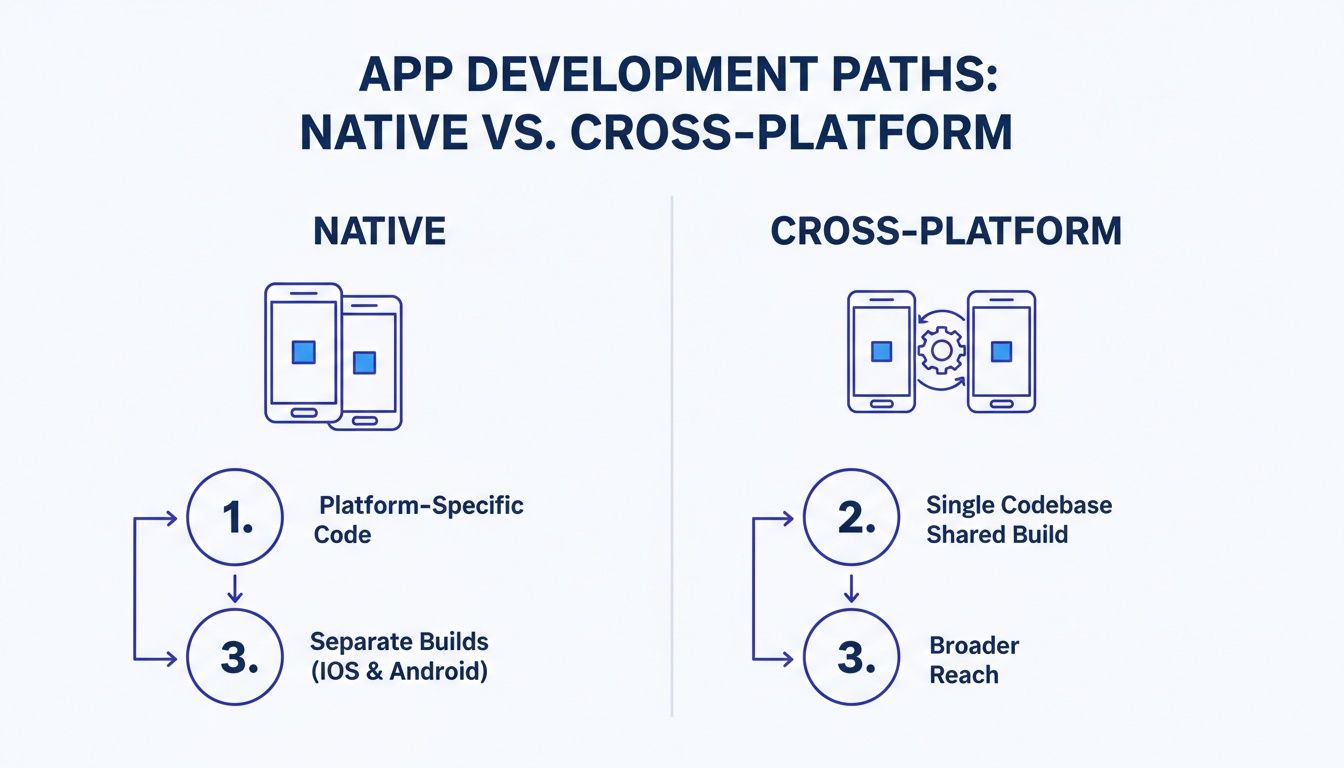
You can see how a single, unified development effort with a cross-platform framework like Flutter creates brilliant apps for both iOS and Android simultaneously.
Stage 1: Discovery and Strategy
This is easily the most important phase—it's the foundation for everything that follows. Before we even think about writing a single line of code, we need to get to the heart of your project. We'll dive deep into your business goals, get to know your target audience, and pinpoint the exact problem your app is going to solve.
Your role here is to bring the vision; our role is to help shape it into a concrete plan. Together, we'll define the app's core features, establish clear key performance indicators (KPIs), and map out a detailed project strategy. This stage is all about making sure we're on the same page and building something that will deliver real, measurable value.
Stage 2: UI/UX Design
With a rock-solid strategy in place, we shift our focus to how the app will look, feel, and function. This is where User Interface (UI) and User Experience (UX) design come into play. UI is the aesthetics—making it visually appealing and aligned with your brand. UX is the logic—ensuring the app is intuitive, easy to use, and genuinely enjoyable.
We start with wireframes, which are like the basic blueprints for each screen. From there, we build interactive prototypes that let you click through the app's entire journey, long before any development starts. This gives you a tangible feel for the final product and allows us to gather feedback and make refinements, guaranteeing the design hits the mark with your users.
Stage 3: Development and Coding
This is where the magic happens and your vision truly begins to materialise. Our developers get to work writing the clean, robust code that will power your application. Working from the approved designs, they'll build out the front-end (everything the user sees and interacts with) and the back-end (the servers, databases, and unseen logic that makes it all work).
This is the stage where choosing a modern framework like Flutter really pays off. Our team builds from a single codebase, which massively accelerates the development timeline and keeps costs down. All this, while still delivering that flawless, native-like performance on both iOS and Android devices.
Throughout this phase, you’ll get regular updates and test builds to review. We believe in keeping you in the loop every step of the way as we bring your app to life.
Stage 4: Quality Assurance and Testing
Before your app is ready for the world, it has to get past our Quality Assurance (QA) team. They put it through its paces with rigorous testing to make sure it’s stable, secure, and completely bug-free. The team tests every single feature across a huge range of devices and operating systems. This isn’t just about spotting crashes; it's about making sure the entire experience is seamless.
The QA process is thorough and includes:
- Functional Testing: Does every button, link, and feature work exactly as it should?
- Performance Testing: How fast is the app? Is it responsive? Does it drain the battery?
- Usability Testing: Is the app actually intuitive and easy for a new user to navigate?
- Security Testing: Are there any vulnerabilities we need to patch up before launch?
A critical part of this is comprehensive security validation. To learn more about protecting your application, it's worth reading a detailed guide on security testing for mobile apps.
Stage 5: Deployment and Maintenance
Finally, the big day arrives: launch day. We take care of the entire submission process, navigating the guidelines of the Apple App Store and Google Play Store to ensure a smooth and successful approval.
But our partnership doesn't stop there. Once your app is live, we continuously monitor its performance, help you gather user feedback, and provide ongoing maintenance. This means we're on hand to fix any issues, roll out updates with new features, and ensure your app stays compatible with new OS versions. This final stage protects your investment and keeps your app relevant for years to come.
If you want to know more about finding the right team to guide you through all five stages, check out our guide to hiring app developers in the UK.
Getting to Grips with Custom Mobile App Costs in the UK
One of the first, most practical questions any business asks is, "So, how much will a custom app actually set us back?" The truth is, there's no single price tag. It's a lot like asking how much it costs to build a house; a garden shed and a multi-storey office block are two very different projects. Custom mobile app development works the same way. The final bill is a direct reflection of what you want to build and how complex it is.
Here in the UK, the investment breaks down into some pretty clear tiers. Getting your head around these brackets helps you match your big idea with a realistic budget and see exactly what you're getting for your money at each level.
Breaking Down the Costs by Complexity
To give you a clearer picture, we can group projects into three main camps. Each one comes with its own set of typical features, timelines, and, of course, costs. You’ll see a natural progression from a simple, foundational product to a powerful, feature-packed platform.
- Simple Apps (The MVP): Think of these as your Minimum Viable Products (MVPs). They're designed with a core set of straightforward features—maybe a few information screens, a basic user login, and a contact form. The whole point is to get a working product into the market fast to test your concept without breaking the bank.
- Medium-Complexity Apps: This is where most business apps live. They often pack more of a punch, with features like custom user dashboards, detailed profiles, real-time chat, and integrations with payment systems or other third-party services. The user interface is much more polished, and a lot more thought has gone into creating a smooth, enjoyable user experience.
- Complex Apps: Now we're talking about the high-end, sophisticated stuff. These apps might be running on complex algorithms, using artificial intelligence (AI), syncing data in real-time for thousands of users, or plugging into massive backend systems. Think large-scale e-commerce platforms, on-demand services like Uber, or enterprise-level management tools.
What to Expect for UK Investment and Timelines
Once you know which tier your project falls into, the financial and time commitments start to make a lot more sense. UK-based research shows that custom mobile app development costs vary widely, starting from around £11,000 for basic cross-platform apps and soaring to over £125,664 for advanced, AI-driven enterprise solutions.
Most medium-complexity projects—the ones with custom dashboards and payment features—tend to land somewhere in the £21,000 to £80,000 range and typically take between 4 and 20 weeks to build.
It's crucial to see this as an investment, not just a cost. The key to getting the best return is choosing a development path that gives you maximum value. This is where modern frameworks like Flutter really shine.
By using a single codebase for both iOS and Android, Flutter can slash initial development costs compared to building two separate native apps. This simple shift makes bespoke app development far more accessible for UK businesses, allowing you to get a premium, high-performance app without the traditionally eye-watering price tag.
For a deeper dive into how different features and choices impact your final budget, be sure to check out our complete UK app pricing guide. It gives you a transparent look at what drives the cost, helping you plan and budget for your project with confidence.
Future-Proofing Your App With Key Technology Trends
A truly great custom app doesn’t just solve today’s problems; it’s built to grab tomorrow’s opportunities. To stay ahead of the curve, your application needs to be ready for the next wave of user expectations. This means looking beyond the features you need right now and thinking about the powerful technologies shaping the future of mobile.
The goal isn't to chase every shiny new trend. It's about strategically weaving in innovations that give you a real, lasting competitive edge. It's about building an app that can grow, adapt, and keep delivering value long after it first hits the app stores.
Embracing AI and Immersive Experiences
Artificial Intelligence (AI) and Machine Learning (ML) are no longer just buzzwords; they're becoming essential business tools. For your app, this can unlock incredible levels of personalisation by learning from user behaviour to offer tailored content, smarter product recommendations, and notifications that actually feel helpful. Imagine an e-commerce app that anticipates what a customer needs before they even search for it.
At the same time, Augmented Reality (AR) is creating more interactive and memorable brand experiences. A furniture retailer could use AR to let customers see exactly how a new sofa looks in their living room, all through their phone’s camera. These technologies turn a simple app into an intelligent, engaging assistant.
In the UK, custom mobile apps development is already being shaped by these forces. With 87% of consumers now shopping via apps, integrating advanced features like AR to boost engagement isn't just a nice-to-have; it's becoming crucial.
The Power of Real-Time Connectivity with 5G
The rollout of 5G across the UK is a complete game-changer for mobile apps. Its super-fast speeds and incredibly low latency open the door for features that were once pure science fiction. We're talking about high-definition video streaming without buffering, real-time collaboration tools, and instant data syncing for the Internet of Things (IoT).
For a logistics company, a 5G-enabled app could provide instantaneous vehicle tracking and rerouting. For a healthcare provider, it could support crystal-clear video consultations without a hint of lag. Building with 5G in mind from day one ensures your app is ready to deliver the next generation of real-time services.
A forward-thinking development strategy isn't just about the features you build today, but the architectural foundation you lay for the innovations of tomorrow. This is where your choice of technology stack becomes paramount.
Why Flutter is the Foundation for a Future-Ready App
To bring these advanced technologies to life, you need a development framework that is both powerful and flexible. This is precisely where Flutter shines. Its modern architecture and single codebase make it far easier to incorporate new capabilities like AI, AR, and IoT connectivity compared to the headache of managing two separate native codebases.
Because Flutter compiles directly to native code, it delivers the high performance needed to run these demanding features smoothly and without compromise. Of course, a huge part of being future-proof is security. To protect user data and maintain trust as your app evolves, it's vital to implement essential app security standards.
Choosing Flutter for your custom mobile apps development isn't just an efficient choice for today; it's a strategic investment in the future. It provides the adaptable, high-performance foundation you need to ensure your app remains relevant, secure, and capable of delighting users for years to come.
Here are the answers to some of the questions we hear most often from business owners across the UK. Getting into custom mobile apps development can feel like a big step, but we’re here to make it straightforward.
How Long Does It Take To Build A Custom App?
This is always one of the first questions we get, and the honest answer is: it depends entirely on what you need the app to do.
A simple Minimum Viable Product (MVP) with just the core functions can be up and running in as little as 8-12 weeks. For something more complex, perhaps with custom dashboards or third-party integrations, you're looking at closer to 4-6 months. The big, feature-rich platforms can easily take 9 months or more to get right.
The timeline really comes down to a few key things:
- How many features are you building, and how complex are they?
- How detailed and interactive does the user interface need to be?
- Are we connecting the app to other software systems you already use?
What Makes Flutter A Better Choice Than Other Frameworks?
There are a few ways to build an app for both iPhones and Android devices at the same time, but Flutter consistently comes out on top for us. Why? It’s all about performance and a genuinely great user experience.
Unlike older frameworks that can feel a bit clunky, Flutter apps are compiled directly into native code. This means they run incredibly fast—often just as fast, or even faster, than apps built separately for each platform.
For a business, this is a game-changer. You get one beautifully designed, high-performance app that works perfectly on both iOS and Android, but without the time and cost of building two separate versions from scratch. It’s the perfect blend of speed, quality, and smart economics.
How Much Involvement Is Needed From My Side?
We need you most at the very beginning. During the initial strategy and design phases, your knowledge of your industry and your vision for the product are absolutely essential. You know your customers better than anyone, and that insight is what helps us build something they’ll actually want to use.
Once we get into the development work, your main job is to give us feedback as we send you progress updates and new builds. We handle all the technical heavy lifting, but we see this as a partnership. You'll always be in the loop, so the final app is a perfect match for your business goals.
Do I Own The App And The Source Code?
Yes, 100%. This is a non-negotiable for us.
When you work with a professional agency on custom mobile apps development, the final product and all its source code should belong to you, and only you. It’s your intellectual property.
Having total ownership means you’re free to do whatever you want with your app down the line—add new features, scale it up, or even sell it. It’s your idea and your asset, and we make sure it stays that way.
Ready to turn your vision into a high-performance mobile app? The team at App Developer UK specialises in building stunning, fast, and reliable applications using the power of Flutter. Contact us today to discuss your project.