Finding Your Flutter App Development Company
Finding Your Flutter App Development Company
Choosing a flutter app development company is a huge first step. It's the decision that sets the stage for building a beautiful, high-performance app for iOS, Android, and the web, all from a single codebase. For UK businesses, finding a local specialist can make all the difference in terms of collaboration, market insight, and final quality.
Why a Specialist Flutter Company Is Your Best Bet
Picking a development partner is one of the most important moves your business will make. You could go with a generalist agency that offers a bit of everything, but a specialist Flutter firm brings a focused expertise that translates directly into a better final product.
Specialisation means they aren't just familiar with Flutter; they live and breathe its ecosystem day in, day out.

This deep knowledge is what allows them to really push the boundaries of what’s possible. They can implement those complex, slick animations, optimise performance down to the smallest detail, and solve tricky challenges that would stump a non-specialist. The result? A faster, more efficient development cycle and an app that feels genuinely native, no matter the device.
The Performance Edge of Flutter
Forget any outdated ideas you might have about cross-platform development. Modern benchmarks consistently put Flutter at the very top for performance, often rivalling or even beating native app speed. Its architecture compiles directly to native ARM code, neatly sidestepping the performance bottlenecks that plague other frameworks.
For your app, this means you get:
- Silky-smooth animations that run at a consistent 60-120 frames per second.
- Rapid startup times that keep users hooked from the moment they tap the icon.
- Efficient resource management, so the experience stays responsive even on older phones.
A dedicated Flutter team knows exactly how to squeeze every last drop of performance out of the framework. They use Flutter's unique rendering engine to create UIs that are not only stunning but incredibly fast—a combination that is absolutely vital for keeping users coming back.
The Real Value of UK-Based Expertise
Working with a UK-based Flutter company adds another strategic advantage. The UK’s app development scene is a buzzing hub of talent and fierce competition. In fact, the market is projected to hit £32.3 billion by 2026, driven by over 15,282 businesses across the country.
This competitive landscape forces a really high standard of quality. A local partner brings more to the table than just code:
- Seamless Communication: Being in the same time zone gets rid of frustrating delays and makes real-time collaboration a breeze.
- Market Acumen: UK specialists just get the local market—consumer habits, design trends, and important regulations like GDPR.
- Stronger Partnerships: Proximity allows for a much more personal and responsive relationship, which is crucial for agile development and long-term success.
When you start evaluating specialist Flutter companies, dig into their portfolios. Look for a track record of handling diverse and complex projects. Seeing examples of them successfully building a modern app is solid proof they can handle sophisticated requirements. Whether you're a startup or an established business, a dedicated UK partner provides the collaborative foundation you need to turn a brilliant idea into a market-leading application.
Navigating the UK Flutter Development Scene
The UK has seriously cemented its place as a global tech powerhouse, and the mobile app development scene is a massive part of that reputation. If you’re hunting for a top-tier flutter app development company, you’ll find the UK is a buzzing, competitive market packed with specialist talent. It’s not just about finding people who can code; it’s about finding strategic partners who get both the tech and the nuances of the local market.
This concentration of expertise isn't just a happy accident. London, for example, is often cited as the second most connected tech hub in the world, right behind Silicon Valley. This acts like a magnet for talent, meaning the UK is home to a significant cluster of dedicated Flutter agencies. We’re talking somewhere between 262 and 272 specialised Flutter development firms across the country, all contributing to a rich ecosystem of innovation.
When you partner with a UK-based agency, you're not just hiring a single team; you're tapping into this collective energy where best practices are shared and new techniques are pioneered constantly.
Why the UK's Tech Culture Matters
What really defines the UK’s tech culture isn't just raw technical skill. It’s a spirit of collaboration and a genuine focus on building products that are actually useful. This is a huge win for clients. A UK agency is far more likely to push back, challenge your assumptions, and suggest improvements. They act as a real partner invested in your app's success, not just a team ticking off a list of tasks.
This collaborative mindset is crucial for building complex, high-performance apps. The local developer community is incredibly active—think regular meetups, conferences, and lively online forums all dedicated to Flutter. This constant chatter and exchange of ideas ensures your development team is always on top of the framework's latest capabilities, ready to implement the newest features for better performance and user experience.
Choosing a UK-based partner means you're not just hiring an agency; you're gaining access to a whole support network. Their developers are part of a community that actively solves problems and pushes the boundaries of what Flutter can do, ensuring your project benefits from the latest advancements.
Finding Specialists in a Crowded Market
With hundreds of agencies out there, you need to look beyond a slick website to find the right fit. The best firms really stand out through their portfolios and their processes. They'll have a gallery of apps that show a deep understanding of Flutter's strengths—things like fluid animations, sophisticated state management, and seamless native integrations.
To cut through the noise, focus on these key areas:
- Sector Experience: Has the agency worked in your industry before? Whether you're in fintech, healthcare, or e-commerce, that domain knowledge can dramatically shorten the learning curve and result in a much more intuitive app.
- Process Transparency: A professional outfit will be completely open about how they work, whether it’s Agile, Scrum, or some hybrid model. You should expect clear communication channels and regular, honest progress updates.
- A Serious Focus on User Experience (UX): Elite Flutter agencies have strong in-house UI/UX design teams. They know that a beautiful app is pointless if it’s a nightmare to use. For a deeper look at what separates the good from the great, check out our guide on the top app development companies in the UK.
Ultimately, navigating the UK Flutter scene is about finding a team that genuinely clicks with your vision and has the proven expertise to bring it to life with precision and a bit of creative flair. The talent is definitely here; the trick is knowing what you're looking for.
How to Vet and Choose Your Development Partner
Picking the right flutter app development company is probably the single most important decision you'll make for your app. This isn't just about hiring people to write code; it's about finding a strategic partner who can take your idea and turn it into a real, successful product. To get it right, you need a solid process to see past the slick sales pitches and figure out what a team can actually do.
The search breaks down into a few key stages, from your initial research all the way to making the final call. It's a methodical process, not a snap judgement.
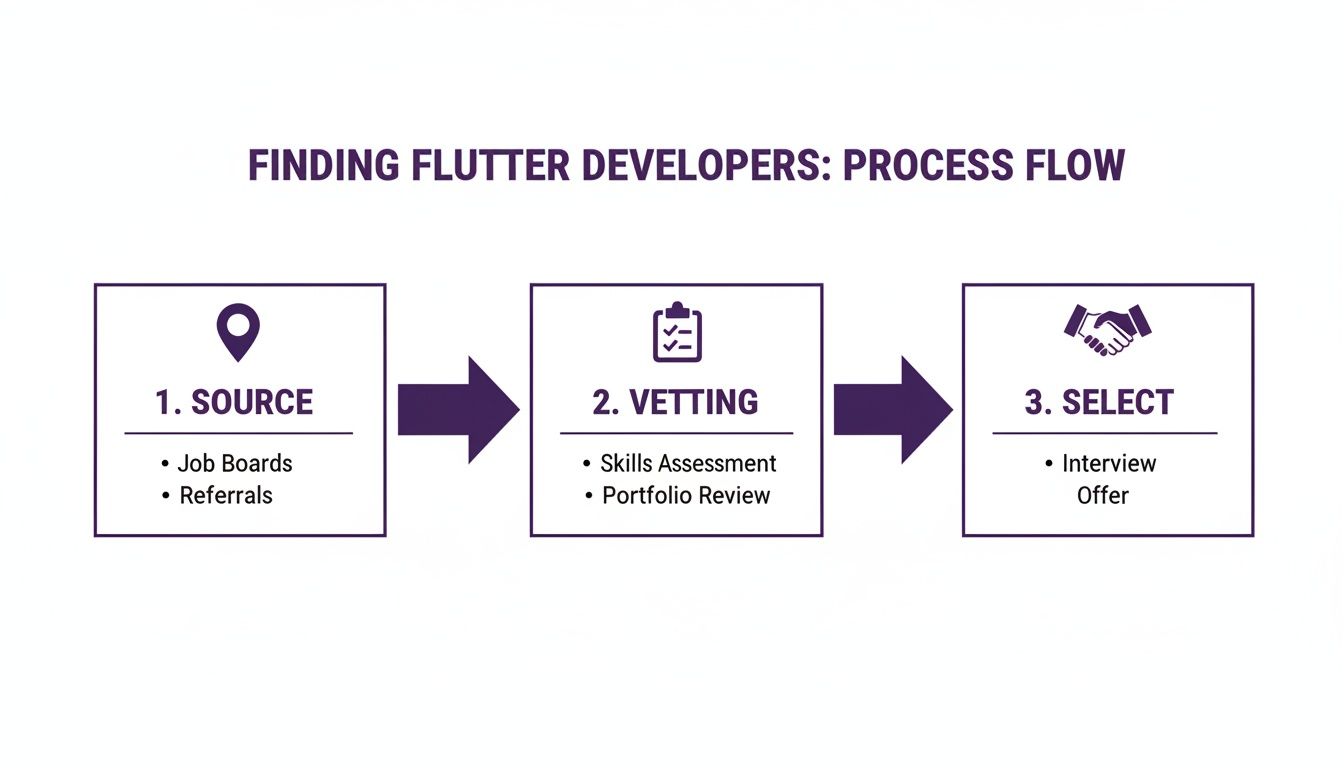
This flow shows how you move from a broad search to a deep evaluation before you commit. It’s all about narrowing down your options intelligently.
Looking Beyond a Pretty Portfolio
A portfolio is more than a gallery of nice-looking screenshots. To really understand an agency's skill, you have to dig in. If their apps are on the App Store or Google Play, download them and have a play around.
Get a feel for the user experience. Is the app quick and responsive? Are the animations smooth, or do they feel clunky? A top-tier Flutter app should feel completely native, which is a great sign of their command over the framework.
Beyond the general feel, you need to look for signs of real technical depth:
- Complex State Management: Can the app handle complicated user data and workflows without crashing or lagging? That’s a hallmark of a well-built application.
- Custom Animations and UI: Anyone can use a template. Look for unique, custom-built UI elements and animations that show they truly understand Flutter's rendering engine.
- Third-Party API Integrations: Modern apps don't work in isolation. Check for smart integrations with services like payment gateways (Stripe), mapping tools, or social media platforms.
Asking the Right Questions to Probe Technical Expertise
Once you have a shortlist, the interview is your chance to see if they really know their stuff. Ditch the generic questions and get into the specifics that reveal their problem-solving skills.
Understanding how a potential partner presents their unique value is crucial. A great resource on how to create a strong value proposition can help you judge how effectively they differentiate themselves.
Here are a few questions I always like to ask:
- "Tell me about a time you hit a major performance bottleneck in a Flutter app. What caused it, and how did you sort it out?"
- "For a large, complex app, what's your go-to state management solution—BLoC, Provider, Riverpod? And more importantly, why?"
- "How do you handle testing in your Flutter projects? What's your strategy for unit, widget, and integration tests?"
- "What’s your process for making sure the UI/UX stays consistent across all the different Android and iOS devices, with all their weird screen sizes?"
The quality of their answers—the detail, the confidence—will tell you everything. Vague, hand-wavy responses are a massive red flag. You're looking for specific examples from their own experience.
Don't Forget Project Management and Communication
Technical brilliance is only half the battle. If an agency's project management and communication styles don't mesh with yours, you're in for a world of pain. Mismatches here lead to missed deadlines, blown budgets, and a lot of frustration.
Be direct and ask about their process:
- How often will we have meetings, and what do they look like?
- What tools do you use to manage the project and communicate (e.g., Jira, Slack, Trello)?
- Who will be my main point of contact, and how easy is it to get hold of them?
- How do you deal with scope creep or when project requirements change halfway through a sprint?
A professional agency will have clear, confident answers to all of these. They should be all about transparency and collaboration, making you feel like you're part of the team, not just a client.
This vetting process might seem like a lot of work, but trust me, it’s worth it. For more advice on this critical step, check out our complete guide to hiring app developers in the UK. Taking the time now to find the right partner is the best thing you can do to set your app up for success.
Getting to Grips with Pricing Models and Timelines
Before you sign on the dotted line with any development partner, you need to get your head around the costs and timelines involved in building a Flutter app. The right flutter app development company won't just be technically brilliant; their pricing and project management style will also need to fit your budget and business goals like a glove.
You'll generally come across three common pricing models. Each has its place, and understanding them is crucial for setting realistic expectations from day one. Let's break them down with some real-world examples.
Fixed Price Contracts
A Fixed Price model is as straightforward as it gets: one price for a clearly defined set of work. The biggest advantage here is predictability, which is a massive relief for startups or businesses working with a tight, fixed budget.
This approach is perfect when you know exactly what you need. Think of a Minimum Viable Product (MVP) where the features are set in stone. You've mapped out every screen, the user journey is crystal clear, and the core functions are non-negotiable. In that situation, an agency can confidently estimate the effort and give you a single, upfront cost.
The catch? It’s inflexible. If inspiration strikes halfway through and you decide you need a new feature, that means a new quote, a change order, and almost certainly a delay.
Time and Materials Agreements
In complete contrast, a Time and Materials (T&M) model is all about flexibility. You pay the agency for the actual hours their team works on your project, typically billed at an agreed hourly or daily rate. This is the go-to choice for complex, long-term projects where the scope is expected to change and grow.
Imagine building a groundbreaking app where you need to react to early user feedback to shape the next phase of development. A T&M contract lets you pivot, adapt, and refine the product without being shackled to the original plan. You get full transparency on where the hours are going, but it does demand a strong sense of trust and sharp project management to keep the budget on track.
Retainer Agreements
A Retainer model is what usually comes after your app has launched. You pay a set monthly fee to secure a specific amount of an agency's time. This is ideal for ongoing support, regular updates, bug fixes, and rolling out smaller features over time.
For instance, once your app is live, you might need five days of a developer's time each month to handle OS updates, keep an eye on performance, and add small improvements based on user data. A retainer guarantees you have access to the very team that built your app, which provides brilliant continuity and peace of mind.
The best pricing model isn’t a one-size-fits-all answer. It’s about what fits your project’s current stage and how much is still unknown. A well-defined MVP is a perfect match for a Fixed Price, whereas a truly innovative product needs the freedom of Time & Materials.
To make things a bit clearer, here’s a quick overview of how the common pricing structures stack up, their ideal use cases, and the potential risks you should be aware of.
Comparing Flutter Development Pricing Models
| Pricing Model | Best For | Key Consideration |
|---|---|---|
| Fixed Price | Clearly defined projects like MVPs with a static scope. | Provides cost certainty but offers little room for changes. |
| Time & Materials | Complex or long-term projects with an evolving scope. | Offers maximum flexibility but requires close budget tracking. |
| Retainer | Ongoing support, maintenance, and iterative improvements post-launch. | Guarantees resource availability for continuous development. |
Choosing the right structure is a big decision, and it’s something a good agency will walk you through, recommending the model that makes the most sense for your vision.
For a deeper dive into what things cost in our local market, check out our comprehensive UK app pricing guide.
Planning for Post-Launch Support and Growth
Getting your app onto the App Store and Google Play can feel like crossing the finish line, but in reality, it’s just the starting gun. A successful launch is simply the first leg in a much longer race involving user feedback, iterative improvements, and long-term growth. This is precisely where a lasting partnership with your Flutter app development company proves its worth.
The app world never sleeps. Apple and Google drop new OS versions every year, bringing with them essential security patches, shiny new features, and, occasionally, changes that can break your app. An app that runs flawlessly today might suddenly start lagging or crashing after a major update. That makes post-launch support an absolute non-negotiable.
A proactive support agreement is your insurance policy. It ensures your app stays compatible, secure, and performant, protecting your investment and keeping your user base happy.
What a Strong Support Agreement Covers
When you’re talking post-launch plans with a potential Flutter partner, you need to dig deeper than a vague promise of "maintenance." A proper support agreement should be incredibly specific, spelling out exactly what’s included to keep your app in prime condition.
At a minimum, your agreement should clearly define:
- Critical Bug Fixes: A documented process for reporting, prioritising, and squashing bugs that ruin the user experience or break core features.
- OS Update Compatibility: Proactive work to guarantee your app runs smoothly on the latest iOS and Android versions from day one of their release.
- Security Patching: Regular updates to all libraries and dependencies to shield your app and its users from emerging security threats.
- Performance Monitoring: Constant tracking of key app metrics like crash rates, load times, and server response times to spot problems before your users do.
A great long-term partner doesn’t just sit back and wait for you to report a problem. They actively monitor your app’s health, suggest improvements, and act as a genuine extension of your team, dedicated to its ongoing success.
The Value of a Long-Term Partnership
The real magic happens when your relationship evolves from a simple client-vendor transaction into a true partnership. The team that built your app has an unmatched, intimate knowledge of its architecture, code, and the original strategic goals. That deep insight makes them the perfect crew to help it evolve.
Once user feedback starts pouring in, you'll uncover golden nuggets of information. People might ask for new features, point out confusing parts of the app, or even show you completely unexpected ways they're using your product. A long-term partner can take this raw feedback, translate it into actionable development sprints, and continuously improve the app. This agile, responsive approach is far more powerful than trying to guess every feature you'll ever need years in advance.
How Flutter Simplifies Long-Term Maintenance
Choosing Flutter isn't just a clever decision for the initial build; its modern architecture is a massive advantage for long-term maintenance, making it a seriously cost-effective choice for sustainable growth.
Because you’re working with a single codebase, the effort needed for updates and new features is cut dramatically. When you add a new function or fix a bug, your Flutter company only has to do it once. The changes are then compiled for both iOS and Android at the same time. This efficiency translates to real-world benefits:
- Reduced Costs: You’re not paying two separate teams (and two separate invoices) to do the same work twice.
- Faster Updates: New features and critical fixes reach all your users much, much quicker.
- Consistent Experience: Every user, whether on an iPhone or an Android, gets the same high-quality, polished experience.
This single-codebase advantage is a massive force multiplier for your app's future. It lets your business stay nimble, respond to market shifts fast, and continuously deliver value without the financial headache of maintaining two native apps. It’s what makes partnering with a skilled Flutter app development company a strategic investment in your product's future.
Got Questions About Hiring a Flutter Agency?
Choosing to partner with a Flutter app development company is a big move, and it's completely normal to have a list of questions before you commit. We get it. To help you get a clearer picture, we've answered some of the most common queries we hear from businesses taking this exact step.
What’s the Real Cost to Hire a Flutter App Development Company in the UK?
This is usually the first thing people want to know, and the honest answer is: it really depends. The final figure is tied directly to how complex your app is, the features you absolutely need, and the experience of the agency you choose. Any decent agency in the UK will give you a transparent, itemised quote so you know exactly where your money is going.
But to give you a ballpark figure:
- A Simple Minimum Viable Product (MVP): You’re likely looking at a starting point of around £25,000. This gets you the core features on a single platform, perfect for testing the waters and validating your idea.
- A More Complex Application: If your app needs a custom backend, several third-party integrations, and a truly polished UI, you could be looking at a range of £70,000 to £150,000+.
A quick word of advice: be suspicious of quotes that seem too good to be true. A rock-bottom price might look tempting, but it often means corners are being cut somewhere important, like quality assurance, user experience design, or post-launch support. It’s always better to think about the long-term value and return on investment, not just the initial cost.
What Does the Development Process Actually Look Like?
A professional agency doesn’t just jump straight into coding. A structured, transparent process is the sign of a great partner, making sure your project stays on schedule and true to your vision. While every agency has its own unique way of working, the journey generally follows a few key stages.
It's a collaborative effort, and you should be kept in the loop the entire time:
- Discovery & Strategy: This is the deep-dive phase. We'll get to grips with your business goals, who your audience is, and the full scope of the project. Together, we'll define what success looks like and map out a solid technical strategy.
- UI/UX Design: Before any code gets written, the design team builds wireframes and high-fidelity mockups. This is your chance to see and feel how the app will function, giving you plenty of opportunities for feedback and tweaks early on.
- Development: This is where the magic happens. The developers bring the designs to life, typically working in agile "sprints"—short, focused bursts of work. At the end of each sprint, you get to see demonstrable progress.
- Quality Assurance (QA): A dedicated QA team puts the app through its paces. They test it on different devices and in various scenarios to hunt down bugs, smooth out performance kinks, and ensure you get a polished, stable product.
- Deployment: The agency will navigate the tricky process of submitting your app to the Apple App Store and Google Play, ensuring it meets all their strict guidelines.
- Post-Launch Support: The relationship doesn't end when the app goes live. A good partnership includes ongoing support for updates, bug fixes, and adding new features down the line.
Why Should I Choose a UK-Based Flutter Company Over Offshoring?
Offshoring might seem cheaper on paper, but working with a UK-based company brings some serious advantages that often result in a much better product and greater long-term value. The benefits are about more than just convenience.
A local partnership creates a sense of shared investment and close collaboration that’s incredibly hard to replicate across different continents and time zones. When your success is their success, you can see it in the quality of the work.
Here’s why a UK partner often makes more sense:
- Seamless Communication: Being in the same time zone means no frustrating delays. You can hop on a quick call to sort something out instantly instead of waiting 24 hours for an email response. It just makes everything smoother.
- Local Market Insight: A UK team has a natural, deep understanding of the local market, user expectations, and cultural quirks. This kind of insight is gold for designing an app that actually connects with your target audience.
- Regulatory Peace of Mind: Your agency will be completely up to speed on UK data regulations like GDPR. This ensures your app is compliant right from the start, saving you from potential legal headaches later on.
How Long Does It Take to Build a Flutter App?
Much like the cost, the timeline for building a Flutter app hinges on its complexity. But this is where Flutter really shines. Because it's a cross-platform framework, it dramatically speeds up the development process compared to building separate native apps for iOS and Android.
As a general guide:
- Simple App: A basic app with a tight feature set can often be designed, built, and launched within 3-4 months.
- Mid-Complexity App: An app with more advanced features, a custom UI, and API integrations will typically take around 5-7 months.
- Large-Scale Application: For a complex, enterprise-grade app with a huge feature set and custom backend, you could be looking at 9 months or more.
This efficiency is one of the main reasons so many businesses are choosing Flutter. You get your app to market faster, reaching users on both major platforms at the same time, without compromising on the quality or performance they expect. For a startup, that speed can be a massive competitive advantage.
At App Developer UK, we specialise in turning your vision into a high-performance, beautiful Flutter application. Our UK-based team is ready to guide you through every step of the process. Contact us today to discuss your project.