Apps Development UK: The Essential guide to apps development uk
Apps Development UK: The Essential guide to apps development uk
A brilliant app idea is a great start, but it's the plan that truly matters. This initial blueprinting stage is easily the most critical part of the entire process. It’s where you take a vague concept and shape it into a real-world project with clear goals, a well-defined audience, and a solid footing in the market—all before a single line of code gets written.
Your Blueprint for UK App Success
Before you get carried away with designs and features, you need to lay a strong strategic foundation. This means doing your homework—research, validation, and some tough strategic thinking—to give your investment the best possible chance of paying off.
This is the point where "I have an idea for an app" becomes "I have a business case for a product that solves a real problem for a specific group of people." Getting your head around the typical software development cycle stages is the bedrock of this blueprint.
First Things First: Who Is This For?
You simply can't build an app for everyone. The first order of business is to get laser-focused on your ideal user. Are you targeting busy London commuters, university students in Manchester, or small business owners in rural Scotland? Each group has entirely different needs, habits, and expectations.
Creating detailed user personas is the best way to bring this audience to life. Think about:
- Demographics: Age, location, job, and income.
- Behaviours: How glued are they to their phones? Are they early adopters or a bit more tech-sceptical?
- Pain Points: What daily frustration or unmet need will your app actually solve for them?
An app for finding independent coffee shops in Bristol is built for a completely different person than one that helps farmers manage crop rotations. Defining this early on will guide every single decision you make later, from features to marketing.
Solving a Real Problem People Care About
At its heart, a great app is just a solution to a problem. So, what problem are you solving? And more importantly, is it a problem people will pay to fix or at least engage with regularly? Your app’s core value proposition has to be crystal clear.
Don't just say, "My app helps people get organised." A much stronger pitch is, "My app helps freelance creatives in the UK track project hours and fire off invoices in under two minutes." That kind of specificity is powerful. It immediately clarifies your app's purpose and makes its value obvious.
I see this all the time: founders build an app packed with impressive-sounding features that don't actually solve the core problem well. Relentlessly focus on the number one value you deliver. Everything else can wait, especially at the start.
Mastering the UK Market
The UK app market is crowded and competitive. That's the reality. With smartphone ownership nearing ~90% of the population and on track to hit 95% by early 2025, the audience is huge—but so is the competition. You have to understand the lie of the land.
Market research isn't just about listing your competitors; it's about learning from their mistakes and successes.
- Who's out there? Look for both direct and indirect competitors.
- What are they getting right (and wrong)? Dive into their app store reviews. What do users love? What are the constant complaints?
- What's your unique angle? What can you do better, faster, or cheaper? Is there a niche they're completely ignoring?
This research helps you find a gap in the market where your app can actually thrive.
Before you jump into the technical side, it's worth taking a moment to answer some fundamental questions. This simple exercise can save you a world of trouble down the line.
Initial App Planning Checklist
| Planning Area | Key Question to Answer | Example |
|---|---|---|
| Core Purpose | What single, primary problem does this app solve? | Helps UK dog owners find and book trusted, local dog walkers. |
| Target User | Who is our ideal user, in specific terms? | A 30-45 year old professional, living in a major city, working long hours. |
| Monetisation | How will the app make money? | Subscription model for walkers, small booking fee for owners. |
| Key Features (MVP) | What are the 3-5 absolute essential features for launch? | User profiles, search/filter, booking system, in-app messaging. |
| Unique Selling Point | What makes us different from competitors? | We offer real-time GPS tracking for every walk and instant photo updates. |
Answering these questions honestly gives you a solid, documented blueprint. It sets the stage for a much smoother, more successful development journey.
Choosing Your Tech Stack: The Flutter Advantage
Once your app's blueprint is locked in, you’ve got a big decision to make: what technology will you use to build it? This isn’t just a technical choice for the developers; it’s a critical business decision that will directly shape your budget, your launch timeline, and how easily you can grow your app down the line.
For UK businesses, especially startups and SMEs, this is a moment where being smart and cost-effective really pays off. You want a high-quality, reliable app in your users' hands, but you can't afford to break the bank or get stuck in a year-long development cycle. This is exactly where a modern framework like Flutter comes into its own.
Why Flutter is a Game Changer for UK Businesses
In the past, if you wanted an app on both iPhones and Android phones, you had two main routes. The first was to build two separate, native apps—one for iOS (using Swift or Objective-C) and another for Android (using Kotlin or Java). While this gives you peak performance, it's incredibly expensive and time-consuming. You’re essentially paying for and managing two different projects.
The other option was to use older cross-platform tools. These saved a bit of money upfront but often came with a heavy price. The performance was sluggish, and the apps just felt clunky and out of place, never quite matching the device's native feel.
Then Google's Flutter came along and completely changed the game. It lets developers write code once and deploy it as a genuine native application on both iOS and Android. This isn't some glorified web page pretending to be an app; it's a high-performance application compiled directly for each platform.
For any business, this single-codebase approach is a massive win. You're not just cutting your development time in half; you're also simplifying every future update, bug fix, and new feature. One team, one codebase, two platforms.
This efficiency is a lifeline for any business involved in apps development UK, where getting to market quickly and keeping a close eye on the budget can make all the difference.
Performance Without Compromise
One of the oldest and most stubborn myths about cross-platform development is that you have to give up performance. With older tech, that was often true. With Flutter, it’s simply not the case anymore.
Recent benchmarks consistently put Flutter at the top for performance, showing its apps perform right alongside—and often better than—their native equivalents. How? Flutter doesn't use a clunky "bridge" to talk to native components. Instead, it has its own high-performance rendering engine that draws every single pixel on the screen. The result is buttery-smooth animations and a responsive feel, hitting a solid 60 frames per second (or even 120 on newer devices).
For your users, this means an experience that feels fluid, fast, and completely at home on their device, whether it's the latest iPhone or a popular Android. You get all the cost and time savings of cross-platform development without the performance penalties of the past.
Faster Development Cycles Mean a Faster Launch
Beyond the single codebase, Flutter has a killer feature that developers absolutely love, and it directly benefits your timeline: Hot Reload.
In traditional development, making a tiny change—like tweaking a button’s colour or adjusting text size—forces the developer to recompile the entire app and restart it. This can take several minutes each time. With Hot Reload, developers see their changes on screen almost instantly, in under a second.
This might sound like a small technical detail, but the impact is enormous:
- Rapid Prototyping: Your team can try out UI/UX ideas in real-time, iterating on the fly to find what works best.
- Instant Bug Fixing: Developers can spot and squash bugs as they work, slashing the time it takes to debug the app.
- Better Collaboration: A designer or project manager can sit with a developer and see their feedback come to life immediately.
This super-fast cycle means your app gets built quicker, tested more thoroughly, and launched sooner. In the competitive UK market, that head start is invaluable. To see how this powerful framework is being used by experts, you can explore some examples of Flutter development in the UK. Ultimately, choosing Flutter isn't just about saving money—it's about building a better product, faster.
Budgeting Your App Development Costs in the UK
"So, what's this actually going to cost?" It’s the million-dollar question—or, hopefully, a bit less. Nailing down the real cost of building an app is one of the first hurdles every business faces. The truth is, there's no single price tag. Your budget will depend entirely on what you want your app to do.
The final cost is a direct reflection of the time and expertise needed to bring your idea to life. A straightforward app with a clean design and basic features will be much lighter on the wallet than a complex platform with custom animations, multiple third-party integrations, and a sophisticated backend. Things like feature complexity, UI/UX design, and your choice of platform are the big-ticket items.
Mapping Out UK App Development Budgets
To give you a real-world ballpark figure, industry data for the UK market shows a pretty wide range. Costs can start from around £11,000 for a simple proof-of-concept and climb to over £125,664 for a high-end application with features like AI or financial integrations. Most projects, however, tend to land somewhere in the middle.
If you want to dive deeper into the numbers, our UK app pricing guide breaks it all down for you.
To make things clearer, let's look at how costs and timelines typically stack up based on the complexity of the project.
| UK App Development Cost and Timeline Estimates | | :--- | :--- | :--- | | App Complexity | Typical UK Cost Range | Estimated Timeline | | Simple (MVP/Prototype) | £11,000 – £21,000 | 1–3 Months | | Moderate (Standard Features) | £21,000 – £52,000 | 4–6 Months | | Complex (Advanced Features) | £52,000 – £125,000+ | 6–18+ Months |
As you can see, a moderately complex app—the kind most businesses build—often requires a 4–6 month timeline and an investment somewhere between £21,000–£52,000. Advanced apps can easily stretch beyond six months, with the budget growing to match.
How Flutter Delivers More Value for Your Budget
This is where your choice of technology really makes a difference. As we touched on earlier, picking a smart framework like Flutter can have a massive impact on these numbers. Because Flutter uses a single codebase for both iOS and Android, it cuts down the development workload significantly.
This infographic shows just how much efficiency you gain in time, cost, and performance.
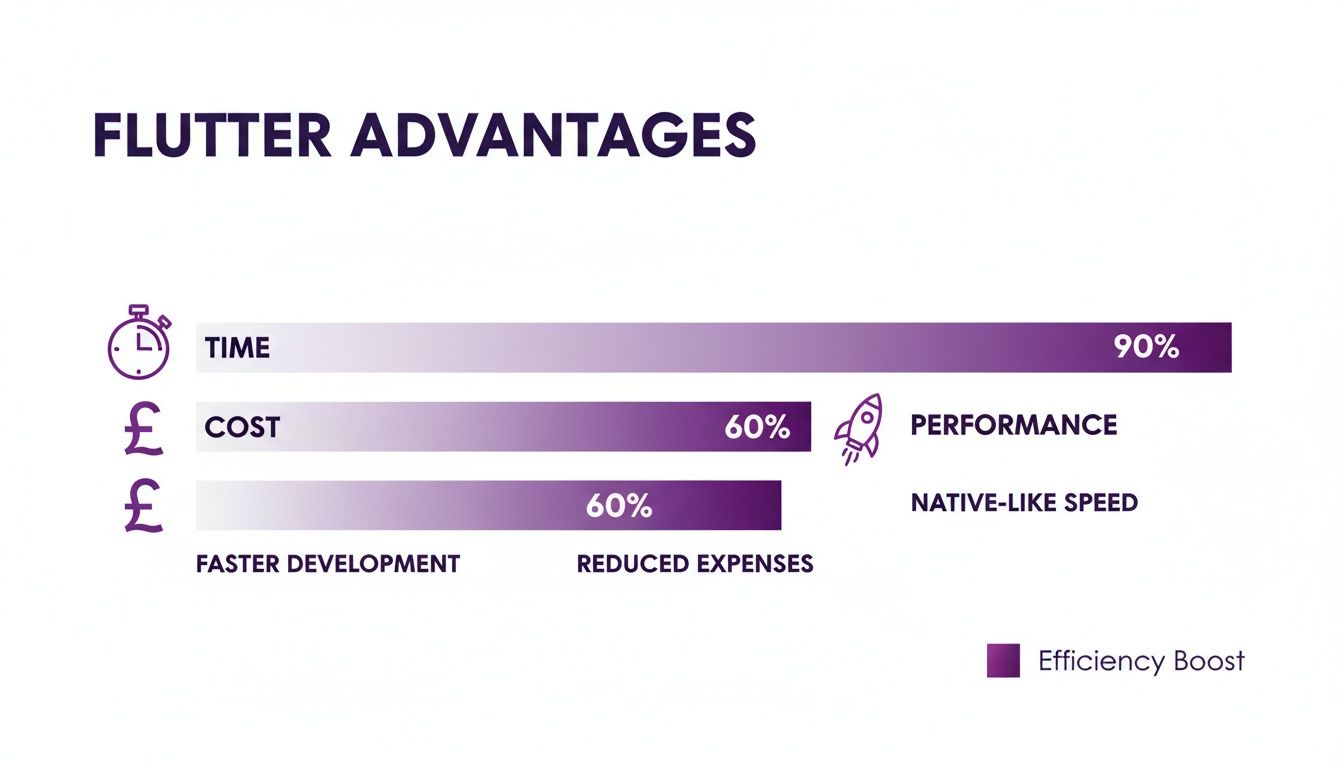
By nearly halving the development effort without compromising on a polished, native feel, Flutter makes your budget work much, much harder.
Uncovering the Hidden Costs of App Ownership
Here’s a classic mistake many founders make: they forget about the costs that come after the launch. The initial development budget is just the beginning. A successful app isn't a one-off project; it’s a living product that needs ongoing investment to stay secure, functional, and relevant.
It's a mistake to view your app as a one-time purchase. Think of it more like a car; you have the initial cost, but you also need to budget for fuel, insurance, and regular maintenance to keep it running smoothly and safely.
To build a realistic financial plan, you absolutely must account for these recurring operational costs from day one.
Essential Ongoing Expenses to Budget For
Forgetting these can lead to some nasty surprises down the road. Make sure your financial plan has a line item for each of these:
- Server and Hosting Fees: Your app’s backend, database, and user data all need a home. Costs here will vary depending on your traffic and usage.
- Third-Party API Subscriptions: Does your app use Google Maps for location services or Stripe for payments? These services often have monthly or usage-based fees that will grow as your user base does.
- Maintenance and Updates: Apple and Google are constantly releasing new OS versions. You'll need to budget for regular updates to ensure compatibility, patch security holes, and fix any bugs that pop up.
- App Store Fees: Both the Apple App Store and Google Play Store charge an annual developer fee just to keep your app listed.
- Post-Launch Marketing: Building the app is only half the battle. You need a separate budget to actually get it in front of people through marketing and user acquisition campaigns.
As a rule of thumb, plan to spend about 15-20% of your initial development cost each year on maintenance and operations. Factoring this in from the start ensures your app has the fuel it needs to succeed long after launch day.
Finding The Right UK Development Partner

You’ve got your strategy mapped out and a clear idea of the technology you want to use. Now comes the moment of truth: who is actually going to build your app?
This isn’t a decision to take lightly. The partner you pick for your apps development UK journey will fundamentally shape the final product, your budget, and frankly, your stress levels.
Think of it less like hiring a contractor and more like entering a business partnership. You need a team that doesn't just write code, but one that gets your vision, communicates without jargon, and has the specific chops to bring your ideas to life. Getting this right is often what separates a celebrated launch from a project that fizzles out, burning cash along the way.
Agencies vs. Freelancers: What’s The Right Fit?
First up, you need to decide whether to bring a development agency or a solo freelancer on board. There's a time and a place for both, and the best choice really hinges on the scale and complexity of your app.
A freelancer can be a fantastic, budget-friendly option for smaller, tightly-defined projects. If you have a single, specific feature to build or need to add some extra muscle to your in-house team, a skilled individual is perfect. The catch? You're entirely dependent on one person's skillset, availability, and time management.
An agency, on the other hand, brings a full crew to the table: project managers, UI/UX designers, several developers, and dedicated QA testers. This all-in-one approach is far better suited to complex apps that demand a range of expertise and need solid, ongoing support. Yes, the upfront cost is higher, but you're paying for reliability, a deep pool of talent, and a structured process designed to minimise risk.
Questions to Ask Before You Sign Anything
Vetting potential partners is non-negotiable. You have to cut through the sales pitch and find out if they're a genuine fit. Don't be shy about digging into the nitty-gritty of their process and technical skills.
Here are the essential questions you need answers to:
- Can you walk me through your development process? Get them to explain how a typical project runs, from the first meeting to launch day. Do they use Agile? How often will you get updates and see real progress?
- How do you handle project management and communication? Find out if you'll have a dedicated point of contact. What tools do they use to keep clients in the loop (think Slack, Jira, or Trello)? Vague answers here are a bad sign.
- Can we see some Flutter apps you've already built? Don't settle for a client list. Ask for links to live apps on the App Store or Google Play. Download them, play around, and see for yourself if the quality is up to scratch.
- Who owns the source code and intellectual property? There’s only one right answer: you do. This must be crystal clear in the contract, guaranteeing you have full ownership of your app when the project is finished.
A partner’s portfolio is their CV. If they can't point you to polished, working Flutter apps with positive reviews, that's a huge red flag. Be wary of vague claims or a portfolio that looks like it hasn't been updated in years.
Checking References and Making Sense of The Quote
Once a potential partner has made your shortlist, it’s time to do your homework. Ask for references from past clients, ideally from projects similar to yours. When you call them, go deeper than, "Were you happy?". Ask them about the communication, how problems were solved, and if they'd hire the team again.
Finally, scrutinise the quote. The cheapest price is rarely the best value. A professional quote won't just be a single number; it will be a detailed breakdown of features, deliverables, timelines, and costs. A vague, lump-sum figure suggests they haven't really listened to your requirements.
A great partner will invest time in understanding your project before sending over a thoughtful, transparent proposal. For a deeper dive into this, our guide to hiring app developers in the UK offers more detailed advice on this crucial process.
Getting to Grips with UK Legal and App Store Rules
Building a great app is only half the battle. Once the code is clean and the design is sharp, you’ve got to navigate the maze of UK legal requirements and app store guidelines. This isn't just about ticking boxes; it's about building a foundation of trust with your users right from the start.
Messing this up can lead to fines, but more importantly, it can kill user confidence before you even get off the ground.
And the stakes are high. The UK's app market is absolutely booming, projected to leap from USD 14.21 billion in 2024 to a staggering USD 32.86 billion by 2030. That growth is built on user trust, making things like data protection a core feature, not an afterthought. You can dig into the numbers yourself in the full industry research.
Let's Talk About GDPR
If you're launching an app in the UK, the General Data Protection Regulation (GDPR) is your new best friend. It’s the rulebook for handling personal data, and it has real teeth. For your app, this means you can’t just ask for data without a very good reason.
The core principle here is "privacy by design." You need to bake data protection into your app's DNA from day one.
- Have a Lawful Basis: You must have a clear, legitimate reason for every single piece of data you collect. For most apps, this simply means getting explicit consent from the user.
- Minimise Your Data: Be ruthless. Only collect the data you absolutely need for a feature to work. If you don't need their date of birth, don't ask for it. It's that simple.
- Get Clear Consent: Forget pre-ticked boxes—they're a big no-no. Users have to actively opt-in, and it needs to be just as easy for them to withdraw that consent later on.
Navigating the legal landscape can feel overwhelming, especially when balancing different compliance frameworks. For a deeper dive into how major regulations overlap, it's worth understanding GDPR and SOC 2 compliance.
The Must-Have Legal Docs
Every app needs a couple of key documents to stay on the right side of the law and be transparent with its users. Don't just copy and paste a template; these are your contract with your audience.
Think of your Privacy Policy and Terms of Service as part of your user experience. They should be written in plain English, easy to find, and clear about the rights and responsibilities of both you and your users.
Your Privacy Policy: This is where you tell users exactly what data you collect, why you’re collecting it, how you keep it safe, and who you might share it with (like third-party analytics tools). Be specific and be honest.
Your Terms of Service (T&S): This document sets the ground rules for using your app. It covers everything from acceptable user behaviour and intellectual property rights to the limits of your own liability.
Conquering the App Stores
Finally, before you can celebrate your launch, you have to get past the gatekeepers: the Apple App Store and the Google Play Store. Each has its own exhaustive set of guidelines that cover everything from safety and performance to design and business models.
Getting rejected by an app store is one of the most common—and frustrating—reasons for a launch delay. Pay close attention to these areas:
- In-App Purchases: Both Apple and Google have very strict rules on how you handle payments for digital goods and services. Get this wrong, and you'll be rejected instantly.
- Content Policies: Your app can't contain anything objectionable, deceptive, or harmful. This is a wide-ranging policy that covers everything from user-generated content to your marketing descriptions.
- User Data: The stores are hot on privacy, too. They double-down on GDPR principles, requiring you to provide clear justifications for any permission your app requests, whether it's for the camera, location services, or contacts.
Your App Development Questions, Answered
Getting ready to kick off a new app project always brings a few questions to the surface. It's completely normal. The world of app development can feel a bit tangled at first, but once you have the right signposts, the path forward becomes much clearer.
We get asked a lot of the same questions by UK businesses just starting out. To help you move forward with confidence, we've put together some straight, practical answers on everything from timelines and team choices to the real costs after your app goes live.
How Long Does It Really Take To Build an App in the UK?
This is always the first question, and the honest answer is: it depends on what you’re building. There’s no magic number, but we can definitely map out some realistic timeframes.
If you’re starting with a Minimum Viable Product (MVP) – just the absolute core features to test your idea – you can often get it designed, built, and launched in as little as 2-4 months. This is a brilliant way to get real user feedback without over-investing upfront.
For a more typical, mid-range app with features like user accounts, payment systems, and a polished UI, you should set aside around 4-7 months. Anything highly complex, involving custom backend systems, tricky algorithms, or very detailed user journeys, will likely take 8 months or more to get right.
Should I Hire a UK Freelancer or a Full Agency?
This is a big one. The choice between a freelancer and an agency really comes down to the scale of your project and how much you can manage yourself.
- A freelancer is a great shout for smaller, very specific tasks. Need someone to build out a single feature or add a particular skill to your existing team? A freelancer can be a cost-effective choice.
- An agency brings an entire team to the table: project managers, designers, several developers, and QA testers, all working in sync. This is almost always the better option for building a complete, complex app from the ground up, especially if you need structured management and long-term support.
For most businesses aiming to launch a full-blown product, an agency simply offers a safer, more complete partnership.
"An app project is rarely just about the code. It's about strategy, design, testing, and long-term maintenance. An agency brings all those disciplines together, which significantly de-risks the entire process for a business owner."
What Are the Ongoing Costs After My App Is Launched?
Your launch day is a huge milestone, but it’s the starting line, not the finish. A common and costly mistake is forgetting to budget for what comes next. A successful app needs ongoing care to keep it secure, functional, and relevant.
As a solid rule of thumb, you should plan to budget roughly 15-20% of your initial development cost each year for maintenance and operations.
This budget usually covers:
- Essential Hosting: The server and database costs that keep your app running.
- Third-Party Services: Any subscriptions you rely on, like Google Maps for location data, Stripe for payments, or push notification platforms.
- Platform Updates: Making sure your app doesn't break when a new version of iOS or Android is released.
- Bug Fixes and Support: Inevitably, small issues will pop up that need fixing to keep your users happy.
Why Is Flutter So Popular With UK Startups?
You've probably heard the name Flutter buzzing around the UK startup scene, and there’s a very good reason for it. For businesses that need to be smart with their cash and quick to market, it offers a massive strategic advantage.
The magic of Flutter is its single codebase. We write the code once, and it runs beautifully on both iOS and Android. This simple fact can cut development time and your initial investment dramatically – often by as much as 40-50% compared to building two separate "native" apps from scratch.
Crucially, you're not cutting corners on quality. The latest benchmarks prove that Flutter delivers top-tier, native-like performance that users expect. For a startup, that means getting a high-quality, fast, and beautiful app onto both major app stores for the price and timeline of one. That’s a powerful competitive edge.
Ready to turn your app idea into a reality with a team that specialises in high-performance Flutter development? At App Developer UK, we build beautiful, reliable, and scalable apps that help UK businesses succeed. Let's discuss your project today.