Your Guide to Finding the Right App Development Course in the UK
Your Guide to Finding the Right App Development Course in the UK
So, you’re thinking about taking an app development course. Good call. It’s the first real step towards building mobile experiences that people will actually use and love. Think of it as a guided path that gives you the technical chops to build, test, and launch apps for a massive global audience.
Whether you're an individual gunning for a new career or a UK business looking to build something fresh, the right course is your ticket into the buzzing app economy.
Starting Your App Development Learning Journey

Deciding to learn app development is a huge move, one that opens doors to one of the most exciting corners of the tech world. But your journey starts with a foundational choice that will pretty much define your entire learning path and what you can build later on. You’ve got to pick a side: the old-school native approach or a modern cross-platform framework.
This isn't just about picking a programming language; it's a strategic decision. Are you prepared to invest double the time and money building two separate apps for iOS and Android? Or would you rather go for a smarter, more powerful solution that gets you both from a single, clean codebase? This guide is here to demystify these options, helping you make the right call for yourself or your team.
The Core Decision: Native vs Cross-Platform
Imagine you need to send the same message to two friends—one only speaks French, and the other only speaks German.
The native approach is like writing two completely separate letters from scratch. You’d have to master both French and German, write each letter perfectly, and spend twice the effort making sure the messages are identical. It works, but it’s a lot of work.
Now, think about the cross-platform way. A modern framework like Flutter is your universal translator. You write the message just once, in one language, and it flawlessly translates it into perfect French and German, keeping every bit of the original meaning intact. That’s the magic of a single codebase.
For businesses and developers here in the UK, that kind of efficiency is a game-changer. It means getting to market faster, slashing development costs, and delivering a consistently brilliant user experience on every device—without ever skimping on performance.
Before you go any further, it's worth taking a moment to see how these two paths stack up.
Quick Overview of App Development Learning Paths
| Attribute | Native Development (iOS and Android) | Cross-Platform with Flutter |
|---|---|---|
| Codebase | Separate codebases for each platform (Swift/Kotlin). | Single codebase for both iOS and Android (Dart). |
| Learning Curve | Steeper. Requires learning two distinct languages and toolsets. | More streamlined. Learn one language (Dart) and one framework. |
| Team Skills | Needs specialised iOS and Android developers, or one person who is an expert in both. | A single developer or team can build and maintain the app for all platforms. |
| Development Time | Slower. You're essentially building two apps from the ground up. | Significantly faster. Write once, deploy everywhere. |
| Cost | Higher, due to double the development effort and potentially larger teams. | Lower, thanks to reduced development time and smaller team requirements. |
| Performance | Excellent, as code is written directly for the device's OS. | Top-tier, near-native performance. Flutter compiles directly to native machine code. |
| Best For | Apps requiring deep, specific OS integration or cutting-edge platform features. | Most apps, especially for businesses wanting speed, consistency, and efficiency. |
This table gives you a clear snapshot. While native has its place for very specific, hardware-intensive apps, Flutter offers a more practical and powerful path for the vast majority of projects today.
Why Flutter Is Gaining Momentum
Look, there are plenty of frameworks out there, but Flutter has really pulled ahead of the pack for a few solid reasons. Recent benchmarks consistently show Flutter delivering top-tier performance, often matching or even beating native apps. Why? Because it doesn’t just interpret code; it compiles directly to the device’s native language, which means silky-smooth animations and a super-responsive feel.
If you're just starting out, it's helpful to see what other frameworks are like. Checking out something like a modern React Native tutorial for beginners can give you a good sense of the landscape.
Ultimately, choosing an app development course built around a modern framework like Flutter sets you up for what the market actually demands: speed, efficiency, and rock-solid performance. If you're considering a more intensive route, our guide on choosing a coding boot camp in the UK has some great pointers.
Why App Development Skills Matter in the UK Market
Before you even think about which app development course to pick, it helps to get a lay of the land. The UK's app economy isn't just ticking over; it's a massive engine for business growth, and it's crying out for developers who can build brilliant mobile experiences. This isn't just a flash in the pan—it's a real shift in how we all live, shop, and work.
What’s pushing this demand? For starters, almost everyone in the UK has a smartphone, so your audience is literally within arm's reach. On top of that, the rollout of widespread 5G is unlocking doors to faster, slicker, and more powerful apps that simply weren't possible a few years ago.
A Multi-Billion Pound Opportunity
The sheer scale of the UK's app market is staggering. It’s become a commercial powerhouse for digital services, with a market value comfortably in the tens of billions and still climbing fast. In 2025, several analyses put the UK mobile app market at around £28.3 billion, a figure that reflects consistent double-digit growth year on year. This boom is all down to the relentless demand for mobile solutions across every major sector. You can read more about the UK's £28.3bn app industry on marketingtechnews.net.
This explosion in value creates an obvious and pressing need. Businesses all over the country are on the hunt for developers who can bring their next big idea to life on mobile.
For individuals, this means a solid, future-proof career is well within reach. For businesses, it’s a glaring commercial opportunity and a clear signal to either hire new talent or upskill their existing teams to keep up.
Key Sectors Driving Demand
The hunger for skilled app developers isn't just coming from one place. A few key sectors are leading the charge, each with its own unique challenges and opportunities—the very things a good app development course should prepare you for.
- Fintech: London is still a global finance hub, and mobile apps are the beating heart of its innovation. From challenger banks to slick investment platforms, the need for secure and easy-to-use financial apps is off the charts.
- Healthcare: Digital health is completely changing how we look after ourselves. Apps for booking appointments, managing prescriptions, and holding virtual consultations are now the norm, creating demand for developers who get data privacy and accessibility.
- E-commerce and Retail: The high street has gone digital. Retailers need flawless mobile experiences to drive sales, run loyalty schemes, and blend their online and physical stores into one seamless journey.
- Enterprise Solutions: It’s not just about customer-facing apps. Businesses are increasingly building custom apps to streamline their internal operations, manage logistics, and support remote teams, which means a huge market for bespoke, high-performance software.
Getting your head around these market forces gives you the "why" behind enrolling in an app development course. It’s not just about learning to write code. It’s about gaining the skills to solve real problems in a thriving, multi-billion-pound market that is actively looking for people like you. The opportunities are right here, right now.
Choosing Your Path: Native vs Modern Cross-Platform
Once you decide to pursue an app development course, you’ll quickly hit a fork in the road. This first decision is a big one, as it shapes your entire learning journey and the kinds of apps you’ll be building. The choice is between the traditional native route and a modern cross-platform approach.
Let’s use an analogy. Native development is like hiring two separate, specialist teams to build a house—one using brick, the other using timber. Both houses will be fantastic and perfectly suited to their materials. The catch? You need two sets of blueprints, two construction crews, and a much bigger budget. You're essentially running two separate projects to get two final products.
In contrast, modern cross-platform development is like using advanced, pre-fabricated modules. You design the house just once. A single, highly skilled team then assembles it on-site with components engineered to create a solid, beautiful structure. It's faster, more cost-effective, and the final quality is every bit as good.
The Efficiency of a Single Codebase
The real magic of cross-platform frameworks, especially Flutter, is the single codebase. Instead of writing all your code in Swift for iOS and then rewriting it from scratch in Kotlin for Android, you write it just once using the Dart programming language. Flutter then acts as a powerful engine, compiling that one set of instructions into beautiful, fully native apps for both platforms.
This isn’t about compromise; it’s a massive strategic advantage. For UK businesses, this translates directly into slashing development time and costs. A smaller, more agile team can deliver a consistent, high-quality experience across every device, getting your product to market in record time.
The old belief was that you had to sacrifice performance for cross-platform efficiency. That’s simply not true anymore. Modern frameworks are engineered for speed, and Flutter leads the pack.
New benchmarks consistently show that Flutter apps not only match the performance of their native counterparts but, in many cases, actually exceed them. This is because Flutter communicates directly with the device's hardware, resulting in the kind of fluid animations and responsive feel that users absolutely love.
This decision tree shows how factors like smartphone saturation and 5G in the UK create a market that demands fast, efficient app development.
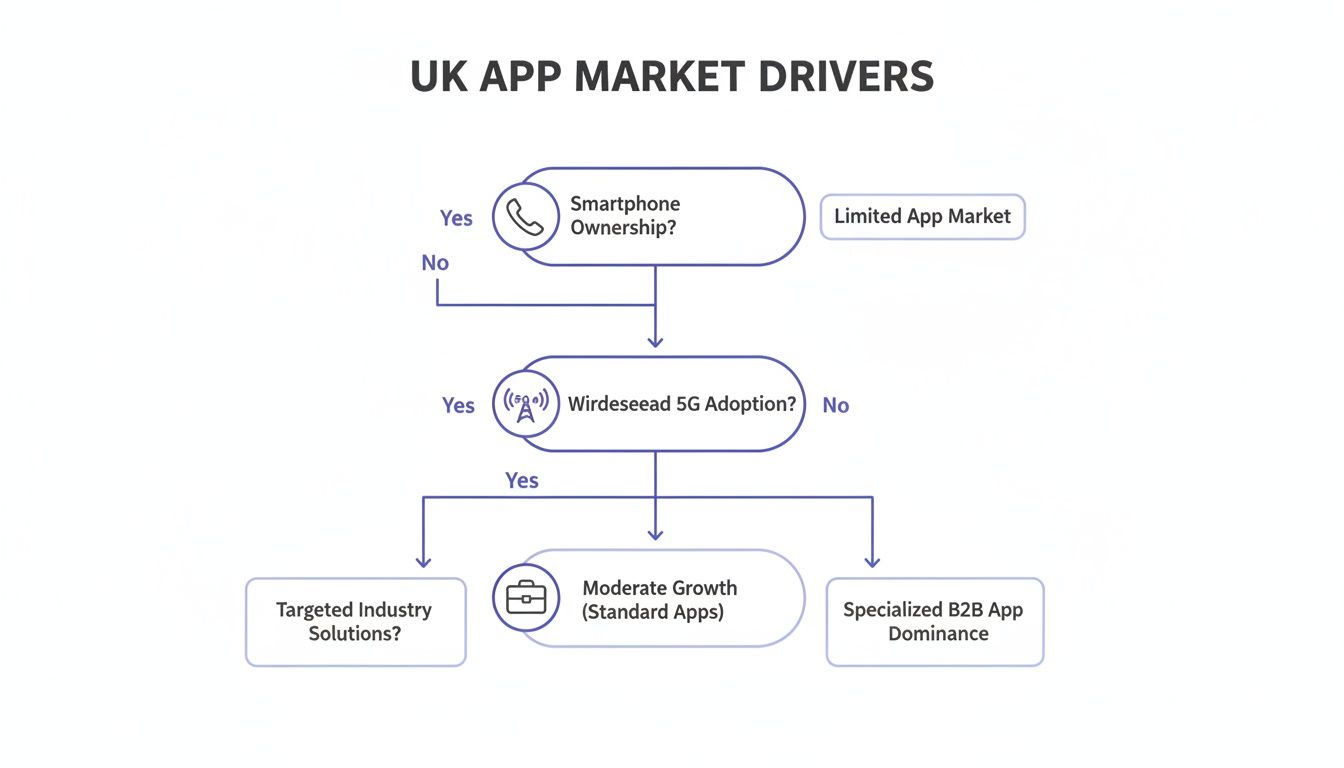
The key takeaway here is that the market's demand for apps across so many industries makes a cross-platform approach—which maximises both reach and speed—an incredibly logical choice.
Why Flutter is the Superior Choice
While other cross-platform options are out there, Flutter really stands out for its performance, tooling, and incredible UI capabilities. Developed by Google, it was designed from the ground up to create visually stunning experiences from a single codebase, without any performance penalties.
To get a clearer picture of how different frameworks stack up, our detailed analysis offers insights into why Flutter is a better choice than React Native for most app projects today.
Choosing a course focused on Flutter doesn't just prepare you for the current demands of the app market; it gives you a future-proof skill. Its versatility allows developers to target mobile, web, and desktop from one unified codebase, making it one of the most valuable technologies to learn right now.
What a High-Quality App Development Course Includes

A top-tier app development course is so much more than just a playlist of coding videos. It should be a properly structured journey that takes you from total beginner to a capable developer, armed with the practical skills needed to build apps that are ready for the real world. The best courses today are often built around a powerful framework like Flutter, which really shows they’re in tune with the industry’s need for efficiency and performance.
Think of it like learning to be a chef. You don't just memorise recipes; you learn proper knife skills, you get a feel for flavour pairings, and you understand how to manage a busy kitchen. In the same way, a brilliant app course gives you the whole picture, covering everything from core programming concepts to the business end of actually launching an app. Knowing what different online course platforms can do is a big part of finding a course that delivers this complete experience.
Foundations in Dart and Flutter Fundamentals
Every great app is built on a solid foundation. For anyone diving into Flutter, that foundation is the Dart programming language. Any course worth its salt will spend the first few modules making sure you’re comfortable with Dart’s syntax, its approach to object-oriented programming, and its modern features like null safety.
Once you've got a good handle on Dart, the curriculum will shift into the core ideas behind Flutter itself. This is where you'll discover how Flutter’s widget-based system works – it’s the secret sauce that lets you create beautiful, consistent user interfaces on any platform. You’ll start with the basic building blocks and quickly move on to piecing together complex, dynamic layouts.
The essential starting modules should cover:
- Mastering Dart: Getting to grips with variables, data types, functions, and object-oriented thinking.
- Understanding Widgets: Learning the crucial difference between stateless and stateful widgets and how to combine them.
- Building Layouts: Creating user interfaces that are responsive and look fantastic on any screen size, from a small phone to a large tablet.
Let's take a closer look at what a typical, well-structured Flutter curriculum might include. The table below breaks down the core modules you should expect to see, outlining the key topics covered and the practical skills you'll walk away with.
Core Modules in a Modern Flutter Development Course
| Module | Key Topics Covered | Practical Skill Gained |
|---|---|---|
| Dart Essentials | Variables, data types, control flow, functions, null safety, object-oriented principles. | The ability to write clean, efficient, and error-free Dart code from scratch. |
| Flutter UI Basics | Widgets (Stateless vs. Stateful), layout widgets (Row, Column, Container), styling, theming. | Building static but beautiful user interfaces and screen layouts for any app idea. |
| State Management | Provider, BLoC, Riverpod; understanding ephemeral vs. app state. | Creating dynamic, interactive apps where the UI updates automatically as data changes. |
| Navigation & Routing | Navigator 1.0 & 2.0, passing data between screens, deep linking. | Building multi-screen applications that users can navigate through intuitively. |
| API Integration | HTTP requests (GET, POST), JSON parsing, working with REST APIs, handling asynchronous data. | Connecting your app to the internet to fetch and display live data from external services. |
| Local Storage | Using packages like shared_preferences or databases like SQLite/Hive for offline data. | The skill to save user data on the device, allowing for offline functionality and persistence. |
| Testing & Debugging | Unit tests, widget tests, integration tests, using Flutter DevTools for performance profiling. | Writing reliable, bug-free code and diagnosing performance issues like a pro. |
| Deployment | Preparing app icons & splash screens, code signing, publishing to Google Play & Apple App Store. | Navigating the entire process of getting your finished app into the hands of real users. |
This kind of structure ensures you’re not just learning theory but are consistently building practical, job-ready skills at every stage of the course.
Advanced Concepts for Real-World Applications
With the fundamentals locked in, a comprehensive app development course will push you into the advanced topics that separate a hobby project from a professional-grade application. These modules are all about teaching you how to build dynamic, data-driven apps that actually solve problems for people. This is where theory becomes a tangible, marketable skill.
One of the most important topics here is state management – which is just a technical term for how your app keeps track of information and updates the screen when that information changes. You’ll also get deep into API integration, learning how to pull in data from the internet. This is what allows your app to show live weather forecasts, the latest news headlines, or product listings from an online store.
By mastering these advanced skills, you gain the ability to build sophisticated apps that are not just functional but also robust, scalable, and a pleasure to use. This is the skill set that UK businesses are actively seeking in developers.
Beyond the Code: Essential Professional Skills
The very best developers know that great code is only part of the story. A truly valuable course will also give you the professional skills needed to thrive in a team and understand the entire app lifecycle, from a rough idea on a napkin to a successful launch.
This means touching on the basics of UI/UX design, so the apps you build are not just powerful but also intuitive and easy to use. You should also be introduced to agile project management methods, as this is how almost all modern development teams work.
Finally, you’ll learn the practicalities of app store deployment – a crucial last step. This involves everything from preparing your app for submission to navigating the specific guidelines for both the Apple App Store and Google Play Store. These non-coding skills are what turn a good coder into a fantastic, well-rounded developer that any team would want to hire.
Budgeting for Your App Development Training
Before diving into any app development course, it’s smart to get a handle on the real investment involved. This isn't just about the price on the tin; it’s about weighing up the cost of training against the often eye-watering expense of outsourcing a custom app project. For most UK businesses, the maths tells a compelling story: upskilling your own team is one of the shrewdest strategic moves you can make.
When you invest in training, you’re not just buying a course—you’re building an internal asset. An in-house team that gets your business goals and can quickly build and adapt your mobile app is worth its weight in gold. This path gives you long-term control and agility, turning what would have been a massive one-off project bill into a sustainable, in-house capability.
The Cost of Outsourcing a UK App Project
To really appreciate the value of training, you have to look at the alternative. Bringing in an external agency to build an app in the UK is a major financial commitment, with the final bill swinging wildly based on complexity, features, and platform support.
UK industry guides paint a clear picture. Recent studies show that typical project budgets for cross-platform apps start at around £11,000 for a bare-bones Minimum Viable Product (MVP). For more complex, feature-heavy solutions, that figure can easily soar past £100,000. On top of that, analysis consistently shows that frameworks like Flutter can slash development costs by 20–40% by using a single codebase for both iOS and Android.
These numbers make the return on investment from training crystal clear. The cost of a solid app development course for a few team members is often just a tiny fraction of the budget needed for even a basic outsourced project.
Training Investment vs Outsourcing Costs
Let's break down the logic. A quality app development course is a fixed, one-time investment. In stark contrast, outsourcing means project fees, ongoing maintenance retainers, and extra charges for every single new feature or update you want down the line.
- Training Investment: You pay once for skills your team keeps forever. They can build, update, and maintain your app as part of their role.
- Outsourcing Cost: You’re paying for one project. The minute you need an update or a second app, the chequebook comes out again for another substantial budget.
Think of it this way: by choosing to upskill, you are not just buying a single app; you are building an app factory. Your team gains the power to deliver multiple projects and continuous improvements, all for the cost of their salary and the initial training.
To get a better feel for how features and complexity drive up the price, have a look at our complete UK app pricing guide. It offers a detailed breakdown that really puts the cost of training into perspective.
The Long-Term Savings of a Flutter-Focused Course
The financial perks of training get even better when the course centres on a modern cross-platform framework like Flutter. As we’ve mentioned, Flutter’s single codebase approach is naturally more efficient, but the long-term savings run much deeper.
A team fluent in Flutter is leaner and more agile. You don't need to hire separate iOS and Android specialists, which drastically simplifies project management and cuts down your salary overheads. This unified skillset means your team can ship features faster and react to market shifts with incredible speed.
Ultimately, budgeting for an app development course is an act of strategic foresight. It’s a direct investment in self-sufficiency, speed, and long-term financial control. Instead of seeing it as a cost, businesses should view it as the most effective way to sidestep the huge expense of external development while building a more capable, future-ready team from within.
Building Skills for the Future of App Development
The world of app development doesn't stand still for a second. The skills that were vital five years ago are now just the starting point, and the technology that will shape tomorrow's apps is already making waves today. For an app development course to give you real, lasting value, it has to prepare you not just for the current market, but for the trends that are actively changing what users expect from their apps.
Getting a handle on these shifts is non-negotiable. Technology isn't just getting better; it's opening up entirely new doors for what an app can achieve. By picking a course that leans into these changes, you or your team will build a set of future-proof skills that stay relevant and valuable for years.
The Impact of 5G on App Experiences
The rollout of 5G across the UK isn't just a minor speed increase—it's a complete game-changer for how apps can function. With connections that are faster and more solid than ever, developers can now build richer, more complex experiences that just weren't feasible before.
Think about what this unlocks:
- Real-time Interaction: Apps can now support flawless high-definition video streaming, lag-free multiplayer games, and instant data syncing across all your devices.
- Complex Data Handling: It's now possible to build apps that crunch huge amounts of data in the cloud, giving the user instant results without bogging down their phone.
- Enhanced Connectivity: Internet of Things (IoT) devices can talk to apps without a hitch, creating new opportunities in smart homes, healthcare, and logistics.
A modern framework like Flutter is perfectly built to thrive in this new era. Its high-performance rendering engine can easily handle the slick user interfaces these advanced apps need, ensuring everything feels smooth even when the app is doing some serious work in the background.
The Rise of AI and Machine Learning in Apps
Artificial intelligence (AI) and machine learning (ML) are no longer just industry buzzwords; they're at the very heart of modern apps. Users have come to expect apps to be smart, predictive, and tailored to them. Adding these technologies is no longer an optional extra—it's what sets you apart in a ridiculously crowded market.
By learning to build apps with AI and ML capabilities, you are preparing for a future where every successful app is an intelligent one. This is the skill set that businesses need to create truly compelling and competitive products.
This isn't a future prediction; it's happening right now. The big tech shifts pushing the demand for app development skills in the UK are all about fast 5G adoption and the explosion of AI/ML. Market reports are showing that a huge chunk of UK apps, with some studies suggesting nearly 60%, now use AI features for things like personalisation, smarter recommendations, and automated tasks. You can dive deeper into these UK mobile app development trends on 5stardesigners.co.uk.
Why Modern Toolchains Are Essential
To build for this future, you need the right set of tools. An app development course that focuses on modern, forward-thinking frameworks is absolutely crucial. This is where Flutter really stands out. It was designed from day one to handle the demands of sophisticated, high-performance apps.
Its entire structure makes it simpler to plug into the services that power these future-focused features. Whether you're connecting to a cloud-based AI model or building a data-heavy dashboard for a 5G network, Flutter gives you the performance and flexibility to get the job done right. Choosing a course built around this technology means the skills you learn today are the ones you'll be using to build the standout apps of tomorrow.
Common Questions About App Development Courses
When you're thinking about an app development course, it’s only natural to have a few questions. Whether you're an individual looking for a career change or a business wanting to upskill your team, getting straight answers is key to making a confident decision.
We get asked these questions all the time by people across the UK. They cover everything from time commitments to which tech is worth learning, so let’s get you the clarity you need to invest in skills that really matter in today's app-first world.
How Long Does an App Development Course Take?
The journey to becoming a skilled app developer is probably shorter than you imagine. A well-structured, intensive course can take a complete beginner and turn them into a job-ready professional in as little as 3-6 months of focused effort.
A huge factor here is the technology you choose. Learning a modern, unified framework like Flutter really speeds things up. Instead of trying to master two completely separate languages and toolkits for iOS and Android, you learn one streamlined system. This is a much faster route to building real-world apps that people can actually use.
Should I Learn Native or a Framework Like Flutter?
For the vast majority of app projects today, learning a cross-platform framework like Flutter is the smartest, most efficient move you can make. It lets you build slick, high-performance apps for both iOS and Android from a single, clean codebase.
This approach saves an incredible amount of time, money, and headaches. While native development still has its place for very specific, niche applications, Flutter has advanced so much that new benchmarks consistently put it at the top for performance. It is now the most powerful and practical option for most businesses that need both speed and quality.
What Is the First Step for Upskilling My Team?
The best starting point is to nail down your business goal. What are you trying to achieve? Are you looking to launch a new app for your customers, build an internal tool to streamline operations, or give an existing application a much-needed refresh? A clear objective will be your compass.
Once you know what you're aiming for, you can find an app development course that lines up perfectly. My advice? Prioritise programmes that teach modern frameworks like Flutter, are heavily project-based, and cover the entire app lifecycle—from the initial design sketches right through to a successful launch on the app stores.
Can I Really Build High-Performance Apps with Cross-Platform Frameworks?
Absolutely. This is a common myth that comes from older, clunkier technologies. Modern frameworks, and Flutter especially, have completely changed the game.
Flutter doesn't rely on a slow web-view bridge to talk to the phone. Instead, it compiles your Dart code directly into native ARM machine code. This means it communicates directly with the device's hardware, giving you incredibly fast, smooth, and responsive apps. The user experience feels genuinely native, and in side-by-side performance tests, Flutter apps often come out on top.
Ready to build an app that performs brilliantly on every platform? At App Developer UK, we specialise in creating stunning, high-performance applications using Flutter. Contact us today to discuss your project.