Unlocking App Success With a UK UX Design Service
Unlocking App Success With a UK UX Design Service
A UX design service is the strategic blueprint for your mobile app, making sure it’s intuitive, efficient, and genuinely enjoyable to use. It’s a deep dive that maps out every single user interaction, going way beyond simple looks to focus on how an app actually feels and works. Getting this right from the start prevents costly rebuilds later and has a massive impact on keeping users happy and coming back.
What Is a UX Design Service, Really?
Ever tried to build a house without an architectural plan? You might end up with four walls and a roof, but would the rooms flow logically? Would you find the light switches where you expect them to be? A UX design service is that essential blueprint for your digital product, especially for a mobile app.
It’s a methodical process that puts the end-user at the absolute centre of everything. The goal is to create a seamless, positive experience that helps people achieve what they want to do without any friction. This involves so much more than just making the app look pretty—that's the job of User Interface (UI) design. UX is the underlying structure, the logic, and the psychology that makes an app just feel right.
The Foundation of a Great App
A proper UX design service gets its hands dirty trying to understand your target audience. It’s all about answering the tough questions before a single line of code is written:
- Who are the real people using this app?
- What problem are they actually trying to solve?
- What drives them crazy about the current solutions out there?
- How can we make their journey from A to B as simple as humanly possible?
To really get under the skin of your users, a huge part of any UX design service is mastering the art of asking good UX research interview questions. This research isn't just a box-ticking exercise; it gives you the hard data needed to make smart design choices instead of just guessing. This groundwork is absolutely vital for apps built with powerful frameworks like Flutter, ensuring the tech is matched by an equally brilliant user experience.
More Than Just Good Looks
It’s easy to mix up UX and UI. They're related, sure, but they do very different jobs. We dive deeper into this in our guide to key user interface design principles, but the main distinction is simple. UX is about the overall journey and how it feels, while UI is about the visual elements and interactive bits you tap and swipe.
To help clear things up, here’s a quick breakdown of how UX and UI differ.
UX Design vs UI Design at a Glance
| Aspect | UX Design (The Blueprint) | UI Design (The Interior Decor) |
|---|---|---|
| Primary Goal | To make the app functional, intuitive, and enjoyable to use. | To make the app visually appealing and interactive. |
| Focus | The user's journey, problem-solving, information architecture, and overall feel. | The look of the app—colours, typography, buttons, icons, and on-screen layouts. |
| Key Questions | "How can we make this process easier for the user?" "Does this flow make logical sense?" | "Which colour palette best reflects the brand?" "Is this button clear and easy to tap?" |
| Process Includes | User research, creating personas, wireframing, prototyping, and usability testing. | Creating style guides, designing individual screens, crafting animations, and visual assets. |
| Measures of Success | User retention, task completion rates, user satisfaction scores, and reduced friction. | Visual consistency, brand adherence, aesthetic appeal, and intuitive interactive elements. |
Ultimately, both are crucial for a successful app, but they tackle different parts of the same challenge: creating an experience that users love.
A brilliant UI on top of a poor UX is like painting a masterpiece on a crumbling wall. It might look good for a moment, but it won't last. The foundation must be solid, and that foundation is built through a meticulous UX design service.
This user-first approach is really taking off across the UK. Businesses are waking up to the power of great design, and the market for UX services is projected to hit USD 0.48 billion in 2026. This growth shows a major shift, with companies in London, Manchester, and Bristol realising that a superior digital experience is the key to customer loyalty. Investing in UX isn't an optional extra; it's the foundational step in building an app that people will love, trust, and keep coming back to.
The Real-World ROI of Professional UX Design
It’s easy to look at professional UX design services as another expense on the balance sheet. But that’s the wrong way to think about it. A better way? See it as a powerful, revenue-generating engine for your business. Good user experience isn’t just about making your app look pretty; it translates directly into tangible results you can measure on your bottom line.
When users find your app simple and intuitive, they’re far more likely to finish a purchase, sign up for your service, or actually engage with your content. This smooth, frictionless journey is exactly what great UX design delivers, turning casual browsers into loyal, paying customers.
From Good Feelings to Hard Numbers
There's a direct and undeniable link between a user's experience and your business's financial health. To really grasp the ROI, you have to see how dedicated User Experience Optimisation drives real commercial growth by boosting conversions, leads, and sales. It’s all about making smart design decisions that move your most important business metrics in the right direction.
Here’s how that actually plays out:
- Higher Conversion Rates: A logical, simplified checkout process can drastically cut down on abandoned carts. If buying from you feels easy and secure, more people will see it through to the end.
- Increased Customer Loyalty: When an app is genuinely enjoyable and simple to use, people come back. This is what drives up customer lifetime value (CLV), a vital metric for any business with long-term ambitions.
- Reduced Support Costs: An intuitive app that anticipates what users need and offers clear guidance simply generates fewer support tickets. That frees up your team’s time and trims down your operational overheads.
For UK startups and SMEs, where every pound has to count, this isn’t a luxury. It’s a serious competitive advantage that can be the difference between a new venture that fizzles out and one that thrives.
The Staggering Return on Investment
The financial impact of focusing on user experience isn't just a theory; it's backed by some pretty compelling data. UK businesses that properly invest in UX design services are seeing explosive growth. This mirrors global trends where every £1 invested can yield an incredible £100 in return—that's a 9,900% ROI. It really highlights how valuable this is for startups and established companies alike.
Just look at the real-world examples. One UK e-commerce platform saw its sales jump by 35% after rolling out a responsive UX redesign. Another software company streamlined its sign-up process and managed to slash user drop-offs by 50%.
A Flutter app is already engineered for high performance, with new benchmarks consistently placing it at the top. Pairing it with world-class UX is like putting a Formula 1 engine in an aerodynamically perfect car. You unlock its full potential, delivering an experience that is not only fast but also exceptionally smooth and satisfying.
Ultimately, investing in a professional UX design service de-risks your entire app development project. It makes sure you're building something people genuinely want and will enjoy using, which saves you from costly redesigns and rebuilds later. By putting the user at the very centre of your strategy from day one, you build a solid foundation for sustainable growth and a powerful return on your investment.
The UX Design Journey for Your Flutter App
So, what really happens when you bring in a professional UX design service? It’s not some mystical creative ritual. Far from it. It's a structured, collaborative journey with clear phases and measurable goals, designed to give you a validated blueprint for your Flutter app long before a single developer gets involved.
Think of it as building progressively, from a high-level idea into a detailed, interactive model that real people have already tested. This entire process is built around one simple but powerful idea: design first, then build. By figuring everything out upfront, we slash risks, dodge expensive mistakes down the line, and make the handover to our developers ridiculously smooth.
Phase 1: Discovery and Strategy
The whole thing kicks off not with pixels, but with a conversation. We start with discovery workshops, which are basically intensive sessions where we get completely immersed in your business. The aim is to get a crystal-clear understanding of your vision, your commercial goals, and the specific problem your app is setting out to solve.
During this phase, we'll map out who you're up against, spot gaps in the market, and pin down exactly what success looks like for your project. It's a strategic deep-dive that makes sure every design choice we make is pulling in the same direction as your business goals. We're not just designing an app; we're designing a solution that moves the needle.
Phase 2: Research and Empathy Building
With a solid strategy in place, we pivot our focus entirely to your future users. This is where we conduct proper user research to understand their needs, their habits, and what drives them nuts. This isn't guesswork. We're talking interviews, surveys, and digging into existing data to build a rich, authentic picture of who we're designing for.
Out of all this research, two critical documents emerge:
- User Personas: These are detailed, almost fictional profiles that represent your key user types. They give a name and a face to your audience, helping the entire team stay laser-focused on who they're actually building for.
- Customer Journey Maps: These visuals map out every single interaction a user has with your app, from the moment they hear about it to the point they can't live without it. They're brilliant for spotting opportunities and flagging potential rough patches in the experience.
Honestly, this phase is all about empathy. By stepping into your users' shoes, we can design an experience that just feels right to them.
Phase 3: Ideation and Prototyping
Now, the blueprint really starts coming to life. We kick off with wireframing—creating simple, black-and-white layouts of the app's screens. Think of these as the architectural drawings for your app. They focus purely on structure, information flow, and layout, without the distraction of colours or fancy fonts.
Once we’ve nailed the basic structure, we build interactive prototypes. These are high-fidelity, clickable mock-ups that look and feel just like the real app. This is a game-changer because it lets you and your stakeholders click around, test the user flows, and give concrete feedback before any code is written.
An interactive prototype is the ultimate validation tool. It allows us to fail fast and learn cheaply, making adjustments in hours with a design tool instead of weeks with development resources. It’s the bridge between a static idea and a functional product.
This simple flow shows how that initial investment in UX pays dividends in real business growth.
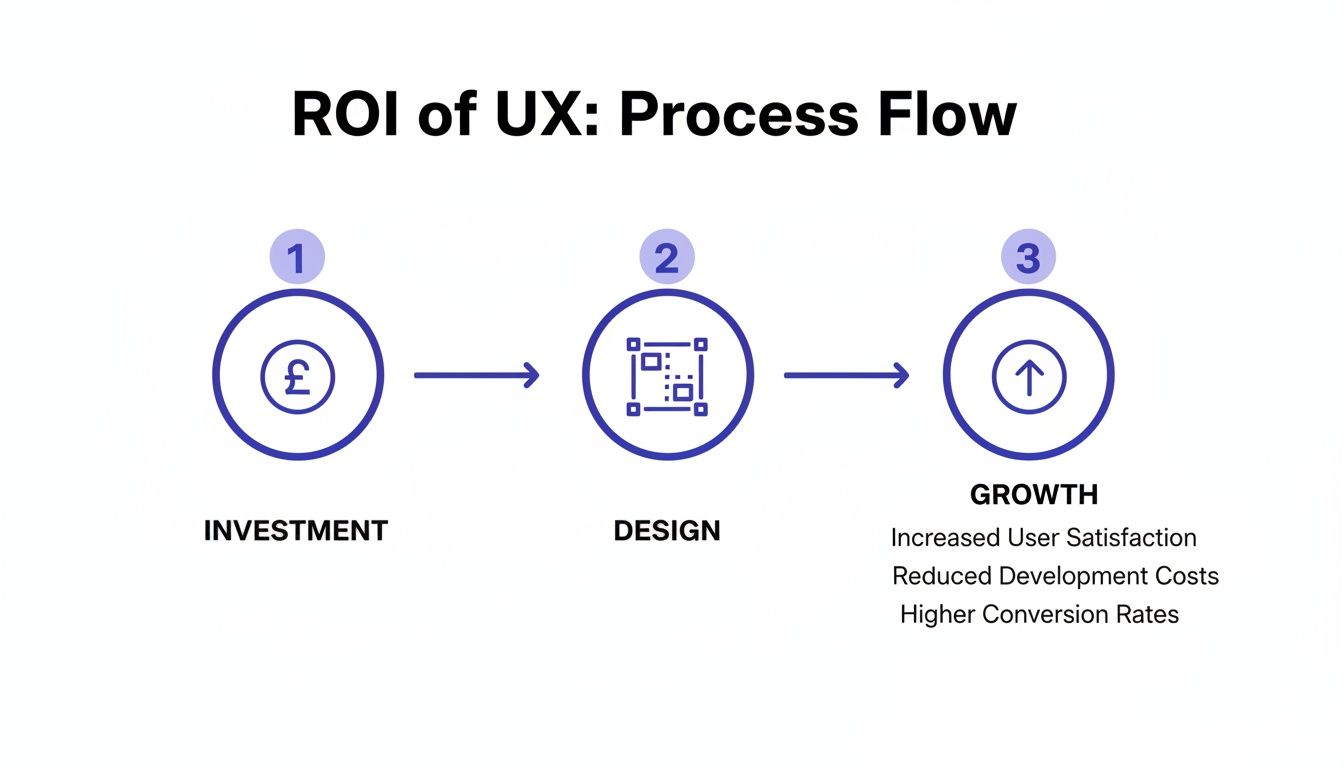
The takeaway is clear: a smart investment in the design phase is what directly fuels the growth you’re after.
Phase 4: Testing and Validation
With a working prototype ready to go, we move to the most important stage of all: usability testing. We put the prototype in front of real users from your target audience and simply watch them try to complete key tasks. We're not asking if they like the colour scheme; we're observing if they can actually use the app to get things done.
The feedback we gather here is pure gold. It gives us data-backed insights into what's working and what's a total dead end, allowing us to tweak and refine the design based on how people actually behave. This cycle of test-and-refine is what separates a decent app from a truly great one.
This meticulous, user-first approach fits perfectly with the agile nature of Flutter app development. By handing our developers a fully tested and polished design blueprint, we ensure the collaboration between design and development is completely seamless. You can learn more about how we build high-performance applications in our guide to Flutter development. This tight integration guarantees the final product isn't just beautiful and intuitive, but also technically solid and performant from day one.
Key Deliverables You Will Actually Use
When you invest in a UX design service, you’re not just paying for conversations and abstract ideas. You’re commissioning a set of tangible, strategic assets that become the foundation for your entire app development project.
These deliverables aren't just documents to file away. Think of them as the working blueprints that guide your team from concept to launch and, crucially, take a lot of the risk out of the build. Each one translates deep user understanding into a practical plan, ensuring your Flutter app is built correctly, efficiently, and always with the end-user in mind. Let’s break down what you should get and why each piece is so valuable.
Giving Your Audience a Face with User Personas
Before you can design a great product, you have to know exactly who you're designing it for. User Personas are fictional but research-backed profiles that represent your ideal users. They go way beyond basic demographics, capturing your audience's goals, motivations, behaviours, and biggest headaches.
Don't mistake a persona for a vague stereotype; it’s more like a detailed character sketch. It gives your designers and developers a clear, empathetic picture of a real person they're building for. This shared understanding stops the team from designing for themselves and keeps every decision grounded in what your users actually need.
Mapping the Experience with Customer Journey Maps
A Customer Journey Map is a visual story of every single interaction a user has with your app to get something done. It charts their steps, thoughts, and feelings at each stage—from the moment they first hear about your app to becoming a loyal fan.
This is an incredibly powerful tool for spotting moments of friction and opportunities to create a bit of magic. It lets your team see the complete picture from the user's perspective, highlighting where the experience might be confusing or frustrating. By mapping this path, you can proactively smooth out the rough patches and ensure a seamless, intuitive flow.
Building the Structure with Information Architecture
If your app is a building, the Information Architecture (IA) is its structural framework. This deliverable maps out how all the content and features are organised, structured, and labelled. The goal is simple: create a logical navigation system that helps users find what they need without having to think too hard.
A solid IA is the backbone of any user-friendly app. It makes sure menus make sense, content is easy to find, and users never feel lost. For a high-performance Flutter app, a well-planned IA is critical for keeping the structure clean, efficient, and scalable as you add more features down the line.
Visualising the Blueprint with Wireframes and Prototypes
This is where your app starts to take a visible shape. Wireframes are low-fidelity, black-and-white layouts that focus purely on structure and where elements go on each screen. They are the bare-bones blueprints, letting you finalise how things work without getting distracted by colours or branding.
A wireframe is about function over form. It forces you to answer the most important question for every screen: "What is the user trying to accomplish here?"
Once the wireframes are locked in, they’re brought to life as interactive prototypes. These are high-fidelity, clickable mock-ups that look and feel just like the real app. This is a game-changer, as it lets you and your stakeholders test the user journey and give concrete feedback before a single line of code is written. It’s the ultimate way to validate your design choices with real people.
Finally, you’ll get a Usability Testing Report. This document pulls together all the findings from user testing sessions, giving you data-backed evidence on what works and what needs a rethink. It’s the proof that your design isn't just based on guesswork but has been validated by your target audience, ensuring your investment leads directly to a better, more successful product.
Choosing the Right UK UX Design Partner
Picking the right partner for your app's UX design is one of the most important calls you'll make. This isn't just about hiring a contractor with some decent design skills; it's about finding a team that gets your business goals and understands the specific technical world of a high-performance Flutter app. A great partner feels like an extension of your own team, not just a temporary supplier.
This decision has a direct impact on your project's success, budget, and timeline. Get it right, and the agency will de-risk your investment by proving ideas work before a single line of code is written. Get it wrong, and you could be looking at costly redesigns and a whole lot of frustration. To choose with confidence, you have to look past the flashy visuals and dig into their strategic thinking.
Evaluating a UX Agency’s Portfolio
A portfolio is more than just a gallery of pretty app screens. Think of it as a collection of success stories that show off an agency's problem-solving chops. When you're looking through their work, don't just skim the final product. You're looking for the story behind it and proof they've handled projects like yours before.
Here's what to zero in on:
- Mobile-First Expertise: Have they actually designed complex, high-performance mobile apps? Their portfolio needs to be full of native or cross-platform projects, not just websites that happen to work on a phone.
- Flutter Experience: An agency that knows Flutter inside and out can design an experience that works with the framework, not against it. This simple fact ensures the final product is both beautiful and efficient, avoiding unnecessary headaches for your developers down the line.
- Measurable Results: The best portfolios show the real business impact of their designs. Look for case studies that talk about boosting conversion rates, increasing user engagement, or improving customer satisfaction scores.
Assessing Their Design Process and Collaborative Spirit
A transparent and collaborative design process is an absolute must. You want a partner who pulls you into the process at every key stage, from the first discovery workshop right through to the final round of usability testing. A top-tier UX design service provider will be excited to walk you through their methodology and explain how they tailor it to different projects.
A truly collaborative agency doesn't just take orders; they challenge your assumptions and aren't afraid to ask tough questions. They're your strategic partner in building a successful product, not just a pair of hands to execute a vision.
How they work with development teams is also a massive deal. Ask them how they document their designs and handle the handover to your engineers. An agency with genuine Flutter experience will know just how vital clear design systems and component libraries are for making the build phase faster and smoother for everyone.
Key Questions to Ask a Potential UX Partner
You have to go deeper than the surface-level questions to find the right fit. The questions you ask should uncover how they think, how committed they are to your users, and whether they're truly collaborative. A great agency will welcome these detailed questions and give you thoughtful, confident answers.
To help you get started, we've put together a checklist of essential questions to vet potential agencies. This will help you find a true partner for your project, not just another vendor.
Vendor Selection Checklist Questions to Ask
| Category | Essential Questions |
|---|---|
| Experience & Expertise | Can you show us a case study for a Flutter app you designed? How do you measure the success or ROI of your UX design projects? |
| Process & Methodology | What does your typical UX design process look like, from start to finish? How do you conduct user research and validate your design assumptions? |
| Collaboration & Communication | How do you collaborate with clients and their development teams during a project? What is your process for handling feedback and design iterations? |
| Technical Acumen | How familiar are you with Google's Material Design guidelines for Flutter? How do you ensure your designs are technically feasible to build? |
Armed with these questions, you'll be in a much better position to gauge an agency's capabilities and see if their approach genuinely aligns with your project's needs.
Making Sense of UX Design Service Costs
Trying to pin down the cost of a professional UX design service can feel a bit like asking, "how long is a piece of string?". The truth is, it’s not a single, off-the-shelf price. The investment reflects the expertise, time, and strategic thinking needed to create an app that people genuinely love to use.
The final figure really depends on your specific needs. For businesses here in the UK, the biggest factor is always the project's scope. A straightforward app with a few key screens is naturally going to cost less than a complex platform with multiple user roles and detailed workflows. The depth of user research required and the level of detail in the final prototypes also play a huge part in the quote you'll receive.
Common Pricing Models Explained
When you start talking to agencies, you'll likely hear about three main ways they price their work. Each has its own benefits, and the best one for you will depend on your project's size, timeline, and how you like to manage your budget.
- Hourly Rates: This is the most flexible option. It’s perfect for smaller jobs, ongoing tweaks, or projects where the full scope isn't quite nailed down yet. You simply pay for the time spent, which is a great way to handle targeted improvements or get expert advice without a massive upfront commitment.
- Fixed-Project Pricing: If your project has a crystal-clear scope and a defined set of deliverables, a fixed price is your best friend. It gives you complete cost certainty right from the start, making it much easier to budget. This is the go-to model for a complete UX design process, from the initial discovery phase right through to polished, developer-ready designs.
- Ongoing Retainers: Think of this as having a UX design partner on speed dial. A retainer is ideal for businesses that need continuous support, like iterating on an existing app, running regular user tests, or having an expert available to bounce ideas off. It builds a strong, long-term relationship focused on constantly making your app better.
The point of a transparent quote isn't just to give you a number. It's about connecting every penny of your investment to a tangible business outcome. A great UX service will always tie the cost back to the real-world value it's creating for your app.
Ultimately, choosing the right model comes down to your unique situation. To see how these costs fit into the broader picture of app creation, our UK app pricing guide breaks down the full cost of app development in the UK. Getting your head around these numbers is the first step towards confidently investing in a UX design service that will set your Flutter app up for success.
Common Questions About UX Design Services
Diving into the world of UX can feel like learning a new language, and it’s natural to have questions, especially when you’re trying to find the right UX design service for your project. To clear things up, we’ve put together answers to some of the most common queries we hear from founders and business owners.
How Long Does the UX Design Process Take?
This is the big one, and the honest answer is: it depends. The timeline for UX design is tied directly to your app's complexity. For a straightforward app with just a few core features, you could be looking at 4-6 weeks for the full journey, from the first discovery call to a developer-ready prototype.
On the other hand, a complex platform with multiple user journeys and in-depth research needs might take 8-12 weeks, or sometimes longer. The crucial thing to remember is that this time isn't a delay; it's an investment. Getting the design blueprint right upfront speeds up the actual coding, preventing expensive mistakes and backtracking later.
Can I Hire a UX Designer for an Existing App?
Absolutely. A UX design service isn't just for building from scratch. In fact, many businesses bring us on board to run a UX audit on an app that’s already live. This is like a health check for your user experience, pinpointing friction points, usability problems, and hidden opportunities to improve things like user retention and conversion rates.
Even small, targeted improvements based on a professional UX audit can lead to significant gains in user satisfaction and business outcomes. It’s about refining what you have to make it work even better for your users.
What Makes a Good UX Partner for a Flutter App?
When you’re building with a high-performance framework like Flutter, you need a UX partner who gets it. The best agencies understand Flutter's capabilities and its design language, particularly Google's Material Design guidelines. They know how to design an experience that feels truly native on both iOS and Android, without creating unnecessary work for your developers.
Take a look at their portfolio. Does it show they’ve worked on mobile apps before? Can they demonstrate a clear process for research, prototyping, and—most importantly—collaborating with engineering teams? That technical awareness is the bridge between a beautiful design and a brilliant final product.
Ready to build an app that users will genuinely love? At App Developer UK, we combine expert Flutter development with a user-centric UX design service to create exceptional mobile experiences. Contact us today to discuss your project.