Finding the Best Agile Course Online for UK Teams
Finding the Best Agile Course Online for UK Teams
Investing in a good agile course online is one of the smartest moves a competitive UK business can make. It’s about equipping your team with the right mindset and frameworks to deliver high-value projects, faster. This kind of training helps teams break free from rigid, outdated planning, teaching them instead how to adapt, collaborate, and react to change with real speed and precision.
Why Agile Training Is a Game Changer for UK Businesses

In the UK's fast-moving tech scene, a great idea is only half the battle. The real challenge is executing it brilliantly and quickly. Traditional project management, with its fixed plans and step-by-step stages, just can’t keep up anymore. This is exactly where Agile methodologies come in and completely change the game.
Think of it like this: a traditional project is like planning a road trip by mapping out every single turn and stop before you even start the car. An Agile project, on the other hand, is more like rally racing. You know the destination, but you’re constantly reacting to the terrain, weather conditions, and your co-driver’s feedback to find the best path forward in real-time.
An agile course online teaches your team how to make that crucial shift from rigid prediction to nimble response. It gives them the skills to navigate the inevitable twists and turns of any project, whether it’s a complex software build or a new marketing campaign.
The Tangible Business Outcomes of Agile Education
Putting your team through formal Agile training isn't just about learning some new jargon; it delivers concrete, measurable results. It fundamentally re-wires how your team approaches their work, putting a laser focus on efficiency and delivering real value.
Nowhere are the benefits clearer than in app development. Applying Agile principles here leads directly to:
- Faster Project Delivery: Big projects are broken down into small, manageable cycles known as sprints. This allows teams to ship working software much sooner and more frequently.
- Stronger Team Collaboration: Agile insists on daily communication and shared ownership, which naturally breaks down the walls between developers, designers, and project stakeholders.
- Better Product Quality: Constant feedback is baked into the process. This loop of continuous refinement ensures the final product is what users actually want and need.
- Greater Adaptability: Instead of fearing change, teams learn to welcome it. They can easily pivot based on new customer insights or shifting business goals without throwing the entire project off course.
Agile isn't just another process to follow. It's a cultural shift toward continuous improvement and putting the customer at the centre of everything. It turns teams from simple task-doers into strategic problem-solvers who actively drive business growth.
Meeting the Surging Demand for Agile Skills
There’s no denying the demand for Agile skills in the UK right now. In fact, enrolments in online Agile courses shot up by 45% between 2023 and 2025. This explosion in popularity is tied directly to the impact it has on app development, where Agile has been shown to slash time-to-market by up to 40%.
For our teams who specialise in Flutter—a framework already famous for its speed—this combination is a powerhouse. It lets us build and launch incredible apps for iOS, Android, and the web from a single codebase with unparalleled efficiency. You can explore more about this growing demand and see why so many businesses are making the switch.
Decoding the Core Agile Methodologies
To really get the most out of an agile course online, you first need to get your head around the powerful frameworks that form its backbone. These aren’t rigid rulebooks; they’re flexible systems built to help teams deliver better work, faster. Think of them as different plays in a sports team's playbook—each one is suited for a different situation, but they all share the goal of winning the game.
The two big names you'll hear about constantly are Scrum and Kanban. While both are rooted in Agile’s core values of teamwork and iterative progress, they approach the work in fundamentally different ways. Nailing these differences is the first step to picking the right approach for your projects.
Learning these frameworks reveals just how structured, yet incredibly adaptable, modern project management can be.
Scrum: The Film Production Framework
Scrum is without a doubt the most popular Agile framework, especially in the world of software and app development. The easiest way to picture it is to think of a film production crew.
In this scenario, the Product Owner is the film's director. They hold the vision for the final movie—the plot, the characters, the emotional impact. Their job is to manage the "product backlog," which is basically the script and a prioritised list of all the scenes that need to be shot.
The Scrum Master is the producer. They aren't telling the actors how to act; their role is to make sure the whole production runs without a hitch. They clear away any roadblocks—a broken camera, a scheduling clash—so the crew can focus purely on their creative work. They are a servant-leader, guiding the process rather than barking orders. For a deeper dive into one of the most widely used agile methodologies, explore the Scrum framework.
Finally, the Development Team is everyone else: the camera crew, the actors, the sound engineers. They are the cross-functional group of experts who actually shoot the film. They work in short, focused bursts called sprints—usually lasting two to four weeks—to complete a specific batch of scenes. At the end of each sprint, they have something tangible to show the director, allowing for instant feedback and quick adjustments.
This sprint-based cycle is Scrum's superpower. It forces teams to deliver working, valuable results regularly, stopping projects from veering off course for months at a time.
Kanban: The Airport Security Line Method
If Scrum is a highly structured film shoot, Kanban is all about continuous flow, a bit like the security line at an airport. The main goal is to visualise the workflow and manage it smoothly to stop bottlenecks from forming.
Picture a simple Kanban board with three columns: "To Do," "In Progress," and "Done." Each task, like a passenger, starts in the "To Do" queue. When a team member is free, they pull a task into "In Progress," just as a security agent waves the next person forward.
The golden rule in Kanban is to limit the work in progress (WIP). An airport doesn’t let everyone rush the scanners at once; that would be chaos. Instead, they manage the flow. In the same way, a Kanban team sets a strict limit on how many tasks can be in the "In Progress" column at any given moment. This one simple constraint stops people from getting overloaded and instantly flags where hold-ups are happening. If "In Progress" is full, the team has to swarm together to get a task finished before anyone can start something new.
This laser focus on visual workflow and continuous delivery makes Kanban a brilliant choice for teams that deal with a constant stream of incoming work, like customer support, content creation, or ongoing app maintenance.
Comparing Core Agile Methodologies
To help you decide which methodology might be a better fit, here’s a quick breakdown of how Scrum and Kanban stack up against each other.
| Feature | Scrum | Kanban |
|---|---|---|
| Cadence | Uses fixed-length iterations called Sprints (e.g., 2 weeks). | A continuous flow model with no prescribed iterations. |
| Roles | Prescribes three specific roles: Product Owner, Scrum Master, Development Team. | No formal roles are required; the existing team structure is often used. |
| Change | Discourages changes during a Sprint to protect the team's focus. | Allows for changes at any time as long as WIP limits are respected. |
| Key Metrics | Velocity (how much work is completed per Sprint). | Cycle Time (how long a task takes from start to finish). |
| Best For | Complex projects with a clear end goal, like building a new app. | Teams with a continuous stream of work, like support or maintenance. |
Ultimately, there's no single "best" option. Scrum provides a structured, rhythmic pulse that drives projects forward, while Kanban offers a flexible, adaptive flow perfect for managing ongoing operational work. The right choice depends entirely on your team, your project, and your goals.
Navigating Agile Certifications in the UK
Stepping into the world of Agile often leads to a crucial question: which certification is right for my team? An agile course online is an investment, so understanding the UK's certification landscape is key to making a smart one. Think of these certifications less like badges and more like specialised driving licences—each one proves a distinct level of skill for navigating different project terrains.
Getting certified shows that a professional has truly grasped specific Agile principles and is committed to a higher standard of work. This formal recognition pays off, improving project outcomes, building client confidence, and giving your team a recognised mark of excellence.
The Top Agile Certifications Explained
While there are many certifications out there, three really stand out in the UK for their industry recognition and practical value. Each one has a slightly different focus, catering to different roles and levels of Agile experience. The right choice really depends on whether your team needs deep expertise in one framework or a broader understanding of multiple Agile approaches.
- Certified ScrumMaster (CSM): This certification is all about the Scrum framework. A CSM is an expert in Scrum’s principles, practices, and values, acting as a "servant-leader" who coaches the team and clears any obstacles that get in the way of a successful sprint.
- Professional Scrum Master (PSM): Like the CSM, the PSM is also centred on Scrum. However, it’s known for its tough assessment, which demands a deep, practical understanding of the Scrum Guide to pass. It’s often seen as proof of a professional’s genuine mastery of the framework.
- PMI Agile Certified Practitioner (PMI-ACP): This one takes a much broader view. Instead of just focusing on Scrum, the PMI-ACP covers a whole range of Agile methods, including Kanban, Lean, and Extreme Programming (XP). It’s perfect for professionals who work in varied Agile environments and need a versatile toolkit.
The diagram below helps to visualise the core differences between Scrum's structured framework and Kanban's continuous flow method, two key concepts you'll encounter in these certifications.
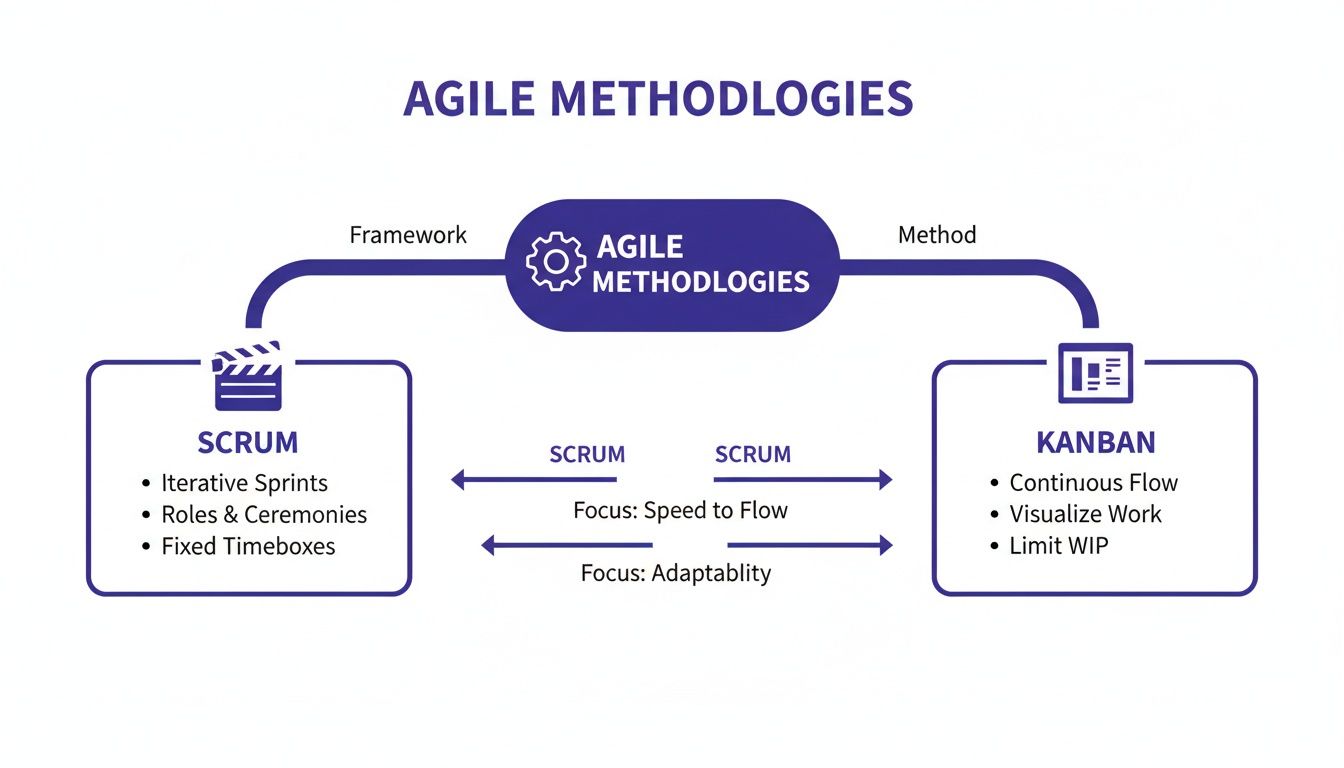
This comparison really highlights how Scrum is designed for delivering complex products in iterative cycles, whereas Kanban is all about managing workflow and improving efficiency on a continuous basis.
The Clear Return on Investment
Investing in certification isn't just another expense; it delivers a powerful return. Certified professionals don’t just learn theory—they learn how to apply proven techniques that cut down on waste, improve predictability, and boost team morale. This has a direct impact on your bottom line.
In the UK, professionals who get Agile certified see substantial career benefits. For instance, those with an Agile Scrum Foundation Certification can earn a median salary that's up to 20% higher, typically ranging from £55,000 to £75,000 a year. With over 150,000 certified professionals worldwide and UK numbers growing by 25% year-on-year, it's clear the industry values these credentials.
Certifications provide a common language and a shared understanding of Agile principles across an organisation. This alignment is the secret ingredient for scaling Agile successfully and consistently delivering high-quality products, especially in demanding fields like app development.
For a comprehensive overview of what's involved, check out our complete UK Scrum Master certification training guide. It breaks down the entire process, from choosing a provider to preparing for your exam, making sure your team is set up for success from day one. It's an investment that builds a more competent, confident, and effective workforce ready to tackle any project.
Choosing the Right Online Course Format
Picking the right format for an agile course online is just as crucial as choosing the methodology itself. How your team learns will have a direct impact on how well they actually grasp and apply Agile principles down the line. Each format offers a completely different experience, built for different team setups, learning styles, and business goals.
This decision isn't simply about what's most convenient; it’s about strategically matching the training environment to your team's specific needs. Get this right, and your investment will pay off. Let’s break down the three main options you’ll come across.
Self-Paced Learning: Flexibility for the Disciplined Team
Self-paced online courses offer the ultimate in flexibility. Team members can chip away at modules on their own schedule, which is perfect for busy individuals or small, highly motivated teams where getting everyone in the same virtual room is a logistical nightmare.
This approach lets people go back over tricky topics and move at their own speed. But that freedom comes with a major catch: it requires a serious amount of self-discipline. Without the structure of a live class, it's easy for team members to fall behind or, worse, never finish the course at all.
- Best for: Small, self-starting teams, individuals with chaotic schedules, or as a budget-friendly introduction to Agile ideas.
- Key consideration: Success entirely depends on the motivation of each person. This probably isn't the best fit for teams that feed off collaborative energy and need instant feedback.
Live Online Classes: Real-Time Interaction and Structure
Live online classes do a great job of recreating the traditional classroom feel, just virtually. You get a real instructor leading the sessions in real-time, providing a structured learning path with set schedules. This really helps build a sense of shared progress and keeps everyone accountable.
The biggest win here is the direct interaction. Your team can ask questions on the spot, jump into group discussions, and work together on exercises in virtual breakout rooms. That immediate feedback loop is priceless for clearing up confusing concepts and building a much deeper, more practical understanding of frameworks like Scrum or Kanban.
The collaborative energy of live online classes often mirrors the very principles of Agile itself. It encourages active participation, immediate feedback, and learning together as a single unit, which helps reinforce the team-focused culture you’re trying to build.
Bespoke Corporate Training: The Tailored Solution for Organisational Change
For bigger companies or any business trying to get multiple teams on the same Agile page, bespoke corporate training is hands-down the most powerful option. Here, a training provider works with you to create a custom curriculum designed around your company’s specific needs, goals, and unique challenges.
A corporate package can weave your company's real-world projects and case studies straight into the training material, making every lesson instantly relevant. The trainer can dive into your specific team dynamics, workflows, and roadblocks, ensuring the learning isn't just theory—it's immediately useful. While it's a bigger upfront investment, the tailored approach drives much deeper adoption and delivers a far more significant, long-term impact on your team’s performance.
How Agile Powers High-Performance App Development
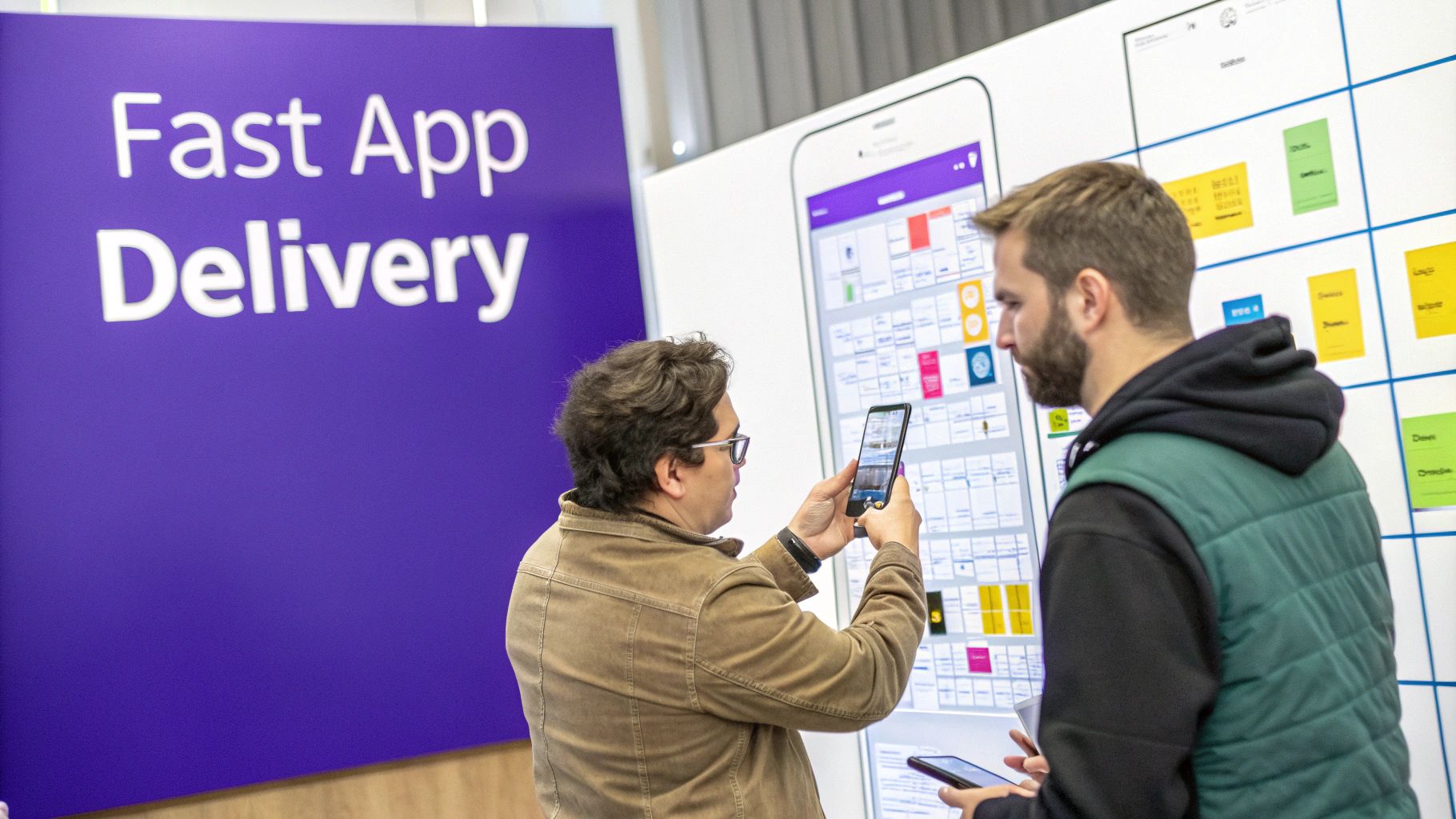
In the world of app development, Agile isn't just another buzzword for project management; it's the very engine that drives success. It gives teams the structure they need to navigate the complexities of building an app while staying flexible enough to adapt on the fly. Without a solid Agile process, even the best ideas can get lost, lose touch with user needs, and ultimately miss the mark.
The whole philosophy is built around making steady progress in small, manageable steps and learning as you go. Instead of trying to build the entire app in one enormous push, Agile breaks the work down into short, focused cycles known as sprints. This iterative approach is absolutely essential for creating modern apps that people genuinely want to use.
At the end of each sprint, you have a small, working piece of the application. This means you can get it in front of stakeholders, test it rigorously, and—most importantly—gather real feedback from actual users. This constant feedback loop is the secret sauce to building products that not only function perfectly but also solve real-world problems.
The Perfect Partnership: Agile and Flutter
As a UK-based Flutter development agency, we’ve seen first-hand how perfectly Agile and modern frameworks like Flutter click into place. Agile gives you the method, but the technology you use dictates how fast you can actually move. This is where the synergy between Agile and Flutter creates a serious competitive advantage.
Flutter was designed from the ground up for speed and efficiency. The ability to build apps for multiple platforms from a single codebase isn't just convenient; it's a complete game-changer. This core strength dovetails beautifully with an Agile workflow, letting development teams move at an incredible pace.
Here’s how they amplify each other:
- Rapid Prototyping: Flutter’s famous "hot reload" feature means developers can see the changes they make almost instantly. An idea discussed in a morning stand-up meeting can become a clickable prototype by the afternoon, dramatically speeding up the feedback cycle.
- Consistent Sprints: With one codebase for iOS, Android, and the web, teams can focus on shipping features across all platforms within a single sprint. This removes the headache of juggling separate development tracks and keeps everyone aligned.
- Superior Performance: Time and again, benchmarks show Flutter leading the pack in performance. This technical muscle ensures that the polished, high-quality app envisioned during the Agile planning stages is exactly what gets delivered to the user.
Agile provides the 'what' and 'why'—the user stories, the priorities, and the collaborative structure. Flutter provides the 'how'—the technical capability to build, test, and deploy beautiful, high-performance apps with unmatched speed and efficiency.
This powerful combination lets us deliver better apps, faster. It’s not about cutting corners; it’s about working smarter with a superior process and toolset to build products that stand out. To see how this works in practice, you can explore our insights on online Agile training for modern app development teams.
Delivering a Definitive Market Advantage
Choosing an agile course online is a brilliant first step towards embedding this high-performance capability into your team. For businesses looking to outsource, partnering with an agency that lives and breathes both Agile and Flutter is non-negotiable. This combination guarantees your project benefits from maximum speed, efficiency, and quality right from the start.
When a team is fluent in Agile, they can react to market shifts or new feedback without throwing the entire project off course. When that same team uses Flutter, they have the technical firepower to implement those changes quickly and effectively across every platform.
This integrated approach keeps projects on time and on budget, while ensuring the final product constantly evolves to meet what users really want. The result? A top-tier, high-performance app that gets to market faster, giving you a significant edge over competitors stuck with slower, more rigid methods. It’s simply the modern standard for excellence in app development.
What's the Investment in Time and Money?

Before jumping into an agile course online, it’s smart to get a handle on what you’ll need to invest, both in terms of cost and time. The price tag for courses here in the UK can swing wildly depending on how deep you want to go and whether a formal certification is involved.
You could find a solid introductory course covering the Agile basics for around £200. But if you’re aiming for a heavyweight certification like a Certified ScrumMaster (CSM) or Professional Scrum Master (PSM), you’re looking at a more serious investment, often pushing past £1,000. It might sound like a lot, but when you weigh it against the gains in project speed and team harmony, it quickly becomes a very sensible business decision.
Time commitment is a similar story. A foundational course might just be a few focused hours—perfect if you need a quick, high-level overview. A full certification bootcamp, on the other hand, is a different beast entirely. It's an immersive experience, usually demanding two or three full days of your team's undivided attention.
Making the Training Actually Work
Just enrolling in a course and hoping for the best is a recipe for disappointment. To get real, lasting value, you need a game plan. A bit of strategy turns a simple training expense into a genuine catalyst for change.
Here’s a practical roadmap to get you started on the right foot:
- Take Stock of Where You Are: Get brutally honest about your team's current way of working. Where are the delays? What’s causing the most friction or miscommunication? Pinpointing these sore spots gives you clear targets for what you need the Agile training to fix.
- Set Clear Training Goals: With your pain points identified, you can set specific objectives. Are you trying to slash the time it takes to get app updates to market? Or maybe you just need your developers and designers to work together more smoothly. Clear goals make choosing the right course a whole lot easier.
- Find the Right Training Partner: Look for UK-based providers who know their stuff, especially those with real-world experience in tech and app development. Read reviews, scrutinise the curriculum, and make sure their approach fits your team. You want hands-on, practical exercises, not just death by PowerPoint.
The real win here isn't a certificate to hang on the wall. It’s about arming your team with a smarter, more effective way of building things—something that directly boosts your results, especially on fast-moving projects like Flutter app development.
Taking Your First Practical Steps
The good news is you don't need to wait for a formal course to start thinking and acting in a more Agile way. You can start building momentum right now by introducing a few small, powerful habits.
A fantastic place to begin is the daily stand-up meeting. It’s simple: a quick, 15-minute meeting at the same time every morning. Each person answers three questions: What did I do yesterday? What will I do today? What's blocking my progress? It's an incredibly effective ritual for boosting communication, keeping everyone accountable, and making sure the team is pulling in the same direction.
By taking these small, deliberate steps, you can move forward with confidence, ensuring your investment in an agile course online delivers a more efficient, collaborative, and successful team.
Answering Your Questions About Agile Courses
Thinking about sending your team on an Agile course? It’s a smart move, but it’s natural to have a few questions bubble up. Most business owners and team leads I talk to have similar queries when they first look into an agile course online. Let's clear up some of the most common ones.
How Long Does an Agile Certification Take?
The timeline for getting certified here in the UK really boils down to which qualification you’re after.
For a foundational certificate, like the Professional Scrum Master I (PSM I), you can often get your team up to speed after an intensive two-day online course. It's a fantastic, fast-paced way to give them the core knowledge they need to get started.
On the other hand, more advanced certifications like the PMI Agile Certified Practitioner (PMI-ACP) are a bigger commitment. They require proven experience just to sit the exam, followed by several weeks of solid study. Good UK providers know that people have jobs, so they offer flexible options like weekend bootcamps or part-time evening classes to fit everything in.
Are Online Courses as Good as In-Person Training?
Yes, without a doubt. A modern online Agile course isn't just a series of boring video lectures; the good ones are designed to be just as interactive and effective as being in the same room.
They use clever tools like virtual whiteboards for brainstorming sessions, breakout rooms for small team exercises, and live Q&A with the instructor. It all comes together to create a really dynamic and engaging learning space.
The biggest win is the flexibility. You cut out all the travel time and costs, and you can get access to the best instructors in the country, no matter where you are. The trick is to pick a provider with a reputation for hands-on, practical training, not just someone reading from slides. If you're curious about the mechanics behind building these kinds of digital learning experiences, there's a definitive guide on how to create and sell online courses that goes into much more detail.
Which Agile Method Is Best for App Development?
This is a classic question! Both Scrum and Kanban are brilliant for mobile app development, but they shine in different scenarios. It’s all about matching the method to the type of work your team is doing.
- Scrum is your go-to for building a brand-new product from the ground up or for adding major new features. Its fixed-length sprints create a predictable rhythm, making sure the team is regularly shipping value and getting that all-important user feedback.
- Kanban is a master at managing a continuous stream of work. Think bug fixes, small app updates, and general maintenance where new tasks can pop up at any time. It’s all about visualising the workflow and keeping things moving smoothly.
The real magic happens when you realise you don't have to choose just one. High-performing teams, especially those working with a versatile framework like Flutter, often create a hybrid. This 'Scrumban' approach uses Scrum's structure for planned feature work while using Kanban's visual flow to handle unexpected bugs and tasks. It really is the best of both worlds.
Ready to boost your team's performance with Agile principles? At App Developer UK, we combine Agile methodologies with the power of Flutter to build exceptional mobile applications. Contact us today to discuss how we can bring your app vision to life.