UK Guide to E Commerce Application Development
UK Guide to E Commerce Application Development
So, what exactly is e-commerce application development? Put simply, it’s the whole process of creating a mobile app specifically for online shopping. We're talking about building a dedicated, easy-to-use platform where your customers can browse products, pay securely, and connect with your brand—all from their smartphone. It’s a journey that covers everything from the initial idea and design sketches right through to coding, testing, and keeping things running smoothly after launch.
Building Your Digital Flagship Store
It helps to think of your e-commerce app as your brand’s digital flagship store. A website is a bit like a billboard; it’s great for attracting passing traffic. An app, on the other hand, is an exclusive, personalised space where you can build real, lasting relationships with your most loyal customers. It lives right there on their device, giving you a direct line for communication and a shopping experience you can tailor just for them.
But this digital store is much more than a simple product catalogue. When developed professionally, it becomes a powerful, multi-faceted tool for your entire business.
The Anatomy of a Successful App
Just like a physical shop, a great e-commerce app has several crucial parts that need to work together perfectly. A solid development plan thinks about each of these from day one.
- The Foundation (Backend): This is your stockroom, your till, and your office all in one. It manages inventory, processes payments, keeps customer data safe, and makes sure everything runs smoothly behind the scenes. If the backend is weak, the whole shop collapses.
- The Storefront (UI/UX Design): This is your shop window, the layout of the aisles, and the helpfulness of your staff. An intuitive and visually appealing design draws people in, helps them find what they’re looking for, and makes paying a breeze.
- The Operations (Integrations): These are the connections that make your store run efficiently. Think of them as linking your app to payment gateways like Stripe, delivery services like Royal Mail, and your marketing tools. Seamless integrations mean orders get processed correctly and customers stay in the loop.
Why It Matters in the UK Market
In the crowded UK market, a professionally built app isn’t a nice-to-have; it’s essential for growth. The UK's e-commerce sector has shown incredible resilience, with the market projected to hit a staggering £353.5 billion in 2025. This growth, fuelled by over 508,000 businesses, points to a major shift in how people shop. Find out more about the UK e-commerce industry growth.
A well-built e-commerce app acts as your most direct sales channel, a powerful marketing platform (hello, push notifications!), and a vital tool for building customer loyalty in a competitive space.
Ultimately, e-commerce application development is all about creating a purpose-built environment designed to do one thing exceptionally well: turn browsers into buyers, and buyers into lifelong fans. It gives you a level of control and direct engagement that you simply can’t get from third-party marketplaces or a standard website alone.
Essential Features for a High-Converting App
A great e-commerce app isn't just a catalogue of your products; it's a shopping assistant that fits in your customer's pocket. To turn casual window shoppers into loyal buyers, your app needs features that make finding and buying products feel completely effortless.
These aren't just shiny extras. They are the absolute essentials for building a mobile experience that actually converts. The journey starts the second they open the app, and if they can't find what they want, they'll be gone in a flash.
Creating an Intuitive Product Discovery Experience
A smart, forgiving search bar is your customer's best friend. People expect to type in what they're looking for, maybe with a typo or two, and get instant, relevant results. This isn't just a search box; it’s the start of their buying journey.
But search alone isn't enough. You need powerful filters to back it up, letting shoppers slice and dice your inventory to find exactly what they need.
Some must-have filters include:
- Price Range: So they can stick to their budget.
- Brand or Designer: For those who know what they love.
- Size and Colour: Absolutely crucial for fashion and home goods.
- Customer Ratings: Letting the wisdom of the crowd guide their choice.
When you make it this easy to find the perfect item, you've already removed the biggest hurdle to a sale, nudging them gently towards the checkout.
The goal is to reduce friction at every single step. A customer who finds a product in seconds is far more likely to proceed to checkout than one who spends minutes scrolling through irrelevant items.
Engineering a Frictionless Checkout and Payment Process
Let's be honest, the checkout is where most online sales go to die. A long, clunky process is the number one reason people abandon their carts. The aim should always be a simple, one-page checkout that gathers everything needed—delivery address, contact info, and payment—in one clean sweep.
To make it even slicker, you need to offer the payment options people actually use. UK shoppers expect convenience and trust, which means modern digital wallets are non-negotiable.
- Apple Pay and Google Pay: These one-tap wonders let customers pay without fumbling for their credit card, making the whole thing incredibly fast.
- Traditional Card Payments: Of course, you still need a secure gateway for Visa, Mastercard, and Amex.
- Buy Now, Pay Later (BNPL): Services like Klarna or Clearpay can seriously boost conversions by giving customers more flexibility.
A speedy, secure checkout gives shoppers the confidence and instant gratification they're looking for, leaving them with no reason to hesitate.
Building Lasting Relationships After the Sale
The sale isn't the end of the story; it's the beginning of a long-term relationship. The post-purchase experience is your chance to build real loyalty and bring customers back again and again.
Well-timed push notifications are your secret weapon here. A simple alert about a shipped order, a delivery confirmation, or an exclusive offer based on what they just bought keeps your brand front and centre in their minds.
Beyond that, easy-to-use order tracking is now a basic expectation. Give customers a clear, visual map of their parcel's journey from your warehouse to their front door. It builds trust and cuts down on "Where's my order?" emails. Lastly, make it easy for them to leave honest reviews. This creates a community around your products and provides powerful social proof that helps convert the next customer.
Choosing the Right Technology for Your App
Picking the right technology stack for your e-commerce app is one of the most critical decisions you'll make. It’s like choosing the engine for a performance car—it directly dictates your app's speed, reliability, and how much it costs to run long-term. This choice will shape your app's performance, define your budget, and ultimately determine how quickly you can get your product into the hands of customers.
For most UK businesses, the goal is simple: reach the widest possible audience without an astronomical budget. This brings us to a fundamental question in app development: do you build two separate, native apps for iOS and Android, or take a more efficient cross-platform route?
Native vs Cross-Platform Development
A native app is built from the ground up for a single operating system, using its specific programming language (Swift for iOS, Kotlin for Android). Think of it as hiring two specialist architects to design two completely bespoke houses—one perfectly suited for London and another for Manchester. Each will be flawlessly integrated into its environment, but you're paying for two full design and construction projects from start to finish.
A cross-platform app, on the other hand, is built from a single codebase that runs beautifully on both iOS and Android. This is more like hiring one brilliant architect to design a high-performance, modular home that can be assembled perfectly in both locations. You get two incredible houses for a fraction of the time and cost. This is exactly the kind of power that modern frameworks like Flutter deliver.
For the vast majority of e-commerce businesses, the cross-platform approach strikes the perfect balance between cost, speed, and quality.
By writing code just once and deploying it across both Apple’s App Store and Google’s Play Store, you can slash your development time and costs by up to 40-50%. That efficiency frees up a significant chunk of your budget to pour into what really matters: marketing and winning over new customers.
Why Flutter is the Premier Choice for E-Commerce
While several cross-platform tools exist, Flutter has quickly become the go-to choice for modern e-commerce apps. Developed by Google, it's engineered to build stunning, high-performance apps from a single codebase, all without ever compromising the user experience.
The old myth was that choosing cross-platform meant you had to sacrifice performance. That's simply not true anymore. New benchmarks consistently place Flutter at the top for performance, showing that Flutter apps don't just match their native counterparts—they often outperform them. Its unique architecture lets it talk directly to the device's hardware, resulting in the kind of buttery-smooth animations and lightning-fast load times that are absolutely vital for keeping shoppers engaged and hitting "buy." To broaden your app's reach and unify customer experiences, a key consideration is learning how to approach mastering multi-channel e-commerce integration.
To make things clearer, let's break down how these development approaches stack up against each other.
Comparing App Development Approaches
| Factor | Native (iOS/Android) | Web App (PWA) | Cross-Platform (Flutter) |
|---|---|---|---|
| Development Cost | Very High (Two separate teams, two codebases). | Low (Builds on existing web tech). | Moderate (One team, one codebase). |
| Time to Market | Slow (Sequential development for two platforms). | Very Fast (Adapts a website). | Fast (Simultaneous launch on iOS & Android). |
| Performance | Excellent (Fully optimised for its OS). | Good (Limited by browser capabilities). | Excellent (Compiles to native code, high FPS). |
| UI Consistency | Challenging (Requires effort to align designs). | Perfect (Consistent as a website). | Perfect (Pixel-perfect UI on all devices). |
| Maintenance | Complex (Update two apps for every change). | Simple (Update the website). | Simple (Update one codebase for all platforms). |
The table really tells the story. Flutter gives you top-tier performance and a beautiful, consistent user interface across every device your customers use. All of this comes while dramatically cutting your initial investment and ongoing maintenance costs. For those weighing up different frameworks, our detailed comparison of Flutter vs React Native highlights why Flutter often comes out on top for modern app projects.
Ultimately, choosing Flutter for your e-commerce app means you no longer have to pick between reaching the entire market and staying within budget. You get the best of both worlds: a high-performance, visually stunning app that positions your UK business for maximum growth.
Your E-commerce App Development Roadmap
Turning a great idea into a high-performing e-commerce app isn’t a single sprint; it's a journey. Think of it like building a house – you’d never start laying bricks without a detailed architectural blueprint. This roadmap is that blueprint, guiding you through each critical stage to ensure your final product is built on a solid foundation.
Following a clear path is essential for success. As you plan your app development journey, it's a good idea to adopt essential SDLC best practices to keep the team operating efficiently from day one.
Phase 1: Discovery and Strategy
Before anyone writes a single line of code, we need to nail down the "why" behind your app. This initial phase is all about deep research and getting our strategy straight. It’s where we answer the big questions that will shape every decision that follows.
Here’s what that looks like:
- Defining Your Target Audience: Who are your ideal customers in the UK? What are their shopping habits, pain points, and what do they expect from a mobile app?
- Competitive Analysis: We take a hard look at what your competitors are doing well and, just as importantly, where they’re dropping the ball. This helps us spot opportunities to make your app stand out.
- Establishing Your Core Value Proposition: What’s the unique value your app will offer? Will it be about pure convenience, exclusive products, or a deeply personalised shopping experience?
- Mapping Core Features: We prioritise the absolute must-have features for your Minimum Viable Product (MVP). This keeps the launch focused and efficient.
This infographic breaks down the technology choices on the table, from native and web apps to the incredibly efficient Flutter framework.
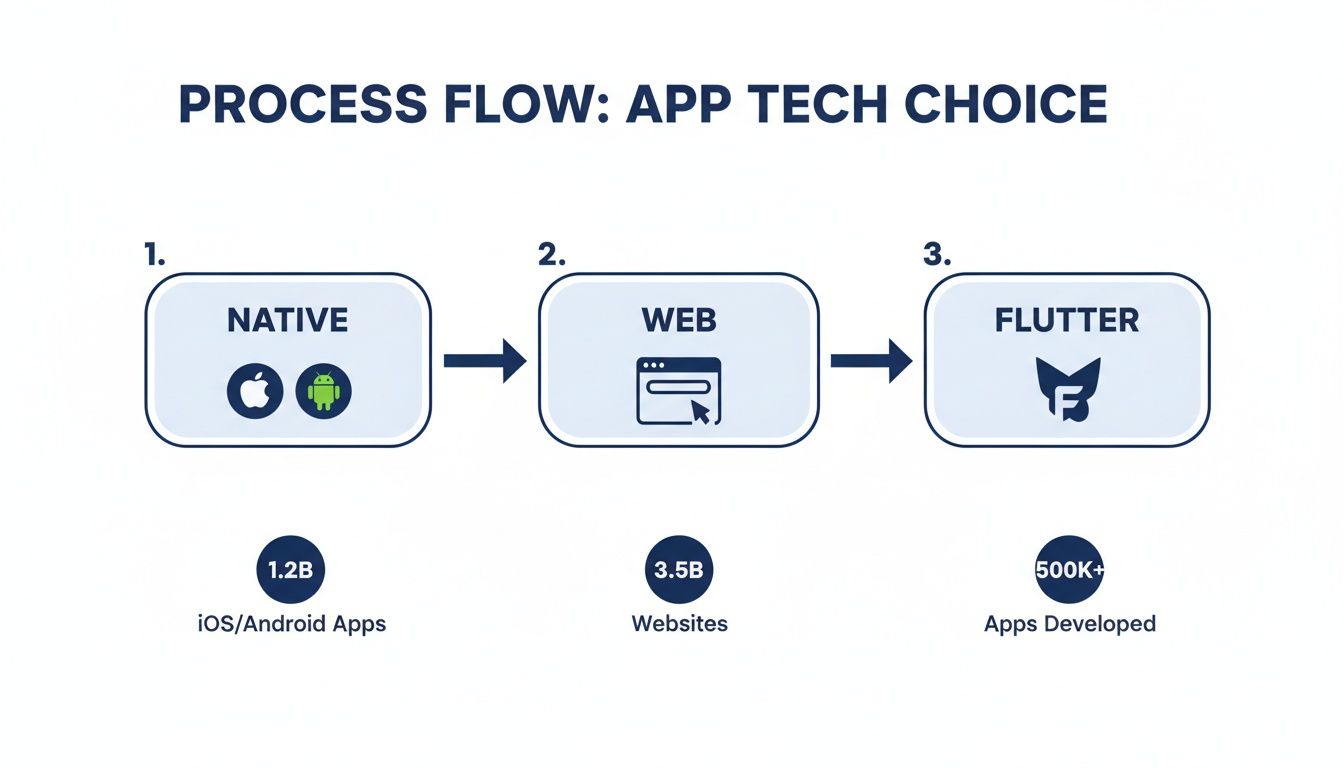 As you can see, Flutter offers a cost-effective and rapid path to market without having to compromise on performance.
Phase 2: UI and UX Design
With a solid strategy in place, it’s time to bring your app’s vision to life. The User Interface (UI) and User Experience (UX) design phase is where we craft the look, feel, and flow of your application. The goal is simple: create an experience that’s not just beautiful, but also completely intuitive for your customers.
We start with wireframes – basic, black-and-white layouts that map out the app’s structure and user journey. From there, we create high-fidelity mockups, which are detailed visual designs showing exactly what the app will look like. Finally, we build interactive prototypes that let you click through the app as if it were real, giving you a proper feel for the final product before development even begins.
Phase 3: Development and QA Testing
This is where the magic happens and your app is actually built. Our developers take the approved designs and strategic plans and turn them into a functional, high-performance application. We use an Agile development methodology, breaking the project down into small, manageable "sprints."
This approach allows for constant feedback and refinement. At the end of each sprint, you get to see a working piece of the app, making sure the project stays on track and perfectly aligned with your vision.
Quality Assurance (QA) testing isn’t an afterthought; it’s woven into the entire development process. We test rigorously at every stage to catch and fix bugs, ensuring your app is stable, secure, and performs flawlessly across different devices.
This detailed testing covers everything from functionality and performance to security, guaranteeing a polished final product that users can trust.
Phase 4: Deployment and Maintenance
Launching your app is a huge milestone, but it’s definitely not the end of the road. The deployment phase involves carefully preparing and submitting your app to the Apple App Store and Google Play Store, navigating their specific guidelines and approval processes.
Once your app is live, the focus shifts to ongoing maintenance and support. The digital world never stands still, with new device models and operating system updates coming out all the time. We provide continuous support to ensure your app stays compatible, secure, and up-to-date. This includes monitoring performance, gathering user feedback for future improvements, and rolling out updates with new features that keep your customers coming back.
Navigating App Development Costs and Timelines
So, what’s this actually going to cost, and how long will it take? These are the two biggest questions every client has, and rightly so. Think of it like building a physical shop: the final price tag and build time depend entirely on whether you’re opening a small pop-up or a multi-storey department store. A digital storefront is no different.
The single biggest driver of cost and time is your project's scope. A straightforward app with the essentials—product pages, a shopping cart, and a simple checkout—is naturally going to be quicker and more budget-friendly. But if you start adding layers of sophistication, like an AI-powered recommendation engine, augmented reality "try-on" features, or complex integrations with your warehouse management system, you're adding development hours and the need for more specialised expertise.
Breaking Down the Key Cost Drivers
To put together a realistic budget, you need to know where the money is actually going. It’s never just one big number; it’s a combination of several crucial parts that all need careful attention.
Here are the main factors that will shape your budget:
- Feature Complexity: The number and intricacy of your features directly drive the timeline. Basic functions are the foundation, but advanced elements like personalised user dashboards, multi-vendor marketplaces, or subscription models demand significantly more development work.
- Design Customisation: A completely bespoke user interface (UI) that screams your brand identity will cost more than a design built from a template. While templates can get you started faster, a unique design offers a much better user experience (UX) and can make a huge difference to your conversion rates.
- Third-Party Integrations: Your app doesn't live in a bubble. It needs to talk to other services like payment gateways (Stripe, PayPal), shipping providers (Royal Mail, DPD), or your CRM. Each of these connections, or APIs, needs to be carefully implemented and rigorously tested to make sure everything runs smoothly.
A classic mistake is trying to save money on backend development. The backend is the engine of your app—it handles all your data, security, and performance. Skimping here is a false economy that almost always leads to critical failures later on.
Realistic Timeline Estimates for Your Project
Time is just as important as your budget. A clear timeline lets you coordinate your marketing, sales, and launch plans effectively. While every project is unique, we can sketch out some general estimates to help you plan.
- Minimum Viable Product (MVP): This is a lean version of your app, containing only the absolute core features needed to launch and attract your first customers. This focused approach gets you to market quickly, typically taking around 3-5 months.
- Full-Featured App: This is a more polished product with a custom design, multiple payment options, push notifications, and advanced search filters. A project of this scale usually requires 6-9 months of development.
- Enterprise-Scale App: We're talking about a large-scale platform with complex integrations, multi-language support, advanced analytics, and the architecture to handle massive user loads. These ambitious projects can easily take 10-12 months or even longer to bring to life.
For a more detailed look at what things cost here in the UK, our guide offers specific insights into the cost of app development in the UK.
Common Pitfalls That Derail Projects
Building a great app isn't just about writing clean code. It's about steering clear of the common traps that blow up budgets and push back launch dates. Knowing what these are from day one is your best defence.
Keep an eye out for these frequent troublemakers:
- Scope Creep: This is the silent project killer. It happens when new features and "nice-to-haves" are constantly added during development without adjusting the budget or timeline. Sticking to a clearly defined MVP is the best way to fight it.
- Neglecting Market Research: Building something without knowing exactly who you're building it for is a huge gamble. You risk pouring money into features nobody wants while completely missing the opportunity to solve a real problem for your customers.
- Underfunding Post-Launch Activities: The budget doesn't end when the app goes live. You absolutely must plan for marketing, user acquisition, and ongoing maintenance. An amazing app that no one knows about is just a great app, not a successful business.
How to Choose Your UK Development Partner
Picking the right development agency is just as important as the app idea itself. Seriously. This single decision will shape your project’s entire journey, from the quality of the final product right down to your budget and launch date. You’re not just looking for a vendor to tick off a list of tasks; you’re searching for a long-term partner who’s genuinely invested in your vision.
Start by digging into their track record. Scour their portfolio for proven success in e-commerce application development. Look for case studies that go beyond just showing off technical skills – you want to see a clear understanding of what actually drives online sales. Do their past apps have a silky-smooth checkout process? Is the navigation so simple a child could use it?
Evaluating Technical Expertise
A slick portfolio is a fantastic starting point, but you need to pop the bonnet and check the engine. Verify their technical expertise, especially with modern frameworks. For any UK business wanting to hit the biggest market possible without breaking the bank, skill in Flutter is a massive plus. An agency that knows its way around Flutter can build a high-performance app for both iOS and Android from one codebase. That saves you a ton of time and money, without skimping on quality.
When you sit down to chat, get straight to the point with questions about how they work:
- How do they handle project management and day-to-day communication?
- What’s their approach to quality assurance and testing? Do they just do it at the end, or is it baked into the process?
- Can they promise transparent updates and are they open to feedback along the way?
A true development partner feels like an extension of your own team. They should offer strategic advice, push back on your assumptions when needed, and be completely focused on building an app that delivers real, measurable business results.
The Value of a Local UK Partner
Choosing a UK-based agency just makes life easier. For one, communication is seamless – no more headaches trying to sync up across different time zones. But more importantly, a local partner gets the UK market. They have an instinct for everything from British consumer habits to regional payment preferences, which ensures your app feels perfectly tailored to your target audience. That kind of local insight is priceless.
And make no mistake, mobile is where the action is. In fact, mobile commerce is a massive growth area in UK e-commerce. As of 2025, smartphones were used for over 55% of all digital sales, with the mobile market itself valued at over USD 100 billion. This trend is only getting faster, with projections showing mobile commerce growing at a compound annual rate of 23.5% through 2030. This makes a partner who lives and breathes mobile-first design absolutely essential. You can find more detail on this trend in the UK's mobile commerce growth report on mordorintelligence.com.
Ultimately, finding the right team boils down to trust and feeling like you're on the same page. Read their client testimonials, ask if you can speak to a previous partner, and make sure their company culture clicks with yours. For more in-depth advice, have a look at our guide to hiring app developers in the UK.
Your E-Commerce App Questions, Answered
Thinking about building a shopping app? You’ve probably got a few questions floating around. That's a good thing. Getting clear, honest answers is the first step to making smart decisions for your business.
Let’s break down some of the most common queries we hear from UK business owners just like you.
How Long Does It Take to Build an E-Commerce App?
There's no one-size-fits-all answer here; it really depends on what you need. If you're starting with a Minimum Viable Product (MVP) – just the essential features to get you trading – you’re typically looking at 3-5 months.
But what if you're aiming for a fully custom app with a unique design, special features, and connections to various third-party services? In that case, the timeline stretches to about 6-12 months, sometimes longer. The good news is that using a smart framework like Flutter can often speed things up, since we can build for both iPhone and Android at the same time.
What Is the Difference Between an E-Commerce Website and an App?
Think of it like this: your website is your high-street shop window. It’s brilliant for getting discovered through search engines and drawing in new customers. An app, on the other hand, is like giving your best customers a VIP key to a private entrance. It’s installed right on their phone, offering a slicker, faster, and more personal way to shop.
An app is your secret weapon for customer loyalty. It uses phone features like push notifications to bring people back, turning a one-off purchase into a long-term relationship far more effectively than a mobile website ever could.
Why Is Flutter a Great Choice for E-Commerce Apps?
Flutter is a game-changer for e-commerce, and here’s why. It lets us build one beautiful, high-speed app that works flawlessly on both iOS and Android, all from a single set of code. For you, that means one thing: it significantly saves time and reduces development costs.
It also has a fantastic toolkit for creating a smooth, responsive user interface that feels completely native to the device. This is absolutely vital for keeping shoppers happy and preventing them from abandoning their carts. Recent performance tests have shown Flutter is right up there with the fastest technologies, so you're getting a powerful, cost-effective solution without cutting any corners.
Ready to build a high-performance e-commerce app that drives sales and delights your customers? The team at App Developer UK specialises in creating stunning, custom Flutter applications for UK businesses. Contact us today to discuss your project.