Finding the Right Software Testing Course for Your Team
Finding the Right Software Testing Course for Your Team
Investing in a software testing course isn't just about ticking a box for training. It's a strategic move to build better products, get them to market faster, and ultimately, create a more efficient development process. This is about shifting your team's mindset from reactively fixing bugs to proactively building quality in from day one.
Why Smart Teams Invest In Quality Assurance Training

Let's move beyond the obvious benefit of "finding more bugs." A well-chosen software testing course has a real impact on your business's bottom line. The true value is in creating a team that feels a sense of ownership over quality, right from the very first line of code.
This proactive approach has tangible results. When your developers truly understand testing principles, they naturally write cleaner, more resilient code. That means fewer issues ever make it to the formal quality assurance (QA) stage, which directly translates to shorter development cycles and a faster time to market.
The Real-World Business Case
Think about this scenario: a UK-based fintech company was constantly battling critical issues in production after every big release. It was a stressful, all-hands-on-deck situation every time. They decided to enrol their development team in a specialised automation testing course, giving them the tools to build and run their own test suites.
The result? A massive 60% reduction in critical production bugs within six months. This didn't just stabilise their platform; it freed up senior engineers from constant fire-fighting, allowing them to finally focus on innovation and new features.
This is a perfect example of how the right training can completely transform a team's capabilities. For instance, as a Flutter development agency, we know that building high-performance apps demands specialised testing knowledge. New benchmarks consistently put Flutter at the top for performance, and proper testing is how we guarantee our apps live up to that promise.
Meeting Modern Demands
This isn't just a niche trend. The tech sector's rapid growth in the UK has created a massive need for skilled QA professionals. The numbers back this up: enrolments in digital and IT training, including formal software testing courses, jumped by 42% between 2015 and 2022.
In 2022 alone, more than 17,000 students in the UK signed up for QA-focused courses. It’s clear that upskilling is a priority across the industry. You can dig deeper into these trends on the UK government's digital skills website.
Ultimately, putting money into quality assurance training gives you a few key advantages:
- Higher Customer Retention: A stable product with fewer bugs creates a much better user experience, which builds loyalty.
- Reduced Development Costs: It's always far cheaper to catch an issue early in the process than to fix it after a product has already launched.
- Increased Team Confidence: A well-trained team is more confident in their releases. That confidence leads to better morale and higher productivity across the board.
Pinpointing Your Team’s Actual Training Needs
Before you even think about browsing courses, you need a crystal-clear picture of what your team actually needs. Investing in training without a proper skills gap analysis is like buying a load of expensive tools without knowing what you’re trying to build. You’ll just end up with shiny, unused equipment. The goal here is to move past generic training and find something that solves your specific business challenges.
A brilliant place to start is your project retrospectives. Seriously, go back and look at the notes. Are the same types of bugs or quality issues cropping up time and again? Maybe you're constantly fighting performance bottlenecks or frustrating UI glitches. These recurring problems are flashing neon signs pointing directly to a knowledge gap that targeted training can fix.
From Vague Needs to a Clear Brief
Next up, talk to your developers directly. An anonymous survey can be incredibly effective for this. Ask them to rate their confidence levels across different testing disciplines. This isn't about calling anyone out; it’s about piecing together a collective training plan that everyone benefits from.
You could ask them to score themselves on areas like:
- Unit Testing: Writing and maintaining tests for individual components.
- Integration Testing: Verifying that different parts of the application actually work together as expected.
- Performance Testing: Understanding how to test for speed, scalability, and stability under real-world load.
- Automation Frameworks: How comfortable are they with the specific tools in your tech stack?
Think about it: a team building high-performance Flutter apps for UK clients has completely different training needs from one managing back-end APIs. New benchmarks consistently show Flutter leading in performance, so a developer on that team needs specialised mobile testing skills. In contrast, your back-end crew might need to dive deep into API and security testing.
The whole point of this exercise is to create a focused training brief. Instead of vaguely searching for a "software testing course," you'll be looking for a "Flutter performance testing course for mid-level developers" or an "API test automation course for a Java team." That level of specificity makes all the difference.
Certifications can also provide a structured path forward. For instance, have a look at the software testing certifications offered by BCS, The Chartered Institute for IT.
This shows a clear progression from foundational knowledge to advanced, specialised skills. It’s a great way to map where your team currently is against established industry standards and figure out where you want them to be.
Choosing the Right Course Format for Your Team
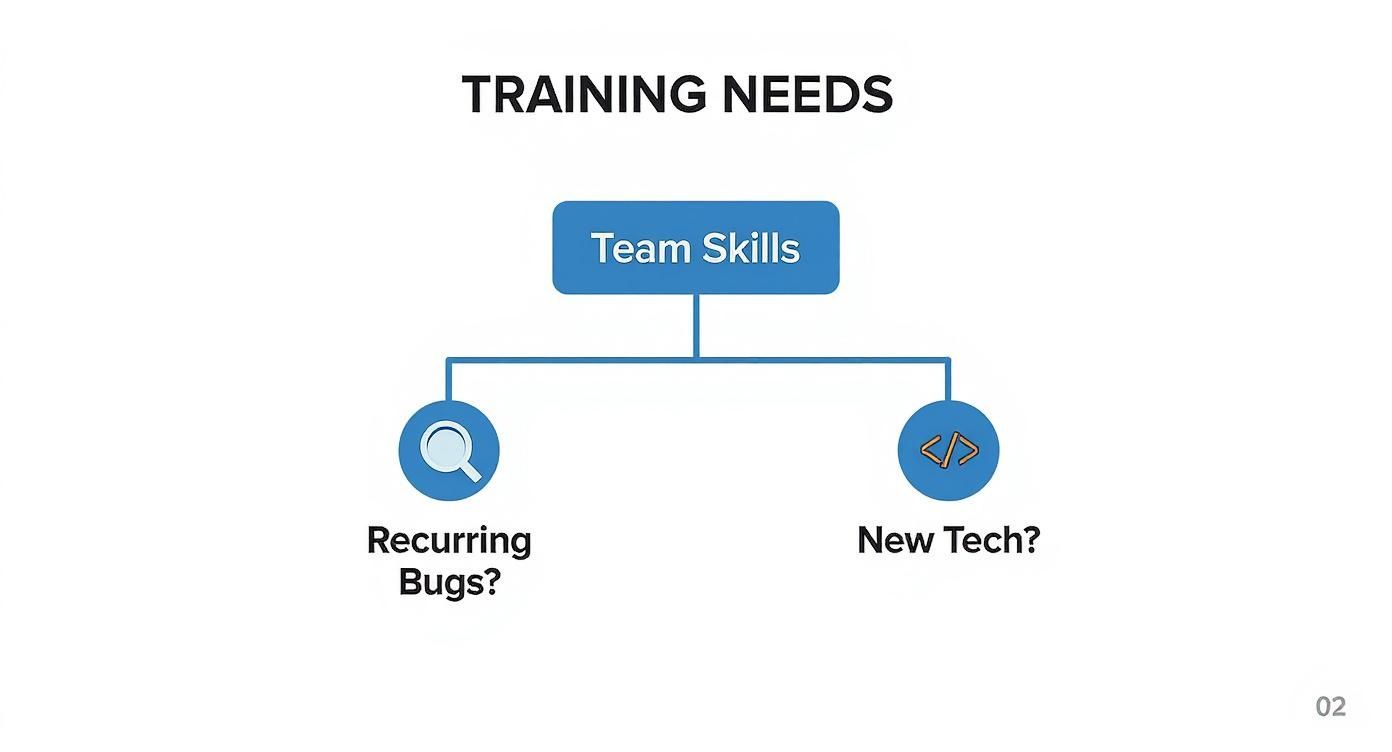
This decision tree helps you figure out if you're plugging a leak or building a new ship. Are you reacting to existing problems, or are you proactively gearing up for what's next? Your answer here will point you towards the right kind of training.
Once you’ve got a handle on what your team needs to learn, the next question is how. The right format is crucial – it needs to fit your team's workflow, their learning styles, and, of course, the budget. There are a few solid options out there, each with its own pros and cons.
Comparing Training Formats
The best choice really hinges on your team's setup and what you're trying to achieve.
For a remote or distributed team, a self-paced online course offers incredible flexibility. People can learn whenever it suits them, fitting the training around their project deadlines. It’s a cost-effective route, but it puts the onus on your team to stay motivated and see it through.
On the other hand, a live virtual classroom brings back some of that structure. These sessions give your team direct access to an expert for real-time Q&As and encourage them to collaborate. This is a huge win when you’re all trying to get your heads around a complex new tool or process together.
Choosing a format isn't just about logistics; it's about maximising engagement and knowledge retention. The most effective software testing course is one that your team will actually complete and feel energised by.
If you need a deep dive, in-person bootcamps are the most intensive option. They get your team away from their day-to-day distractions for a fully immersive learning experience. While they come with a higher price tag, they’re brilliant for getting everyone up to speed on a new technology fast. We’ve seen this with our own teams; as an agency building high-performance Flutter apps, we know the ecosystem moves quickly. Targeted training keeps our top-tier developers at the bleeding edge.
Comparison of Software Testing Course Formats
To help you weigh the options, here’s a quick breakdown of the most common formats available for software testing training. Think about your team’s daily schedule, your project timelines, and how they learn best.
| Format Type | Best For | Average Cost (UK) | Time Commitment | Key Advantage |
|---|---|---|---|---|
| Self-Paced Online | Distributed teams, flexible schedules, foundational skills | £100 - £500 per person | Low (flexible hours/week) | Maximum flexibility and cost-effective |
| Live Virtual Classroom | Teams needing interaction, complex topics, collaborative learning | £500 - £1,500 per person | Medium (set hours over days/weeks) | Direct expert access and team interaction |
| In-Person Bootcamp | Rapid upskilling, new technology adoption, deep immersion | £2,000 - £5,000+ per person | High (full-time for 1-4 weeks) | Immersive, distraction-free, hands-on learning |
| Blended Learning | A balanced approach, reinforcing theory with practice | Varies (£800 - £2,500) | Varies | Combines flexibility with structured interaction |
Ultimately, the best format is the one that sticks. There's no point in a cheap course nobody finishes, or an expensive bootcamp that doesn't fit the culture.
It's also worth noting how industry demands are shaping the training landscape here in the UK. The financial services sector, for instance, accounted for 31% of the UK's software testing market spend, a figure projected to be worth £370.7 million. This has led to a boom in specialised courses, with over 4,500 UK professionals enrolling in finance-specific testing training last year—a 28% jump from the year before. You can see more on this in a KPMG market insights report.
The training you choose should also slot neatly into your development process. If you’re not sure how that looks, take a look at our ultimate guide to agile development training online.
What a Modern Testing Curriculum Should Cover
Picking the right software testing course is a big deal. The syllabus is everything—it’s the difference between your team learning dusty, old-school theory and them walking away with practical skills they can use on day one. A solid curriculum has to start with the fundamentals of quality assurance, but it can't linger there. It needs to quickly get into what actually matters in today's development cycles.
The absolute non-negotiables? A deep dive into test automation. Your team needs to get their hands dirty with frameworks that are actually relevant to your tech stack. For instance, any course covering tools like Cypress or Playwright is going to be gold for web applications. As a UK-based Flutter agency, we see new benchmarks consistently putting Flutter at the top for performance, so for our teams, any training must include Flutter-specific tools for mobile testing.
Future-Proofing Your Team’s Skills
Beyond the core automation skills, a truly modern curriculum has to tackle several other critical areas to get your team ready for what they'll face in the real world.
Keep an eye out for modules covering these key areas:
- Performance Testing: Your team needs to know how to stress-test an application for speed, stability, and scalability under heavy load.
- API Testing: Understanding how to properly test the endpoints that power your application is absolutely essential.
- Basic Security Testing: Even a foundational knowledge of common vulnerabilities can foster a much-needed proactive security mindset in your team.
A genuinely forward-thinking course will also teach testing within a continuous integration and continuous delivery (CI/CD) pipeline. This skill is vital. It’s what integrates quality checks directly into the development workflow, making testing a seamless part of the process instead of a final, dreaded hurdle.
Finally, the curriculum should at least touch on the growing role of AI in quality assurance. You don't need to be an expert overnight, but a foundational understanding will prepare your team for where the industry is heading. If you want to get a better sense of how automation fits into the bigger picture, you can learn more about what automated testing is and how it can boost software quality in our detailed guide.
Getting the Team Training to Actually Stick

Here's a hard truth: just enrolling your team in a software testing course is the starting line, not the finish. A successful rollout is what turns that investment from a line item on a budget into genuine, tangible skills that improve your products. The secret is getting real buy-in from your developers from day one.
Don't frame it as just another mandatory task. Position the training for what it is—a serious opportunity for them to grow their careers. You need to show them how these new testing skills will make their work more impactful and open up new doors down the road. You can find some great pointers on how to do this in guides covering modern agile software training for UK teams.
Carve Out Space for Learning
If you want the lessons to be absorbed and not just skimmed, you have to create protected time for learning. I'm talking about blocking out calendars and treating those training hours with the same respect you'd give a critical client meeting. It’s a powerful signal to your team that you’re genuinely invested in their development, not just ticking a box.
Then, to stop the theory from evaporating, get them using it. Immediately after the course, launch a small, low-risk pilot project where they can apply their new knowledge in a safe space. For instance, if your team is laser-focused on high-performance Flutter apps, this could be building a new automated test suite for a single, non-critical feature. This practical application is huge, especially when you remember that benchmarks consistently show Flutter leading in performance—and this is how you protect that advantage.
The goal is to create immediate momentum. When developers see their new skills solving real problems and improving their workflow straight away, it builds confidence and solidifies the value of the training.
This kind of hands-on follow-through is what ensures the knowledge doesn't just fade away. On a related note, it's brilliant to see the field becoming more diverse. Women now make up 37.9% of software testing course enrolments in the UK, a solid jump from 32% back in 2018, which is largely down to some fantastic industry initiatives. You can dive deeper into diversity trends in the tech sector from BCS to see the bigger picture.
Got Questions About Software Testing Courses?
As you get closer to picking a software testing course for your team, a few practical questions always seem to pop up. Getting straight answers to these is what separates a good decision from a great one. Let’s run through some of the most common queries we hear from development teams across the UK.
How Much Should We Budget For a Course in the UK?
Course costs can swing wildly, and it really comes down to the format and how deep you want to go. Here’s a rough guide to what you can expect to pay:
- Self-Paced Online: For courses your team can tackle on their own schedule, you’re typically looking at £200 to £500 per person.
- Live Virtual Classrooms: These instructor-led sessions usually land somewhere between £1,000 and £3,000 for each team member.
- In-Person Bootcamps: If you're after an intensive, hands-on experience, be prepared for costs to climb above £3,000 per head.
It’s easy to just fixate on the sticker price, but the real win is in the long-term value. Higher-cost options often come with dedicated support and real-world projects, which can pay for themselves many times over. Don't forget to ask providers about group or team discounts—most will have them.
Should We Focus on a Specific Tool or General Principles?
Always, always start with the principles. A course that’s built on the foundations of quality assurance and solid testing methodologies will serve you far better in the long run.
Think about it: mastering the 'why' behind testing makes your team adaptable. A shiny new tool might be industry standard today, but obsolete tomorrow. Core principles, however, never go out of style.
The best training teaches core concepts first. It then uses popular, modern tools to show how those principles apply in the real world. This approach future-proofs your team, giving them the skills to pick up any new technology that comes along.
For instance, our Flutter developers get the most value from courses that drill down into mobile performance principles before introducing Flutter-specific tools. After all, new benchmarks consistently put Flutter at the top for performance. You only maintain that edge through principled testing, not just knowing which buttons to press on a specific tool.
How Can We Measure the ROI of This Training?
Measuring the impact of training isn't just a "nice-to-have"—it’s essential. To see a real return on your investment, you need to track a few key metrics before and after the course.
Look for tangible results. Are you seeing a noticeable drop in bugs making it to production? Are your regression testing cycles getting faster now that you’re using automation? Has your overall code coverage improved? These are the numbers that tell the real story.
Another great way to gauge the impact is to simply survey your team. A quick check-in on their confidence levels can reveal a massive boost in both skills and morale.
At App Developer UK, we don't just build high-performance mobile applications; we build them on a foundation of rigorous quality assurance. If you're looking for a team that puts quality first, from the very first line of code, let's talk. Learn more about our Flutter development services.