How to Hire the Right iPhone Apps Developer in the UK
How to Hire the Right iPhone Apps Developer in the UK
Finding the right iPhone app developer is more than just a hiring task—it’s the first real step in turning your idea into a tangible product. This guide is your roadmap for navigating the UK's crowded app market to make a hire that’s not just good, but strategic. We'll start by digging into how to translate your vision into a concrete project brief that actually attracts top-tier talent.
Your Blueprint for a Successful Hiring Process
Bringing an app to market isn't just a tech project; it's a major business investment. The mobile app scene in the UK is valued at roughly £28.3 billion and still climbing. To get a piece of that pie, you need the right development partner.
With forecasters predicting over 8.5 billion app downloads in the UK in 2025 alone, the opportunity is huge. But so is the competition.
Success starts with a clear plan. Before you even think about listing features, you need to nail down the core problem your app solves. That clarity is what separates a fuzzy idea from a project brief that gets results.
Define Your Core Vision First
Before you can find the right developer, you need to know exactly what you’re building and why. Getting this foundation right from the start prevents expensive U-turns later and keeps everyone pulling in the same direction.
Kick things off by answering these questions:
- What's the main problem this app solves? Be specific. "Connecting local dog walkers with busy owners" is a hundred times better than "a social app for pets."
- Who are we building this for? Get a clear picture of your ideal user. Their needs, habits, and tech-savviness will shape everything from design to functionality.
- What are the absolute must-have features for launch? This is your Minimum Viable Product (MVP). The goal is to solve that one core problem brilliantly. Everything else can wait.
This initial roadmap simplifies the whole journey, laying the groundwork for a successful hire.
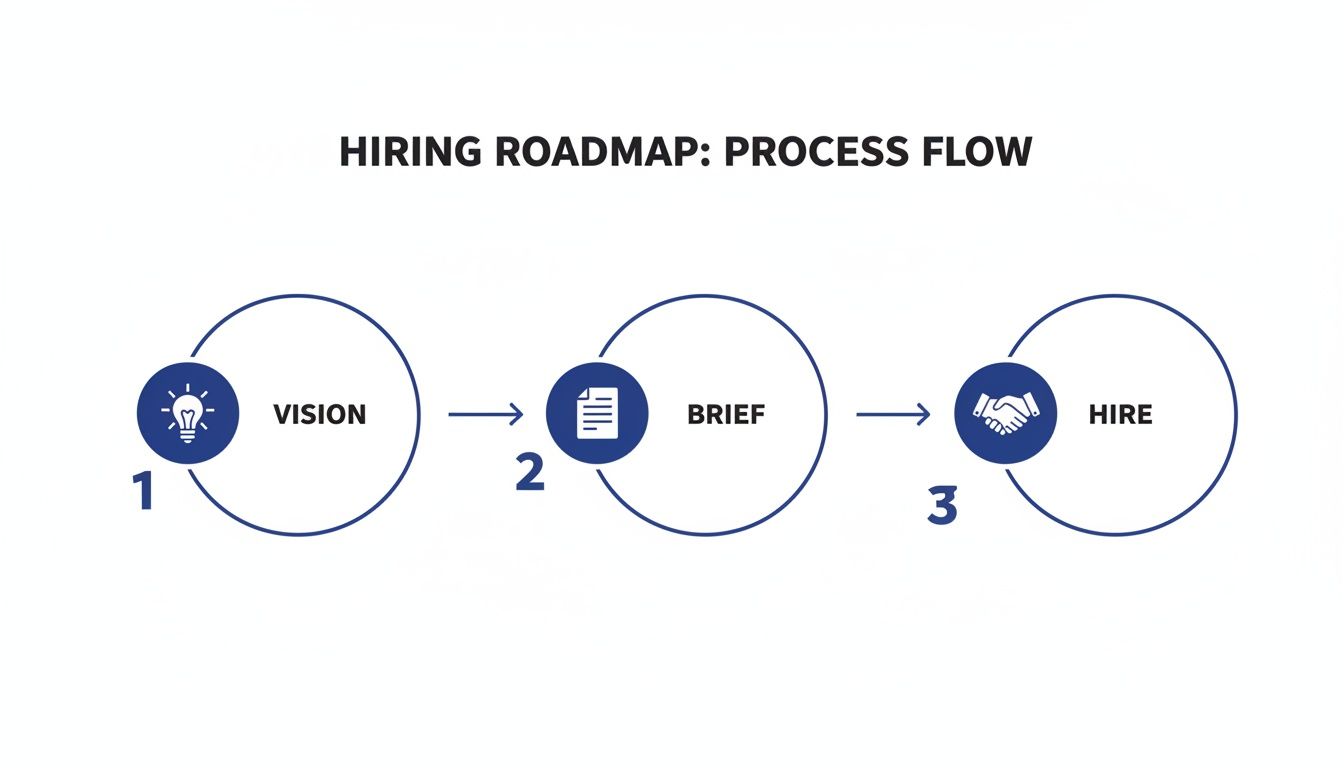
As you can see, a clear vision and a solid brief aren't just prep work—they're the pillars that support a great hire.
Your project brief is your most powerful recruitment tool. It needs to sell not just what you're building, but why it matters. This is how you attract developers who are genuinely invested in your mission, not just looking for another gig.
To help structure this thinking, here’s a quick overview of the key milestones.
Hiring Roadmap Key Milestones
This table breaks down the critical stages of your hiring journey, from initial brainstorming to getting your new developer started.
| Phase | Key Objective | Primary Outcome |
|---|---|---|
| 1. Vision & Strategy | Define the app's core purpose, target audience, and MVP features. | A clear vision document that guides all future decisions. |
| 2. Project Brief | Translate the vision into a detailed technical and functional specification. | A comprehensive brief that attracts qualified developers. |
| 3. Sourcing & Vetting | Identify, interview, and evaluate potential candidates or agencies. | A shortlist of top-tier developers who fit the project. |
| 4. Hiring & Onboarding | Finalise contracts, set up communication channels, and kick off the project. | A signed contract and a developer ready to start building. |
Each phase builds on the last, ensuring you move from a big-picture idea to a well-defined project with the right person at the helm.
With a well-defined vision in hand, you’re ready to craft a brief that will stand out to the right people. For a deeper dive into the mechanics of the recruitment process itself, check out this ultimate guide to recruiting and hiring software engineers. A little preparation here transforms your search from a simple transaction into a strategic partnership.
Pinpointing the Essential Developer Skills You Need

Once you have a clear brief, the next job is to zero in on the specific skills that will actually bring your app to life. Finding a great iPhone apps developer isn't just about ticking boxes on a CV; it’s about finding a partner with the right blend of technical mastery and real-world experience.
The developer scene for iPhone apps here in the UK is incredibly vibrant. The Apple App Store is home to roughly 1.96 million apps globally, and the UK's strong community of indie developers and small studios constantly pushes the boundaries.
But let's be realistic—the competition is brutal. Over 30% of apps worldwide get fewer than 100 downloads, which really underscores the challenge UK developers face in getting noticed. To have a fighting chance, your developer needs a modern, robust skill set.
Core Technical Proficiencies
At the heart of any iOS project are the programming languages and frameworks that make it all work. While a lot of skills go into a successful app, a few are simply non-negotiable for anyone building for Apple's ecosystem.
Your ideal candidate should have serious expertise in these areas:
- Swift and the iOS SDK: Swift is Apple's modern, powerful programming language. Proficiency here is absolutely essential for building fast, secure apps that won't become obsolete in a year. A top-tier developer will also have an almost encyclopaedic knowledge of the iOS Software Development Kit (SDK), which contains all the tools needed to build for iPhone, iPad, and other Apple devices.
- Version Control with Git: Modern software development is a team sport, and it's impossible to collaborate without version control. Git is the industry standard for tracking code changes and allowing multiple developers to work on a project without stepping on each other's toes. Someone fluent in Git is organised and ready to work in a professional team.
- UI/UX Design Principles: Your developer doesn't need to be a designer, but they absolutely must have a solid grasp of Apple's Human Interface Guidelines. The best apps just feel right. That intuitive feel comes from a developer who understands how to turn a great design into a functional, user-friendly experience that feels completely at home on an iPhone.
A great developer builds more than just features; they build experiences. Their ability to implement a clean, responsive UI is just as critical as their ability to write clean code. The two are inseparable in a high-quality app.
The Cross-Platform Advantage with Flutter
While native Swift development is the gold standard for iOS, many businesses today need to reach customers on both iOS and Android. This is where a modern framework like Flutter becomes a game-changer. As UK-based Flutter specialists, we’ve seen its benefits first-hand.
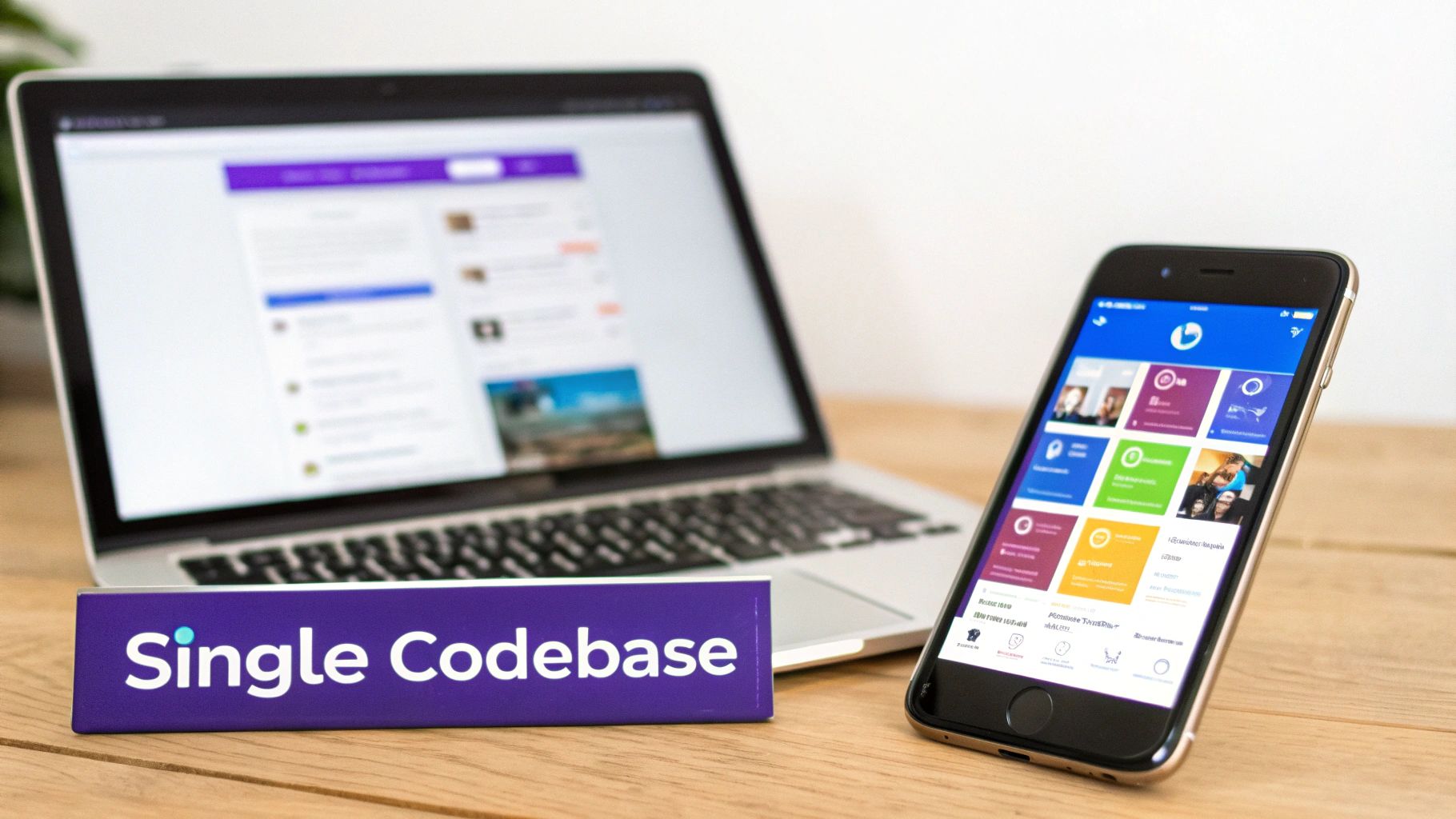
Flutter allows developers to build beautiful, natively compiled apps for mobile, web, and desktop—all from a single codebase. New benchmarks consistently show Flutter’s performance rivalling, and often exceeding, native apps. For a business, this translates to faster development, lower costs, and a consistent brand experience across every platform, without cutting corners on quality or speed.
Beyond the Code: Soft Skills
Technical chops are only half the story. The soft skills a developer brings to the project often make the difference between a smooth success and a constant headache.
It’s crucial to look beyond the code and understand what makes a great tech hire on a deeper level. You should be looking for proactive communication, a genuine curiosity for solving tricky problems, and the ability to work well with others. These are the traits that elevate a good coder into a truly great technical partner.
How to Effectively Evaluate Developer Candidates
A polished CV and a confident interview are a decent start, but they won't tell you much about a candidate's real-world problem-solving chops. To find a truly capable iPhone apps developer, you need to dig a lot deeper than what they say they can do and focus on what they've actually built.
The first port of call is their portfolio. Don't just glance at the shiny screenshots – download the apps they’ve worked on from the App Store. How do they actually feel on your phone? Are they snappy and responsive, or do they feel sluggish and crash unexpectedly? User reviews are gold here; they offer unfiltered feedback on an app’s performance and stability.
Pay close attention to the user interface (UI) as well. If an app is confusing or a pain to navigate, it’s a massive red flag. It suggests the developer doesn't really think about the end-user experience, which is a deal-breaker for any successful app.
Beyond the Portfolio
Past work is a great indicator, but you also need to get inside a candidate's head. The interview is your chance to see how they think, tackle problems, and whether their personality will mesh with your team's culture.
Forget the generic, textbook technical questions. Instead, hit them with a real-world scenario that’s relevant to your project.
- Problem-Solving: "We've got to integrate a new payment gateway, but our current system doesn't support it out of the box. How would you approach this, and what are the main hurdles you'd expect to face?"
- Collaboration: "Picture this: the UI/UX team has handed you a design you know will seriously slow the app down. How do you handle that conversation without stepping on toes?"
- Code Quality: "Could you walk me through your process for testing your code? When do you personally consider a feature 'done' and ready to ship?"
Their answers will reveal far more than just technical knowledge. You'll get a real sense of their communication style and how well they play with others. A solid testing process, for example, is the hallmark of a true professional. To get a better handle on this, you can learn more about what automated testing is and how it boosts software quality in our detailed guide.
The Value of a Paid Technical Challenge
Finally, I always recommend a small, paid technical challenge. This isn't about getting free work; it's a fair and incredibly effective way to see their skills in action. The task should be clearly defined, directly related to the kind of work they'll be doing, and something they can realistically finish in a few hours.
A paid technical test is one of the most reliable predictors of future performance. It lets you see their coding style, their attention to detail, and how they approach a specific problem—insights a simple conversation could never give you.
This small upfront investment can save you a world of headaches, time, and money down the line. It validates their skills, shows you respect their time, and gives you concrete evidence to back up your hiring decision.
Decoding App Development Costs in the UK
Let’s talk about the elephant in the room: the budget. This is often the most nerve-racking part of any app project. Without a good grasp of the market rates, you can easily end up overspending or, just as bad, underestimating what it takes to build a quality product.
The simple truth is there's no "one size fits all" price for an iPhone app. The cost is always a direct reflection of its complexity.
So, what should you expect to invest? Industry data from 2025 gives us a pretty solid baseline. For a moderately complex mobile app here in the UK, you’re looking at a range of £21,000 to £52,000, with the build taking roughly four to six months. If your app has more sophisticated features, the cost can climb to between £53,000 and £75,000. These numbers are shaped by developer hourly rates, which usually sit between £15 and £38, depending on their expertise.
What Drives the Final Cost
The biggest question is always, "What pushes my project into a higher price bracket?" It almost always comes down to the number and complexity of the features you need.
An app that just shows static content and has basic user profiles will be worlds cheaper than one that needs real-time data syncing, a custom-built server backend, and secure payment processing.
Here are the main cost drivers you need to keep in mind:
- Feature Complexity: Every single feature adds to the timeline and budget. For instance, letting users log in with their social media accounts is fairly straightforward. Building a custom AI-powered recommendation engine? That’s a whole different ball game.
- Backend Infrastructure: Does your app need a server to store user data, handle accounts, or process payments? A reliable, scalable backend is a major and necessary investment.
- Third-Party Integrations: Need to pull in data from other services like Google Maps or integrate a payment processor like Stripe? Connecting to these external APIs adds another layer of work.
- Design and UI/UX: A beautiful, custom-designed user interface will naturally require more design and development hours than a simple layout based on a template.
It's crucial to remember that the initial build cost isn't the end of the story. A successful app is a living, breathing product. You'll need to budget for ongoing server hosting, bug fixes, maintenance, and vital updates for new iOS releases. Forgetting these long-term costs is one of the most common pitfalls.
Choosing the Right Pricing Model
When you start talking to an iPhone apps developer or an agency, you’ll likely be offered one of two pricing structures: a fixed price or an hourly rate. Knowing the difference is key to managing your budget and making sure everyone’s on the same page.
A fixed-price model is exactly what it sounds like—you agree on one total cost for a very clearly defined project scope. This is fantastic for predictability, especially if your requirements are nailed down. The only catch is that any changes or new ideas will mean a new quote, which can slow things down.
On the other hand, an hourly rate (often called Time & Materials) gives you a lot more flexibility. You simply pay the developer for the hours they actually put in. This is perfect for complex projects where you know things might change and evolve. The trade-off is less budget certainty, so you need to be on top of project management and have crystal-clear communication.
For a deeper dive into which model works best for different types of projects, our comprehensive UK app pricing guide is a great resource.
Why Flutter Is a Smart Choice for Modern Apps
What if you could reach every single customer, whether they’re on an iPhone or an Android, without having to double your development budget? That's the powerful idea behind Flutter. As a UK agency that lives and breathes this framework, we’ve seen first-hand how much of a game-changer it is for businesses.
Traditionally, if you wanted to be on both the App Store and Google Play, you had to build two separate, native apps. That meant two specialist development teams, two different codebases, and, you guessed it, two budgets. It’s an expensive and slow process that, frankly, puts a dual-platform launch out of reach for many.
Flutter completely flips that model on its head. It’s a modern framework, backed by Google, that lets an iphone apps developer build stunning, high-performance apps for both iOS and Android from a single codebase. This isn't about cutting corners; it's a massive strategic advantage.
Performance Without Compromise
For years, the biggest knock against cross-platform tools was performance. They often felt sluggish, like a website crammed into an app's shell. Flutter is built differently. It compiles its code directly into native ARM machine code, completely bypassing the performance bottlenecks that plagued older frameworks.
Time and again, modern benchmarks show Flutter at the top of the pack for performance, often matching or even beating native apps. What does that mean for you? Buttery-smooth animations, snappy load times, and a responsive user experience that feels completely at home on an iPhone.
Flutter’s entire architecture is built for speed. It talks directly to the phone’s platform without needing a clumsy JavaScript bridge. This is how it delivers that genuinely native feel, making sure your users get the slick, high-quality experience they expect from a top-tier iOS app.
When Is Flutter the Right Call?
While we're huge advocates for Flutter, it's not a silver bullet for every single project. You need to know where it truly shines. The good news is that Flutter is an absolutely fantastic choice for the vast majority of app projects, especially for businesses that need to move fast and be smart with their budget.
Think about these scenarios where Flutter is the undisputed winner:
- Brand-Centric UI: If your app has a strong, custom-branded design, Flutter’s incredibly expressive UI toolkit makes it simple to create a pixel-perfect, consistent look and feel across both iOS and Android.
- MVPs and Start-ups: Getting a Minimum Viable Product (MVP) to market quickly is everything for a new venture. Flutter’s single codebase massively speeds this up, letting you test your ideas and get real user feedback in a fraction of the time.
- Budget-Conscious Projects: Building one app instead of two is a huge cost-saver. It frees up your budget for the things that really drive growth, like marketing and user acquisition.
There are exceptions, of course. If your app’s core purpose depends on the absolute latest, bleeding-edge iOS feature—say, deep integration with a brand new watchOS API on day one—then a native Swift approach might be the only way. For most businesses, though, this is a rare edge case. And when looking at Flutter vs React Native, we find Flutter's superior performance and all-in-one tooling make it the smarter investment for the future.
Onboarding Your Developer and Ensuring Long-Term Success
You’ve found your ideal iphone apps developer and the contract is signed. That’s a huge win, but the real work is just beginning. A solid onboarding process is what turns that initial hiring excitement into a genuinely productive partnership. It’s all about setting clear expectations from the start to get the project off the ground smoothly.
First things first: the contract. Think of this document as the bedrock of your entire project. It’s there to protect both you and your developer, so it needs to be detailed, clear, and leave zero room for guesswork later on.
Make sure your contract explicitly covers the scope of work, payment milestones linked to clear deliverables, and a transparent clause on who owns the intellectual property. Getting this right from the outset prevents headaches and builds a professional foundation for your collaboration.
Building a Strong Foundation
Once the paperwork is sorted, it's time to get practical. A well-organised project kickoff meeting is your chance to get everyone aligned on goals, tools, and how you’ll communicate. This is where you lay the groundwork for a seamless start.
A good kickoff ensures everyone is singing from the same hymn sheet. Here’s what you absolutely need to cover:
- Access and Credentials: Get them set up immediately with everything they need. This means access to your project management software (like Jira or Trello), code repositories (such as GitHub or GitLab), and any design files, whether they’re in Figma or Sketch.
- Communication Channels: Decide on a primary channel for day-to-day chat, like Slack or Microsoft Teams. It's also wise to schedule regular check-ins—maybe a quick daily stand-up or a more in-depth weekly progress review—to keep things on track and tackle any issues early.
- Project Roadmap: Run through the initial roadmap together. Be crystal clear about the goals for the first sprint, what "done" actually means for the first batch of tasks, and what the immediate priorities are.
Think of your app not as a one-off project but as a living product. A successful launch is just the beginning. Your long-term strategy must account for regular iOS updates, bug fixes, and future feature enhancements to ensure lasting relevance and performance.
Planning for the Entire App Lifecycle
Finally, an app is never truly "finished." It needs ongoing care and attention. You should discuss the plan for post-launch support and maintenance right from the very beginning. An app that isn't updated for new iOS versions quickly feels dated and even risks being removed from the App Store.
Establish a clear process for how bug fixes will be handled and how you'll scope and integrate new features down the line. By building this long-term view into your relationship from day one, you ensure your iphone apps developer is a true partner invested in the app's entire journey, not just the initial build.
Got Questions? We've Got Answers
Stepping into the world of app development can feel a bit like learning a new language. It's completely normal to have questions. Here are some of the most common ones we hear from UK businesses, along with our straightforward, no-nonsense answers.
What's the Real Cost to Hire an iPhone App Developer in the UK?
This is the big one, and the honest answer is: it depends. The cost swings pretty widely based on how experienced the developer is and, more importantly, how complex your app idea is.
For a freelance developer, you could be looking at hourly rates anywhere from £40 to over £90. A simple app with a few core features might kick off around the £20,000 mark. But if you’re dreaming up something more ambitious with custom back-end work and complex integrations, that figure can easily climb past £60,000. The absolute best way to get a realistic number is to have your requirements clearly defined before you start asking for quotes.
Should I Go for a Native iOS Developer or a Flutter Developer?
This is a crucial strategic decision. If your app absolutely must have the latest, bleeding-edge iOS-only feature the moment it’s released, and you have zero plans to ever launch on Android, then a native Swift developer is a safe bet.
However, for the vast majority of businesses, that’s a pretty restrictive approach. The smarter play is usually to reach users on both iOS and Android without the headache and expense of managing two completely separate apps.
That's where Flutter comes in. It's an incredibly efficient and powerful framework that delivers native-level performance and a beautiful, consistent UI across both platforms. For most businesses, it’s simply the most intelligent financial and strategic choice for modern app development.
How Long Does It Really Take to Build an iPhone App?
Just like cost, the timeline is tied directly to your app's complexity. There's no one-size-fits-all answer, but we can give you a rough guide.
A Minimum Viable Product (MVP), which is a lean version with just the essential features to get you launched, could be built and ready to go in 3-4 months.
If your app needs more firepower—things like payment gateways, social media logins, or other third-party integrations—you’re probably looking at a 5-8 month timeline. For highly complex apps that require intricate systems or a bespoke back-end, it's not uncommon for development to take 9 months or longer. A detailed project roadmap from your developer will give you a much clearer picture for your specific project.
Ready to turn your vision into a high-performance app that works beautifully on both iOS and Android? At App Developer UK, we live and breathe Flutter, building stunning, efficient applications for businesses like yours.