Flutter App Development Your Guide to Building High-Performance Apps
Flutter App Development Your Guide to Building High-Performance Apps
Choosing Flutter app development isn't just a tech decision for UK businesses anymore; it's a powerful strategic move. Think of it as the ultimate shortcut to getting your app onto iOS, Android, and the web, all at the same time. This approach saves a phenomenal amount of time and money, helping you get to market faster while delivering a consistent, high-quality experience for every single user.
Unlocking a Strategic Edge in the UK Market
For most UK businesses, the goal is straightforward: reach the largest possible audience with an incredible app, but without doubling the development budget. The old way involved building two separate native apps—one for Apple's iOS, another for Google's Android. That path isn’t just expensive; it’s slow and a nightmare to maintain.
Flutter neatly sidesteps this entire problem. Developed by Google, it’s an open-source framework that lets developers build, test, and launch beautiful, natively-compiled apps for mobile, web, and even desktop from one single codebase.
It's like writing one set of instructions that works perfectly on every device. This streamlined approach cuts down on complexity, freeing up your team to focus on what really matters: creating an exceptional user experience and delivering value to your customers before the competition does. For a deeper dive, check out our detailed comparison of Flutter vs React Native to understand why Flutter is the superior choice.
Driving Growth in a Booming Market
The UK's mobile app development scene is exploding, on track to become a £32.3 billion powerhouse by 2026. This growth opens up massive opportunities for businesses that invest smartly. Flutter’s cross-platform efficiency is a game-changer here, capable of slashing build costs by an estimated 40-70% and dramatically reducing long-term maintenance overheads. You can explore more insights on the UK app market from IBISWorld.
This kind of financial efficiency gives both startups and established companies the freedom to spend their resources more wisely—investing in marketing, user acquisition, and new features instead of just funding redundant coding.
Flutter isn't just about saving money; it's about reallocating resources towards growth. By building one app for all platforms, you free up capital and development time that can be reinvested into creating a better product and outmanoeuvring competitors.
Why Performance Is a Non-Negotiable
In the past, cross-platform tools often felt like a compromise. You got convenience, but you paid for it with sluggish performance and an interface that just didn't feel 'native'. Flutter has completely rewritten that story.
Unlike other frameworks that need a 'bridge' to talk to the phone's native features, Flutter compiles directly to native ARM machine code. It speaks the hardware's language fluently. The result is lightning-fast graphics and a buttery-smooth user experience that feels completely indistinguishable from a native app. Time and again, new benchmarks show Flutter leading the pack on performance, ensuring your app feels responsive and modern, no matter the device.
How a Single Codebase Unlocks Faster Development

The real magic of Flutter is its single codebase. Imagine you’ve written one brilliant marketing brief. With the click of a a button, it perfectly adapts into a blog post, a social media update, and an email campaign – without you rewriting a single word. That’s the core idea behind Flutter app development: you write the code once, and it runs everywhere.
This approach completely changes the game for development timelines. Instead of managing two separate teams for iOS and Android, you have one unified team building one version of your app. Not only does this simplify communication, but it also guarantees that new features and important updates land on all your users' devices at the same time. You get flawless brand consistency across every platform, without the extra overhead.
Building with Widgets: The LEGO Block Analogy
So, how does Flutter build things so quickly? The answer is widgets. The easiest way to picture widgets is to think of them as high-quality, pre-made LEGO blocks. Every single piece of your app's interface—a button, a text box, a slider, or even a whole screen layout—is a self-contained, customisable widget.
This means developers don't have to build every visual element from the ground up. Instead, they can just pick and choose from this vast library of widgets, snapping them together to construct beautiful and complex user interfaces in a fraction of the time. This component-based system has some serious advantages:
- Speed: Assembling pre-made components is always going to be faster than coding every little detail from scratch.
- Consistency: When you use the same widget for a button across the app, you guarantee it looks and feels the same everywhere, reinforcing your brand identity.
- Customisation: Widgets are ready to go out of the box, but they’re also incredibly flexible. Your developers can easily tweak them to match your exact design vision.
This lets your Flutter app development team spend less time on grunt work and more time on what really matters: perfecting the user experience and building the unique features that will make your app a success. It’s a framework built for both speed and creativity.
Hot Reload: The Game-Changer for Creativity
Another feature that puts the accelerator down on development is Hot Reload. Traditionally, if a developer made a small change to the UI—say, adjusting a colour or nudging a button—they’d have to recompile the entire app and wait for it to restart. This could take minutes, completely breaking their creative flow.
Hot Reload kills that delay. With Flutter, a developer can inject their updated code directly into the running app, and the change appears almost instantly—often in less than a second. It transforms a slow, tedious process into a real-time, interactive design session.
Hot Reload is more than just a cool tech feature; it’s a productivity multiplier. It allows developers to experiment, squash bugs, and build UIs at the speed of thought, which radically shrinks the time it takes to go from a rough idea to a polished product.
Achieving True Native Performance
Crucially, all this speed doesn’t mean you’re compromising on quality. As we’ve touched on, Flutter compiles its code directly to the native language of the device. It talks straight to the hardware, which is a massive advantage over other frameworks that use a 'bridge' to translate code on the fly. Those bridges often create performance bottlenecks and a clunky user experience.
The latest benchmarks consistently show Flutter delivering buttery-smooth animations and a responsive feel that’s completely indistinguishable from a natively built app. By mixing the efficiency of a single codebase with the raw power of native compilation, Flutter gives you the best of both worlds. It’s a fast, flexible, and powerful way to get exceptional results for your business, right here in the UK.
Of course. Here is the rewritten section, crafted to sound completely human-written and natural, following all your requirements.
Unlocking Key Business Benefits with Flutter
While the tech specs are impressive, what really matters are the tangible business results. For UK businesses, choosing Flutter app development isn't just a technical decision; it's a strategic move that delivers on three core fronts: incredible performance, major cost savings, and stunning user interfaces that customers love. These aren't just buzzwords—they’re direct outcomes of Flutter’s smart, modern design.
Flutter’s secret sauce for performance is how it talks directly to the device. It compiles straight into native machine code, avoiding the lag-inducing "bridges" that older cross-platform frameworks rely on. This direct line to the hardware, powered by Google's advanced Impeller rendering engine, means everything feels incredibly fluid and responsive. For your users, this translates to smooth animations, instant feedback, and an app that feels just as fast and reliable as its native counterparts.
Slashing Costs and Accelerating Timelines
The efficiency gained from a single development team building for both iOS and Android is a game-changer. You're not just saving money; you're simplifying everything. Project management becomes clearer, quality assurance is streamlined, and you eliminate countless redundant tasks. The bottom line? You get your app to market faster and with a much leaner budget.
This is a massive advantage in the competitive UK market. We're seeing cross-platform frameworks like Flutter deliver 40-70% cost reductions on the initial build and 30-50% in maintenance over three years. With the UK mobile market projected to hit a staggering £32.3 billion by 2026, capturing a slice of the 8.5 billion annual downloads means being smart and efficient. You can read more about this growth from Netguru.
Choosing Flutter is a strategic financial decision. It means investing your resources in innovation and marketing rather than duplicating engineering efforts. This frees up capital to focus on growing your user base and enhancing your product.
Crafting Pixel-Perfect User Experiences
One of Flutter’s most loved features is its massive library of customisable widgets. Think of these not just as standard buttons or sliders, but as the building blocks for creating a truly unique, brand-centric interface. Flutter gives developers and designers total control over every single pixel on the screen, breaking free from the rigid design constraints of standard native components.
This creative freedom means your app's user interface can perfectly match your brand's look and feel. The result is a consistent, memorable experience for your users across every device. Your app won't just work brilliantly—it will look beautiful and stand out in a crowded marketplace. Of course, a great app also needs a smart revenue strategy, which is why it's vital to understand how to monetize mobile apps for long-term success.
Flutter Development vs Traditional Native Development
To really see the difference, let’s put Flutter side-by-side with the traditional approach of building two separate native apps. The table below breaks down the key factors that matter most to your business.
| Factor | Flutter App Development | Traditional Native Development (iOS & Android) |
|---|---|---|
| Development Speed | Significantly faster due to a single codebase and features like Hot Reload. | Slower, requiring two separate development cycles and teams. |
| Project Cost | Lower initial and ongoing costs with a smaller, unified team. | Higher costs due to redundant work and larger team requirements. |
| UI Consistency | Perfect brand and UI consistency across all platforms by default. | Difficult and time-consuming to maintain visual parity between platforms. |
| Performance | Native-level performance with direct compilation and GPU acceleration. | Excellent performance, but Flutter now matches and often exceeds it. |
| Maintenance | Simplified, as updates and bug fixes are applied to one codebase. | Complex, requiring separate updates and testing for both iOS and Android. |
As you can see, Flutter presents a compelling case, especially for businesses looking to maximise their return on investment without compromising on quality or performance. It simplifies the entire development lifecycle, from the first line of code to ongoing maintenance.
Real-World Flutter Success Stories in the UK

Theory is one thing, but the real test of any technology is how it performs out in the wild. Across the UK, big names aren't just dipping their toes in Flutter app development—they’re building core parts of their business on it. These aren't just scrappy startups taking a punt; we're talking about major, established players making a strategic choice to get ahead.
When household names adopt Flutter, it’s powerful proof of what it can do. It shows the framework is tough, scalable, and secure enough for highly regulated industries like finance. Let's dig into how two major UK companies have used Flutter to innovate and seriously improve their customer experience.
Virgin Money Unifies its Banking Experience
Virgin Money, one of the UK’s most prominent banks, had a common—and costly—problem. They were juggling two entirely separate mobile apps: one for iOS and another for Android. This meant double the work, which slowed down new feature releases and made it a nightmare to keep the experience consistent for everyone.
Their solution was a bold one: merge both apps into a single, clean codebase with Flutter. This wasn't just a tech refresh; it was a business move designed to speed everything up. By switching to Flutter, their team could now design, build, and test new functions just once before rolling them out to every single user at the same time.
It’s a perfect example of Flutter’s power in a production environment, helping Virgin Money get features to market faster and deliver a slicker banking experience. This kind of strategic move shows just how much UK financial institutions are relying on Flutter to stay agile.
For an enterprise like Virgin Money, choosing Flutter sends a clear message. It confirms that the framework delivers the performance, security, and scalability required to operate successfully in the demanding UK financial sector.
Tide Powers Rapid Growth for UK Businesses
Another fantastic example is Tide, the digital business banking platform. Serving over 650,000 UK business members, Tide has grabbed a huge chunk of the market by offering a fast, intuitive, mobile-first banking solution. And what’s at the heart of their app’s success? Flutter.
Tide uses Flutter for its entire mobile experience, allowing them to innovate and expand at a breakneck pace. The single codebase lets their 'Platform Team' quickly adapt and launch new features, which is absolutely critical in the fast-moving world of fintech. For a company that needs to stay ahead of the curve, Flutter gives them the speed and flexibility to respond to market changes without missing a beat.
Tide’s success proves that Flutter isn't just for simple apps. It's a powerhouse for building complex, feature-rich platforms that can scale to serve hundreds of thousands of users. Their story shows that Flutter app development is a smart and effective strategy for ambitious UK businesses targeting rapid growth.
These examples are just the tip of the iceberg, but they highlight a clear trend. From major banks to disruptive fintechs, UK companies are embracing Flutter to build better products, faster. This real-world validation shows that Flutter is more than ready for enterprise-level challenges. A great user experience is key, and our work on the SleepRelax App demonstrates our commitment to quality in every project.
Planning Your Flutter App Development Project
Starting a new app project can feel like a big undertaking, but it doesn't have to be a leap into the unknown. With a clear roadmap, the journey from a spark of an idea to a polished app in the hands of your users becomes surprisingly straightforward. The first step is always to get a handle on timelines and costs.
The single biggest factor that shapes your project's timeline and budget is its complexity. A simple, focused app is a very different beast from one with intricate backend systems and multiple third-party integrations. By breaking projects down into common complexity tiers, we can give you a much clearer picture of what to expect.
Typical Project Timelines
While every app is unique, most projects tend to fall into one of three buckets. This isn't a rigid formula, but it's a brilliant starting point for planning and making sure we're all on the same page from day one.
- Basic Apps (2–3 months): Think Minimum Viable Products (MVPs) or single-purpose tools. These apps usually have a clean, simple UI, a core set of features, and don't need much from a backend. A straightforward task tracker or a simple product catalogue viewer are great examples.
- Medium-Complexity Apps (3–6 months): This is where things get more interesting. These apps often need features like social media logins, user profiles, payment gateways, or connections to external data sources via APIs. Most e-commerce and booking platform apps sit comfortably in this category.
- Advanced Apps (6+ months): We're now in the territory of large-scale, enterprise-grade applications. These projects demand complex backend architecture, real-time data synchronisation, high-level security, and a completely custom, polished UI/UX. Think of sophisticated fintech platforms or all-in-one business management tools.
Key Factors Influencing Your Budget
The timeline gives you the 'when', but the budget is all about the 'what'. Several key variables will directly influence the final cost. Understanding these from the outset helps you make smart decisions and invest your money where it counts.
Planning your budget effectively isn't just about controlling costs; it's about strategically investing in the features that will deliver the most value to your users and the best return for your business.
Here are the main things that will shape the overall cost of your Flutter app development project:
- UI/UX Design Intricacy: There's a big difference between a clean interface using standard Flutter components and a highly bespoke design with custom animations and unique visual flair. The more tailored the user experience, the more design and development time it's going to need.
- Third-Party API Integrations: Need to connect your app to other services? Whether it's a payment processor like Stripe, a mapping service like Google Maps, or social media platforms, each integration adds a layer of complexity that needs to be built, tested, and maintained.
- Backend Development Needs: If your app needs user accounts, has to store data, or requires a content management system (CMS), then it's going to need a solid backend. The complexity of this server-side engine is one of the most significant factors in the overall project cost.
- Long-Term Maintenance and Support: Getting your app on the stores is just the beginning of the journey. You'll need to factor in ongoing costs for things like server hosting, bug fixes, performance monitoring, and crucial updates to keep it compatible with the latest iOS and Android releases.
Partner with the UK's Flutter Development Experts
We've walked through the ins and outs of Flutter app development, from its incredible native-like performance and design flexibility to the major cost and time savings it offers. But theory is one thing. Now, it's time to put that knowledge into action and build something amazing.
That’s where a dedicated, UK-based agency comes in—one that lives and breathes Flutter and knows how to turn your vision into a reality.
While some businesses explore a founder's guide to offshore app development, we believe in the power of local partnership. Working with a team in your timezone, who understands the nuances of the UK market, makes all the difference.
Our Proven Development Process
We’ve refined our workflow over countless projects to be clear, collaborative, and focused on one thing: success. We don't just build apps; we build partnerships. Our process is designed to take you from a rough idea to a polished, market-ready product without any guesswork.
Here's how we get it done, together:
- Discovery and Strategy: It all starts with a conversation. We dive deep into your business goals, who your users are, and what success looks like for you. This creates the strategic blueprint for the entire project.
- Design and Prototyping: Our UX/UI designers get to work, crafting an interface that’s not just beautiful but also intuitive and genuinely engaging for your users. We'll build prototypes you can click through, so you know exactly how it will feel.
- Development and Testing: This is where the magic happens. Our expert Flutter developers write clean, maintainable code. At the same time, our QA team relentlessly tests every feature to squash bugs and ensure the app is stable, fast, and reliable.
- Launch and Support: Getting on the App Store and Google Play can be tricky, but we handle the entire submission process for you. After launch, we’re still here, providing the support and maintenance needed for your app's long-term health and growth.
Of course, every project is different. The timeline really depends on how ambitious your feature list is.
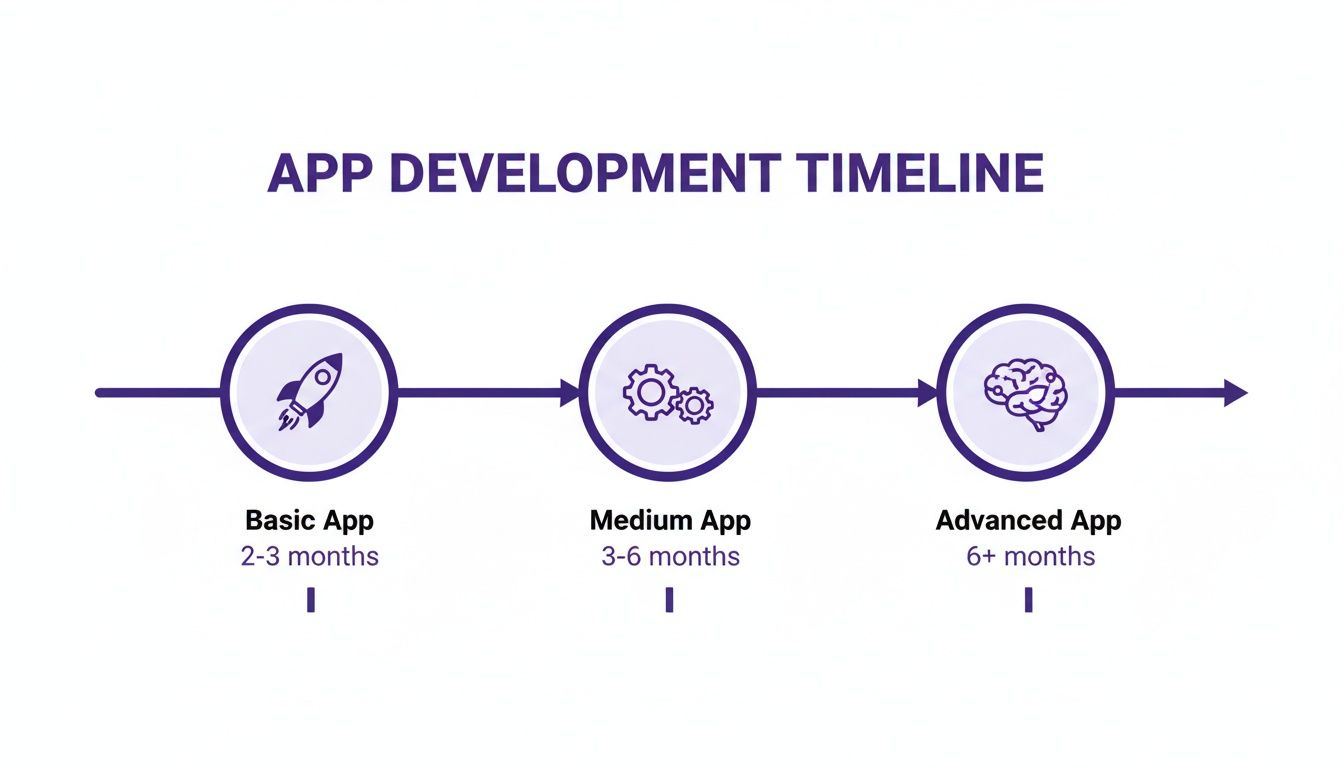
As you can see, a straightforward app can be up and running relatively quickly. More complex, feature-rich applications naturally require more time to get just right.
Your app is more than just code; it's a vital tool for business growth. Our mission is to build custom, high-performance applications that deliver tangible results and help you thrive in the competitive UK market.
Ready to see how we can bring your vision to life? You can learn more in our detailed guide on Flutter app development services for UK businesses.
Get in touch today for a no-obligation chat about your project. Let's build something brilliant.
Your Flutter Development Questions, Answered
Thinking about your next steps? It’s completely normal to have questions about how Flutter app development works in the real world. We’ve put together the most common queries we hear from UK business leaders, with clear, straightforward answers to help you make a confident decision.
Let's dive into the core concerns that matter most: performance, long-term costs, and technical capabilities.
How Does Flutter's Performance Compare to Native Apps?
This is the big one, and the answer is a huge reason why Flutter is so popular. In the past, choosing a cross-platform tool often meant accepting a slower, clunkier app. That's no longer the trade-off you have to make.
Flutter compiles directly to native machine code – the device's own language. This means it doesn't need the slow, clunky 'bridges' that held back older frameworks. Paired with Google's advanced Impeller rendering engine, the result is an app that feels incredibly fast, smooth, and responsive.
For almost every type of application, the performance of a Flutter app is virtually indistinguishable from a native one. Benchmarks consistently show Flutter leading the pack, ensuring your users get the slick, high-quality experience they demand.
How Does App Maintenance Work with a Single Codebase?
This is where the single codebase model really proves its long-term value. With traditional development, you're juggling two completely separate apps. That means double the work, double the cost, and double the headaches every time you need an update.
Flutter makes that complexity disappear. Need to fix a bug, roll out a security patch, or add a new feature? Your team does the work just once. That single update then deploys across both iOS and Android simultaneously.
This unified approach makes the entire maintenance process dramatically simpler. It doesn't just save a huge amount of time and money; it also cuts down the risk of platform-specific bugs, keeping the experience consistent for everyone.
This efficiency frees up your budget and your team's time to focus on innovation and making your app even better, not just keeping the lights on. It’s simply a smarter, more sustainable way to manage your app's lifecycle.
Can Flutter Apps Access Native Device Features?
Absolutely. It’s a common myth that cross-platform apps can't 'talk' to the phone's hardware, but Flutter has a really elegant solution for this. Your app will have full, unrestricted access to all the native features of a device.
Flutter uses a clever system called 'platform channels'. You can think of these as secure tunnels that let Flutter’s Dart code communicate seamlessly with the native code on both iOS (Swift/Objective-C) and Android (Kotlin/Java).
This powerful setup means your app can take full advantage of device-specific hardware and software, including:
- Camera and Photo Library: For snapping photos, recording video, and accessing user galleries.
- GPS and Location Services: To power maps, tracking, and location-aware features.
- Bluetooth and NFC: For connecting to wearables, smart devices, and enabling contactless payments.
- Biometric Sensors: Including fingerprint scanners and Face ID for secure, easy logins.
There are no compromises here. Anything a native app can do, your Flutter app can do, too. You get all the efficiency of a single codebase with the full power of a native build.
Ready to turn your app idea into a high-performance reality? The team at App Developer UK specialises in building beautiful, fast, and reliable Flutter applications for businesses across the UK. Contact us today for a no-obligation consultation and let's discuss how we can bring your vision to life.