Native App vs Web App Choosing the Right Strategy
Native App vs Web App Choosing the Right Strategy
At its heart, the difference is simple. Native apps are built to live on a device, giving them top-tier performance and full access to its hardware. On the other hand, web apps run inside a browser, offering instant access to anyone, anywhere. Your choice boils down to a classic trade-off: do you want a perfectly seamless, integrated user experience, or the broadest possible reach with a lower upfront investment?
Making the Right First Choice for Your Business
Deciding between a native app and a web app is one of the first, most crucial steps you'll take. This decision ripples through everything that follows, from your budget and project timeline to the very way you connect with your customers. It's far more than a technical detail—it's a strategic move that will shape your potential for growth and user loyalty.

Core Definitions
Before we dive deeper, let's get the terminology straight. A native app is coded specifically for one operating system, like iOS or Android. Developers use the platform’s own language—Swift for iOS or Kotlin for Android—which lets the app run incredibly fast and tap into every feature the device offers.
A web app, in contrast, is really a website that's been cleverly designed to look and feel like an app on a mobile device. You get to it through a browser, so there's nothing to install. The more advanced versions, known as Progressive Web Apps (PWAs), blur the lines by offering features like offline access and push notifications, but they're still ultimately working within the limits of a browser.
The native versus web debate is really a tug-of-war between raw performance and sheer accessibility. Native apps deliver an unmatched user experience, but web apps give you instant reach without the hurdle of an app store download.
The UK mobile app market tells a compelling story. It's projected to hit a staggering £28.3 billion by 2025, which shows just how much British consumers value the slick, high-quality experience that native apps provide. This deep-rooted preference for installed apps is something businesses can't ignore.
Of course, going native means playing by the rules. Businesses have to navigate the specific requirements and potential challenges related to App Store guidelines set by Apple and Google.
At a Glance Comparison Native App vs Web App
To help simplify that initial choice, here's a quick look at how native and web apps stack up against the criteria that matter most to a business.
| Criterion | Native App | Web App |
|---|---|---|
| Performance | Highest possible speed and responsiveness. | Slower, dependent on browser and network quality. |
| Device Access | Full access to GPS, camera, contacts, etc. | Limited access to device hardware features. |
| Distribution | Through app stores (Apple App Store, Google Play). | Accessible via any web browser on any device. |
| User Experience | Fluid, intuitive, and aligns with OS conventions. | Less integrated, experience can feel disjointed. |
| Offline Access | Can be designed to function fully offline. | Limited offline capabilities, even with PWAs. |
| Development | Higher initial cost and longer timeline. | Lower initial cost and faster development. |
This table gives you a starting point, but the right answer for your project depends entirely on your specific goals, budget, and audience.
A Detailed Breakdown of Technical Differences
To really get to the heart of the native vs. web app debate, we need to look beyond the surface. The choice you make here isn't just a technical one; it's a strategic decision that affects everything from raw performance and user experience to how you actually get your app into customers' hands. Let's break down the critical distinctions that matter.
Raw Performance and Speed
Performance is probably the biggest single difference between native and web apps. Native apps are written in the specific programming language of the device's operating system (OS) – that means Swift or Objective-C for iOS, and Kotlin or Java for Android. This direct line of communication with the device's hardware means they are incredibly fast and responsive.
Animations are fluid, complex calculations happen in a snap, and demanding features like high-res graphics or heavy data processing run without a hitch. Just think of a graphics-intensive mobile game or a powerful video editing tool; these experiences demand the kind of horsepower only native code can reliably deliver.
Web apps, on the other hand, run inside a browser. Their performance will always be constrained by the browser's own limitations and, of course, the user's internet connection. While modern web tech has come a long way, it simply can't compete with the raw efficiency of an app that speaks the device's mother tongue.
A native app is like a bespoke suit, tailored perfectly to one person for optimal comfort and performance. A web app is more like a high-quality adjustable jacket—versatile and accessible, but it never quite offers that perfect, custom fit.
User Experience and Interface Fluidity
Great user experience (UX) is a direct result of great performance. Because native apps are built for a single platform, they seamlessly adopt all the established design conventions and UI elements of that OS. This means the app feels instantly familiar and intuitive to the user.
An iPhone user has certain expectations for how swipes, gestures, and menus should work, and a native iOS app delivers that experience perfectly. This consistency leads to a more engaging app that people are more likely to keep using. While web apps can be designed to look and feel like a native app, they often fall just short. Those tiny lags, non-standard controls, or browser pop-ups can create a friction that chips away at the overall experience.
Access to Device Hardware and Features
This is where native apps have a clear, undeniable advantage. Going native gives you unrestricted access to the device's complete set of hardware and software features.
This includes things like:
- GPS and Geolocation: Absolutely vital for services like ride-sharing, food delivery, or location-based marketing.
- Camera and Microphone: The backbone of social media, communication apps, and anything involving media capture.
- Accelerometer and Gyroscope: Used for gaming, fitness tracking, and augmented reality experiences.
- Push Notifications: A hugely powerful tool for re-engaging users, which are far more reliable and effective in native apps.
- Contacts and Calendars: Essential for apps that need to integrate deeply into a user's personal information.
Web apps, including the more advanced Progressive Web Apps (PWAs), have gained some access to these features, but it's often less reliable and requires users to grant permission through the browser, sometimes repeatedly. For any business that relies on dependable hardware access, native is really the only way to go. You can learn more about the evolving capabilities of modern web solutions in our essential guide to Progressive Web Apps.
Development Cost and Timeline
Historically, the major downside to native development has been the cost and time. Building separate apps for iOS and Android means maintaining two different codebases, which often requires two specialised development teams and doubles the workload for testing and updates. This can be a major hurdle for many small and medium-sized UK businesses.
Web apps are a different story. With a single codebase that works across all platforms, they offer a much quicker and more budget-friendly path to launch. Development is generally simpler, and updates can be pushed out instantly without waiting for app store approval. This agility is a massive plus for businesses that need to move and adapt quickly.
But the game has changed. Modern cross-platform frameworks, especially Flutter, have emerged as a fantastic middle ground. Flutter lets developers build beautiful, high-performance apps for both iOS and Android from just one codebase. Recent benchmarks consistently put Flutter at the top for performance, effectively bridging the gap. It gives you the cost-saving benefits of web development with the power and feel of a native app.
To provide a clearer picture, let's compare these options side-by-side.
In-Depth Feature Comparison
This table breaks down the key technical and business considerations when choosing your path.
| Feature | Native App | Web App (including PWAs) | Key Business Implication |
|---|---|---|---|
| Performance | Highest possible; direct access to device hardware. | Slower; dependent on browser and internet connection. | For demanding apps (gaming, high-res graphics), native is essential for a good user experience. |
| User Experience (UX) | Seamless and intuitive; follows platform-specific design conventions. | Can feel less integrated; potential for browser-related friction. | Better UX leads to higher user retention and satisfaction, which directly impacts long-term success. |
| Device Feature Access | Full and unrestricted access to GPS, camera, push notifications, etc. | Limited and less reliable access; requires browser permissions. | If your core functionality relies on device hardware, native development is the only truly reliable option. |
| Development Cost & Time | High; requires separate codebases and teams for iOS and Android. | Lower; a single codebase works across all platforms, speeding up development. | Web apps offer a faster, more affordable route to market, ideal for MVPs or businesses with tighter budgets. |
| Distribution | Exclusively through app stores (Apple App Store, Google Play). | Accessible via any web browser through a URL; no app store needed. | App stores provide a trusted discovery channel but come with strict rules and revenue sharing. Web apps offer more freedom. |
| Maintenance | Complex; updates must be submitted, approved, and downloaded by users. | Simple; updates are pushed to the server and are instantly live for all users. | Web apps are far easier and cheaper to maintain, eliminating version fragmentation and approval delays. |
| Offline Functionality | Excellent; designed to work offline from the ground up. | Limited; PWAs offer some offline capabilities via caching, but it's not as robust. | For apps that must function reliably without an internet connection (e.g., travel guides), native is superior. |
| Security | Generally more secure due to OS-level protections and app store vetting. | More vulnerable to common web threats; security relies on server and browser standards. | Native apps provide a more secure environment for sensitive user data, which builds trust. |
Ultimately, the right choice depends entirely on what you're trying to achieve, who your audience is, and what resources you have available.
Distribution and Maintenance
The way users find and access your app is worlds apart. Native apps are discovered and downloaded from app stores like the Apple App Store and Google Play. This gives you a centralised and trusted distribution channel, but it also means navigating a strict review process and paying platform fees.
In the UK market, this channel is fascinating. While Android has a slight lead in market share with 50.1% of devices compared to iOS at 49.3%, the revenue figures tell a different story. In 2024, the Apple App Store is projected to capture an enormous 69.36% of all app revenue in the UK. This tells us that while your potential audience is split almost evenly, iOS users are far more likely to spend money. You can discover more insights about the UK mobile application market on GrandViewResearch.com.
Web apps completely sidestep the app stores. They're found through a simple URL, are easy to share, and can be indexed by search engines. Maintenance is a breeze—you deploy updates to your server, and they're instantly available to everyone. With a native app, every update requires users to download a new version, which can lead to many people running outdated software. This cycle of updates and approvals adds a layer of complexity that web apps just don't have.
How User Experience Drives Business Results
When you pit a native app against a web app, the conversation almost always lands on one critical factor: user experience (UX). A smooth, intuitive UX isn't just a nice-to-have anymore; it's the engine that powers everything from user engagement and retention right through to your bottom line. The technology you choose will directly shape that experience, and in turn, your business's success.
Native apps almost always come out on top here. They’re built specifically for the device's operating system, creating a perfect synergy that you can feel. This harmony translates into fluid animations, instant responses, and an interface that just feels right to the user. The performance difference is tangible—users notice it, even if they can't quite put their finger on why.
This seamless interaction has a huge impact on user behaviour. When an app is fast and reliable, people stick around longer, explore more, and are far more likely to do what you want them to do, whether that's making a purchase or signing up.
The Power of Engagement and Retention
Higher engagement isn't just a number to show off in a meeting; it leads to real business results. Data from the UK market makes it clear that native apps consistently outperform their web-based cousins on the metrics that actually matter.
For instance, research shows conversion rates on native apps are around 3 times higher than on mobile websites. On top of that, users look at 4.2 times more products per session inside an app compared to a mobile site. These figures aren't small—they show a much deeper level of engagement and a clear path to increased revenue.
This difference is often down to features that are just more powerful in a native environment.
- Reliable Push Notifications: A native push notification is a direct line to your user. It’s personal, effective, and proven to boost retention. They are far more likely to bring someone back to your app than browser notifications, which are often ignored or blocked entirely.
- Offline Capabilities: A native app can be built to work properly even without an internet connection. This is a game-changer for users on the move, creating a dependable experience that builds trust and keeps them coming back.
These capabilities make your app a reliable tool in someone's daily life, not just another bookmark lost in a sea of browser tabs.
Translating UX into Business Value
A great user experience is an investment that pays for itself through customer loyalty and lifetime value. A smooth, frustration-free journey encourages repeat business and gets people talking—the kind of organic marketing that money can't buy.
On the flip side, poor performance is a fast track to losing customers. A slow-loading web app or a clunky interface leads to high bounce rates and abandoned shopping carts, hitting your revenue directly.
For businesses that want to build lasting relationships with their customers, investing in a high-performance native or cross-platform app delivers a clear return. The friction-free journey it creates is the foundation for maximising customer lifetime value.
Investing in a well-crafted native experience means putting the user first, from start to finish. Of course, good design principles are crucial no matter which platform you choose. It's always a good idea to ground your project in general user experience design best practices to ensure you're meeting modern expectations. By focusing on how users actually interact with your brand, you create a powerful competitive advantage. You can learn more about how expert UX design services can transform mobile apps and drive real business success.
Practical Scenarios: When to Use Each Approach
The technical specs are one thing, but figuring out where native and web apps fit in the real world is what really matters. The right choice always boils down to your business model, who you're trying to reach, and what your goals are for the future. Let’s break down some common scenarios to see which approach comes out on top.
Go Native for High-Engagement Services
Think about businesses that live and die by the quality of their user experience. We're talking about services people rely on every single day, where performance and reliability are absolutely non-negotiable.
An on-demand food delivery service like Deliveroo or a ride-sharing app like Uber is a perfect example. Their entire business hinges on flawless GPS tracking, instant push notifications, and a slick, responsive interface that never misses a beat. A web app just can’t deliver the raw performance or deep device integration needed for this kind of model to work.
The same logic applies to:
- Social Media Platforms: Look at Instagram or TikTok. Their success is built on a buttery-smooth UI, heavy use of the phone’s camera, and powerful on-device media processing.
- High-End E-commerce Brands: For a luxury retailer, the shopping experience is part of the brand promise. A native app delivers the fluid animations, crisp product imagery, and secure, one-tap payments that premium customers expect.
- Internet of Things (IoT) Apps: Any app designed to control smart home devices, connect to wearables via Bluetooth, or interact with other hardware needs the kind of direct access only a native build can provide.
In these situations, the higher upfront cost of a native app (or a high-performance cross-platform option like Flutter) makes perfect sense. That investment pays for itself through a superior user experience, which directly fuels engagement, loyalty, and, ultimately, revenue.
Choose Web Apps for Accessibility and Information
On the flip side, sometimes your main priority is getting your content or tool in front of as many people as possible, with the least amount of fuss. This is where web apps truly shine—when the goal is broad, immediate access over feature-rich complexity.
A news publication or a blog is a classic example. The primary goal is for people to read articles quickly, from any device, without any barriers. Forcing a download from an app store is just adding unnecessary friction. A well-built responsive website or a Progressive Web App (PWA) is the perfect fit, offering instant access and easy sharing with a simple link.
A web app is the path of least resistance for your users. If your goal is maximum reach for content or simple functionality, eliminating the app store download is your biggest advantage.
Other great use cases for web apps include:
- Internal Business Tools: Things like company dashboards, holiday trackers, or internal wikis are ideal as web apps. They work on any device an employee has, with no installation or managed updates required.
- Simple Utility Calculators: Does a mortgage calculator or currency converter need native power? Absolutely not. A web app gets the job done instantly in the browser.
- Event Landing Pages: For a one-off conference, a PWA can offer a schedule, speaker bios, and basic updates without asking attendees to download a whole new app they’ll only use for two days.
By opting for a web app in these scenarios, businesses can launch faster and for a fraction of the cost, putting their resources where they’ll have the most impact.
Finding the Middle Ground with Flutter
The native vs. web app debate often feels like you have to pick a side. Businesses think they're stuck choosing between the raw power of native development and the budget-friendly reach of web apps. But that's a false choice. It completely ignores the powerful, practical middle ground that's emerged: modern cross-platform development.
For many UK businesses, the best solution isn’t at either extreme. It’s a framework that delivers a top-tier, native-like experience without the headache and cost of building and maintaining two separate apps. This is exactly where tools like Flutter come in, and they're changing the game entirely.
What Is Flutter?
Developed by Google, Flutter is an open-source UI toolkit for building beautiful, natively compiled applications for mobile, web, and desktop—all from a single codebase. Unlike older cross-platform tools that acted as a clumsy bridge to native components, Flutter’s approach is fundamentally different. It uses its own high-performance rendering engine to draw every single pixel on the screen.
This means Flutter apps aren't held back by the limitations of platform-specific UI elements. The result? Blisteringly fast performance, consistent visuals across both iOS and Android, and a level of creative freedom that’s tough to beat.
Flutter isn't just a compromise; it’s a strategic advantage. It lets businesses achieve the slick user experience of a native app while keeping the efficiency and cost savings of a single-codebase approach.
The Performance Advantage
When you're looking at cross-platform options, performance is everything. This is where Flutter really shines. New benchmarks consistently put Flutter at the top of the pile for raw speed, often matching or even beating truly native apps in real-world scenarios.
This incredible performance comes down to a few key things:
- Compiled Code: Flutter code is compiled directly into native ARM machine code. This gets rid of the performance bottlenecks you see in solutions that rely on JavaScript bridges.
- Direct Rendering: Because it controls every pixel itself, Flutter sidesteps the unpredictable rendering pipelines of the operating system. This leads to smooth, consistent animations running at 60 frames per second (fps) or even higher.
- A Single Codebase: Your development team can build, test, and release features for both iOS and Android at the same time. This massively reduces development time, slashes costs, and gets your product to market so much faster.
This combination allows a business to launch an app that feels just as quick and fluid as a fully native build, but for a fraction of the time and money. It effectively closes the performance gap that once made the native app vs web app decision so agonising.
Balancing Cost, Speed, and Quality
For startups and SMEs across the UK, how you use your resources is make-or-break. The old-school native route—hiring separate iOS and Android teams—is often far too expensive and slow. Web apps are cheaper, but they often can't deliver that sticky, engaging experience you need to build a loyal following.
Flutter breaks that cycle. It lets you build one high-quality application that serves your entire mobile audience. This unified development process doesn't just save cash; it also guarantees feature parity and a consistent brand experience on every device. If you need a partner to guide you, exploring expert Flutter development services in the UK can provide the expertise to turn your vision into a high-performance reality. It's a strategic approach that offers a sustainable, scalable way to compete.
So, How Do You Make the Final Call?
Choosing the right development path isn't just a technical decision; it's a business one. After weighing up the pros and cons in the native vs web app debate, the next step is to look inward at your specific goals, your budget, and what your users really expect. Getting this right is what separates a good idea from a profitable, successful application.
To cut through the noise, ask yourself these critical questions:
- Who are you building this for? Are they expecting a slick, high-performance experience that feels like a natural part of their phone, or is getting them to your content quickly, with zero friction, the top priority?
- What does your app actually do? Does its core value depend on tapping into the phone's hardware, like the GPS for location tracking, the camera for scanning, or push notifications that absolutely must work every time?
- What's the long-term plan? Are you aiming to build a loyal community of highly engaged users who see your app as an essential daily tool? Or is your main goal to get your content in front of as many eyes as possible through search engines?
- What are your resources? Let's be realistic about your budget and timeline. How can you deliver the best possible experience without stretching your finances or deadlines to breaking point?
This flowchart helps simplify things by mapping out the decision based on what matters most to your business—performance versus development speed.
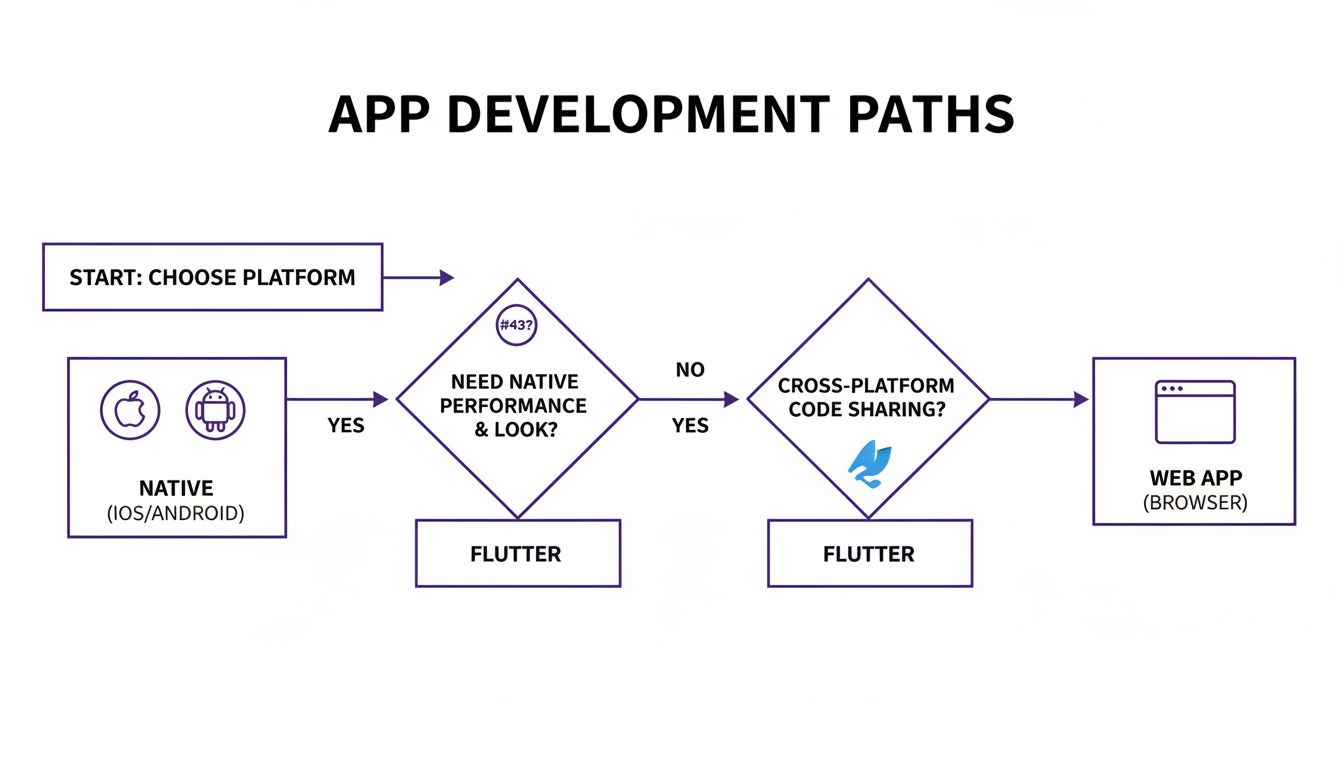
As the diagram shows, if performance is non-negotiable, you’re looking at native or cross-platform solutions. Web apps, on the other hand, are a solid choice for simpler projects where speed of delivery is key.
Our Expert Recommendation
For the vast majority of UK businesses we work with—those aiming for real growth, deep customer engagement, and a genuine edge over the competition—the choice is surprisingly clear. A web app can be a useful starting point, but it often struggles to deliver the kind of premium experience that builds brand loyalty and keeps users coming back.
A superior user experience isn't just another feature; it's the very foundation of a successful mobile strategy. When you invest in high performance, you're investing directly in customer retention and future revenue.
That’s why we confidently recommend a high-performance, cross-platform application built with Flutter. It truly offers the best of both worlds: you get the near-native speed and smooth feel that users adore, but with the cost savings and faster development time that comes from a single codebase. With benchmarks consistently placing it at the top for performance, Flutter represents the smartest, most sustainable investment for any business that’s serious about mobile success.
Frequently Asked Questions
When you're weighing up a native app vs a web app, a few key questions always seem to pop up. We’ve answered the most common ones here to help you make a final, confident decision.
Which Is Better for SEO: a Native App or a Web App?
Hands down, web apps (including PWAs) are the clear winner for search engine optimisation (SEO). Because they're built with standard web technologies, their content is completely visible and indexable to search engines like Google. This is a huge advantage, letting you pull in organic traffic directly from search results.
Native apps, on the other hand, live within the walled gardens of the Apple App Store and Google Play. Their content can't be crawled by Google. Instead of SEO, you'll focus on App Store Optimisation (ASO) to improve your app's visibility inside these stores. Most businesses also build a separate marketing website to get discovered through search and drive downloads.
Can a Web App Be Converted into a Native App?
Technically, yes, but it’s rarely a good idea. You can wrap a web app in a "webview" container and publish it to the app stores. However, this approach almost always results in sluggish performance and a clunky user experience that just doesn't feel right. Users can spot a wrapped website a mile off.
To get the polished feel and smooth performance users expect, you really need to build the app with native code from the ground up.
This is where a high-performance, cross-platform framework like Flutter really shines. It bridges the gap by building a truly native application for both iOS and Android from a single codebase. You get genuine native performance without the compromises of a cheap web wrapper.
How Much More Expensive Is a Native App Than a Web App?
Traditionally, building a native app has been far more expensive. The reason is simple: you were essentially funding two separate projects, one for iOS and one for Android. This meant double the developers, double the testing, and double the ongoing maintenance costs.
But modern cross-platform frameworks have completely flipped this on its head. By using a single codebase for both platforms, Flutter slashes the development budget. You get an app that feels and performs like a native build for a much more reasonable investment, making it a powerful and cost-effective alternative.
Ready to build a high-performance app that delivers an exceptional user experience without breaking the bank? The expert team at App Developer UK specialises in creating stunning, natively compiled applications using Flutter. Contact us today to bring your vision to life.