What Is Software Architecture Explained Simply
What Is Software Architecture Explained Simply
Think of software architecture as the high-level strategy for a software system. It’s the essential blueprint that defines how all the major pieces fit and work together to meet business goals, focusing on the big picture rather than the tiny details of the code.
The Blueprint for a Successful App

Ever tried to build a skyscraper without a blueprint? You might get the first few floors up, but you'd quickly run into chaos. Can the foundation handle more weight? How do the plumbing and electrical systems connect between levels? Without that master plan, the whole project becomes unstable, inefficient, and will almost certainly collapse.
Software architecture is that exact blueprint for any digital product, whether it's a simple mobile game or a complex enterprise platform. It’s not about the individual lines of code—the bricks and mortar, if you will—but about the fundamental structure holding everything together.
What Does a Software Blueprint Define?
Just like a building plan, a software architecture forces you to make critical decisions early on that will dictate the project's entire future. It sets the ground rules and high-level vision that guide the development team, ensuring everyone is building towards the same goal.
A solid architectural plan will clearly map out:
- Key Components: The main functional blocks of the system, like a user authentication service, a payment processor, or a data analytics engine.
- Interactions: How these different components talk to each other, making sure data flows logically and securely through the application.
- Technology Choices: The programming languages, frameworks, and databases best suited for the job. For high-performance mobile apps, for instance, many UK businesses now prefer Flutter for its speed and cross-platform capabilities.
- Scalability Path: A clear strategy for how the app will grow to handle more users, data, and features without falling over.
To give you a clearer picture, here’s a quick breakdown of these core concepts using our building analogy.
Core Architectural Concepts at a Glance
| Concept | Analogy (Building Blueprint) | Role in Software |
|---|---|---|
| Components | Individual rooms or floors | Self-contained parts of the app (e.g., login, profile, cart) |
| Interactions | Hallways, lifts, and wiring | How data and commands move between components (APIs) |
| Technology Choices | Building materials (steel, concrete) | The frameworks and languages used to build the app |
| Scalability Path | Plans for adding new wings or floors | How the app will expand to support future growth |
Each of these elements is crucial for building a system that doesn't just work on day one but continues to perform for years to come.
This kind of proactive planning is what sets successful projects apart. The UK’s software development industry is booming, with revenue expected to hit £1.1 billion, largely driven by the demand for custom solutions. In such a competitive market, a well-defined architecture isn't a luxury; it's what allows businesses to innovate efficiently and build products people can rely on. You can read more about the UK's software industry growth and what’s driving it.
A great architect doesn’t just build for today’s needs; they anticipate tomorrow’s challenges. The goal is to create a structure that is not only strong but also flexible enough to adapt and evolve over time.
Ultimately, understanding software architecture comes down to this: it’s the strategic foundation that ensures an application is robust, maintainable, and built to last. It’s what turns a simple collection of code into a cohesive, powerful, and successful digital product.
Why Good Architecture Is a Business Superpower
 Solid software architecture is far more than a technical box-ticking exercise for developers; it's a critical business asset that directly impacts your bottom line. Thinking of it as a strategic investment rather than just another cost is the first step toward building a product that can actually win in the market.
At its core, a well-architected system is what allows a business to scale smoothly, roll out new features quickly, and maintain the high performance users expect. This kind of agility gives UK businesses a powerful competitive edge. When your app can handle a sudden flood of new users without crashing, you keep those customers and protect your reputation. A clean, modular architecture also means your development team can deliver that new feature everyone's asking for in weeks, not months.
The True Cost of Neglecting Architecture
On the flip side, poor architecture creates a domino effect of problems that quietly drain your resources and kill your growth potential. This is what we call technical debt—the hidden cost of rework you create by choosing an easy, limited solution now instead of a better, more thoughtful approach.
Bad architectural choices almost always lead to:
- Crippling Delays: Simple updates turn into complex nightmares, slowing down innovation and burning out your team.
- Mounting Costs: Fixing deep-rooted structural issues is always more expensive than getting the blueprint right from day one.
- Security Risks: Disorganised, messy systems are full of hidden vulnerabilities just waiting to be exploited, putting your business and your users' data at risk.
These aren't just hypotheticals. A staggering 93% of technology leaders in the UK and US have reported negative business outcomes because their documented software architecture didn't match the reality of their codebase. It’s a stark reminder of how easily an unmanaged architecture can become a major business liability. You can explore the full report on software development architecture to dig into the findings yourself.
A strong architecture acts as a force multiplier for your business. It makes your development faster, your product more reliable, and your operations more secure, paying for itself many times over.
Ultimately, investing in a robust plan up front is what saves you from costly, painful rebuilds down the road. For mobile apps built with high-performance frameworks like Flutter, a solid architecture is what unlocks its true potential. It ensures your app isn't just fast today, but also ready for whatever challenges tomorrow brings. It’s how you outmanoeuvre the competition and build a business that lasts.
Understanding the Core Architectural Components
To really get your head around software architecture, you need to look at its fundamental building blocks. Just like a car is made of an engine, chassis, and transmission, every software system is built from a few core elements. Understanding these parts helps demystify how a high-level plan actually turns into a working application.
At its heart, any software architecture boils down to three key things: components, connectors, and constraints. Let's break them down.
Components: The Functional Engines
Components are the self-contained, functional parts of your application. Think of them as specialised teams in a company. One team handles customer sign-ups, another processes payments, and a third manages inventory. Each team has a clear job and can operate pretty much on its own.
In a mobile app, a component might be the user authentication service, the shopping basket functionality, or the notification system. They are the primary actors doing the actual work. These services often need to talk to a server, a vital part of the process you can learn more about in our guide on what backend development is.
Connectors: The Communication Lines
Next up, you have connectors. These are the pathways that allow your components to talk to each other. If components are the specialised teams, then connectors are the company's communication channels—the emails, phone calls, and meetings that let them coordinate their efforts.
In the software world, connectors are things like API calls, database queries, or event notifications. For example, when you tap "Add to Basket" in an app, a connector sends a message from the product page component to the shopping basket component, telling it to update. Without them, each component would be isolated and completely useless.
Constraints: The Rules of the Game
Finally, there are constraints. These are the non-negotiable rules and limitations that govern the entire system. Think of them as company policies or industry regulations that everyone has to follow, like data protection laws or strict budget limits.
Constraints aren't just limitations; they are guiding principles that ensure consistency, security, and quality across the entire system. They force deliberate, thoughtful decisions.
For instance, an architectural constraint might be that all data must be encrypted both in transit and at rest, or that the application must respond to any user action within 500 milliseconds. Another huge constraint is the technology choice itself—deciding to build with a high-performance framework like Flutter sets the foundation for the entire project. These rules make sure the final product is secure, reliable, and does what the business needs it to do.
Exploring Common Architectural Patterns
Think of an architectural pattern like a chef's recipe. You wouldn't invent a new way to bake a cake every single time, would you? Instead, you’d follow a proven recipe that guarantees a delicious result. In software, architectural patterns are our trusted recipes for solving common structural problems.
These are battle-tested templates for organising your code. By relying on established solutions, you can build a system that’s logical, efficient, and far easier to manage down the line, instead of reinventing the wheel on every project.
This all comes down to how the core parts of any architecture—components, connectors, and constraints—fit together.
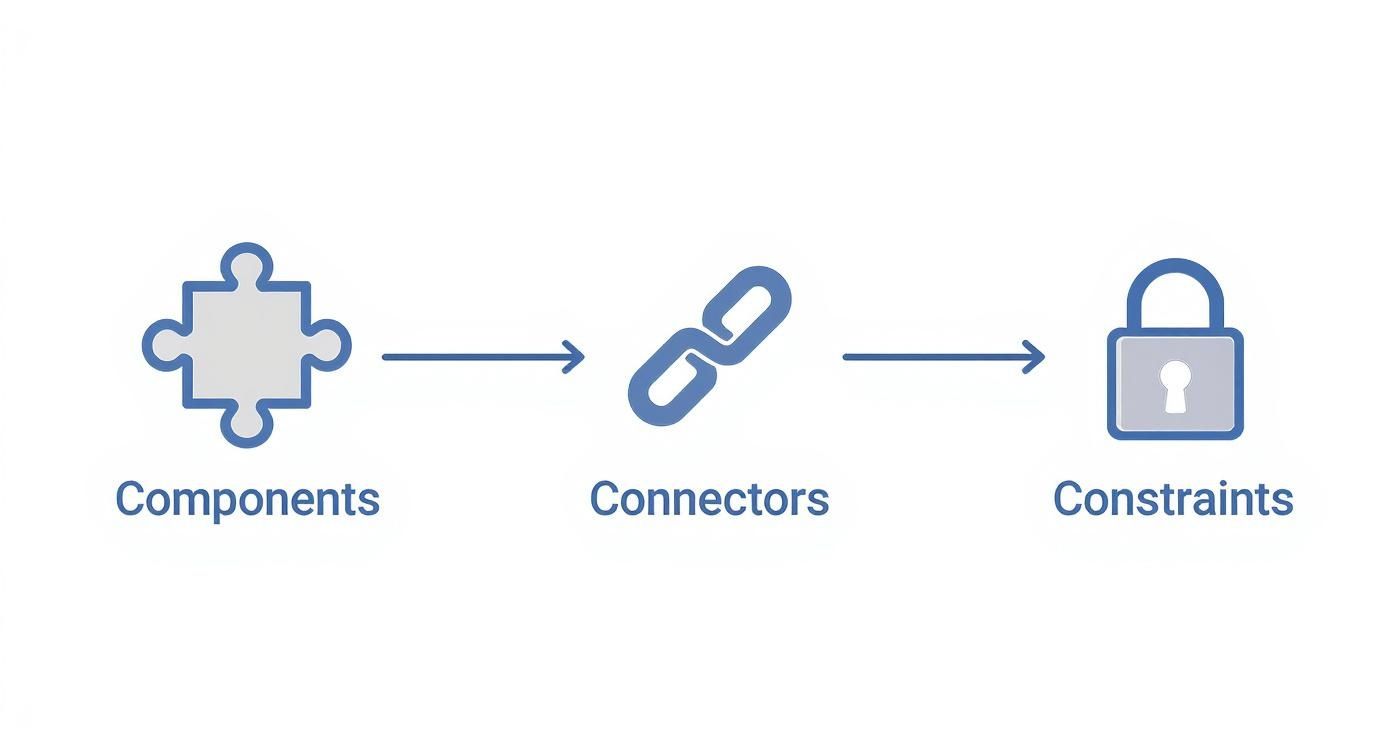
This fundamental flow gives us a map for how an application should function. It's the foundation upon which all good architectural patterns are built. Let's look at a few of the most popular patterns you'll see in modern app development.
Model-View-Controller (MVC)
One of the real veterans of software design is Model-View-Controller (MVC). It’s been around for ages because it does one thing exceptionally well: it separates an application's functions into three distinct, interconnected parts. This makes the code so much cleaner and easier to maintain.
- Model: This is the brains of the operation. It manages all the app's data and business logic, like saving a user's profile or fetching product details from a server.
- View: This is everything the user sees and interacts with. The View’s job is simply to display the data from the Model in a user-friendly way.
- Controller: This is the traffic cop standing between the Model and the View. It takes user input (like a button tap) from the View, tells the Model what to do, and then updates the View with any new information.
This separation is a game-changer for team collaboration. Your UI designers can work on the View while backend developers focus on the Model, all without treading on each other’s toes.
Model-View-ViewModel (MVVM)
As apps became more interactive and UI-heavy, a more modern pattern gained popularity: Model-View-ViewModel (MVVM). It's a natural evolution of MVC but introduces a new player, the ViewModel, to create an even stronger separation between the UI and the business logic.
The core idea behind patterns like MVVM is to create a 'separation of concerns'. This principle helps reduce complexity, making the codebase easier to test, debug, and scale over time.
In MVVM, the ViewModel is a specialist. It grabs raw data from the Model and meticulously prepares it for display in the View. This is perfect for frameworks that use data binding, where UI elements can automatically refresh when the data they're linked to changes. It leads to incredibly smooth and responsive apps.
This is a go-to approach in high-performance frameworks like Flutter, where a reactive, slick UI is one of the biggest selling points.
Clean Architecture
When you're building something big—a truly complex, enterprise-level application—you need something more robust. That's where Clean Architecture comes in. It’s less of a single pattern and more of a philosophy for creating a highly modular, testable, and independent system.
The concept organises code into distinct layers, like the rings of an onion, with one strict rule: dependencies can only point inwards.
At the very centre, you have your core business logic. This layer knows absolutely nothing about the outside world—no databases, no UI frameworks, nothing. This protects the most critical part of your application from changes in technology. It's completely future-proof.
While it can feel a bit over-engineered for small projects, this pattern is priceless for building long-lasting systems that need to evolve and adapt for years to come.
Comparing Popular Architectural Patterns
Choosing the right pattern depends entirely on your project's needs. A simple app might not need the complexity of Clean Architecture, while a large-scale enterprise system would quickly become unmanageable with a basic MVC setup.
Here’s a quick comparison to help you see where each pattern shines.
| Pattern | Best For | Key Benefit | Potential Drawback |
|---|---|---|---|
| MVC | Simple applications, web apps with clear user actions. | Straightforward to implement and widely understood. | Can become messy in complex UIs ('Massive View Controller'). |
| MVVM | UI-heavy applications, projects using reactive frameworks like Flutter. | Excellent separation of UI and logic; great for testing. | Can have a steeper learning curve than MVC. |
| Clean Architecture | Large, complex, long-term enterprise applications. | Highly testable, independent of frameworks, and very scalable. | Can be overkill and adds significant boilerplate for small projects. |
Ultimately, the goal is to pick a structure that makes your code easy to understand, test, and maintain. A little forethought here saves a massive headache later on.
Choosing the Right Architecture for Your Flutter App
Moving from theory to the real world of building mobile apps, picking the right software architecture becomes incredibly important. For developers in the UK building with Flutter, this isn't just an academic exercise—it's a decision that will directly shape your app's performance, how easily it can grow, and whether it’s a nightmare to maintain down the line.
The right architecture isn't just about keeping your code tidy; it's about unlocking what Flutter is truly capable of.
Flutter is built around a reactive, widget-based system. Think of it this way: the UI automatically updates itself whenever the app's data (or 'state') changes. This design works best when you use an architectural pattern that manages that state cleanly and efficiently. If you choose a pattern that fights against this reactive flow, you’ll end up with tangled, unpredictable code that’s a real headache to debug.
Why Flutter Demands a Specific Architectural Approach
The main goal here is to draw a clear line between your business logic and your UI code. When everything is jumbled together—your user interface, how you handle data, and your business rules—a tiny change in one spot can cause a cascade of unexpected problems elsewhere. This is exactly why architectural patterns are non-negotiable for any serious Flutter project.
Two of the most popular and effective patterns in the Flutter community are BLoC and Provider. Both were designed to play nicely with Flutter's reactive nature, making sure everything has its proper place.
- Provider: This is a fantastic, straightforward pattern that’s great for managing state. It lets you "provide" data to any widget further down the widget tree, making it easy to pass information around without overcomplicating your UI code. It’s often the go-to for simpler apps.
- BLoC (Business Logic Component): This one is a bit more structured. BLoC uses streams to manage the flow of data between your UI and the business logic. It's a powerhouse for complex apps where you need to handle intricate state changes and user interactions with absolute precision.
Using either of these approaches will lead to code that is dramatically cleaner, much easier to test, and ready to scale as your app gets bigger.
Unlocking Peak Performance with the Right Blueprint
Flutter consistently tops the charts for cross-platform performance, with recent benchmarks confirming its position at the very top. But you don't get that speed for free. A poor architectural choice can create bottlenecks that completely torpedo the framework's performance gains.
Good architecture in Flutter isn't just about organisation; it's about performance. By managing state efficiently, you ensure the UI rebuilds only when necessary, resulting in a buttery-smooth user experience.
The right pattern, whether it's BLoC, Provider, or another, helps you build high-performance apps that genuinely stand out. By structuring your app with care from day one, you’re laying a solid foundation that is not only fast but also flexible enough to adapt to future needs.
This strategic thinking is the cornerstone of successful Flutter development and is what ensures your project is built to last. For any UK business aiming to launch a top-tier mobile app, getting the software architecture right is the first and most critical step.
Building Your App to Last
Ultimately, software architecture isn't a task you simply tick off a list and forget about; it's an ongoing, strategic practice. If we go back to our skyscraper analogy, a well-thought-out architectural blueprint is your best defence against future headaches like technical debt and poor scalability. It’s the structural integrity that stops the whole thing from collapsing when new pressures are applied.
This upfront planning is the true foundation for innovation, quality, and long-term success. It’s what allows your application to evolve gracefully, adapting to new features and changing user demands without forcing you into a complete teardown and rebuild.
Good architecture gives your business a durable competitive advantage. It's what allows your application to not just launch successfully but to thrive and grow in a competitive market.
Investing in a solid plan from the start means your project stays robust and maintainable down the line. This approach goes hand-in-hand with rigorous quality assurance, which is why understanding what automated testing is perfectly complements a strong architectural strategy.
By combining a solid blueprint with consistent quality checks, you build an application that is genuinely designed to last. It’s how you turn a simple idea into a powerful, reliable, and future-proof digital product that can stand the test of time.
A Few Common Questions
Even when the core ideas are clear, a few specific questions always seem to pop up. Let's tackle some of the most common ones to really cement your understanding.
What’s the Real Difference Between Software Architecture and Software Design?
Think of it like building a new city. Software architecture is the city plan. It decides where the major districts go, how the main motorways connect everything, and where the essential utilities like power and water will run. It's the high-level, strategic blueprint for the whole system.
Software design, on the other hand, is like designing a single house within one of those districts. It gets into the nitty-gritty details: the layout of the rooms, the type of bricks to use, and how the internal plumbing connects. Architecture sets the grand vision; design figures out how to actually build the individual pieces.
How Often Should We Be Reviewing Our Software Architecture?
Your architecture should never be a document you write once and file away to gather dust. It’s a living part of your system and needs to evolve as your product does.
It's a really good idea to review it regularly. Key moments are when business goals pivot, a new technology appears on the scene that you can't ignore, or you start to feel performance grinding to a halt. For teams working in an agile way, these reviews can slot right into sprint planning or be triggered any time a big new feature is on the table.
An architecture review isn't about pointing fingers or finding fault. It's a proactive health check, making sure your system's foundations are strong enough for what's coming next and you're not quietly racking up risky technical debt.
Can I Actually Change the Architecture of an App That's Already Live?
Yes, you absolutely can, but it’s something you have to approach with a lot of care and planning. The process is often called refactoring or re-architecting, and the smartest way to do it is bit by bit to keep risks low and avoid breaking things for your users.
Trying to perform a massive architectural transplant on a live application can get complicated and expensive, fast. This is exactly why putting the effort into a solid, flexible architecture from day one is so important—it helps you sidestep the need for a huge, costly overhaul later on.
Ready to build a high-performance app with a rock-solid architectural foundation? The team at App Developer UK specialises in creating robust and scalable mobile applications using Flutter. Contact us today to bring your vision to life.