Hire Application Developer: How to hire application developer for your project
Hire Application Developer: How to hire application developer for your project
Before you even think about hiring an application developer, you need to get a firm grip on the UK’s tech scene. It's a competitive world out there. Understanding the going rates for salaries, the hotspots for talent, and how big shifts like AI are changing the game is non-negotiable. Get this right, and you’ll craft an offer that top-tier developers can't ignore.
Understanding the UK Tech Hiring Landscape
Trying to hire an application developer in the UK without knowing the market is like navigating blindfolded. It's a fast-moving, fiercely competitive environment, especially in booming sectors like fintech and healthtech where skilled developers are snapped up fast. The demand is constantly outrunning the supply, and that simple fact shapes everything from salary expectations to how long a great candidate stays on the market.
For you, this means a simple job advert just won't cut it. You need to build a compelling story. Why should a developer join your team? It's about more than just the pay cheque; it’s about the challenge of the project, the tech stack they'll get to work with, and the culture you’ve built.
Regional Salary Differences and Emerging Hubs
For years, London was the undisputed centre of the UK tech universe. While it's still a major player, other cities are seriously stepping up. Places like Manchester, Edinburgh, and Bristol are now home to thriving developer communities, attracting a mix of exciting start-ups and established tech giants.
This shift has a direct knock-on effect on salaries. A developer role in London will almost always come with a higher price tag. But don't discount the emerging hubs—the lower cost of living and better quality of life are huge draws for many tech professionals. This has created a much more distributed and accessible talent pool across the country, which is great news for hirers.
This visual breakdown gives you a clearer picture of the salary variations you can expect across the UK.
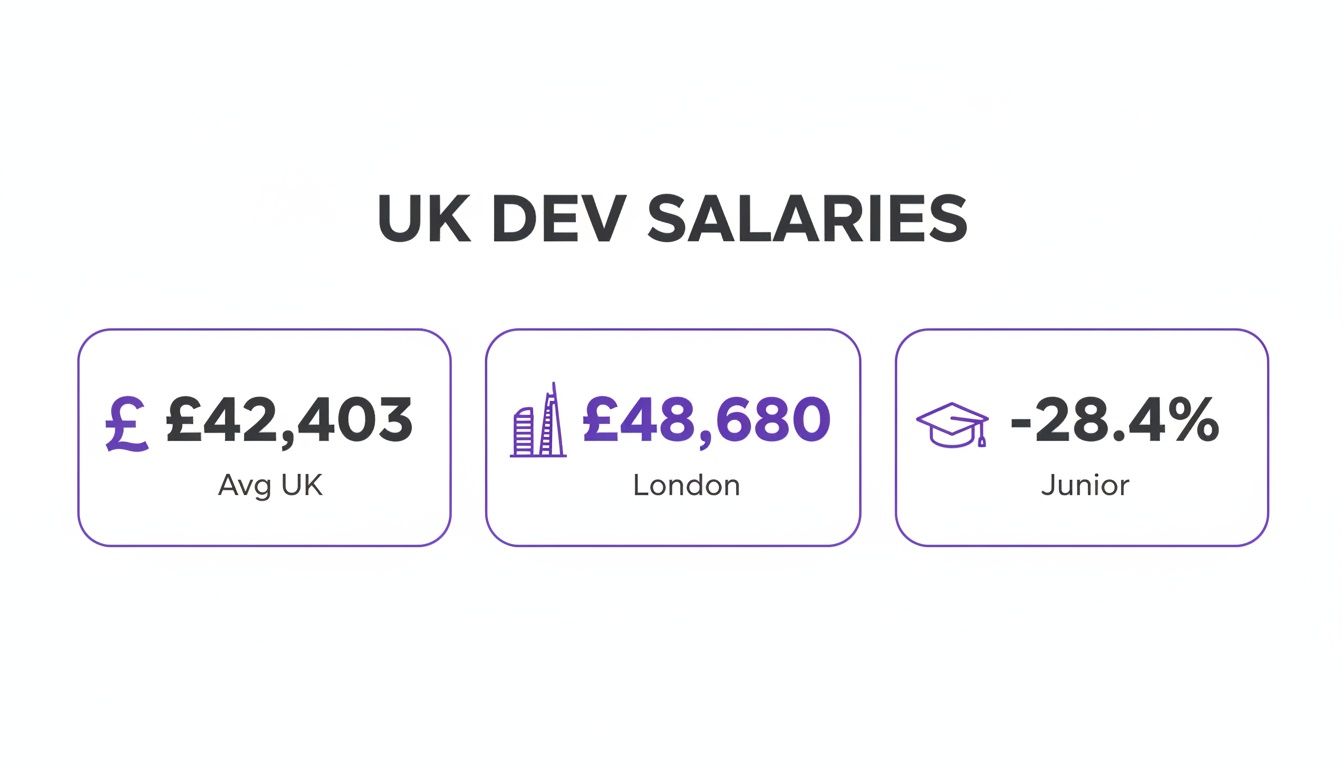
As the data shows, London salaries are higher, but what's really interesting is the shrinking number of junior roles. This makes experienced, skilled developers even more valuable.
The Impact of AI on Developer Roles
The explosion of generative AI is another massive factor you can't ignore. AI tools are now handling a lot of the routine, boilerplate coding, and that's changing what companies are looking for. The focus has shifted heavily towards experienced mid-to-senior level developers. Businesses need people who can tackle complex problem-solving, architect robust systems, and think strategically—skills that AI can't touch.
Recent market analysis from May 2025 backs this up. While software developer roles are back in the top five most in-demand jobs, the number of entry-level graduate positions has dropped by a staggering 28.4% compared to last year. At the same time, average advertised salaries have jumped to £42,403, a 9.38% increase, with London leading the pack at £48,680.
Key Takeaway: The market for junior developers is tightening as AI takes on more of the basic coding work. This means businesses are wisely investing in skilled, experienced developers who can offer strategic value far beyond just writing lines of code.
This is a critical insight for anyone looking to hire. Your search needs to be laser-focused on individuals with proven experience and a strong portfolio. It's simply more important than ever. For a closer look at these market dynamics, our ultimate guide to UK mobile app development is a great resource.
To give you a snapshot of the current environment, here’s a quick summary of the key metrics influencing your hiring decisions.
UK Application Developer Hiring At a Glance
| Metric | Key Finding | Implication for Hirers |
|---|---|---|
| Junior Role Availability | Entry-level positions have decreased by 28.4% year-on-year. | Focus recruitment efforts and budget on attracting mid-to-senior level talent with proven experience. |
| Average Salary (UK) | Increased by 9.38% to £42,403. | Be prepared to offer a competitive salary that reflects the market-wide increase in compensation. |
| London Salary Premium | The average advertised salary in London is £48,680. | If hiring in London, budget accordingly for the higher salary expectations. |
| Talent Distribution | Tech hubs are growing in cities like Manchester, Edinburgh, and Bristol. | Broaden your search beyond London to tap into a wider, more accessible talent pool. |
Ultimately, the data paints a clear picture: the demand for experienced, strategic thinkers is on the rise, and companies are willing to pay for that expertise.
Defining Your Project and Pinpointing Key Developer Skills
Before you even think about hiring an application developer, you need to have a crystal-clear vision of what you’re actually building. Trust me, a vague idea like "an app for my business" just won't cut it. It’s a sure-fire way to attract the wrong talent and waste a lot of time and money.
What you need is a concrete technical specification. Think of it as the blueprint for your project. This initial work is non-negotiable. It forces you to iron out every feature, user journey, and technical detail before a single line of code gets written. Nailing this down from the start gives you a clear direction and stops costly misunderstandings from creeping in later on.

From Idea to Technical Specification
Your project spec needs to be the ultimate source of truth for your app. A developer should be able to pick it up and instantly get what you’re trying to achieve—the scope, the complexity, and the end goal.
Start by defining the core purpose of the app. What problem are you solving for your users? From there, you can start breaking it down into specific features. Let's say you're building a fitness app. Your feature list might look something like this:
- User Authentication: Secure sign-up and login, probably with email and social accounts.
- Workout Tracking: The core function to log exercises, sets, and reps.
- Progress Visualisation: Some simple graphs and charts to show progress over time.
- Social Sharing: A button to let users share their workout achievements on social media.
For each feature, it’s a great idea to write a corresponding user story. For example: "As a user, I want to sign up with my Google account so I can start tracking my workouts quickly." This gives developers the why behind the what, which is incredibly valuable.
Choosing the Right Technology Stack
Deciding on your tech stack is one of the biggest calls you'll make. It affects everything from how fast you can build to how much it will cost, right through to the final user experience. For businesses that want performance, efficiency, and a future-proof solution, Flutter is a game-changer.
Developed by Google, Flutter lets developers build slick, high-performance apps for mobile, web, and desktop—all from a single codebase. This is huge. It means you don’t need separate teams for iOS and Android, which can slash your development time and budget.
Recent benchmarks consistently show Flutter leading the pack in performance. It offers a smooth, responsive user experience that genuinely rivals fully native apps. In a market where app performance can make or break user retention, that’s a massive advantage.
Choosing a modern framework like Flutter also sends a clear signal to potential developers. It shows you’re serious about building a high-quality product and investing in the right tools. This alone can help you attract talented, ambitious people who want to work with the best tech out there.
Essential Flutter Developer Skills to Look For
When you hire a developer for a Flutter project, you need to look beyond general coding chops. You're looking for a specialist who has the right skills to bring your vision to life. A strong candidate will have a few key areas of expertise nailed down.
Here’s a checklist of the non-negotiable skills any Flutter developer you consider should have:
- Mastery of Dart: Flutter is built with the Dart programming language. Any serious candidate must have a deep understanding of its syntax, features, and best practices. No exceptions.
- Robust State Management: Ask them about their experience with state management solutions like BLoC, Provider, or Riverpod. Getting this right is critical for building an app that can scale without becoming a mess.
- Native Platform Integration: Your app will probably need to use native device features like the camera, GPS, or push notifications. Look for someone who has experience writing platform-specific code or using plugins to bridge that gap.
- API Integration: The ability to hook the app up to your backend services is fundamental. For a deeper dive, check out our guide on what backend development involves and see how it powers your app’s features.
- Testing and Debugging: A great developer doesn’t just write code; they write clean, testable code. They should be comfortable with automated testing frameworks to make sure the app is stable and bug-free.
Pinpointing these specific skills ensures you’re not just hiring a coder. You’re bringing on a technical partner who can build a polished, high-performing application that will hit your business goals.
How to Source and Vet Top Developer Candidates
Alright, you’ve got a solid project plan. Now for the tricky part: finding the right developer to bring it to life. Hiring a great application developer isn't as simple as posting a job ad and waiting for the magic to happen. It demands a proactive, savvy approach to unearth people with the right technical chops and the right mindset for your project. Where you look and how you filter will make or break your hiring process.
Forget relying solely on the usual job boards. While a platform like LinkedIn is a must-have for professional networking, the real talent often hangs out in developer-centric communities. You'll find passionate, engaged developers in places like GitHub, Stack Overflow, and niche UK tech forums. This is where you get direct access to people who live and breathe code.

Crafting a Job Description That Actually Attracts Talent
One of the biggest mistakes I see is treating a job description like a dry shopping list of technical acronyms. Top-tier developers, especially those skilled in Flutter, are bombarded with offers. To even get a look-in, your job description needs to sell your vision and the unique challenge your project offers.
Stop just listing technologies. Instead, frame the role around the problems they’ll get to solve. What impact will their work have? What interesting challenges will they tackle? This is what speaks to a developer's innate desire to build something meaningful.
Let’s look at a quick before-and-after:
| Standard Approach | Engaging Approach |
|---|---|
| "We are seeking a Flutter developer with 3+ years of experience in Dart and BLoC." | "Join us to build a groundbreaking fitness app that will help thousands of users achieve their health goals using Flutter." |
See the difference? The second example instantly connects the role to a purpose, making it far more compelling. If you want to dive deeper into this, it’s worth exploring some modern candidate sourcing strategies.
Moving Beyond the CV to Properly Vet Candidates
Let’s be honest: a polished CV can hide a multitude of sins. The only real way to vet an application developer is to see their code in the wild. This is where digging into their portfolio and GitHub profile becomes non-negotiable. It’s your first proper glimpse into their actual skills and coding standards.
When you’re looking through a candidate's portfolio, you need to go deeper than just a list of finished projects. You're hunting for evidence of their problem-solving ability and their whole approach to building software.
Here are the key things I always scrutinise:
- Code Quality and Organisation: Is the code clean, well-commented, and structured logically? A quick tour of their public GitHub repos tells you a lot about their discipline and attention to detail.
- Relevant Project Experience: Have they actually built something with similar complexity to what you need? If your app leans heavily on complex API integrations, for example, look for projects that prove they’ve done it before.
- Architectural Decisions: Can you see the thought process behind their architecture? Look for patterns like BLoC or Provider in their Flutter projects. Smart architectural choices are a dead giveaway of a developer who thinks about long-term maintenance and scalability.
- Passion for Learning: A developer’s GitHub activity can also reveal a commitment to their craft. Are they contributing to open-source projects? Tinkering with new technologies? Many developers also sharpen their skills through formal training, and you can get a feel for the landscape from our guide to the top application development courses in the UK.
Pro Tip: Don't just look at the shiny finished product in their portfolio. Go one step further. Clone one of their public repositories and try to run the project yourself. This simple, hands-on check can instantly expose issues with documentation, dependencies, or sloppy code that you’d never spot otherwise.
By focusing on these practical indicators, you can quickly filter your list down to developers who have already proven they have the skills you need. This shifts the focus from what they say they can do on their CV to what they can actually do, setting you up for a much more productive interview.
How to Run Interviews and Technical Tests That Actually Work
So, you’ve got a shortlist. Great. Now comes the part where we separate the wheat from the chaff. The interview stage is your chance to look beyond a polished portfolio and really dig into a candidate's problem-solving skills, their communication style, and, crucially, how they’ll gel with your team. Nailing this part is the key to a hire that sticks.
Let's be clear: the goal isn't to terrify candidates with abstract whiteboard problems or obscure brain teasers. You need a process that mirrors the real world. You want to see how they think, how they collaborate, and how they code when faced with the kind of challenges they'll actually encounter on the job.
Moving Beyond the Standard Interview Script
To get a real sense of what a developer can do, you need to ask questions that make them tell stories about their experiences. This is where behavioural and situational questions shine. They force candidates to move past rehearsed answers and talk about what they've actually done.
It gives you a much clearer picture than just asking, "Do you have experience with BLoC?" and getting a simple "yes" in return.
Here are a few questions I’ve found work wonders:
- For Situational Problem-Solving: "Imagine you've been handed a feature brief that seems technically impossible with the current deadline. How would you handle that conversation with the project manager?"
- For Behavioural (Teamwork): "Tell me about a time you had a strong disagreement with a UI/UX designer over a feature. What happened, and how did you resolve it?"
- For Technical Depth: "Walk me through the most complex state management challenge you've tackled on a Flutter project. Which solution did you go with, and what was your reasoning?"
There's no single 'right' answer to these. What you're listening for is their thought process, how they communicate complex ideas, and their ability to navigate the day-to-day hurdles of a development role.
Designing a Flutter Coding Challenge That Isn’t a Waste of Time
The technical assessment is probably the most critical part of the whole process. And yet, so many companies mess it up with ridiculously long, irrelevant, or purely theoretical tests. A great technical challenge respects the candidate's time while giving you a clear window into their actual coding ability.
A good technical test isn't about finding a perfect, textbook solution. It’s about seeing a developer's approach to a problem, how they structure their code, and their eye for detail. A small, well-defined task will tell you far more than a vague, sprawling one.
One of the best assessments for a Flutter developer is a small, contained coding challenge. Give them a basic project skeleton and a clear, concise set of requirements. For instance, you could ask them to build a single screen that pulls data from a mock API, displays it in a list, and lets the user filter the results.
This kind of test lets you evaluate several crucial skills all at once:
- API Integration: Can they handle asynchronous data calls properly? How do they manage loading and error states?
- State Management: What approach do they take to manage the state of the filter and the data list? Is it clean?
- UI Implementation: Can they take a simple design and turn it into clean, reusable Flutter widgets?
- Code Quality: Is the code well-organised and readable? Does it follow standard Dart conventions?
This practical task gives you a genuine preview of what they'd be like on the job—a far better indicator of success than watching them scribble algorithms on a whiteboard. In a tight market, showing you value a developer’s time with a concise, relevant test can make your opportunity stand out. And with the UK's software development sector seeing employment grow by 4.7 percent in 2025 alone, every advantage counts. Employers are already struggling with skills gaps in other areas, so an efficient and insightful evaluation process is non-negotiable for a specialised framework like Flutter. You can find more UK software development employment trends on ibisworld.com.
Right, you've done the hard yards—sifting through portfolios, conducting interviews, and running technical tests. You’ve finally found the one: the developer who gets your vision and has the skills to bring it to life. Now for the crucial part.
In a fiercely competitive tech market, a weak offer will get you nowhere fast. You need to present a package that doesn’t just meet expectations but genuinely excites the best candidates. This is your moment to seal the deal and kick off a brilliant working relationship.
Putting a Compelling Offer on the Table
First things first, let's talk money. A lowball offer is a complete non-starter. You need to anchor your proposal in the realities of the current UK market, reflecting the developer's experience and location, whether they're in a London tech hub or a growing centre like Manchester.
Crafting a Competitive Compensation Package
The UK developer salary landscape is tiered, and understanding it is key. With 43 percent of software engineers having over a decade of experience, you're dealing with a mature talent pool that knows its worth. Junior developers might start in the £22,500–£40,000 range, but senior roles can easily fetch between £61,952–£92,500 or more, especially with in-demand skills. For a closer look at the numbers, the latest UK software engineering salary insights from Platform Recruitment are a great resource.
But salary is just one piece of the puzzle. Top developers are looking for more than just a paycheque; they want a role that fits their life.
Key Takeaway: A winning offer is a blend of competitive pay and meaningful benefits. Don't underestimate the power of non-monetary perks—they often make the difference in a candidate's final decision.
Here are a few benefits that really hit the mark with UK developers today:
- Flexible Working: Remote or hybrid work isn't a perk anymore; it's an expectation. For 68% of candidates, this is a deal-breaker.
- Professional Development: An annual budget for courses, conferences, or certifications shows you’re invested in their growth. It's a massive plus.
- The Right Kit: Supplying a high-spec laptop and the best software tools shows you respect their craft and want to empower them to do their best work.
- Generous Pension: A solid pension plan demonstrates that you care about their long-term financial wellbeing.
Locking It Down with a Watertight Contract
Once they’ve verbally accepted, it's time to make it official. A clear, comprehensive contract is non-negotiable. It protects both you and your new developer, heading off any potential misunderstandings before they start. It's always a smart move to have a legal professional give your template the once-over to ensure it's compliant with UK employment law.
A solid contract leaves no room for doubt.
Essential Clauses for Your Developer Contract
Your contract needs to be crystal clear on a few key points:
- Scope of Work & Responsibilities: What exactly will they be doing? Define the role, duties, and what success looks like. This should mirror what you discussed during the hiring process.
- Compensation & Payment Terms: Spell out the salary, pay dates, and any details about bonuses or share options.
- Intellectual Property (IP) Rights: This is a big one. The contract must state that any code, designs, or other work they create for you belongs to your company.
- Confidentiality & Non-Disclosure (NDA): A clause that legally requires the developer to protect your company's trade secrets, internal data, and client information is essential.
- Termination Conditions: Outline the notice period for both sides and the specific circumstances under which the contract could be terminated.
Finalising the offer and contract isn't just admin. It’s the last, vital step in your journey to hire an application developer who can turn your ideas into a fully-functioning reality. Get it right, and you’ll start your new partnership on a foundation of clarity, trust, and mutual respect.
Frequently Asked Questions About Hiring a Developer
Hiring your first application developer can feel like a minefield. You’ve got questions about timelines, costs, and what to do if things don’t go to plan. Getting these answers sorted upfront makes the entire process much smoother. Let's tackle the most common queries we see from businesses stepping into the world of app development.
What’s a Realistic Timeline for Hiring a Developer?
Let's be clear: hiring a good developer isn't an overnight job, especially in a competitive market like the UK. A realistic timeframe, from finalising the job description to your new hire’s first day, is typically four to eight weeks. Trying to rush this is a recipe for a bad hire, which ends up costing you far more in the long run.
So, what does that look like in practice?
- Week 1: This is all about preparation. You’ll be nailing down the project scope, defining the technical skills you need, and writing a job description that actually attracts the right people.
- Weeks 2-3: Time to go hunting. You'll be actively sourcing candidates from places like LinkedIn, specialist developer communities, and maybe even recruitment partners. The applications will start rolling in.
- Weeks 4-5: The filtering begins. This is when you'll screen CVs, dive into portfolios and GitHub profiles, and start conducting those initial introductory calls.
- Week 6: Now we get technical. You'll be running coding tests or practical assessments and holding the final interviews with your top candidates.
- Week 7: Decision time. You'll make an offer, negotiate the terms, and get the contract signed.
- Week 8 and beyond: Don't forget the notice period! For senior roles in the UK, this is often four weeks, so you'll need to factor that in before they can start.
Following a timeline like this gives you enough breathing room to properly vet everyone without letting the process drag on and lose great candidates.
How Much Does It Cost to Hire an Application Developer?
This is the big question, and the honest answer is: it varies. The cost to hire an application developer depends heavily on their experience, location, and the hiring model you choose. There's no single price tag, but we can look at the typical figures.
In the UK, freelance developers usually charge anywhere from £40 to over £150 per hour. A junior developer will sit at the lower end of that scale, while a senior Flutter specialist with a killer portfolio will command the premium rates.
Development agencies are a different beast. Their rates often fall between £100 and £200 per hour. That might sound steep, but it typically includes a whole team – project managers, designers, and QA testers. It's a more complete, managed service. Budgeting effectively is key here, and for businesses wanting to get smarter with their spending, learning about reducing recruitment cost per hire can provide some incredibly valuable insights.
Don’t forget about the hidden costs. A good rule of thumb is that annual app maintenance will cost 15-20% of the initial development budget. Build this into your financial plan from day one to avoid any nasty surprises down the line.
What If My First Hire Isn’t the Right Fit?
It happens to the best of us. No matter how thorough your vetting process is, sometimes a new hire just doesn't click. The most important thing is to spot the mismatch early and handle it decisively but fairly.
This is exactly what the probationary period is for. Most UK employment contracts include one, usually lasting three to six months, giving both you and the developer a chance to see if it’s a good fit.
If you realise things aren't working out, here’s how to handle it:
- Document everything. Don't just go on a vague "feeling." Note down specific examples where the developer hasn’t met the expectations set out in the job description or during their onboarding.
- Give clear, direct feedback. Set up a meeting to discuss your concerns. Be constructive, not critical, and set measurable goals for them to work towards.
- Offer support. Is the problem really them, or is it a lack of resources or unclear direction? Make sure they have everything they need to succeed before you make a final call.
- Make a decision. If you don't see significant improvement, it's better for everyone to part ways during the probationary period. A lingering bad fit can poison team morale and derail your project.
By managing the situation professionally, you can end things on good terms and restart your search with a much clearer picture of what you truly need.
Ready to hire a Flutter application developer who can bring your vision to life? At App Developer UK, we specialise in building high-performance, beautiful apps from a single codebase. Contact us today to discuss your project and see how our expert team can help you succeed.