Coding Boot Camp UK: Your Guide to coding boot camp uk
Coding Boot Camp UK: Your Guide to coding boot camp uk
A coding bootcamp in the UK is a high-intensity, career-focused training programme designed to get you job-ready for a tech role in a matter of months. Think of it like learning a new language. You could take a weekly class for a couple of years, or you could move to the country and immerse yourself completely. The bootcamp is the immersion option, throwing you into the deep end of practical, real-world coding from day one.
What a UK Coding Bootcamp Is Really Like
Picture this: instead of a three or four-year university degree covering vast amounts of theory, you’re in a focused 12-to-16-week sprint. That’s the entire philosophy behind a coding bootcamp. They cut out the academic fluff and concentrate purely on the in-demand, practical skills UK employers are desperate for right now.
It’s an intense, project-driven way to learn, built for speed and relevance. From the very first week, you won't just be reading about code—you'll be writing it. You’ll build actual applications, work in teams on collaborative projects, and graduate with a portfolio that proves to hiring managers you can do the job.
The Different Ways You Can Learn
The modern bootcamp isn't a rigid, one-size-fits-all model anymore. To fit around different lifestyles, schedules, and learning styles, a few popular formats have emerged across the UK:
- Full-Time Immersive: This is the classic bootcamp experience. It’s an intense, all-in course, either in-person or online, that demands your full attention for 40+ hours a week.
- Part-Time Flexible: Perfect for people juggling a full-time job or family life. These courses stretch the same curriculum over a longer period, usually with classes in the evenings and on weekends.
- Online and Remote: Offering the ultimate flexibility, these bootcamps let you learn from anywhere. They typically blend live-streamed lectures and workshops with self-paced modules and virtual team projects.
This variety is a huge reason for their explosion in popularity. The UK coding bootcamp market is booming, with projections showing it was set to grow by around $49.55 million between 2021 and 2025. This surge is driven by their affordability compared to traditional degrees and the ever-growing number of students looking for a faster route into tech.
A coding bootcamp is, at its heart, an exercise in career transformation. It’s designed to take ambitious people—no matter their background—and give them a direct, efficient path into the tech industry by focusing on what actually matters: skills, projects, and employability.
Whether your goal is to master JavaScript or Python, the curriculum is laser-focused on getting you job-ready. If you're curious about how long that takes, have a look at our guide on how long it takes to learn Python and what to expect. This accelerated, results-driven approach has cemented the coding bootcamp UK model as a legitimate and respected alternative for career-changers and aspiring developers.
Decoding the Modern Boot Camp Curriculum
Think of a modern coding boot camp in the UK as a specialised toolkit for today’s tech industry. The curriculum isn't about dry, abstract theory; it's a hand-picked collection of the most in-demand skills that UK employers are desperate to find. It’s a direct line to a specific career, where every single lesson and project is a calculated step toward getting you hired.
Rather than a broad, one-size-fits-all education, boot camps funnel their teaching into specialised streams. Each one targets a different corner of the tech world, letting you choose a path that genuinely clicks with your interests and career goals.
The Core Learning Paths
While every boot camp puts its own spin on things, most programmes are built around a few high-demand specialisations. These are the roles that UK companies are constantly trying to fill, and the skills you learn are mapped directly to what they’re looking for in job descriptions. The aim is to make you more than just knowledgeable—it's to make you immediately useful to an employer from day one.
You'll typically see these common streams:
- Full-Stack Web Development: This is the classic boot camp experience. You learn to build entire web applications from scratch, covering both the user-facing front-end (what people see and interact with) and the server-side back-end (all the logic and databases humming away behind the scenes).
- Data Science & Analytics: Perfect for anyone who loves finding stories in numbers. This path teaches you how to gather, clean, analyse, and present data to help businesses make smarter, more informed decisions. It’s a field that has seen absolutely explosive growth.
- Mobile App Development: This specialisation is all about building applications for smartphones and tablets. It's a fast-paced, creative field for anyone who wants to build the apps that people rely on every single day.
The image below gives a great overview of the core benefits that make these intensive programmes so effective.
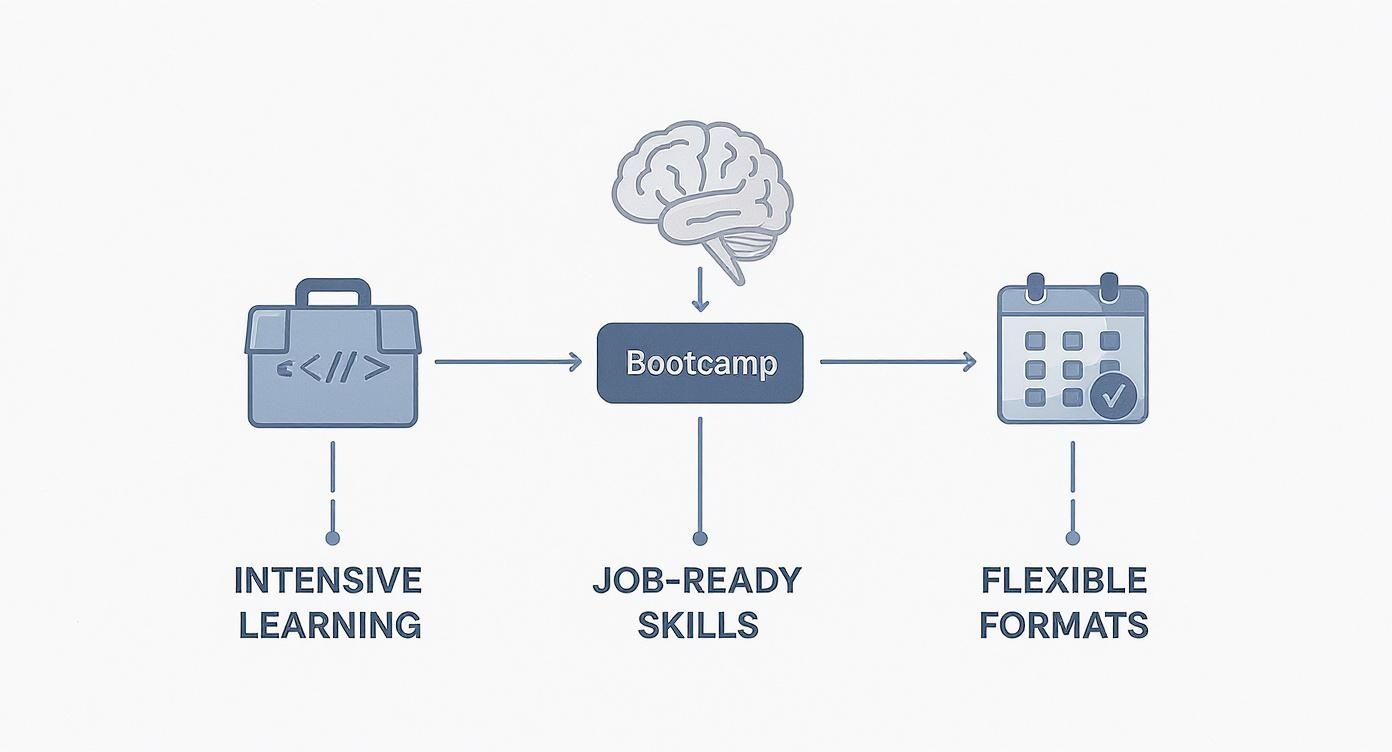
It really breaks down how the blend of intensive learning, practical skills, and flexible formats creates such a powerful launchpad for a new career.
A Look at Common UK Boot Camp Learning Paths
To give you a clearer picture, let's break down what each path involves. The table below outlines the typical specialisations, the core technologies you'll learn, and the kinds of jobs they prepare you for in the UK market.
| Specialisation | Core Technologies | Potential UK Job Roles |
|---|---|---|
| Full-Stack Web Development | JavaScript (React, Node.js), HTML, CSS, SQL/NoSQL Databases | Junior Web Developer, Full-Stack Engineer, Front-End Dev |
| Data Science & Analytics | Python (Pandas, NumPy), SQL, Machine Learning Libraries (Scikit-learn), Tableau | Junior Data Analyst, Data Scientist, BI Analyst |
| Mobile App Development | Flutter, Dart, Swift (iOS), Kotlin (Android) | Junior Mobile Developer, App Developer, Flutter Engineer |
| Software Engineering | Java or C#, .NET, Spring, Object-Oriented Programming (OOP) Principles | Junior Software Engineer, Back-End Developer |
| Cyber Security | Networking Protocols, Python, Bash, Kali Linux, SIEM tools | Junior Security Analyst, Pen Tester, Cyber Associate |
As you can see, each path is designed to equip you with a very specific set of tools for a very specific set of jobs. It’s all about focused, outcome-driven learning.
Unpacking the Tech Stack
Each one of those specialisations comes with its own set of essential tools, known in the industry as a 'tech stack'. This is just a fancy term for the mix of programming languages, frameworks, and software used to build a project. A good boot camp makes sure its tech stack is bang up to date with what UK companies are actually using.
For instance, a Full-Stack course will be heavily focused on JavaScript, the engine behind interactive websites, often paired with popular frameworks like Node.js for the back-end. A Data Science programme, on the other hand, will be all about Python, a language prized for its powerful data analysis tools.
When it comes to Mobile Development, the industry is shifting. The smart boot camps are now teaching more efficient, modern solutions. A technology getting huge traction right now is Flutter, Google's framework for building slick, high-performance apps for mobile, web, and desktop—all from a single codebase.
Flutter is fast becoming a game-changer. Recent benchmarks consistently place it at the top for performance, leading the pack in speed and efficiency. The ability to create beautiful, fast, cross-platform apps makes it a highly valuable skill for any UK developer to have.
Choosing a boot camp that teaches a modern tech stack like Flutter is a savvy move. It puts you right at the front of the queue, armed with skills that are not just current, but built for the future. Employers really value developers who can work with these powerful, efficient tools.
Building a Job-Winning Portfolio
This might be the most important part of any boot camp curriculum: the relentless focus on actually building things. You don't just sit and listen to lectures about coding; you get your hands dirty and use those concepts to create real-world projects.
You'll typically work on a series of projects that get more complex as you go. You might start by building a simple interactive website, then level up to a full-blown web application with a database. The course often finishes with a final team project that simulates what it’s like to work in a professional development environment.
This project-based learning is absolutely vital. It means you walk away with something tangible to show employers. When you graduate, you won't just have a certificate; you'll have a portfolio packed with projects that prove what you can do. That portfolio is your best friend in the job hunt—it's the concrete evidence that you can deliver.
Understanding the True Cost and How to Fund It
Investing in a coding bootcamp in the UK is a serious financial step, but it’s one that can genuinely pay off for your career. As you start looking around, the first thing you'll see is the tuition fee, and that’s obviously the biggest part of the puzzle.
The sticker price for most private UK bootcamps lands somewhere between £5,000 and £15,000. That’s a big range, and it reflects everything from the length of the course and the tech you’ll learn to the level of career support and the bootcamp’s reputation. It’s a hefty sum, no doubt, but it’s helpful to think of it as an investment in a future career with real growth and earning potential.
Looking Beyond the Tuition Fee
The real cost of a bootcamp goes beyond that initial course fee. To get a proper handle on your finances, you need to think about a few other essentials, especially if you’re diving into a full-time, immersive course.
A sensible budget should also include:
- Living Expenses: If you’re quitting your job to study full-time, you’ve got to cover rent, bills, and food for the three or four months you’ll be learning.
- Equipment: Most people have a laptop that’ll do the job, but you might need an upgrade to run demanding developer software. It’s always worth checking the bootcamp’s specific hardware requirements before you start.
- Lost Income: This one’s the opportunity cost. You’re giving up your salary for a few months, so having enough savings to tide you over is absolutely key.
Getting your head around these extra costs from the beginning means you can throw yourself into the course without money worries hanging over you.
Mapping Out Your Funding Options
The good news? You don’t necessarily have to find all the cash yourself. In the UK, a growing number of funding options have popped up to make a tech education accessible to more people, whatever their financial situation.
The whole point of these funding options is to knock down financial barriers and open up the tech industry. From straightforward loans to clever payment plans, there are more ways than ever to finance your career change.
Let’s walk through the most common ways people in the UK are paying for their training.
Student Loans and Financing Partners
Lots of bootcamps work directly with finance companies that offer specialised student loans. These lenders get the bootcamp model and offer payment plans designed for it – often, you won’t have to start paying anything back until after you’ve graduated and found a job. It’s a popular and pretty straightforward way to handle the upfront cost.
Scholarships and Diversity Grants
The tech industry is making a real effort to become more inclusive, and bootcamps are often leading the charge. Many offer scholarships and grants specifically to help people from underrepresented groups get a foot in the door.
You’ll often find funding like:
- Women in Tech Scholarships: Designed to get more women into developer roles.
- Diversity Grants: For people from minority ethnic backgrounds.
- Career Changer Bursaries: To help people moving from lower-income jobs or sectors.
These can make a massive difference to the overall cost, so always have a good look at the admissions page for any bootcamp you’re considering.
Income Share Agreements (ISAs)
An Income Share Agreement, or ISA, is a really interesting way to fund your studies. With an ISA, you pay little to nothing upfront. Instead, you agree to pay a set percentage of your salary back for a fixed amount of time, but only after you land a job paying over a certain amount. If you don't find a job or your salary doesn’t hit that threshold, you don’t pay. It’s a model that ties the bootcamp’s success directly to yours, which makes it a very appealing option for many.
Employer Sponsorships
Finally, don’t write off asking your current employer to sponsor you. If you can build a solid case for how your new coding skills will directly benefit the company, they might just agree to cover some or all of the cost. It’s a true win-win: you get to learn valuable new skills, and they get to keep a talented employee who’s now even more capable.
Of course. Here is the rewritten section, crafted to sound human-written and natural, following the provided style guide and requirements.
How Government Skills Bootcamps Are Changing the Game
Beyond the private courses and clever funding models, there's another powerful way into the UK tech scene that often flies under the radar: government-backed Skills Bootcamps. These are free, intensive training programmes built from the ground up to give adults the exact digital skills the job market is crying out for. Think of it as a life-changing opportunity to pivot into a new career, but without the hefty price tag you’d expect from a traditional coding boot camp in the UK.
This whole initiative is a direct response to closing the UK's digital skills gap. For anyone dreaming of becoming a developer, it’s a golden ticket. The programmes typically run for 12 to 16 weeks and are offered in flexible formats. Best of all, they're designed hand-in-hand with employers, so you know the curriculum is what companies actually need right now.
Who Is Eligible and What Can You Learn
So, who can get in on this? The main criteria are being an adult aged 19 or over and living in England. The doors are open to a massive range of people—whether you're unemployed, self-employed, or even looking to upskill at your current job. And here’s the real kicker: every single person who finishes the programme is guaranteed a job interview with a local employer.
The courses on offer are a roll-call of the most in-demand tech skills:
- Software Development and Engineering
- Web Development (covering both front-end and back-end)
- Cloud Computing (think AWS and Azure)
- Cybersecurity Analysis
- Mobile App Development (often including modern frameworks like Flutter)
- Data Analytics and Science
This screenshot from the official government portal gives you a peek at how you can search for available courses.
The portal lets you filter by what you want to learn and where, making it incredibly straightforward to find a relevant course right on your doorstep.
The Financial Impact and Career Outcomes
The results speak for themselves. This isn't just a free course; it's a strategic investment in the UK workforce that delivers a clear path to a much higher salary.
The UK government’s investment in Skills Bootcamps provides a direct, cost-free route into high-paying tech careers, removing financial barriers and equipping thousands of individuals with the job-ready skills that employers are actively seeking.
A huge £550 million investment from the government is on track to train around 64,000 people by 2024-2025 in fields like software development and cybersecurity. Research shows that graduates can land jobs with average salaries hitting over £70,000—more than double the UK’s median salary. You can read more about these impressive outcomes straight from the government's official announcement.
For anyone serious about a career change, these government-backed Skills Bootcamps are an opportunity you really can't afford to miss.
Landing a Job After Your Boot Camp
This is the big question, isn't it? The one on every prospective student's mind: will a coding boot camp in the UK actually get me a job? The short answer is a resounding yes, but it’s not magic. Your success hinges on the quality of the bootcamp’s career support and, just as importantly, your own drive. A good programme doesn't just teach you to code; it teaches you how to get hired.
That leap from student to employed developer is where a bootcamp’s real value comes into play. The best ones weave career development right into the curriculum from day one. It’s not some tacked-on extra at the end; it's a core part of the experience designed to mould you into a competitive candidate for the UK tech scene.

From Portfolio to Paycheque: The Role of Career Services
Think of a bootcamp’s career services team as your personal job-hunting pit crew. Their entire goal is to get you across the finish line, armed with the tools, confidence, and connections you need to land that first role. It’s an incredibly hands-on, multi-faceted support system.
Here’s what that support usually looks like:
- Portfolio and CV Reviews: Career coaches work with you to sharpen your CV and polish your project portfolio, making sure it speaks the language of hiring managers and properly shows off your new skills.
- Mock Interviews: You’ll be put through your paces with tough practice interviews. They cover everything from technical whiteboarding challenges to tricky behavioural questions, so nothing catches you by surprise on the big day.
- Direct Employer Connections: Top bootcamps have spent years building networks of hiring partners—companies that actively want to hire their graduates. They arrange introductions, host exclusive hiring days, and often feed you roles that aren't even advertised publicly.
These services completely demystify the hiring process. They give you a massive leg up on self-taught developers who are trying to figure all this out on their own.
What the Numbers Say About Job Placement
The data really backs this up. Coding bootcamps across the UK consistently post strong job placement stats, with many graduates finding tech roles soon after they finish. According to 2025 industry reports, you'll find that most reputable bootcamps have placement rates between 70–80% within just a few months of graduation. Some of the elite providers report even better figures, with around 96% of their immersive programme graduates landing jobs in the field.
A successful job hunt after a coding bootcamp is a partnership. The bootcamp provides the training, career support, and industry connections, while you bring the dedication, persistence, and a proactive attitude to the search.
This high success rate isn't an accident. It comes from having a curriculum that’s perfectly aligned with what employers actually need and a robust, dedicated career support team pushing you forward.
The Types of Jobs Graduates Land
Once you’ve graduated from a coding boot camp UK course, you’ll be well-prepared for a whole host of entry-level and junior tech roles. The exact job titles will depend on what you specialised in, but some of the most common ones you'll see are:
- Junior Software Engineer
- Junior Web Developer
- Data Analyst
- Junior Mobile App Developer
- QA Tester
For those who dive into mobile development, particularly with modern frameworks like Flutter, the career path can be especially exciting. As a Flutter developer in the UK, we're seeing huge demand for professionals who can build sleek, high-performance apps that work across different platforms. To get a feel for the opportunities out there, take a look at our in-depth guide to the iOS developer career path, which shares a lot of common ground with a career in Flutter.
At the end of the day, landing a job is about so much more than a certificate. It's about the real-world skills you've gained, the professional portfolio you've painstakingly built, and the strategic support you get to navigate what is a competitive—but incredibly rewarding—job market.
How to Choose the Right UK Coding Boot Camp
With so many options out there, picking the right coding boot camp in the UK can feel overwhelming. The key is to break the decision down into manageable chunks, so you can confidently find a programme that really clicks with your learning style and actually sets you up for a career. It’s all about looking past the slick marketing and getting to the heart of what matters for your future.
Start by giving the curriculum a proper look. Are the technologies they teach genuinely what UK companies are hiring for right now? A bootcamp that’s still focused on outdated frameworks is a surefire way to waste your time and money. You want to see programmes built around modern tech stacks, like Python for data science or JavaScript with React for web development.
A boot camp's curriculum is its promise to you. Make sure that promise aligns with the real-world skills UK employers are hiring for today, not five years ago. This choice directly impacts your immediate employability.
Evaluating the Key Factors
Beyond the tech stack, a few other things separate a run-of-the-mill bootcamp from a truly great one. You’ve got to assess the whole experience, from how they teach to the kind of career support you’ll get once you’ve finished.
It helps to have a checklist to compare your options:
- Instructor Quality: Who’s actually teaching the course? You want instructors with proper industry experience under their belts, not just academics.
- Career Support Services: Do they have a dedicated team for career coaching, mock interviews, and portfolio reviews? Solid career services are non-negotiable.
- Alumni Network and Outcomes: Can they show you verified job placement stats? It’s also worth tracking down past students on LinkedIn to get their honest, unfiltered opinions.
- Learning Environment: Does their teaching style suit you? Try to join a virtual open day or a taster session to get a real feel for the programme's pace and culture.
The Questions You Must Ask
Before you sign on the dotted line, you need to get straight answers from the admissions team. Don't be shy about asking direct, even tough, questions. How transparent they are is often a pretty good sign of their quality and integrity.
Make sure you ask things like:
- What’s the typical student-to-instructor ratio in your classes?
- Can you walk me through your career support process, from day one to after graduation?
- How do you keep your curriculum fresh and in line with what the industry is doing?
- What specific companies have hired your graduates in the last six months?
Getting this information will give you the confidence to make the right call. For a deeper look at your educational options, you can also explore our article on how to find top app development courses today. Choosing the right coding boot camp UK is the first massive step in your new tech career—so make it a good one.
Answering Your Questions About UK Coding Bootcamps
Jumping into the world of tech education understandably brings up a lot of questions. To give you some clarity, we’ve put together a few straightforward answers to the things people most often ask when looking at coding bootcamps in the UK. Think of this as your quick-start guide to clearing up any doubts and making a confident next move.
A big worry for many people is that they need a traditional university degree just to get a foot in the door. This is probably one of the biggest myths holding people back from a career in tech.
Do I Need a Degree to Get into a Bootcamp?
Absolutely not. A university degree is almost never a requirement for getting into a UK coding bootcamp. Most providers, and especially the government-backed Skills Bootcamps, care a lot more about your drive, your natural ability to solve problems, and your motivation than your academic history.
What they’re really looking for is your potential to thrive in a fast-paced, intensive learning environment and your commitment to starting a new career. This focus on practical aptitude over formal qualifications opens up the tech industry to people from all sorts of backgrounds.
How Do UK Employers Actually View Bootcamp Graduates?
More and more, UK employers have come to really value the practical, hands-on skills that bootcamp grads bring to the table. In an industry that moves at lightning speed, companies love candidates who can show up with a solid portfolio of real-world projects and start contributing from day one.
This makes bootcamp graduates incredibly competitive candidates for junior developer roles.
The modern UK tech employer is far more interested in what you can build than where you studied. A bootcamp graduate with a strong project portfolio and demonstrable skills is a genuinely valuable hire.
What Kind of Salary Can I Expect After Graduating?
Your starting salary will naturally depend on a few things, like where you’re based and the specific tech you’ve specialised in. That said, a junior developer graduating from a coding bootcamp UK programme can realistically expect to earn a starting salary somewhere in the £30,000 to £45,000 range.
If you’ve completed a specialised or government-backed programme in a high-demand field like mobile app development, you could even command a higher starting salary. It all comes down to the immediate value you can offer a business.
Ready to turn your app idea into a reality with a team that gets the UK market? At App Developer UK, we specialise in building high-performance, beautiful applications using Flutter. Contact us today to discuss your project and see how our expert developers can help you succeed.