Mobile Apps Development London Your Strategic Guide
Mobile Apps Development London Your Strategic Guide
Dipping your toes into mobile apps development in London is more than just a project; it’s an entry into one of the most vibrant tech ecosystems on the planet. But before a single line of code gets written, your app's fate is often decided by the groundwork you lay. A solid plan, a real understanding of the market, and a crystal-clear vision are non-negotiable.
Launching Your App in the London Tech Scene
London's tech scene isn't just growing – it's a global force. The city is a unique melting pot of top-tier talent, venture capital, and a ridiculously diverse audience hungry for the next big thing. For any business thinking about building an app here, getting a feel for this environment is the first, most crucial step. It’s what separates a functional app from one that actually gets traction and makes an impact.
Getting from a spark of an idea to a chart-topping app isn't black magic. It's a structured journey, a series of deliberate steps designed to strip out the risk and crank up the potential for success.
Defining Your App's Core Purpose
First things first: what problem are you actually solving? Before you get lost in fancy features and slick designs, you need to nail down your app's core purpose.
A vague goal like "making a new social media app" is a fast track to nowhere. You need to get specific. Something like "a private network for London's allotment gardeners to trade surplus veg" – now that has a clear purpose, a defined audience, and a measurable goal.
Think of this purpose statement as your North Star. Every decision you make, from which features to build first to how you word your marketing, should point back to it. It keeps the whole project lean, focused, and genuinely valuable to the user.
Identifying Your Target Audience
Just as important as the 'what' is the 'who'. Who, exactly, is this app for? You need to know them inside out. The best way to do this is by creating a user persona – a detailed, fictional character who represents your ideal customer.
Get into the weeds and think about their:
- Demographics: Age, location (are they in Shoreditch or Richmond?), profession.
- Behaviours: What are they doing right now to solve the problem your app addresses? Are they using a clunky spreadsheet or a messy WhatsApp group?
- Pain Points: What are their biggest frustrations with the current solutions?
- Motivations: What's the one thing that would make them hit 'download' and keep coming back?
This isn't just a box-ticking exercise. A deep understanding of your audience dictates everything. An app built for busy City bankers will look, feel, and function completely differently from one designed for art students in Camden.
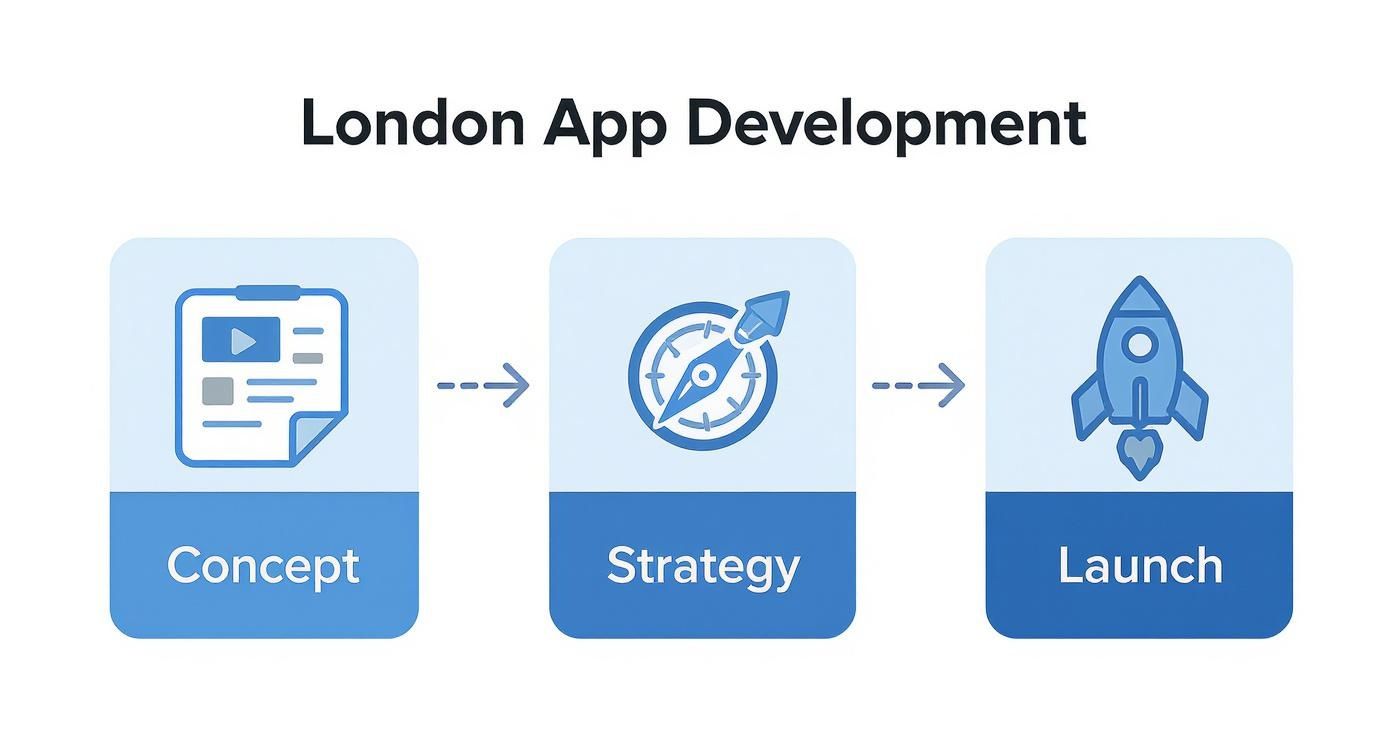
As the diagram shows, a solid concept and strategy are the bedrock of the entire project. This foundational work is what separates the apps that thrive from the ones that vanish without a trace.
The market potential is staggering, but so is the competition. The mobile app development market in London is a huge slice of the UK's digital economy pie. In 2023, the UK mobile app market hit USD 12.7 billion, and it's projected to soar to USD 32.9 billion by 2030. You can discover more insights about UK mobile app market trends to really grasp the scale of the opportunity you're tapping into.
Why Flutter Is Your Competitive Edge

Choosing the right technology for your app is a huge decision. It’s one of those choices that will directly shape your budget, your launch date, and the quality of the final product. For businesses diving into mobile apps development in London, the pressure to be fast, smart, and better than the competition is immense. This is exactly where Flutter comes in.
Flutter isn't just another framework on the pile. Developed by Google, it's a strategic move for any modern business. The core idea is brilliantly simple: write the code once, and it runs beautifully on both iOS and Android. That simple fact immediately slashes your development time and costs because you're not paying a team to build and manage two completely separate apps.
For a London startup, that kind of efficiency is a game-changer. It means getting your Minimum Viable Product (MVP) out the door faster, finding out if you have a market hit on your hands sooner, and tweaking things based on real feedback without burning through all your cash. For a larger, more established company, it’s about creating a unified mobile experience that feels consistently high-quality, no matter what device a customer is using.
Unmatched Performance and Stunning Visuals
In the app world, performance is everything. Users have zero patience for laggy, unresponsive interfaces. Even a tiny delay can be enough to make them hit 'uninstall'. For years, the knock against cross-platform tools was that they just couldn't match the slickness of native apps. Flutter completely rewrote that story.
Here's the technical bit, made simple: many other frameworks use a sort of translator to talk to the phone's native features. Flutter skips that entirely and compiles its code directly into the phone's native language (ARM code). There’s no middleman, which means no performance bottleneck. The result? Apps that are incredibly fast and smooth.
Flutter’s architecture is built to hit a buttery-smooth 60 frames per second (fps). That’s the gold standard for animations and screen transitions, making your app feel polished and premium. This isn't just a nice-to-have; it directly impacts how satisfied your users are.
This raw power is matched with a beautifully expressive and flexible set of UI tools. Flutter uses a system of 'widgets', which are like building blocks for your interface. It gives developers total creative freedom to build stunning, bespoke designs that look and feel perfect on any screen. You're not stuck with the default buttons and menus of iOS or Android.
Accelerated Development with Hot Reload
If you ask any Flutter developer what their favourite feature is, they'll almost certainly say Hot Reload. This is where the magic really happens. It lets a developer see the changes they make to the code appear on the app in real-time—or near enough, usually in under a second—without having to restart everything.
Imagine your team is polishing the user interface. With Hot Reload, they can adjust a layout, change a colour scheme, or move a button, and see the result instantly. This creates a rapid feedback loop that absolutely transforms the development process.
- Faster Fixes: Bugs get squashed quicker, and small UI tweaks are handled on the fly.
- Better Collaboration: Designers can sit with developers and perfect the look and feel together, in real-time.
- Serious Productivity Boost: Hours are saved every week by not waiting for the app to re-compile after every minor change.
This speed gives you a massive competitive advantage. In a market as fierce as London's, getting your app launched weeks or even months ahead of a rival can make all the difference.
Future-Proofing Your Investment
Picking Flutter isn't just a decision for today; it's an investment in a platform built for tomorrow. With Google's backing, it has a massive and growing community of developers who are constantly improving it and adding to its capabilities. You can get a deeper sense of what's possible by exploring our detailed guide to Flutter development services and how they can give your business an edge.
This strong support network means the framework is always being updated with the latest features and security patches. Better yet, Flutter's ambitions go beyond mobile. It already supports building for web browsers, desktop computers, and even embedded devices, all from that same single codebase. For any business with a long-term vision, that makes Flutter the smart, strategic choice for any serious mobile app project in London.
Finding the Right London App Development Agency

Okay, you've settled on Flutter as your tech stack. Smart move. Now comes the really critical part: finding the right partner for your mobile apps development in London. This isn't just about hiring a team of coders. You're looking for a strategic ally who will live and breathe your project, someone who brings genuine market insight to the table, not just technical skill.
London’s tech scene is buzzing, which is both a blessing and a curse. It's teeming with talent, but that also means you have to cut through a lot of noise. Start local. Tap into tech meetups and browse professional networks like LinkedIn to get a feel for agencies that have a solid reputation right here in the city.
Once you’ve got a shortlist, the real detective work begins. It’s time to look past the slick sales pitches and get to the heart of what each agency can actually deliver.
Dissecting an Agency's Portfolio
A portfolio is more than a gallery of nice-looking screenshots; it’s an agency's CV. It’s your evidence of whether they can actually walk the walk. When you’re looking at their past work, you need to dig deeper.
Ask the tough questions that reveal their true technical chops:
- Real Flutter Expertise: Have they built genuinely complex, feature-heavy apps with Flutter? Don't be fooled by simple catalogue-style apps. Look for examples with sophisticated functionality.
- Proven Market Performance: How did their apps actually do once they hit the App Store? Ask them about user numbers, engagement stats, or even revenue if they can share it. An app that looks great but nobody uses is a failure, plain and simple.
- Problem-Solving Chops: Ask them about the biggest technical nightmare they faced on a project and how they fixed it. Their answer will tell you a lot about their honesty and their ability to think on their feet.
This kind of deep dive helps you separate the agencies that just build apps from the ones that build successful digital businesses.
Key Questions for Those First Calls
Your initial chats with an agency are your first diagnostic tool. It’s your best chance to get a feel for their expertise, how they communicate, and their general vibe. Come prepared with questions that go beyond the obvious "how much will it cost?"
A prospective partner’s process says everything about the final product you'll receive. If they can’t articulate a clear, transparent, and collaborative project management style, consider it a major red flag.
Focus on how they work. What’s their project management methodology? Most good agencies use an Agile approach because it’s flexible and allows for constant feedback. Find out who your day-to-day contact will be and how often you can expect to hear from them. Transparency from day one is a huge green light. For a more exhaustive list of questions, our guide on hiring UK mobile app development companies is a great resource.
The London market is all about efficiency and speed, which is why cross-platform is so popular here. Between 2023 and 2024, roughly 30% of UK businesses opted for frameworks like Flutter. Why? Because a single codebase slashes development time and cost, giving startups a fighting chance.
Evaluating Beyond the Code: A Checklist
To keep your evaluation structured, a simple scoring system can be incredibly helpful. It forces you to compare agencies on the same terms, moving beyond a gut feeling to a more data-driven decision.
Here’s a simple checklist you can adapt. Score each agency from 1 (poor) to 5 (excellent) on the criteria that matter most to you.
London Agency Evaluation Checklist
| Evaluation Criteria | Agency A Score (1-5) | Agency B Score (1-5) | Notes and Observations |
|---|---|---|---|
| Flutter Portfolio & Expertise | Do they have complex, relevant examples? | ||
| Project Management Process | Is their process transparent and agile? | ||
| Communication & Culture Fit | Do they feel like collaborative partners? | ||
| Client Testimonials & Reviews | What are their past clients really saying? | ||
| Post-Launch Support & Maint. | Is there a clear plan for after the app goes live? | ||
| Understanding of Your Goals | Did they 'get' your business vision? | ||
| Cost & Value Proposition | How does their quote align with the value offered? | ||
| Total Score | Sum of the scores above. |
This isn't about finding the highest score, but about using the scores and your notes to facilitate a final, informed decision. The 'Notes' column is often the most valuable part.
Thinking About Life After Launch
Finally, remember you’re choosing a long-term partner, not just a contractor for a one-off job. The success of your app depends on what happens after it launches.
Talk to them about ongoing maintenance, security patches, and how they handle future updates. A top-tier agency will have a clear support plan ready to go, ensuring your app stays secure, relevant, and running smoothly long after the launch party. It's this forward-thinking that separates the good agencies from the great ones.
Decoding App Development Costs and Timelines
When it comes to mobile apps development in London, the two questions I hear most often are, "How much is this going to cost?" and "How long will it take?" Let's be honest, vague answers and ballpark figures just don't cut it when you're trying to build a solid business case.
The truth is, there’s no single price tag. The cost is a spectrum, and your ambition is what determines where your project falls on it. Every feature you decide to add, every third-party service you need to integrate, and every beautifully designed screen directly impacts the final budget. A simple app with one core function will naturally cost far less than a complex platform needing user accounts, payment gateways, and real-time data syncing. Getting your head around this is the first step to setting a budget that’s both realistic and achievable.
Breaking Down the Costs of App Development
In a competitive market like London, app development costs can vary wildly, but they generally fall into predictable brackets based on complexity. The most accessible starting point is often a Minimum Viable Product (MVP), which is designed to test your core concept with just the essential features. It’s a lean approach that lets you get real user feedback quickly, without a massive upfront investment.
As you start layering on more sophisticated features, the costs will naturally climb. Here’s a rough guide to what you might expect:
- Simple Apps (e.g., MVP): These are all about a single, core function. They usually have a basic user interface and minimal backend needs. Think of a straightforward mortgage calculator or a simple utility tool.
- Mid-Complexity Apps: This is where things get more interesting. These apps often include user profiles, social media logins, a custom UI/UX design, and connections to external data sources through APIs. Many of the successful business and consumer apps you use every day started out in this range.
- Complex Enterprise Apps: We're talking large-scale platforms here. These involve advanced features like secure payment processing, sophisticated backend databases, real-time analytics, and detailed plans for ongoing maintenance.
A huge financial lever you can pull is choosing a modern framework like Flutter. Because you’re building from a single codebase for both iOS and Android, you can slash development hours by up to 40%. That translates directly into significant cost savings, all without sacrificing performance or a polished look and feel.
For a much more detailed financial breakdown, have a look at our comprehensive UK app pricing guide, which offers deeper insights into the specific costs you can anticipate.
Mapping a Realistic Project Timeline
Just like the cost, the timeline for developing your app isn't a one-size-fits-all number. A well-run project follows a clear, phased approach, with each stage building on the last. One of the most common mistakes I see is trying to rush this process—it almost always leads to a poor-quality product and costly fixes down the road.
A typical project journey is broken down into several key phases. While a simple MVP might be live in 2-4 months, a more complex application can easily stretch to 6-9 months, or sometimes even longer.
The Key Phases of Development
- Discovery and Strategy (2-4 Weeks): This is the foundation of your entire project. Your development partner should work closely with you to refine your idea, define the project scope, analyse what your competitors are doing, and create a detailed roadmap and feature list. Don't skip this.
- UI/UX Design (3-6 Weeks): Now for the fun part. The designers will create wireframes and mockups to map out the user's journey and build an interface that’s both intuitive and visually engaging. This phase is all about making sure the app is not just functional but genuinely enjoyable to use.
- Development Sprints (8-16+ Weeks): This is where the magic happens and is usually the longest phase. Using an Agile approach, developers build the app in "sprints"—short, focused periods of work that result in testable pieces of functionality being delivered regularly.
- Testing and Quality Assurance (2-4 Weeks): Before you can even think about launching, the app needs to go through rigorous testing. This is where we hunt down and squash bugs, check performance on different devices, and ensure everything runs smoothly for the end-user.
- Deployment and Launch (1 Week): The final hurdle! This involves submitting the app to the Apple App Store and Google Play Store and successfully navigating their review processes.
Understanding these phases from the outset helps you align your business goals, plan your marketing strategy, and manage everyone's expectations effectively.
Building an App That Lasts Beyond Launch

Launching your app is just the starting pistol, not the finish line. In a market as fast-moving as London's, the apps that truly succeed are the ones engineered for tomorrow, not just for today's trends. Forward-thinking agencies don’t just build apps; they build resilient digital products designed to scale, adapt, and stay relevant for years.
This means looking beyond the immediate feature list. It’s about building a solid foundation that can support richer, smarter, and more connected user experiences as technology inevitably moves forward.
Weaving Intelligence into Your App
Artificial Intelligence (AI) and Machine Learning (ML) aren't just buzzwords anymore; they are powerful tools being used right now to create genuinely smarter mobile apps. A skilled mobile apps development London agency can use these technologies to turn a standard app into something deeply personal and predictive.
Think about what this means in the real world:
- Personalised Content: An e-commerce app can use ML to analyse a user’s browsing habits and recommend products they’ll actually want, boosting sales and keeping them coming back.
- Predictive Functionality: A fintech app could use AI to spot a user's spending patterns and offer timely budgeting advice, adding real value beyond just showing transactions.
- Smarter Support: AI-powered chatbots can handle common questions 24/7, freeing up your support team to deal with more complex problems and keeping users happy.
These advanced technologies are quickly becoming what users expect. Features like interactive chatbots and predictive analytics are now standard in sectors like finance and e-commerce. You can read the full research about the UK mobile application market to get a clearer picture of where things are heading.
Preparing for a More Connected World
Beyond AI, other big technological shifts are opening up new doors for mobile apps. The rollout of 5G and the growth of the Internet of Things (IoT) are fundamentally changing what's possible, paving the way for real-time, data-rich experiences that used to be the stuff of science fiction.
For instance, a logistics app could use IoT sensors on packages to give customers pinpoint-accurate, live tracking. A fitness app could connect seamlessly with a whole range of smart gym equipment, syncing workout data instantly. The low latency and high speed of 5G make these kinds of instantaneous features not just possible, but smooth and reliable.
Building with a performance-focused framework is the key to unlocking these technologies. Flutter, for example, is built from the ground up to handle complex animations and high-frequency data updates with ease. This ensures your app stays fast and responsive, even as you add more advanced features.
By planning for these innovations from the start, you're not just adding flashy features. You are building an app that offers deeper value, keeps users engaged, and creates a strong defence against your competitors. It's a forward-thinking approach that ensures your investment continues to deliver, long after launch day.
Getting the Paperwork Sorted for a Winning Partnership
You’ve done the hard yards. You've sat through the pitches, reviewed the portfolios, and finally picked the agency you want to build your app. It’s a huge step, but don't pop the champagne just yet. The final bits of admin are what turn a promising chat into a rock-solid, long-term partnership. It’s time to get everything in writing and set the stage for a smooth ride from the first line of code to launch day and beyond.
Think of the legal agreement as the blueprint for your entire project, not just a formality. It’s there to protect both you and the agency, making sure there are no expensive surprises down the line. A transparent, detailed contract is the sign of a pro agency that’s been around the block.
What Your Development Contract Must Cover
Your development contract needs to be crystal clear, leaving absolutely no room for interpretation. You’ll want to pay special attention to a few key clauses that protect your investment and, most importantly, your intellectual property.
Here are the absolute non-negotiables:
- Intellectual Property (IP) Ownership: This is the big one. The contract must state, without a shadow of a doubt, that you own 100% of the code and everything that comes with it once the final bill is paid. This gives you total control over your app's future.
- Clear Payment Milestones: Payments should always be linked to tangible progress you can see and approve. For instance, a payment might be scheduled after the UI/UX designs get your sign-off, or when a major feature is ready for a demo. This keeps momentum high and ensures you’re only paying for work that’s actually been done.
- Defined Deliverables and Scope: The document should spell out exactly what you're getting, from the source code and design files to the app store listings themselves. Just as important is listing what isn't included, which helps prevent scope creep later on.
A well-drafted contract isn't about a lack of trust; it's about creating total clarity. It’s the foundation that aligns everyone’s expectations, freeing up both your team and theirs to focus on what really matters: building an amazing app.
Kicking Things Off the Right Way
Once the contract is signed, the focus shifts to getting the project started properly. Any good agency will have a slick onboarding process designed to get everyone on the same page from day one. This usually starts with a kickoff meeting to introduce the key players on both sides, set up communication channels (like a shared Slack channel or a Trello board), and agree on a regular check-in schedule.
This first phase really sets the tone for the entire project. It's the perfect chance to make sure the agency’s team truly gets your business goals and the specific problem you’re solving for your users.
Planning for Life After Launch
Getting your app live is just the beginning of the journey, not the end. The long-term success of your app hinges on having a solid plan for ongoing maintenance and future updates. This isn't something to tack on at the end; it's a conversation you should have before a single line of code is written.
A proactive support and maintenance plan usually covers:
- Routine Maintenance: Squashing minor bugs, keeping an eye on performance, and generally making sure the app runs like a dream.
- Essential Security Updates: Proactively patching any vulnerabilities to keep your app and your users’ data safe from new threats.
- Future Feature Rollouts: A clear roadmap for adding new features and functionality to keep your app relevant and keep your audience coming back.
Nailing down these details from the outset ensures your partnership is built on clarity, trust, and a shared vision for making your app a long-term success.
Your Questions, Answered
Navigating the world of mobile app development can feel like a minefield of questions. Let's tackle some of the most common ones we hear from businesses planning to build a mobile app in London.
How Long Does It Take To Build An App?
This is the million-dollar question, isn't it? The honest answer is: it depends entirely on what you're building.
A straightforward Minimum Viable Product (MVP) – something with core features to test the market – can often be designed, built, and launched in as little as 2-4 months. But if you're aiming for a more complex, feature-rich app with custom UI, backend integrations, and user profiles, you're realistically looking at a 6-9 month timeline, or even longer to get it absolutely right.
Why Is Flutter A Better Choice Than Other Frameworks?
We're big believers in Flutter, and for good reason. It’s all about performance and efficiency. Unlike a lot of other cross-platform options, Flutter doesn't mess around—it compiles directly to native ARM code. This cuts out performance bottlenecks, giving you a slick, responsive user experience that feels just as good as a truly native app.
The latest benchmarks consistently show Flutter leading the pack in speed and rendering. For any business that refuses to compromise on quality, it’s a no-brainer. Plus, using a single codebase means development is faster and you see significant cost savings. It's a win-win.
Choosing Flutter isn't just a technical decision; it's a strategic business move. It allows London startups and established companies alike to get a high-performance, beautiful app to market faster and more cost-effectively than ever before.
What Are The Ongoing Costs After Launch?
Getting your app live is a huge milestone, but it's not the end of the road. To keep your app successful long-term, you need to budget for what comes next. These ongoing costs generally fall into three key areas:
- Server Hosting: This covers the backend infrastructure that keeps your app running and your data flowing.
- Maintenance and Bug Fixes: Think of this as a retainer for ongoing tech support. It ensures any glitches are squashed quickly and the app stays smooth for your users.
- Updates: You'll need to budget for future features and, just as importantly, compatibility updates to keep up with new iOS and Android versions.
Factoring these costs into your budget from day one is one of the smartest things you can do. It's crucial for maintaining a healthy, successful, and professional application.
Ready to turn your vision into a high-performance app that captivates your audience? Partner with App Developer UK and let our Flutter experts build a solution that drives real business results. Get in touch with us today!