A Guide to iOS Developer Hire in the UK
A Guide to iOS Developer Hire in the UK
Before you even think about posting a job advert for an iOS developer, you need a crystal-clear plan. It all comes down to defining your project's core needs to sidestep costly mistakes later on. The big decision, right out of the gate, is whether you need the absolute peak performance of a native iOS app or the speed and efficiency of a cross-platform solution.
Getting this right from the start means you’ll attract candidates who can deliver real business impact from day one.
Defining Your Needs Before You Hire an iOS Developer
Jumping into the hiring process without a solid project definition is like setting sail without a map. You might end up somewhere, but it’s probably not where you wanted to go. The first, most critical decision is about the technology stack, as this directly dictates the kind of developer you need.
This choice almost always boils down to a fundamental trade-off: native performance versus cross-platform efficiency.
Native iOS vs Cross-Platform Efficiency
A native iOS developer, fluent in Swift and UIKit, is your best bet when your number one goal is delivering the highest possible performance. This is the path for you if you need to tap into the latest iOS features the moment they’re released and create a user experience that feels perfectly at home in the Apple ecosystem. Think of apps with heavy graphical processing, complex animations, or deep hardware integrations like the camera or advanced sensors.
But sometimes, your business goals are better served by a different approach.
If your project involves launching on both iOS and Android simultaneously, managing a tight budget, or just getting to market fast, a cross-platform framework is often the smarter choice. This is where a framework like Flutter really shines. As a Flutter app development agency in the UK, we've seen first-hand how it streamlines the entire process.
With Flutter, you can build beautiful, high-performance apps for multiple platforms from a single codebase. It’s not a compromise on quality, either. Recent benchmarks consistently place Flutter at the top for performance among cross-platform solutions, often rivalling native app speed. This efficiency doesn't just save time; it slashes development costs and simplifies long-term maintenance.
This diagram breaks down that core choice: are you aiming for max performance or maximum efficiency?
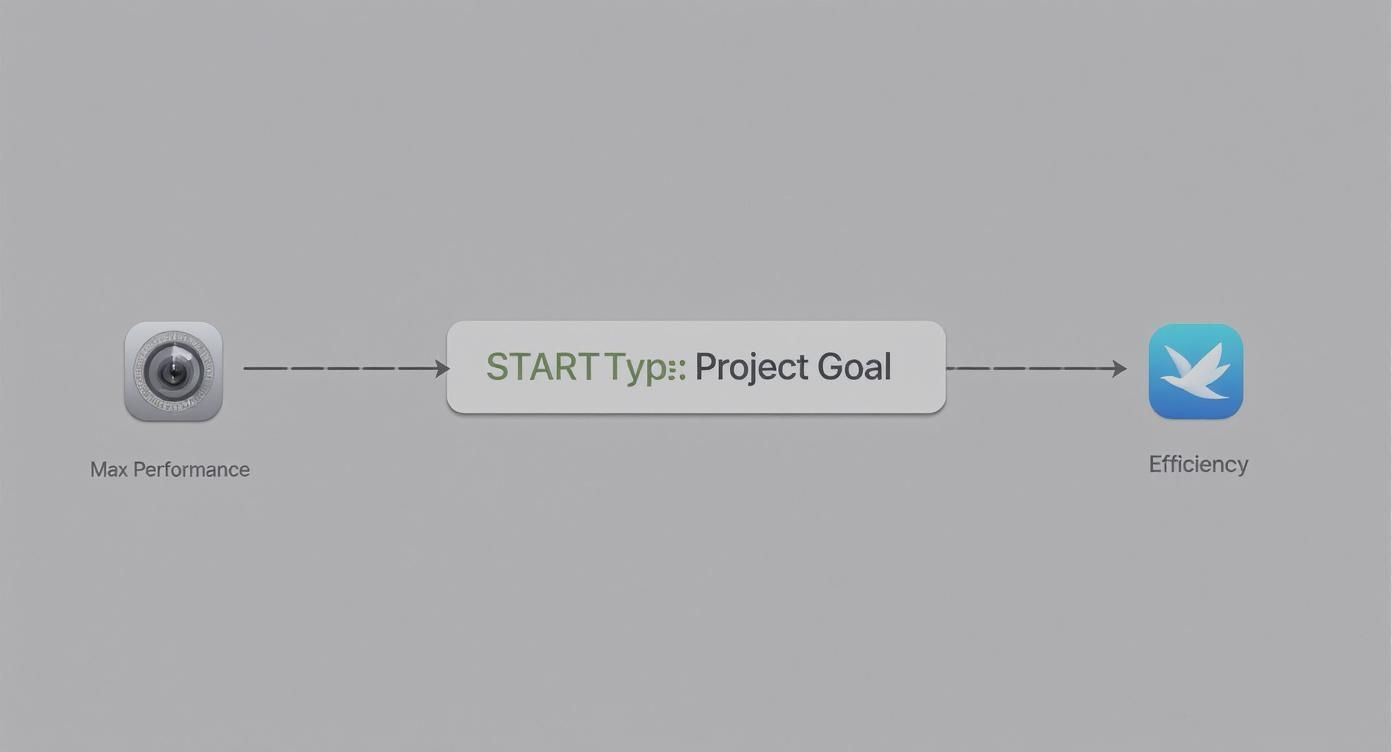
The key takeaway is simple: your project's primary goal—whether it's unmatched performance or efficient multi-platform delivery—should be the compass that guides your hiring strategy.
Here’s a quick comparison to help you decide.
Hiring Model Comparison Native iOS vs Flutter Developer
| Consideration | Hire an iOS Developer When... | Hire a Flutter Developer When... |
|---|---|---|
| Performance Needs | Your app requires maximum performance, complex animations, or intensive processing. You can't afford any compromise on speed. | You need great performance that is often on par with native speeds. The app is not graphically intensive or reliant on heavy background tasks. |
| Platform Strategy | You are focusing exclusively on the iOS market for the foreseeable future. A premium, platform-specific experience is your top priority. | You need to launch on both iOS and Android simultaneously or in quick succession. A consistent look and feel across platforms is key. |
| Budget & Timeline | You have a more generous budget and a longer timeline, allowing for separate, dedicated development for each platform. | You're working with a tighter budget and need to get to market quickly. A single codebase significantly reduces time and cost. |
| Feature Requirements | Your app needs immediate access to the very latest iOS-specific features (e.g., new ARKit or Core ML updates) as soon as they are released. | You can wait a short while for the cross-platform community to add support for brand-new, platform-specific features. |
| Team Skills | Your existing team has strong Swift/Objective-C skills, or you plan to build a dedicated Apple-focused development team. | Your team is familiar with Dart, or you want a single team that can manage both iOS and Android versions of your app. |
Ultimately, there's no single "right" answer—it's about what’s right for your project. Choosing the correct path now will save you a world of headaches later.
Building Your Project Specification
Once you’ve chosen your path, it’s time to get into the details. This isn’t just a technical exercise; it’s about translating your business objectives into a functional specification that a developer can actually build from. Start by outlining the core features and the user journey.
Ask yourself these questions:
- Key Milestones: Can you break the project into major phases? What does the Minimum Viable Product (MVP) look like? What features will be in phase two?
- User Experience (UX): What’s the look and feel you're aiming for? Is it a simple, utility-focused app or a visually rich, engaging experience?
- Third-Party Integrations: Make a list of any essential APIs or services the app needs to connect with, like payment gateways (Stripe), social media platforms, or analytics tools (Firebase).
The demand for mobile talent is huge, driven by Apple's vast ecosystem. The mobile app developers' revenue sector is projected to hit an incredible £28.3 billion in 2025, a figure that highlights the continuous need for skilled developers.
This planning phase is absolutely crucial, whether you're hiring an in-house employee, a freelancer, or a remote team. For a great deep dive into finding top talent, check out this proven playbook for hiring remote developers. By understanding exactly what you need, you can create a detailed role specification that attracts the right experts. You can also get more insights from our guide on the iOS developer career path.
How to Write a Job Description That Attracts Top Talent
In a market swamped with opportunities, a generic job description is the fastest way to get your role ignored. If you're serious about hiring an iOS developer who can make a real difference, you need an advert that does more than just list technical skills. It has to sell the opportunity.
Your goal is to make a top-tier engineer stop scrolling and actually consider what your project offers.
A standout job post goes way beyond a simple checklist of Swift, SwiftUI, and UIKit. It tells a story—about the role, the team, and the company itself. It needs to articulate the unique problems the developer will get to solve, give a real sense of your company culture, and show a genuine path for growth. Think of it as your first pitch to a potential team member. Make it count.
Go Beyond the Technical Checklist
Look, every job description for an iOS developer is going to mention Swift and experience with Apple's frameworks. That’s just the baseline. To stand out, you need to detail the problems they’ll be solving with those skills. Frame the work around its impact, not just a list of mundane tasks.
Instead of saying, "Write and maintain code for our iOS application," try something more compelling. How about: "Own the development of our new in-app checkout experience, directly impacting conversion rates and user satisfaction." See the difference? The second version speaks to ambition and ownership, which are massive motivators for the best talent.
You want to attract developers who are genuinely passionate about building great products, not just clocking in and out. As one veteran developer put it, the magic is in having an idea, opening Xcode, and seeing it exist in reality a few hours later. Your job description should capture that excitement.
Structure of a Compelling Job Advert
A well-structured advert is easy to scan and helps candidates quickly figure out if the role is a good fit. I always think of it as having three core parts: the hook, the details, and the sell.
The Hook: The Role Summary
This is your opening paragraph. It has to be concise and powerful.
- Good Example: "Join our fintech startup as a Senior iOS Developer and lead the creation of a secure, intuitive mobile banking app set to challenge the big banks. You'll be working on features that help thousands of UK users manage their finances better every day."
- Poor Example: "We are looking for an iOS Developer with 5+ years of experience to join our growing team. The ideal candidate will be proficient in Swift."
The first example paints a picture and connects the role to a meaningful outcome. The second is just… beige. It will attract uninspired applications, plain and simple.
The Details: Responsibilities and Requirements
Here, clarity is everything. Use bullet points to lay out what the developer will actually do and what they’ll need to succeed.
- Be specific about tech: If you use Combine for reactive programming or rely heavily on Core Animation, say so. This helps the right people self-select and shows you know what you’re talking about.
- Split "must-haves" from "nice-to-haves": This widens your talent pool. Maybe experience with CI/CD tools like Fastlane is a bonus, not a deal-breaker.
- Focus on problem-solving: "Collaborate with our product team to design and implement new user-facing features" is so much stronger than just "Develop new features."
Your job description isn't just a request for skills; it's a window into your company's culture and engineering standards. A detailed, thoughtful description signals a professional and organised team that a great developer would want to join.
The Sell: Why Join Us?
This is where you close the deal. What makes your company a great place to work? And please, don't just list generic perks like free coffee.
- Talk about the team: "You'll be joining a tight-knit team of four mobile engineers who value clean code and collaborative problem-solving."
- Highlight real growth opportunities: "We offer a dedicated training budget and have clear pathways to a Lead Developer role."
- Showcase your mission: Explain what your company is trying to achieve and how this role directly contributes to that bigger picture.
By putting some real thought into your job description, you dramatically increase your chances of attracting the high-calibre iOS developer your project truly deserves.
Sourcing and Vetting Your iOS Developer Candidates
You’ve got a compelling job description. Now comes the real challenge: getting it in front of the right people. Knowing where to look is half the battle when you want to hire an iOS developer. The goal isn’t just to get a flood of applications; it’s to build a high-quality pipeline so you can focus your energy on the most promising individuals from the very start.
This means exploring a smart mix of channels, from the big-name job boards to those niche developer communities where top talent often hangs out.
Where to Find Skilled iOS Developers
Casting a wide net is a good start, but it needs to be strategic. The UK market for iOS developers is buzzing, and knowing the best spots to post your role can seriously speed up your search.
Here are the most effective channels I’ve seen work time and time again:
- Specialised Tech Job Boards: Forget the generalist sites. Platforms like Otta, Cord, and the UK-specific corners of LinkedIn are where the action is. Developers on these sites are actively looking, which means they’re more likely to engage with you quickly.
- Professional Communities: Don't underestimate the power of going direct. Spending some time in communities on GitHub and Stack Overflow can be incredibly revealing. You can spot skilled developers by looking at their contributions and how they solve problems for others.
- Recruitment Agencies: If time is your most precious resource, partnering with a specialised tech recruiter can be a game-changer. They already have networks of pre-vetted candidates and can deliver a strong shortlist fast. Just be aware that this convenience comes with a premium price tag.
Make no mistake, the demand for iOS talent in the UK is climbing. In the six months leading up to December 2025, iOS Developer roles ranked 604th among all IT positions advertised—a huge jump of 85 places from the year before. This shows just how competitive the market is becoming. You can dig into more stats about the UK's iOS job market on itjobswatch.co.uk.
Screening Résumés and Portfolios Effectively
Once the applications start landing in your inbox, the real work begins. The initial screening isn’t about finding “the one” just yet. It’s about quickly filtering out the noise to identify the candidates who are genuinely worth your time.
When you’re looking at a CV, search for a clear story of growth. A strong candidate won’t just list a bunch of technologies; they’ll show a clear progression in their responsibilities and the complexity of the projects they’ve handled.
A great portfolio is a developer's story. It should showcase not just the finished product but also their thought process, problem-solving abilities, and passion for creating exceptional user experiences. Look for evidence of clean, well-structured code and a deep understanding of Apple's design principles.
Pay close attention to their GitHub profile and any personal projects. This is your chance to see their code in the wild. Is it well-documented? Do they write clean, maintainable Swift? A developer who invests their own time into building things shows a level of passion that you just can’t teach.
Spotting Red Flags and Green Flags
As you sift through applications, certain signals will pop out, helping you sort candidates quickly. Learning to spot these tells can save you from countless hours spent on interviews that were never going to work out. For a bit of context on how new talent gets into the industry, our guide to coding boot camps in the UK is a great read.
Green Flags to Look For:
- Active GitHub Profile: A public repo with personal projects or contributions to open-source software is a massive plus. It’s proof of passion and skill.
- Detailed Project Descriptions: The candidate explains what they built, why they built it, and the challenges they overcame along the way.
- Familiarity with Modern iOS Practices: They mention SwiftUI, Combine, and architectural patterns like MVVM, showing they’re keeping their skills sharp.
- Clear Communication: A well-written, typo-free CV often points to a professional who cares about the details.
Red Flags to Avoid:
- Vague or Generic CVs: If their résumé could be for any software job and doesn’t scream "iOS," it's a warning sign.
- No Portfolio or Code Samples: While not always a deal-breaker, a complete lack of demonstrable work makes it nearly impossible to gauge their actual ability.
- Unexplained Job Hopping: A pattern of short stints at multiple companies can signal an issue with commitment or teamwork.
- Keyword Stuffing: Simply listing every Apple technology under the sun without any project context is often a sign of inflated experience.
By combining smart sourcing with a sharp vetting process, you’ll build a pipeline of strong candidates and put yourself in the best possible position to make a fantastic hire.
You’ve whittled down the applicants to a strong shortlist. Now for the crucial part: the interviews. This is where you separate the good from the great.
When you’re looking to hire an iOS developer, the interview isn't about trick questions or abstract puzzles. It’s about creating a space where you can see how a candidate thinks, solves real-world problems, and collaborates with others. A well-planned process helps you build a complete picture of each person, moving beyond just a checklist of skills.
Each step, from the first chat to the final technical deep-dive, should tell you something new.
From Screening Call to Technical Deep-Dive
Kick things off with a quick, 30-minute screening call. This is purely about alignment. You're just confirming the basics: does their experience line up with their CV? Are their salary expectations in the right ballpark? Do they actually seem interested in your company?
This first filter is a massive time-saver for everyone. No point moving forward if the fundamentals don't match.
Next up is the technical interview, the real heart of the process. This shouldn't be a pop quiz. It’s a proper conversation designed to dig into their genuine, hands-on experience.
Instead of just asking for definitions, try probing for stories:
- Architectural Patterns: Don't ask, "What is MVVM?". Instead, try: "Tell me about a time you used MVVM. What were the benefits, and what challenges did you run into?" This gets you practical application, not just theory.
- Memory Management: A great question is, "Can you walk me through a memory leak you had to debug? What tools helped you find it, and what was the fix?" This reveals how they handle pressure and troubleshoot.
- API Design and Networking: Ask how they’ve handled things like API versioning, caching data, or managing errors when the network is flaky. This shows they've built robust apps for the real world.
The best technical interviews feel more like a collaborative problem-solving session than an interrogation. You want to understand how a candidate thinks, not just if they know the "right" answer.
Crafting a Relevant Coding Challenge
A take-home task or a live coding session is your chance to see their skills in action. The golden rule here is to make it relevant. Forget abstract algorithm puzzles unless that’s genuinely what they’ll be doing day-to-day.
A far better approach is a small, self-contained project. For instance, ask them to build a simple app that pulls data from a public API and displays it in a list. This one task lets you assess multiple things at once:
- Code Quality: Is it clean, readable, and well-structured?
- Project Setup: How do they organise files and manage dependencies?
- Problem-Solving: Did they make sensible choices about libraries and architecture for a project of this scale?
Give them a reasonable deadline—a few days is usually fair—and be crystal clear about what you're looking for. Let them know that their approach and code clarity matter just as much as a perfectly working final product.
Using a Rubric for Objective Evaluation
To keep the hiring process fair and avoid unconscious bias, use an evaluation rubric. This simple tool helps your interview panel score every candidate against the same criteria, keeping everyone on the same page. It forces you to define what "good" looks like before you even start, which leads to much clearer, more objective decisions.
Here’s a basic structure you can adapt.
A simple scoring matrix like this helps standardise feedback from everyone involved in the interview process. It shifts the conversation from "I liked them" to a more structured discussion based on specific evidence.
Sample iOS Developer Evaluation Rubric
| Skill Category | Assessment Criteria | Score (1-5) | Notes |
|---|---|---|---|
| Swift Proficiency | Demonstrates deep understanding of language features, memory management (ARC), and Swift best practices. | ||
| UIKit/SwiftUI | Shows practical experience building complex, responsive user interfaces with modern Apple frameworks. | ||
| Problem-Solving | Articulates a clear, logical approach to technical challenges. Considers edge cases and trade-offs. | ||
| Communication | Explains complex technical concepts clearly to both technical and non-technical interviewers. | ||
| Team Fit | Shows a collaborative attitude and expresses enthusiasm for the company's mission and project goals. |
By making this a standard part of your process, you can compare candidates fairly and make a final choice based on tangible evidence, not just a gut feeling.
Getting the Offer Right: iOS Developer Salaries and Rates in the UK
You’ve done the hard work, found your ideal candidate, and now comes the final hurdle: making an offer they can’t refuse. In a market where top iOS talent is always in demand, getting the compensation package right isn't just a formality—it’s the move that closes the deal.
Your offer needs to do more than just meet expectations. It has to stand out and convince your number one choice that your opportunity is the best one they'll get. To do that, you need a solid grasp of the salary landscape across the UK, which can swing wildly based on location, years of experience, and whether you're hiring an employee or a contractor.
UK Salary Benchmarks for In-House iOS Developers
No surprises here—London still commands the highest salaries, driven by the cost of living and a dense concentration of tech firms. But don't overlook other booming hubs like Manchester, Bristol, and Edinburgh. They have vibrant tech scenes of their own and offer competitive, if slightly different, pay scales.
The biggest factor influencing pay, though, is hands-on experience. Let’s break it down by seniority.
- Junior Developers (0-2 years): These are developers with a good grasp of the fundamentals, usually proficient in Swift but still cutting their teeth on real-world projects. Expect to see salaries in the £35,000 to £50,000 range, with London roles pushing towards the top end of that bracket.
- Mid-Level Developers (2-5 years): This is where developers really hit their stride. They can work independently, build out complex features, and are often familiar with key architectural patterns like MVVM. They're the engine room of many development teams.
- Senior/Lead Developers (5+ years): At this level, you’re hiring for deep expertise. These developers might specialise in tricky areas like performance tuning or security. They’re also expected to mentor others, lead projects, and make high-stakes architectural calls. For senior roles in major cities, salaries can easily climb north of £80,000.
Day Rates for Freelance and Contract Developers
Bringing in a freelance or contract iOS developer gives you a ton of flexibility, but it operates on a different financial model. Instead of an annual salary, you’ll be paying a day rate. This rate isn’t just for their coding skills; it covers their business overheads, expertise, and the fact they don't get benefits like paid time off.
Here’s a rough guide to day rates in the UK:
- Mid-Level Freelancers: You’ll likely be looking at a rate between £450 and £600 per day.
- Senior/Specialist Freelancers: For seasoned contractors with a specialised skill set, rates typically start at £600 and can go up to £800+ per day. This is especially true for projects that need a fast turnaround or niche expertise.
These figures give you a sense of the direct development costs you'll need to budget for. To see how this fits into the bigger picture, check out our UK app pricing guide to understand the cost of app development.
Structuring a Compelling Compensation Package
The salary is the headline, but it’s rarely the whole story. The best candidates look at the entire package on the table. A crucial part of this is knowing how to determine effective salary ranges that are competitive in the market while making sense for your business.
A strong offer is more than just a number. It's a combination of competitive pay, meaningful benefits, and a work environment that fosters growth, demonstrating that you value your team members as individuals, not just as lines of code.
To make your offer genuinely attractive, think beyond the payslip and consider adding these elements:
- Flexible Working: The option to work remotely or set flexible hours is pretty much a standard expectation now, not a perk.
- Professional Development Budget: A dedicated annual budget for conferences, online courses, or certifications shows a real investment in their long-term career.
- Modern Tech Stack: No great developer wants to work with outdated tools. Providing the latest hardware and software is a massive draw for passionate engineers.
- Health and Wellness: A solid benefits package, especially one including private health and dental insurance, is always highly valued.
To give you a more concrete example, recent data for 2025 shows that iOS developers in London with 3-5 years of experience are commanding salaries between £65,000 and £75,000. Even those with just one to two years under their belt are looking at £55,000 to £65,000. With this kind of data in hand, you’re in a much better position to build an offer that’s impossible to ignore.
You’ve navigated the hiring maze, aced the interviews, and finally landed your top candidate. Brilliant. But don't pop the champagne just yet—the real work is just beginning. The first few weeks are make-or-break for a new hire. A well-thought-out onboarding process is what turns a promising developer into a loyal, high-performing team member for the long haul.
A smooth start does more than just get your new developer acquainted with the codebase. It’s about weaving them into the team's culture, making expectations crystal clear, and showing them you’re invested in their success right from day one. Get this initial period right, and you'll see a massive impact on both their happiness and how long they stick around.
The First Day: A Blueprint for Success
The first day shouldn't be a deep dive into complex legacy code. It’s all about making your new hire feel welcome, equipped, and ready to go. The real goal is to eliminate friction and start building those all-important team connections.
Before they even open their laptop, make sure all their accounts are active and any hardware is good to go. Nothing kills first-day excitement faster than spending hours waiting for permissions.
A solid first-day plan should cover:
- A Warm Welcome: Kick things off with a brief, informal team meeting so they can put faces to names. It’s a small gesture, but it instantly breaks the ice and makes them feel part of the crew.
- Essential Access: Give them a checklist of all the tools they’ll need. Think Git repositories, project management software like Jira, and your team's chat channels on Slack.
- Initial Environment Setup: Pair them with a "buddy" on the team to help get the project running on their machine. This is a fantastic way to tackle any tricky environment configurations and kickstart a collaborative relationship from the get-go.
Think of it as laying the groundwork. The stronger the foundation you build on day one, the faster your new developer will start delivering real value. It’s an investment that pays for itself almost immediately.
Setting Clear Expectations: The 30-60-90 Day Plan
One of the most effective tools in your onboarding arsenal is the 30-60-90 day plan. This isn't just corporate jargon; it's a practical roadmap that outlines clear goals for their first three months. It cuts through any ambiguity and gives your new hire a tangible sense of progress and accomplishment.
This plan provides much-needed structure, helping both you and them measure progress and stay aligned on what success looks like.
A great onboarding plan doesn't just hand over a laptop and a password. It provides a clear path from newcomer to confident contributor, demonstrating a real commitment to the developer's growth and integration within the team.
Here’s what a typical structure looks like for a developer:
- First 30 Days (Learning and Setup): This is all about absorption. The main goals are to get their development environment fully set up, get their head around the core app architecture, and ship a small, low-risk bug fix. That first small win is a massive confidence booster.
- Next 60 Days (Contribution and Collaboration): In this phase, they should start picking up small-to-medium-sized tasks. You want to see them actively participating in code reviews, contributing to sprint planning, and working with other team members to solve problems.
- Final 90 Days (Ownership and Independence): By the three-month mark, your new hire should be a fully fledged member of the team. They ought to be working more independently, taking ownership of bigger features, and even suggesting improvements to the codebase or processes.
A structured approach like this ensures you aren’t just throwing your new iOS developer in at the deep end. You’re systematically building their confidence and competence, paving the way for a successful and lasting partnership.
Frequently Asked Questions About Hiring iOS Developers
When you're looking to hire an iOS developer, a few common questions always seem to pop up. I’ve seen hiring managers across the UK run into the same uncertainties, so let's clear the air and give you the answers you need to build your team with confidence.
How Long Does It Typically Take to Hire a Good iOS Developer in the UK?
Realistically, you should plan for a four to eight-week timeline from the moment you post the job description to your new developer’s first day. This gives you enough breathing room for sourcing, multiple interview rounds, a proper technical test, and getting the final offer sorted.
Be warned: the market for talented iOS developers is incredibly competitive. If your hiring process drags on, you risk losing your best candidates to other companies who are moving faster.
What Are the Most Important Non-Technical Skills for an iOS Developer?
Technical chops like Swift and UIKit are a given, but it’s the non-technical skills that separate a good coder from a great team player. These are the qualities that really contribute to a healthy, productive team.
Look out for these key soft skills:
- Crystal-clear communication: The ability to explain a tricky technical problem to someone non-technical is priceless.
- A collaborative spirit: You want someone who thrives in a team, actively joins in on code reviews, and isn't afraid to brainstorm to find the best way forward.
- Real problem-solving grit: The best developers are curious and relentless when they hit a tough bug or an architectural puzzle.
A genuine passion for building an amazing user experience and an almost obsessive attention to detail are also massive green flags.
The ability to have an idea, open Xcode, and then a few hours later see that idea exist in reality is truly magical. A great developer possesses this passion, driving them to build high-quality, user-centric applications.
Should I Focus on Hiring a Junior, Mid-Level, or Senior iOS Developer?
This one comes down to what you actually need for your project and who’s already on your team. There’s no single right answer here; it’s all about finding the person who fits your specific situation.
If you need someone to take the lead, mentor others, and make those big architectural calls, you absolutely need a senior developer. But if you’re looking to add more hands to the deck for well-defined tasks under solid leadership, a mid-level developer is a fantastic choice.
Junior developers are a brilliant addition if, and only if, you have a strong mentorship programme in place and the time to really invest in their growth.
At App Developer UK, we specialise in building high-performance, beautiful mobile applications using Flutter. If your goal is to launch an exceptional app on both iOS and Android efficiently, our expert team can bring your vision to life. https://app-developer.uk