Mastering Agile Scrum Training to Boost Team Performance
Mastering Agile Scrum Training to Boost Team Performance
In a competitive market like ours, just going through the motions of Agile isn't enough to get ahead. Real business agility—the kind that makes a tangible difference—comes from proper agile scrum training. This is what shifts your teams from simply ‘doing’ Agile to truly ‘being’ Agile, a change that directly impacts your project outcomes and, ultimately, your bottom line.
Why Agile Scrum Training Is a Game Changer for UK Businesses
Lots of UK businesses bring in Agile practices like daily stand-ups and sprints, hoping for a quick win. But without everyone sharing a deep understanding of the why behind these rituals, they often just become empty, mechanical tasks. It’s a bit like having a Formula 1 car in the garage, but nobody on the team knows how to drive it properly. You’ve got the high-performance parts, but not the skill to actually win the race.
This is the critical gap that formal agile scrum training fills. It gives your entire team—from the developers writing the code to the project managers steering the ship—a unified language and a solid grasp of Scrum’s core values. This alignment is vital for breaking down silos, sparking genuine collaboration, and fostering a culture where you're always getting better.
Moving Beyond Mechanical Agile
It’s easy to fall into common traps without proper training. Daily stand-ups morph into tedious status reports instead of snappy, problem-solving huddles. Sprint planning sessions lack strategic focus, and retrospectives fizzle out without producing any real, meaningful actions. This is what we call "mechanical Agile," where you’re performing the ceremony, but the mindset is completely missing.
Effective training fixes this by hammering home the ‘why’ behind every Scrum event and role. It teaches teams to:
- Embrace Empiricism: Start making decisions based on hard evidence and real-world experience, not just guesswork.
- Foster Self-Management: Empower your teams to take true ownership of their work and solve problems on their own two feet.
- Commit to Goals: Rally everyone around a shared Sprint Goal, making sure the whole team is pulling in the same direction.
This shift in thinking is especially crucial in fast-moving sectors like mobile app development. For our Flutter teams, this shared understanding means we can build, test, and iterate on high-quality features much faster, delivering brilliant products that actually meet what the market wants. You can dig deeper into implementing this by checking out our guide on effective Agile methodology training for UK teams.
The Commercial Case for Training
Putting money into professional development isn't just a feel-good exercise; it has a clear commercial upside. The demand for proven Agile skills is directly linked to higher capability and better project results. This is reflected in clear market trends, where 69% of organisations pay higher salaries to individuals with Agile skills and 55% pay more for certified professionals. For UK employers, this highlights a direct economic incentive to sponsor Scrum training to attract and keep top talent. You can read the full Scrum Alliance report for more on these findings.
Investing in agile scrum training isn't just an expense; it's a strategic investment in your company's ability to adapt, innovate, and outperform the competition. It harmonises your team's efforts, turning disparate individual contributions into a powerful, unified force for delivering exceptional value.
Understanding the Scrum Framework Without the Jargon
To really get what good agile scrum training is all about, let's first strip away the confusing buzzwords. Forget the official terminology for a moment. Instead, think about building a high-spec, custom kitchen. It's a fantastic real-world parallel that shows how Scrum breaks down a complex project into manageable, value-focused steps.
Picture the homeowner's complete wish list: granite worktops, a smart fridge, under-cabinet lighting, and a specific tile backsplash. This entire list of wants and needs, big and small, is essentially the Product Backlog. It’s a living document, a master to-do list for everything the final kitchen could possibly include, all prioritised by what’s most important to the homeowner.
A project that big can feel totally overwhelming. So, instead of trying to do everything at once, the building team agrees to a Sprint. This is a short, fixed period of time—maybe two weeks—where they commit to completing a specific chunk of the work. For instance, a single Sprint could be dedicated entirely to installing all the cabinets and worktops.
The Key Players and Their Roles
Every successful project needs people in clearly defined roles, and Scrum is no different. The entire framework revolves around a small, focused team with three distinct jobs to do.
- The Product Owner: This person is the voice of the customer—in our analogy, the homeowner. They make the final calls on what gets built next, ensuring the team is always working on the most valuable features first.
- The Development Team: These are the skilled craftspeople who actually build the kitchen: the plumbers, electricians, and carpenters. They're a self-organising unit, responsible for taking items from the wish list and turning them into a high-quality finished reality.
- The Scrum Master: Think of this person as a facilitator or project guide, not a traditional boss. They are a servant-leader who makes sure the team has what it needs, removes any obstacles (like a delayed delivery of materials), and helps everyone stick to the Scrum process.
This is where training becomes the linchpin, unlocking the team's potential to drive genuine success and get a real edge on the competition.
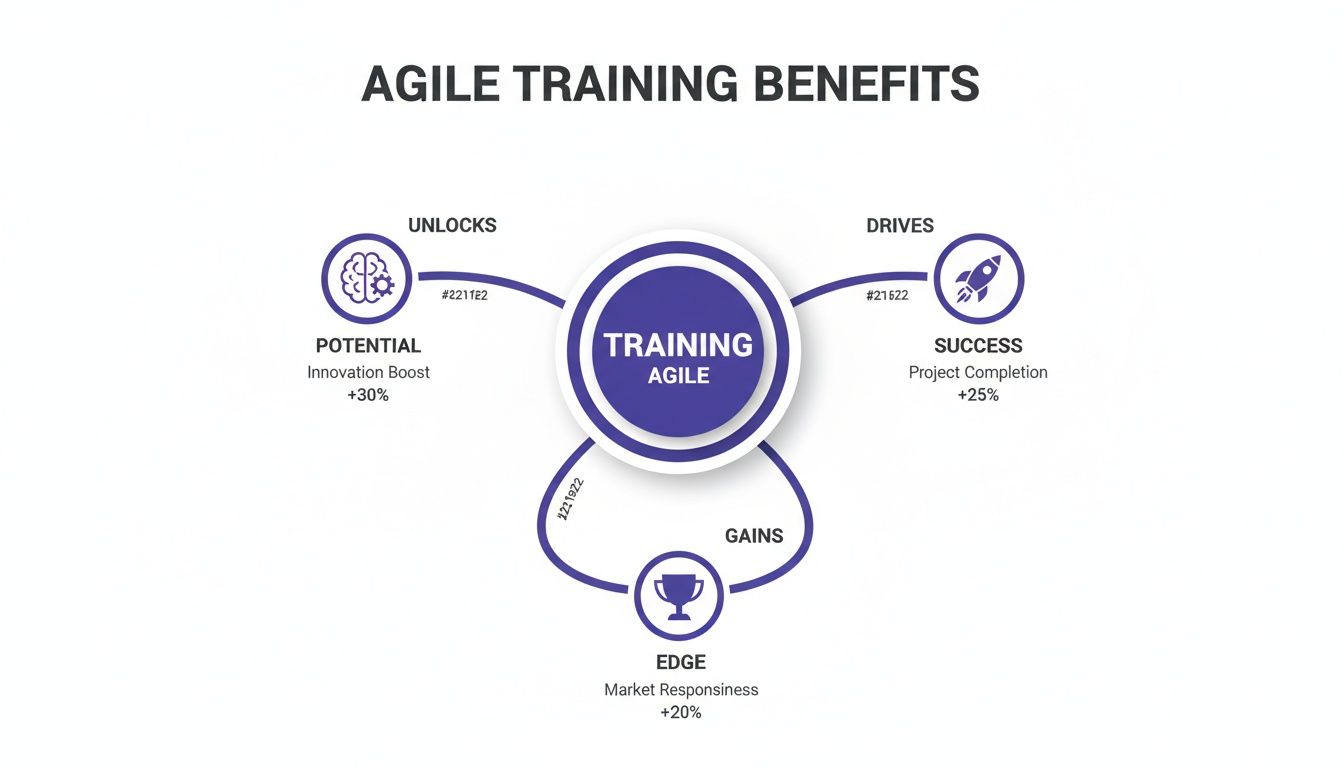
As you can see, the training itself is the engine that transforms a team's raw potential into measurable results and a distinct market advantage.
Creating a Rhythm of Progress with Scrum Events
The real power of Scrum comes from its series of structured meetings, or "events." These create a steady rhythm of checking in and adapting as you go. Each one has a clear purpose, designed to keep the project on track and foster constant improvement.
One of the most famous events is the Daily Scrum. This isn't some long, drawn-out status meeting. It’s a quick, 15-minute huddle every morning where the builders align on the day's tasks, sync up, and flag any immediate problems. Getting this right is crucial, and there are some great tips out there for streamlining your Daily Standup agenda.
Then, at the end of every Sprint, two really important things happen:
- The Sprint Review: The team demonstrates the finished work—showing off the newly installed cabinets and worktops—to the homeowner and anyone else who's interested. This is the moment for immediate, real-world feedback.
- The Sprint Retrospective: After the review, the team gets together privately. They talk about what went well in the Sprint, what didn't, and what they can do better next time. This relentless focus on getting better is the true engine of Scrum.
By breaking a huge vision down into fixed-length Sprints, defined roles, and purposeful events, Scrum turns a potentially chaotic process into a predictable, transparent, and adaptive workflow. It makes sure the team is always building the most valuable thing next and is constantly getting better at it.
Choosing the Right Agile Scrum Training Path for Your Team
Picking the right training format isn't just about logistics; it's a strategic move that dictates how well your team will actually grasp and use Agile principles. For businesses in the UK, it really boils down to three main paths, each with its own set of trade-offs. The best choice comes from balancing your team's learning style, your budget, and just how much hands-on problem-solving you need.
The first big question is: does your team learn better in a structured, group setting, or by studying at their own pace? Think of it like learning a new recipe. Some people want a chef right there with them in a live class, guiding every step. Others would rather watch a video, pausing and rewinding whenever they need to. Neither way is wrong, but one will definitely click better with your team's culture.
Comparing Training Delivery Formats
To help you decide, let’s break down the pros and cons of the most common training methods out there. Each one is built for different situations, from teams scattered across the country to those all in one room needing to get their hands dirty.
Here's a side-by-side comparison of the three main training delivery methods to help you choose the best option for your team's needs, budget, and location.
Comparing Agile Scrum Training Formats
| Format | Best For | Pros | Cons |
|---|---|---|---|
| Self-Paced Online Courses | Individuals with lots of self-discipline or teams with clashing schedules and a tight budget. | Maximum flexibility, lower cost, lets people revisit tricky topics as needed. | No direct instructor feedback, very little peer collaboration, higher chance of not finishing. |
| Live Virtual Training | Distributed UK teams that need expert guidance and a structured course without the travel bill. | Blends expert teaching with the convenience of remote access, encourages team interaction. | Can lead to 'Zoom fatigue', isn't as immersive as being in-person, time zones can be a pain. |
| In-Person Workshops | Teams that can get together in one place and thrive on immersive, hands-on collaboration. | The highest level of engagement, real-time problem-solving, and great for team building. | The most expensive option (venue, travel), less flexible with scheduling, requires everyone to be physically present. |
As you can see, there's a clear trade-off between flexibility on one side and immersive, collaborative learning on the other. Your choice should really come down to your main goal. Are you just trying to get knowledge into people's heads, or are you trying to fundamentally change how your team works together?
Navigating the Certification Landscape
Along with the format, you'll also need to think about certification. While you don’t technically need a certificate to practise Scrum, getting your team formally certified creates a consistent, shared understanding of the framework. It stops that common headache where everyone has their own slightly different—and often conflicting—idea of what Scrum is.
Two of the most respected and recognised certifications for Scrum Masters come from Scrum Alliance (Certified ScrumMaster) and Scrum.org (Professional Scrum Master). Both are excellent, but they have slightly different angles.
- Certified ScrumMaster (CSM): To get this one, you have to attend a two-day course led by an instructor. The focus is on understanding Scrum principles and what the Scrum Master does within a team. It’s generally seen as a great foundation, with a strong emphasis on the collaborative learning experience.
- Professional Scrum Master (PSM): This certification is all about passing a tough online exam. You can take courses to prepare, but they aren't mandatory. The PSM is known for testing a really deep and nuanced understanding of the Scrum Guide and how to apply it in tricky real-world situations.
The choice between CSM and PSM often comes down to what you want to achieve. If you're after a shared, interactive learning experience that helps build team spirit, the CSM route is a fantastic fit. If your main goal is to prove a deep, theoretical command of the Scrum framework, the PSM exam is a solid benchmark.
At the end of the day, the best agile scrum training path is one you choose deliberately, not one you just fall into. By thinking carefully about the delivery format that fits your team and picking a certification that matches your goals, you're setting yourself up for success. This thoughtful approach is what ensures your investment turns into a team that isn't just 'doing' Scrum, but truly living its principles to deliver amazing results.
Applying Scrum to a High-Performing Flutter Team
Generic agile scrum training gives you the rulebook, but the real magic happens when you apply those rules to a specific technology. For UK businesses aiming to build standout mobile apps, tailoring Scrum for a Flutter development team isn't just a nice-to-have; it's how you unlock serious efficiency and quality. Why? Because Flutter, with its unique architecture and features, is practically built for Scrum's iterative, feedback-driven rhythm.
The goal is to create a training curriculum that moves beyond theory and plugs directly into the Flutter development lifecycle. Think of it less like a standard driving lesson and more like advanced performance training for a specific racing car. You're not just learning to drive; you're learning how that car's unique engine and handling can be pushed to win the race.

A Curriculum Tailored for Flutter Excellence
An effective training plan for a Flutter team doesn't just skim over standard Scrum events and artefacts. It has to connect every principle to the day-to-day reality of building a cross-platform app.
A solid curriculum should zero in on these core areas:
- Flutter-Centric Product Backlog Management: This is where Product Owners learn to write user stories that account for platform-specific UI/UX quirks while still capitalising on Flutter's single codebase. It also covers the tricky balance of adding new features against paying down crucial technical debt, like widget library updates or state management refactoring.
- Integrating Scrum with CI/CD Pipelines: Developers need to see how Sprint Goals connect to automated build, test, and deployment cycles. This is vital. It ensures every successful Sprint produces a tangible, potentially shippable increment that has already passed through rigorous quality checks.
- Leveraging Hot Reload for Dynamic Sprint Reviews: This is where Flutter really shines within Scrum. Teams are trained to use Flutter’s hot reload feature as a secret weapon during Sprint Reviews. Forget static demos; developers can implement stakeholder feedback in real-time, tweaking the UI on the fly for a genuinely collaborative and impressive review process.
This kind of tailored approach makes the training immediately useful, adding real value from the very first Sprint.
Unlocking Performance with an Agile Mindset
The synergy between Scrum and Flutter becomes incredibly clear when you look at performance. Recent benchmarks consistently place Flutter at the top for creating smooth, natively compiled apps from a single codebase. But all that potential is wasted if the development process itself is chaotic and inefficient.
An Agile Scrum framework provides the discipline and structure needed to harness Flutter's technical capabilities. It ensures that development efforts are focused, user-centric, and consistently delivering value, turning raw performance potential into a market-leading product.
Without a structured process, even the best toolkit can lead to a messy project. Scrum provides the steady rhythm of Sprints, the clarity of a well-managed backlog, and the continuous feedback loops required to build complex apps without descending into chaos. To see how this works in practice, our guide on Flutter app development services for UK businesses offers some great examples.
Applying Scrum Across the App Lifecycle
Proper agile scrum training shows teams how the framework supports a Flutter project from the first napkin sketch all the way to post-launch maintenance. It’s not just a process for the main build phase; it’s a complete approach for the entire product journey.
Let’s break it down by stage:
- Initial Design Sprints: Before anyone writes a single line of code, the team can run a design Sprint. The objective? To rapidly prototype and test UI/UX concepts with actual users, ensuring the app's foundation is solid before committing to development.
- Development Sprints: This is the core cycle of building, testing, and iterating on features. The team works in focused bursts, delivering functional, polished pieces of the app every couple of weeks.
- Post-Launch Update Sprints: Once the app is live, Scrum provides the perfect structure for managing updates, fixing bugs, and rolling out new features. The Product Backlog simply evolves to reflect user feedback and shifting business priorities, enabling continuous improvement.
By applying Scrum principles at every stage, a Flutter team can maintain momentum, adapt to market demands, and make sure the app stays relevant and high-performing long after its initial launch.
How to Measure Your Return on Training Investment
Investing in agile scrum training feels like the right call, but how do you actually prove it was worth it? To get past the buzzwords and see a genuine return on investment (ROI), you need to focus on real-world metrics that show a tangible difference. The trick is to get a clear picture of where you are before the training starts, so you can track the improvements afterwards.
This all begins with identifying the right key performance indicators (KPIs) for your team. You're looking for data that tells a story about your team's efficiency, predictability, and the quality of their work. Think of it like a fitness programme; you need the "before" photos and measurements to really appreciate the "after" results.

Key Quantitative Metrics to Track
Hard data is your best friend here. It provides the most compelling evidence of improvement, giving you objective numbers to build a business case and show stakeholders exactly how the training has paid dividends.
- Team Velocity: This is simply a measure of how much work your team gets done in a single Sprint. A steady, predictable increase in Velocity after training is a massive green flag, showing the team is working more efficiently and cohesively.
- Cycle Time: This tracks how long it takes for a task to go from 'in progress' to 'done'. Shorter Cycle Times mean you're delivering value to your users faster and ironing out the kinks in your workflow.
- Predictability (Say/Do Ratio): This one is crucial. It measures how well the team delivers on what they promised at the start of a Sprint. Better predictability means stakeholders can actually trust the team's forecasts, which is gold for business planning.
The real magic happens when these metrics improve together. A higher Velocity is great, but a higher Velocity combined with better predictability and faster delivery is the hallmark of a high-performing, well-trained team.
Vital Qualitative Measures of Success
But numbers don't tell the whole story. The shifts in culture and behaviour that come from effective agile scrum training are just as important, even if they're a bit harder to pin down. These improvements often create the foundation for long-term, sustainable success.
You can gather this kind of feedback through simple surveys, one-on-one chats, and by just listening during Sprint Retrospectives.
- Boosts in Team Morale: A happier, more empowered team is a more productive one. Period. Look for signs of increased ownership, better collaboration, and a generally more positive atmosphere.
- Improved Stakeholder Satisfaction: When stakeholders feel more in the loop and see a steady stream of valuable updates, their confidence in the development team skyrockets.
- Reduction in Bugs or Rework: This is a huge sign of improved quality. When you see a drop in the number of defects found after a feature goes live, it means the team is building things right the first time, saving a massive amount of time and money.
Studies across the sector back this up. It's common for organisations to report big jumps in delivery predictability and product quality. Some vendor reports have even cited quality improvements as high as 2x–3x in certain situations.
Knowing how to properly calculate the ROI on training is the final piece of the puzzle. This financial justification is what secures future investment in your team's growth. These metrics, both hard and soft, combine to tell a powerful story that connects your training investment directly to core business goals. For more on this, you can also explore how to master project management fundamentals for app success.
A Few Common Questions About Agile Scrum Training
Even after weighing up the benefits, you probably still have a few questions before committing to agile scrum training. It’s a significant investment, after all. This section tackles the most common queries we hear from business leaders and development teams across the UK, giving you the clear, straightforward answers you need to move forward with confidence.
How Long Until We See Results From Scrum Training?
You'll notice small, immediate wins almost straight away. Things like better team communication and alignment will likely improve within the first couple of Sprints – that’s usually about two to four weeks. The simple act of sharing a common language smooths out daily interactions and makes planning sessions far more productive.
The bigger, more measurable gains in productivity, predictability, and product quality tend to show up after about three months. That’s the sweet spot where the new workflow starts to feel natural, and the principles of Scrum become second nature to the team.
Is Scrum Certification Really Necessary for Our Team?
While you don't technically need a certificate to practise Scrum, getting certified provides a powerful and consistent foundation for your team. It guarantees that everyone—from your developers right through to your stakeholders—is on the same page about the rules, roles, and principles. That shared understanding is crucial for sidestepping common pitfalls and getting up to speed much faster.
For critical roles like the Scrum Master and Product Owner, certification does more than just validate their expertise; it lends real credibility to their leadership. Think of it as a valuable investment in the integrity of your process and the people you’re trusting to guide it.
The biggest hurdle in adopting Scrum is almost always cultural change, not learning the framework's mechanics. It demands a shift from a top-down approach to a culture of trust, collaboration, and team empowerment. Securing genuine buy-in is the most critical factor for success.
Can Scrum Work for Non-Software Projects?
Absolutely. At its core, Scrum is a framework for managing complex work, which makes it incredibly versatile. We've seen it used successfully by marketing departments, R&D labs, and even HR teams to deliver value bit by bit and adapt to changing priorities.
Any project with evolving requirements that would benefit from frequent feedback can thrive under Scrum’s structure. The rhythm of focused Sprints, clear roles, and continuous improvement applies to a huge range of business challenges. For instance, a marketing team could use a two-week Sprint to launch a digital campaign, review the results, and plan their next move based on real-world data.
Ready to unlock your team's full potential with an Agile mindset tailored for high-performance app development? At App Developer UK, we specialise in creating world-class Flutter applications by embedding these powerful principles into our workflow. Contact us today to discuss how we can bring your app vision to life.