Your Guide to Agile Development Training Courses
Your Guide to Agile Development Training Courses
Agile development training is a structured way to get your team fluent in the principles and practices of methodologies like Scrum and Kanban. The whole point is to deliver value faster and more efficiently by embracing iterative progress, genuine collaboration, and a mindset of continuous improvement. The best courses go way beyond the textbook, giving your team practical skills they can use immediately to boost productivity and the quality of their work.
Why Agile Training Is No Longer Optional
In the fiercely competitive world of software development, just having the best tools won't get you across the finish line.
Picture a high-performance racing team. You can have the fastest car on the track—think of it as your high-performing Flutter framework—but without a skilled pit crew working in perfect sync, you're not winning any races. This is exactly why formal Agile training has become a mission-critical investment for modern UK businesses.
Untrained teams often just go through the motions. They might hold daily stand-ups or use a task board, but they completely miss the collaborative spirit and the relentless focus on improvement that actually drives results. This leads to tangled workflows, blown deadlines, and a team of frustrated developers.
The True Impact of Structured Training
Great agile development training courses do more than just teach a process; they cultivate the collaborative culture that's absolutely essential for rapid development cycles. When a team is properly trained, they learn to communicate clearly, adapt to shifting requirements on the fly, and take collective ownership of the project's success. It builds a far more resilient and motivated workforce.
"A Kanban board is an instant sense-making device. It requires zero explanation to understand. However, Kanban’s primary advantage is also its biggest flaw. It’s easy to be fooled by Kanban’s hidden sophistication."
This really hits the nail on the head. Even tools that look simple on the surface have a hidden depth that only proper, structured training can unlock. Without it, teams are just scratching the surface, missing out on the massive efficiency gains that come with real mastery.
Business Benefits Beyond the Code
The advantages ripple out far beyond the development team itself. To really get why Agile training is so vital today, it's worth looking at the wider benefits of investing in employee training and development in any industry. For businesses here in the UK, this investment pays off in very real, tangible ways:
- Faster Time-to-Market: Cohesive, well-drilled teams simply deliver features faster, getting your product into your customers' hands sooner.
- Better Product Quality: Agile’s constant loop of iterative testing and feedback means fewer bugs and a much more polished final product.
- Happier, More Engaged Teams: Giving teams clear processes and a truly collaborative environment doesn't just feel good—it significantly boosts job satisfaction and slashes burnout.
Ultimately, putting money into Agile training is an investment in your company's core ability to compete and innovate. This guide is your roadmap to navigating the often-confusing world of certifications and choosing the perfect course for your team.
Navigating the World of Agile Certifications in the UK
Stepping into the world of Agile certifications can feel a bit like staring at a bowl of alphabet soup. With acronyms like CSM, SAFe, and AgilePM floating around, figuring out which one is right for you or your team can be a real head-scratcher. Getting this choice right is a massive step towards success, and it all starts with understanding what each certification really offers.
Across the UK, these courses have become a standard part of professional development, especially in tech. Employers are actively looking for credentials in frameworks like Scrum, AgilePM, PRINCE2 Agile, SAFe, and Kanban. Nailing one of these certifications shows you're serious about staying current with proven, practical Agile methods.
The choice to train or not often feels pretty straightforward for most UK businesses.
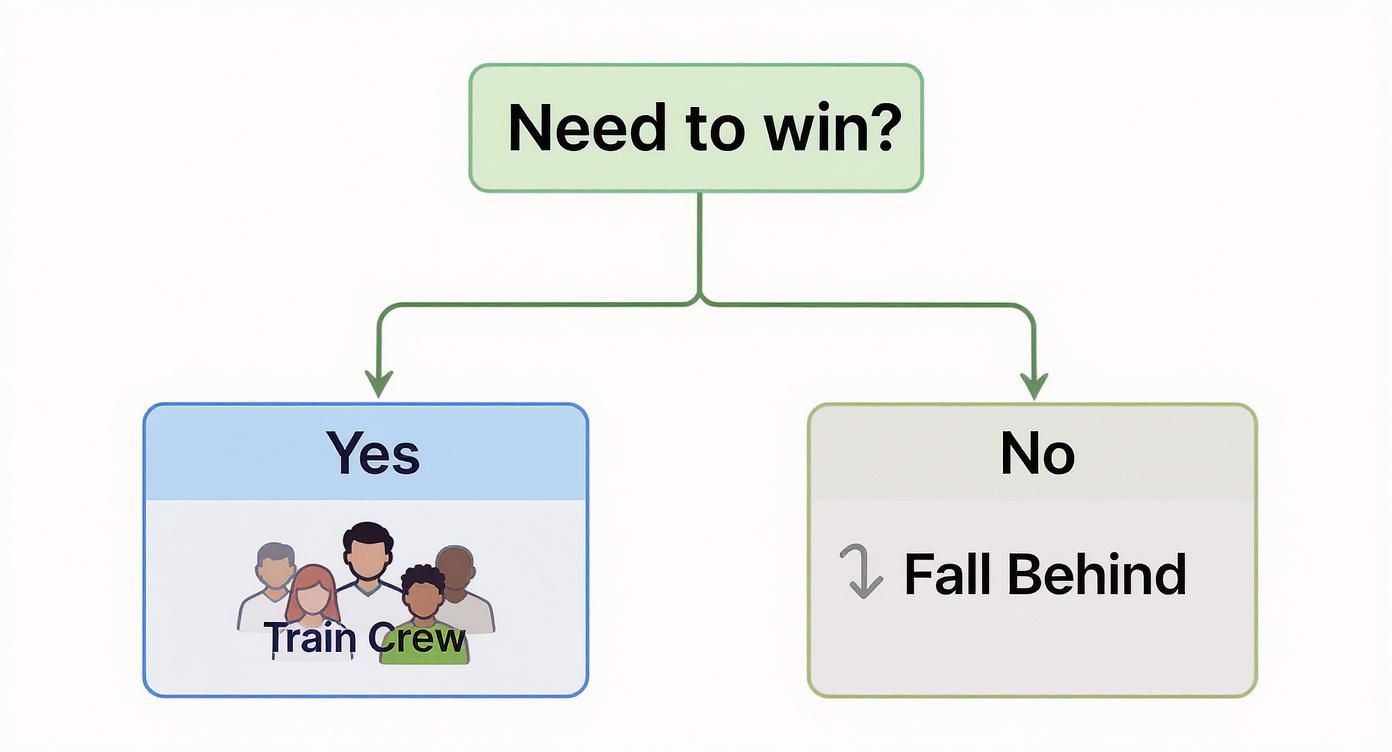
It’s a simple truth: investing in your team’s skills is a direct line to staying competitive. Standing still just isn't an option.
To help you find the right path, let's break down some of the most popular Agile certifications available here in the UK.
Comparing Top Agile Certifications in the UK
Here’s a quick breakdown of the most common certifications, their primary focus, and who they’re really built for.
| Certification | Primary Focus | Best Suited For |
|---|---|---|
| CSM/CSPO | Scrum framework roles and events | Software development teams, product managers, and team facilitators. |
| AgilePM | Blending project management governance with Agile flexibility. | Project Managers in organisations transitioning to Agile. |
| PRINCE2 Agile | Integrating Agile concepts into the formal PRINCE2 methodology. | Organisations already using PRINCE2 that want to adopt Agile delivery. |
| SAFe Agilist (SA) | Applying Agile principles at an enterprise scale across multiple teams. | Leaders, managers, and executives in large, complex organisations. |
Each of these has its own place, so the "best" one really depends on your team's specific goals and the environment you work in.
The Powerhouse of Product Development: Scrum
For teams focused on building products, especially in fast-paced worlds like mobile app development, Scrum is almost always the go-to framework. It’s got a beautifully simple structure that’s surprisingly powerful for tackling complex work. The two main certifications you’ll see are:
- Certified ScrumMaster (CSM): This is for the person who acts as the team's facilitator. The Scrum Master isn't a boss in the traditional sense; they're a "servant-leader" who clears obstacles, shields the team from distractions, and makes sure everyone sticks to the Scrum framework. For a proper deep dive, check out our complete UK Scrum Master certification and training guide.
- Certified Scrum Product Owner (CSPO): This certification is for the individual who owns the product's vision and is responsible for its ROI. The Product Owner is the master of the product backlog, deciding what gets built next to deliver the most value to the customer.
Scrum’s magic lies in its clear roles and its time-boxed events (or "ceremonies"). This creates a steady, predictable rhythm for development, which is perfect for teams building something like a Flutter app, where getting frequent feedback and adapting on the fly is everything.
Agile for Project Managers: AgilePM and PRINCE2 Agile
Not everything fits neatly into the product development box. For businesses that come from a more traditional project management background, certifications like AgilePM and PRINCE2 Agile build a bridge between established governance and Agile delivery.
AgilePM gives project managers the tools to keep a firm grip on scope, budget, and deadlines while still getting the speed and flexibility of an iterative approach. It’s about merging the best of both worlds.
This is a perfect fit for UK companies that need to run projects with clear start and end dates but also need to be able to react when things change. PRINCE2 Agile takes this a step further by weaving Agile thinking directly into the DNA of the widely-used PRINCE2 methodology.
Scaling Agility for the Enterprise: SAFe
So, what happens when you’ve got dozens of Agile teams all needing to pull in the same direction to build one massive solution? That’s where the Scaled Agile Framework (SAFe) steps in. SAFe is a comprehensive blueprint for making Agile work at the enterprise level.
It adds extra layers of coordination, like the Agile Release Train (ART), to keep all those teams aligned and in sync. A SAFe Agilist (SA) certification is often a must-have for leaders and managers in big organisations who are serious about achieving true business agility. It’s a big commitment, but for huge, complex projects, it's essential.
What a High-Value Agile Course Actually Teaches
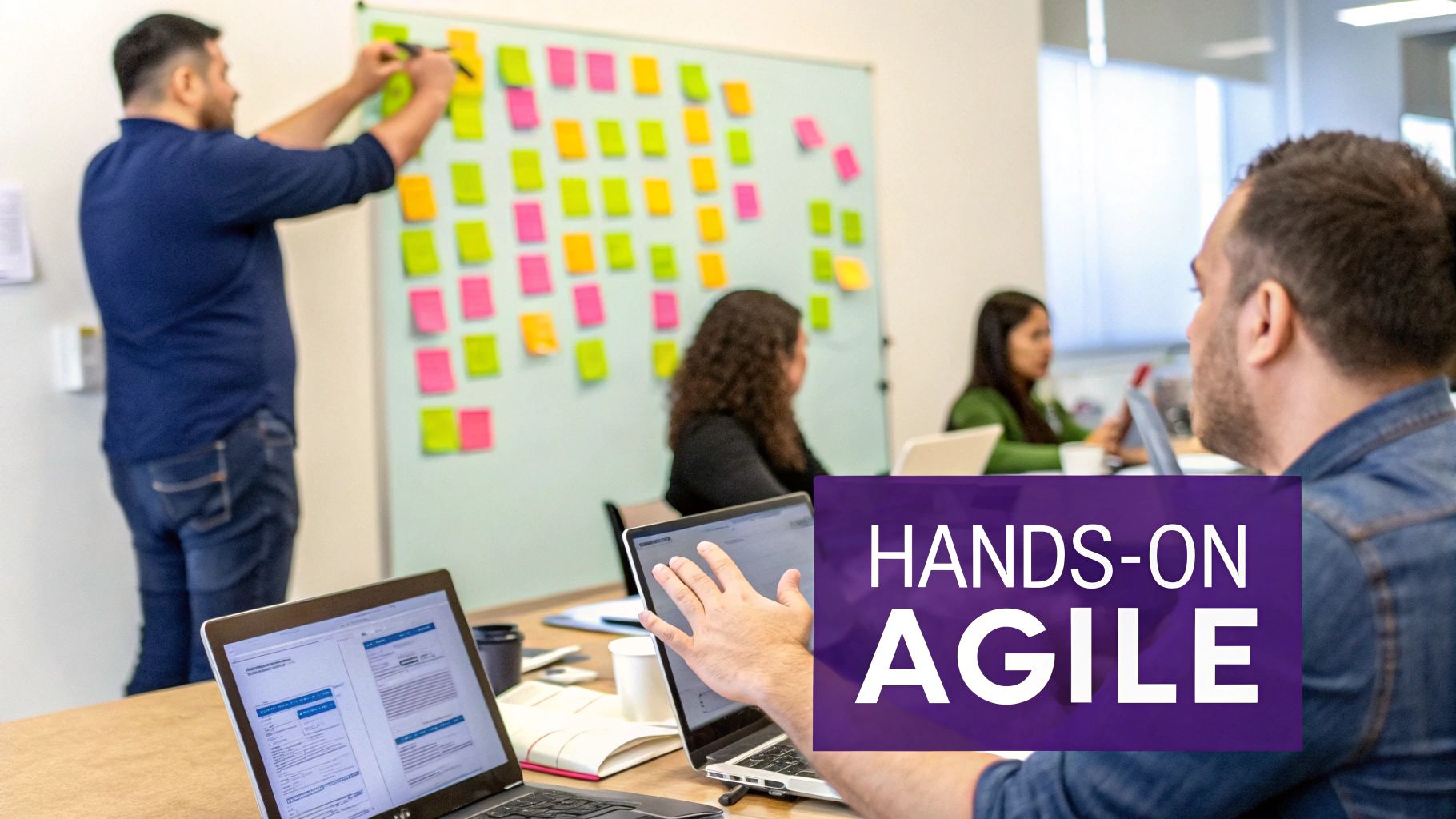
Let's be honest: not all agile development training courses are created equal. The real difference between a lecture that puts your team to sleep and a workshop that genuinely sparks change lies in what is being taught—and, more importantly, how.
A high-value course won't just throw textbook definitions at you. It gets your team equipped with practical, roll-up-your-sleeves skills they can apply from day one.
The journey has to start with the fundamentals. Any training worth its salt will anchor everything in the four core values and twelve principles of the Agile Manifesto. This isn't about rote memorisation; it's about deeply understanding the "why" behind Agile. It's the philosophy, the foundation upon which every practice and framework is built.
From there, the course must dive into the specific frameworks that bring these powerful principles to life.
Mastering the Core Frameworks
A solid curriculum will zero in on the two most widely-used agile frameworks: Scrum and Kanban. They both spring from the same agile roots, but they operate very differently in the real world. A quality course will make these differences crystal clear, so you can pick the right tool for the job.
- Scrum: This is your go-to for complex product development with a clear goal, like building a brand-new feature for your Flutter app. It uses fixed-length iterations called sprints to deliver work in predictable, bite-sized chunks.
- Kanban: This is perfect for teams handling a constant flow of work with ever-shifting priorities, like a support or maintenance team. The focus here is on visualising the workflow and limiting work-in-progress to get things done as efficiently as possible.
The best courses don't just teach the rules. They explain the strategic thinking behind choosing one over the other, considering everything from your team's size and project type to your company's overall culture.
"Kanban doesn’t require any changes to roles or meetings when first getting started." This evolutionary approach can make it a smoother entry point for organisations that are resistant to sudden, sweeping changes.
From Theory to Hands-On Practice
This is the part that separates the great training from the merely good. It's one thing to read about agile ceremonies; it's another thing entirely to live them. A top-tier course will use interactive workshops and realistic simulations to build that crucial muscle memory around key agile practices.
These practical, hands-on sessions should absolutely cover:
- User Story Mapping: A brilliant, collaborative way to build a visual map of the user's journey, helping the whole team see the product from the customer's perspective.
- Backlog Refinement: The essential, ongoing process of adding detail, estimates, and order to the items in the product backlog.
- Sprint Execution: Running simulated sprints from start to finish, covering everything from planning and daily stand-ups to reviews and retrospectives.
These activities are non-negotiable. They bridge that massive gap between knowing the concepts and being able to actually execute them when the pressure is on.
The Overlooked Essential: Soft Skills
Finally, the most impactful agile training addresses the human element head-on. At its heart, Agile is all about people working together effectively. A truly comprehensive curriculum will teach the soft skills that make the whole system tick.
This means training on facilitation, teaching Scrum Masters how to guide productive meetings without taking over. It means covering stakeholder negotiation, giving Product Owners the tools to manage expectations and prioritise like a pro.
And crucially, it champions servant leadership—the powerful mindset that a leader’s main job is to support and empower their team to do their absolute best work. Without these skills, even the sharpest technical teams will struggle to see the full benefits of Agile. A course that teaches these human skills alongside the processes is one that delivers real, lasting change.
Choosing the Right Training Format and Budgeting for Success
So, you’ve picked out the right kind of agile certification for your team. What’s next? The big question now is how you're going to deliver that training. This decision is more than just logistics; the format you choose will directly shape the cost, flexibility, and ultimately, how much your team gets out of the whole experience.
Getting this right is crucial for making your training budget count. The choice really comes down to a couple of key matchups: private in-house training versus public courses, and online sessions versus getting everyone in a room together. Each has its own rhythm and benefits, and the best fit hinges on your team’s size, budget, and how they learn best.
In-House vs Public Courses
Your first major decision is whether to send people out to a public course or bring a trainer into your world for a private session.
- Public Courses: These are fantastic if you’re training just one or two people. They’re also brilliant for networking. Your team members get to mix with professionals from other UK companies, swapping stories and learning from each other’s challenges. The catch? The material is one-size-fits-all, so it won’t be tailored to your specific projects or internal struggles.
- In-House Training: If you’re training a whole team (think five or more people), this is often the smarter financial move. But the real win here is the customisation. A good trainer will weave your real-world projects and team-specific pain points directly into the curriculum. Suddenly, the training isn’t abstract anymore—it’s immediately useful.
Imagine a Flutter development team. An in-house course can be built around the rapid-fire iteration cycles that Flutter is known for. That kind of targeted training is leagues more effective than a generic public workshop.
Virtual vs In-Person Classrooms
Next up: should the training happen online or face-to-face? The world has gotten very good at virtual learning, and honestly, both formats can deliver a top-notch experience.
Choosing between virtual and in-person training isn't just about convenience; it's a choice about your team's learning culture. Virtual offers incredible flexibility, while in-person creates a unique space for deeper collaboration and team bonding.
Let's lay out the differences.
| Feature | Virtual Instructor-Led Training | In-Person Classroom Training |
|---|---|---|
| Cost | Generally lower. No travel, venue hire, or accommodation to worry about. | Higher. You're covering the venue, the instructor's travel, and materials. |
| Flexibility | High. People can join from anywhere, and sessions can often be recorded. | Low. It requires fixed dates and travel, pulling the team off their work. |
| Engagement | Relies heavily on digital tools like polls and breakout rooms to keep focus. | Naturally high. The direct, real-time interaction is hard to beat. |
| Networking | It's possible through chats and forums, but it can feel a bit forced. | Excellent. The best conversations often happen over coffee during breaks. |
For businesses going the virtual route, a smart first step is to check out an ultimate online course platform comparison. Understanding the tools available can make all the difference in creating an online experience that’s just as engaging as being in the room.
Budgeting for Agile Training in the UK
Let’s talk numbers, because proper planning means knowing the costs. In the UK, prices for agile certification courses are all over the map, depending on the provider, the certification body, and the format. Take AgilePM training as an example. Online Foundation courses typically run between £800 and £1,400, while the Practitioner level lands somewhere between £1,000 and £1,600. A combined online package might set you back £1,800 to £2,500.
In contrast, classroom courses are a bigger investment. Prices often start around £3,995 for just the Foundation level, showing just how much UK companies are willing to invest in getting their teams skilled up.
This price difference really spells out the trade-off. Online courses are a more affordable way in, which is why finding the right agile online course in the UK has become such a hot topic. But that premium for in-person training buys you an immersive, focused environment that can be invaluable for cementing complex ideas and really bringing a team together. The right choice is the one that balances your budget with the results you need.
Adapting Agile for High-Performance Flutter Teams

Standard agile practices are a fantastic starting point, but trying to apply them 'out of the box' to mobile development can feel like trying to fit a square peg in a round hole. For UK-based Flutter teams, tailoring your agile approach is the secret to unlocking the framework’s real power and gaining a serious competitive advantage.
The world of mobile development moves to its own beat. It's a rhythm dictated by app store release cycles, platform-specific user experience demands, and complex build pipelines. A one-size-fits-all approach just won't cut it when you're aiming for the top.
Fusing Agile Iteration with Flutter Speed
This is where things get exciting. Agile’s iterative nature is a perfect match for Flutter's standout features. The framework is rightly celebrated for its incredible performance—with recent benchmarks placing it at the top—and developer-friendly tools, especially the hot reload function. This feature creates an incredibly tight feedback loop, letting developers see UI changes almost instantly.
A well-trained agile team can turn this technical advantage into a strategic weapon. Picture a sprint review where a stakeholder suggests a UI tweak. With Flutter, your team can make that change and show the revised version moments later, not days. This fusion of agile process and Flutter speed is a game-changer, dramatically accelerating development and validation.
By aligning short, focused agile sprints with Flutter's rapid iteration capabilities, teams can create a development engine that is not just fast, but also incredibly responsive to user feedback and business needs.
What to Look for in a Mobile-Centric Agile Course
When you're sifting through the many agile development training courses on offer, it’s vital to find a provider who genuinely understands the mobile ecosystem. Don't settle for generic software examples. Your team needs training that speaks their language and solves their specific problems.
Look for a training provider who can offer:
- Relevant Case Studies: Can they show you success stories with other mobile or, even better, Flutter development teams in the UK?
- Mobile-Specific Artefacts: The training needs to cover how to adapt user stories and acceptance criteria for mobile screens, gestures, and different platform conventions.
- CI/CD Integration Focus: Automation is a huge part of modern mobile development. You can get a sense of just how crucial this is by exploring what continuous integration means for Flutter apps. The training must show how agile workflows plug into your CI/CD pipeline for smooth builds and deployments.
Modifying Agile Ceremonies for Flutter Teams
Adapting ceremonies is where the real magic happens. For example, your backlog refinement sessions should explicitly include tasks for platform-specific testing or dealing with the latest OS updates from Apple and Google.
Similarly, your sprint planning has to account for the unpredictable app store review process. A smart Flutter team might plan to have a release candidate ready mid-sprint, submitting it early to create a buffer against potential rejection or long review times.
It’s this kind of practical, tailored thinking that turns a good Flutter team into a great one, amplifying the framework's performance to consistently deliver outstanding mobile apps.
How to Measure the ROI of Your Agile Training
Putting your team through agile training is a proper investment, and you'll need more than a vague feeling that things are "better" to justify the spend. To prove the investment paid off, you need to show its real-world business impact. This means getting past the anecdotes and focusing on cold, hard data that tells a clear story about your return on investment (ROI).
The trick is to know where you started. Before any training kicks off, you have to capture a snapshot of your team's performance as it is right now. This pre-training data is your baseline, the benchmark you'll measure all future improvements against. It’s what lets you build a compelling case backed by solid evidence.
Tracking Quantitative Improvements
Numbers don’t lie. The most convincing arguments for ROI are always built on quantitative metrics – the measurable signs of your team's efficiency and output. Once your team has completed their training, keep a close eye on these key performance indicators (KPIs) to see just how much has changed.
Key metrics to monitor include:
- Team Velocity: This is all about how much work the team can get through in a single sprint. If you see a steady increase in velocity after the training, it's a clear sign they’re delivering more value in the same amount of time.
- Cycle Time: This measures the total time it takes for a task to go from 'in progress' to 'done'. Shorter cycle times are a direct result of a smoother, more efficient workflow and faster delivery to your users.
- Defect Rate: Keep track of the number of bugs or defects that pop up after a feature goes live. A falling defect rate is proof that the training has boosted quality and cut down on the costly, productivity-killing rework.
These metrics give you a direct line from the training investment to tangible improvements in speed and quality. They are the bedrock of your ROI calculation.
It's easy to fall into the trap of only measuring outputs, like the number of features shipped. Real ROI is also found in a team's improved predictability and stability. These are tougher to pin down with numbers but are incredibly valuable to the business.
Assessing Qualitative Gains
Not every win from agile training can be neatly plugged into a spreadsheet. The qualitative improvements are just as important for understanding the full impact on your team’s culture and how they work together. These insights often reveal the deeper, long-term value of your investment.
To get a handle on this, think about using simple surveys or having a few structured chats before and after the training to see how things have shifted.
Important qualitative measures include:
- Stakeholder Satisfaction: Are your internal clients and external customers happier with the team's progress, communication, and the final product?
- Team Autonomy and Morale: Does the team feel more empowered to make their own decisions and solve problems without constant oversight? A happier, more autonomous team often leads to lower staff turnover and more innovation.
- Predictability: Can the team give a more accurate forecast of what they can realistically deliver in a sprint or a quarter? Better predictability builds trust right across the organisation and makes business planning a whole lot easier.
When you combine these qualitative insights with your hard data, you get a powerful, complete picture of the training's success. It shows that your investment didn't just make the team faster—it made them stronger, more collaborative, and more aligned with the business goals. You're not just ticking boxes; you're building a culture of continuous improvement that will deliver value for years to come.
Any Questions About Agile Training?
Dipping your toes into the world of agile training can bring up a few common questions. It’s completely normal. This section is here to give you some clear, straightforward answers to help you figure out the best path for your team.
We'll cut through the jargon and get straight to the practical stuff – from what you need to start, to how long your certifications are good for, and the classic Scrum vs. Kanban debate.
What Do We Need Before Starting Agile Training?
Honestly, for most foundational agile courses, the only real prerequisite is an open mind. You don't need to be a tech wizard. These courses are built to introduce the agile mindset from scratch, making them perfect for everyone, whether you’re a developer, a project manager, or even in marketing or the C-suite.
Now, if you're looking at more advanced certifications, like a Practitioner-level course or a SAFe Agilist certification, you’ll usually need to have the foundational course under your belt first. It's always a good idea to double-check the specific requirements with the training provider.
How Long Does an Agile Certification Actually Last?
That’s a great question, and it really depends on who issues the certificate. Some certifications are yours for life once you’ve earned them. No strings attached.
Others need to be renewed to show you’re keeping your skills sharp. For instance:
- Scrum Alliance certifications (like CSM) need a top-up every two years. This usually involves a renewal fee and earning a few professional development units.
- AgilePM certifications have a longer shelf life but require renewal every five years by passing a re-registration exam.
Keeping your certifications active isn’t just about compliance; it shows you’re still committed to your professional growth and the agile way of thinking.
Should My Team Use Scrum or Kanban?
This isn't about picking a winner; it's about finding what fits your team's workflow. Neither one is inherently "better" than the other, but one will likely feel more natural depending on the type of work you do.
Scrum is fantastic for product development teams tackling complex problems with a clear end goal, like building a new Flutter app from the ground up. The structured sprints give the work a predictable, reliable rhythm. Kanban, on the other hand, is built for teams managing a constant flow of tasks with shifting priorities – think support desks or operations teams.
A solid agile course will walk you through the strengths of both. You’ll leave feeling confident enough to pick the right one for your team, or even mix and match elements to create a hybrid approach that’s a perfect fit.
The demand for these skills is exploding across the UK, moving way beyond just software teams and into marketing, HR, and even finance. Foundational certifications like the Certified ScrumMaster (CSM) are hugely popular, while the SAFe Agilist certification is becoming a must-have for people working in larger organisations. You can discover more insights about the growing demand for agile skills to get a feel for the market. Choosing the right training can make a massive difference to your team's performance and your own career.
Ready to transform your development process and build high-performance mobile apps? App Developer UK specialises in creating stunning, powerful applications using the Flutter framework, amplified by agile methodologies. Let our expert UK-based team help you bring your vision to life with speed and precision.
Contact us today to discuss your Flutter app development project