Hire mobile application developer in the UK
Hire mobile application developer in the UK
Before you even think about hiring a mobile app developer, you need a detailed blueprint of your app idea. This isn't just a suggestion; it's the absolute foundation for a successful project. This initial planning stage is what turns a vision into a concrete, buildable plan, ensuring any developer you bring on board knows exactly what you need.
Defining Your App Before You Hire Anyone
Jumping into the hiring process without a crystal-clear vision is like setting sail without a map. You might have a brilliant idea, but if you can't define the problem it solves, the audience it serves, and the essential features it needs, you're setting yourself up to waste a lot of time and money.
The UK mobile app market is booming, which means you have to be strategic. Rushing this first step is one of the most common reasons projects fail before a single line of code is ever written.
The market's rapid growth proves just how important it is to get this right. In 2025, the UK’s mobile application market hit a staggering £28.3 billion, with an impressive annual growth rate of around 12.9%. This is driven by a huge appetite for apps, with downloads expected to rocket past 8.5 billion in 2025. These numbers show that while users are hungry for great apps, the competition is fierce.
Pinpoint Your Target Audience and Core Problem
Forget about features for a moment. First, you have to answer two critical questions: who is this app for, and what specific problem does it solve for them? A vague answer like "everyone" is a non-starter. You need to get specific.
- Audience Persona: Are you building for busy parents in London who need quick meal solutions? Or maybe for university students across the UK looking for a better way to manage their study schedules? Create a detailed profile of your ideal user.
- Problem Statement: Articulate the pain point you're solving. For instance: "Busy parents struggle to find and cook healthy, quick meals during the week, leading to stress and an over-reliance on takeaways." Your app's entire purpose is to solve that problem.
A developer’s job is to build a technical solution to a human problem. If you can't clearly define that problem, even the best developer in the world will build the wrong app. This clarity is the single most important asset you bring to the table.
Outline Your Minimum Viable Product (MVP)
You don't need to build every feature you've ever dreamt of right out of the gate. The smart move is to focus on a Minimum Viable Product (MVP). This is the simplest, most stripped-down version of your app that solves the core problem for your target audience and delivers immediate value.
Think of it this way: for that meal-planning app, the MVP isn't a social network for foodies with celebrity chef live streams. It's a simple tool that lets a user:
- Select their dietary preferences.
- Get five simple recipes for the week ahead.
- Generate a matching shopping list.
That's it. Everything else is a "nice-to-have" for a future update. This focused approach gets your app to market faster, cuts your initial costs, and lets you gather real user feedback to guide what you build next. For a deeper look at this process, check out our guide on moving from concept to launch for UK apps.
Choose Your Platform Wisely
Finally, you need to decide where your app will live: iOS, Android, or both? For most UK businesses looking for the widest possible reach, the answer is both. This is where a strategic technology choice can make or break your budget.
You could hire separate developers to build two "native" apps from scratch, but that essentially doubles your cost and development timeline.
A far more efficient, modern approach is to hire a mobile application developer who's an expert in a cross-platform framework like Flutter. This lets you build a single, high-performance app from one codebase that runs beautifully on both iOS and Android devices.
Here's a quick breakdown of how Flutter stacks up against traditional native development.
Flutter vs Native Development At a Glance
| Feature | Flutter (Cross-Platform) | Native (iOS/Android) |
|---|---|---|
| Codebase | Single codebase for both platforms | Separate codebases for iOS (Swift/Objective-C) and Android (Kotlin/Java) |
| Development Speed | Faster development and time-to-market | Slower, as two separate apps need to be built and maintained |
| Cost | More cost-effective; one developer team | Higher cost; requires two specialised teams or developers |
| Performance | Excellent, near-native performance | Highest possible performance, tailored to the specific OS |
| UI Consistency | Consistent look and feel across all devices | UI is platform-specific, following Apple and Google's design guidelines |
| Team Size | Smaller, more unified team needed | Requires separate iOS and Android specialists |
Modern benchmarks consistently put Flutter at the top for performance, delivering that smooth, native-like experience users demand. For startups and businesses in the UK, choosing Flutter is a massive strategic advantage that saves money and gets you to market faster, all without compromise.
Choosing Your Hiring Model: Freelancer, Agency, or In-House?
Once your app blueprint is solid, you’ve hit your first major fork in the road: who is actually going to build this thing? It’s a huge decision, and it’s about way more than just the upfront cost. Your choice will shape your budget, your timeline, and how much of your own time you’ll need to sink into managing the project.
You’ve really got three main paths. You can hire a freelancer, bring an agency on board, or build your own in-house team. Each route has its own pros and cons, and the right one for you depends entirely on your project's complexity and the resources you have at your disposal. Get this wrong, and you could be looking at blown budgets and a whole lot of stress.
This decision often starts right back at your initial idea and which development path you choose, as this visual decision tree shows.
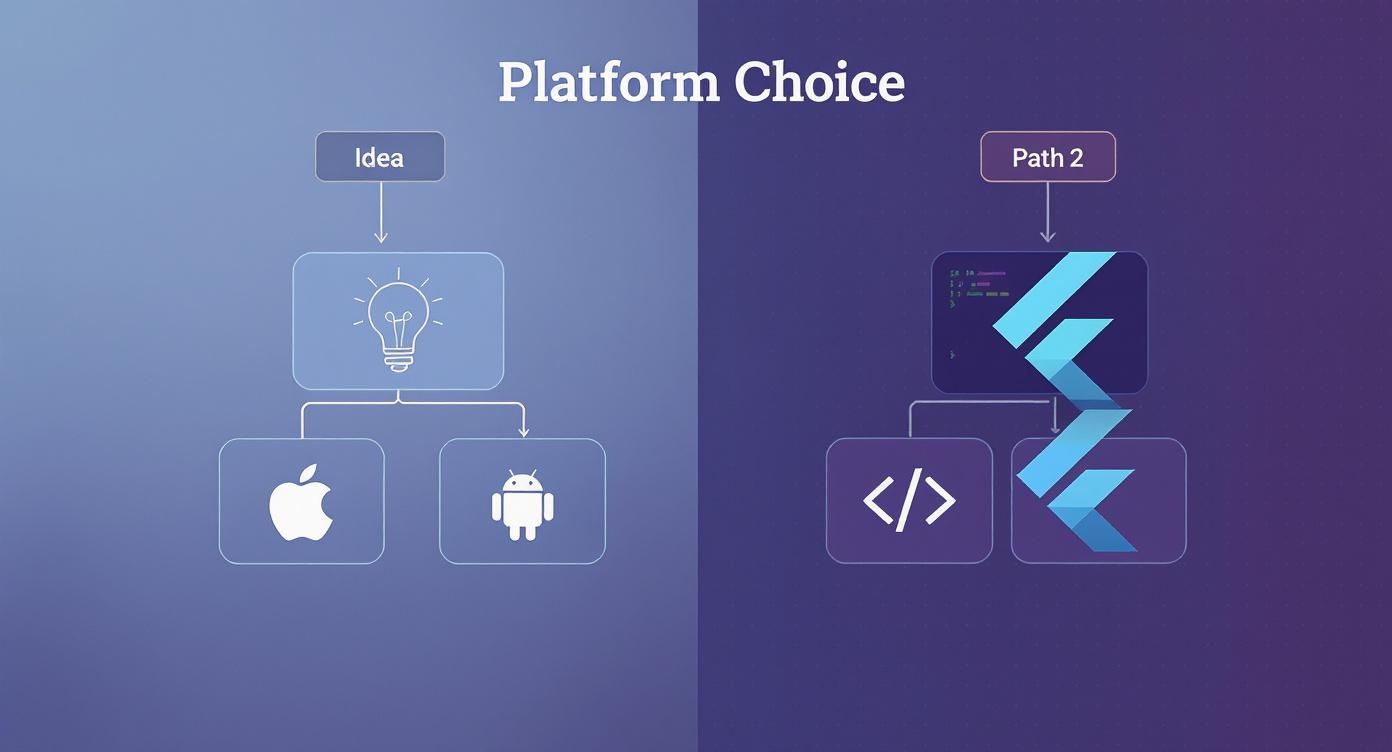
As you can see, opting for a cross-platform solution like Flutter streamlines everything into one development track. This unified approach often pairs perfectly with the all-in-one team structure an agency provides.
The Freelancer Route: A Solo Specialist
Going with a freelance developer is often the most budget-friendly option, at least on paper. It's a great fit for smaller, tightly-defined projects or if you just need to plug a specific skills gap in your existing team. If your MVP scope is crystal clear and you've got the project management chops (and the time) to oversee everything, a freelancer can be a brilliant choice.
The catch? The buck stops with you. You're not just the client; you're the project manager, the product owner, and the head of quality assurance, all rolled into one. Every part of the process, from design handovers to testing and App Store submission, lands on your desk.
A freelancer is like hiring a skilled surgeon; they are brilliant at their specific task. But you are still responsible for building the operating theatre, managing the nursing staff, and ensuring the patient—your app—gets comprehensive care before and after the procedure.
Partnering with a UK Agency: A Full Team
For anything more complex, or for businesses that simply don't have the bandwidth to manage a developer day-to-day, partnering with a UK-based agency is usually the most strategic move. When you work with a team like App Developer UK, you’re not just hiring a coder. You're plugging into a ready-made, coordinated machine.
This integrated team almost always includes:
- Project Managers to keep everything on track, on time, and on budget.
- UI/UX Designers to make sure your app is a joy to use.
- Flutter Developers to do the actual building.
- QA Testers who hunt down bugs before your users do.
This setup drastically cuts down on your management headaches and lowers the project risk. The agency owns the entire development lifecycle, giving you a single, accountable point of contact and the peace of mind that every angle is being handled professionally. Yes, the initial investment is higher than a freelancer, but you're paying for a smoother process, a wealth of collective expertise, and a polished, market-ready product at the end of it.
Building an In-House Team: The Long-Term Play
Assembling your own in-house development team is the biggest commitment of all. This path really only makes sense for larger companies or well-funded start-ups where the app is the core business and will need constant, long-term work.
Having your own team gives you unparalleled control and ensures the developers are deeply woven into your company culture. But the costs go way beyond salaries. You have to factor in recruitment fees, onboarding, benefits, high-end equipment, and ongoing training to keep their skills sharp. The process to hire a mobile application developer full-time is slow and expensive enough; building an entire team is a massive undertaking. For most businesses, this is a goal for the future, not a starting point.
Right, you’ve got your strategy nailed down and you know whether you’re after a freelancer or an agency. Now comes the exciting bit: finding the talent to actually build your app.
This is the moment your idea starts the journey from a document on your laptop to a real, tangible product in people’s hands. The quality of the developer you bring on board will make or break the final result. Knowing where to look—and, more importantly, what to look for—is everything.
Don’t let the search overwhelm you. The best way to tackle it is to split the process in two: sourcing and vetting. Sourcing is all about building a solid list of potential candidates. Vetting is where you sift through that list to find the one who’s a perfect match for your project.

Where to Source Your Candidates
Casting your net too wide is a classic mistake. It just leads to a mountain of applications from people who aren't the right fit, and that’s a massive time-sink. Instead, be strategic. Focus your energy on the places where genuinely skilled developers hang out.
- Professional Networks like LinkedIn: This is more than just a digital CV rack. Use specific searches like "Flutter developer UK" to find pros with real experience. Dive into their work history, see what their colleagues say in recommendations, and check out any articles they’ve shared. It gives you a feel for their passion and expertise.
- Specialised Freelance Platforms: Sites like Upwork and Toptal are goldmines for freelance talent. Toptal is famously selective, claiming to only feature developers in the top 3% of their field. Upwork offers a much broader talent pool, but its rating and job history features are brilliant for spotting the high performers.
- Developer Communities like GitHub: Think of GitHub as a developer’s public portfolio. By browsing their repositories, you can see their actual code, how they work with others on projects, and just how comfortable they are with Flutter. A well-kept GitHub profile is a huge green flag—it shows they’re dedicated and proud of their craft.
Vetting Technical Skills Beyond the CV
A polished CV and a slick LinkedIn profile are just the first step. The real test is digging into their actual work to see if they can walk the walk. This is how you separate the talkers from the doers.
First up, their portfolio. Don’t just glance at the screenshots. If the apps they've built are live on the App Store or Google Play, download them. Get a feel for them and ask yourself:
- Is the user interface clean and easy to figure out?
- Does the app feel snappy and responsive?
- Are there any glaring bugs or does it crash unexpectedly?
A portfolio is designed to look good. Your job is to test if it works good. Real-world performance, user experience, and stability are the true measures of a developer's skill, not just attractive mockups.
Next, ask to see some code samples, especially from a Flutter project. You don't need to be a coding genius to get a sense of its quality. Look for code that’s logically organised and has comments explaining what different bits do. Clean, readable code is a sign of professionalism and makes future updates and maintenance so much easier. Any developer who takes pride in their work will be happy to share a sample.
Don't Overlook Essential Soft Skills
Technical brilliance alone isn't enough. Building an app is a collaborative process, and soft skills are the glue that holds everything together. A genius coder who can't communicate properly can quickly become a liability.
As you're vetting candidates, keep an eye out for these crucial non-technical skills:
- Clear Communication: Can they explain a tricky technical problem in plain English? A good developer should keep you in the loop on progress and challenges without drowning you in jargon.
- Proactive Problem-Solving: Do they just follow instructions blindly, or do they think for themselves? A great developer will spot potential roadblocks before they become serious issues and suggest better ways of doing things.
- Business Acumen: Do they actually get what the app is for? The best developers think like product owners. They’re focused on creating value for your users and helping you hit your business goals, not just ticking off a list of features.
Finding the right person when you hire a mobile application developer is all about balancing technical skill with personal fit. A candidate with a strong portfolio, clean code, and great communication is the trifecta that will set your project up for success from day one.
Conducting Effective Interviews and Technical Tests
You’ve got a promising list of candidates and their portfolios look good. Now for the make-or-break part of the hiring process: the interview. This is your chance to get past the CV and see how a developer really thinks, communicates, and solves problems. A well-planned interview process is the only reliable way to know if their skills live up to their claims.
Forget the generic, abstract questions you find on top-ten lists online. To properly hire a mobile application developer, especially for a cross-platform framework like Flutter, your questions need to be specific, practical, and revealing. The aim isn’t to catch them out with trick questions, but to start a real conversation that uncovers their depth of knowledge and actual, hands-on experience.

Beyond Generic Interview Questions
To really get a feel for a developer's practical Flutter skills, your interview needs to dig into the core challenges of modern app development. Vague questions will only get you vague answers. You need to ask targeted questions to see who’s truly competent.
Here are a few examples that cut right to the chase:
- State Management: "Tell me about a complex state management problem you've tackled in a Flutter project. Which solution did you go with—like BLoC, Riverpod, or Provider—and, more importantly, why was that the right call for that particular app?"
- Performance: "Walk me through your process for hunting down and fixing performance bottlenecks in a Flutter app. What tools are in your toolkit for profiling performance?"
- API Integration: "Describe how you'd integrate a complex REST API. How do you manage things like error states, parsing the data, and caching it locally so the app works offline?"
Questions like these push candidates to talk about real projects, not just theory. Their answers won’t just show you what they know, but how they use that knowledge to solve genuine business problems.
Designing Practical Technical Assessments
Let’s be honest, those old-school whiteboard challenges with abstract algorithms are on their way out, and for good reason. They rarely have anything to do with the day-to-day job of a mobile developer. A much better way to see how they’ll perform is to create a test that simulates a real-world task.
This is where a practical technical test is worth its weight in gold. It moves the focus from theoretical puzzles to tangible results and teamwork.
Your goal isn't to hire a computer scientist who can reverse a binary tree on a whiteboard. It’s to hire a mobile application developer who can build, test, and ship features that your users will love. Practical tests are the only way to see that in action.
Here are two highly effective ways to do it:
- A Small, Paid Trial Project: Give them a small, self-contained task that’s relevant to your app. Something like, "Build a single screen that pulls data from this sample API and displays it in a list." Always pay them for their time—a few hours is usually enough. It shows you respect their work and gives you a real piece of code to review.
- A Live Pair-Programming Session: Spend an hour working on a small coding problem together over a shared screen. The point isn't to watch them code under pressure. It's to see how they communicate, collaborate, and think through a problem. You’ll learn more about their thought process and teamwork skills in this session than from any solo test.
The Importance of Testing Knowledge
Finally, a true professional knows that writing the code is only half the battle. Making sure that code is stable, bug-free, and dependable is just as critical. A candidate’s attitude towards testing is a huge clue to their professionalism and commitment to quality.
Ask them about their experience with different testing methods. A solid grasp of what a test case is in software testing is completely non-negotiable. A developer who can confidently discuss unit tests, integration tests, and how they fit into a CI/CD pipeline is someone who builds things to last. That focus on quality will save you a huge amount of time and money in the long run.
Right, you’ve found your perfect developer or agency. The interviews are done, the technical tests are passed, and you’re ready to get building. But don't pop the champagne just yet.
The next steps – sorting out the contract, nailing down the budget, and getting them onboarded – are absolutely crucial. This is where you lay the groundwork for a smooth partnership. Getting this part right means no nasty surprises or costly arguments down the line. It’s all about protecting your project and setting everyone up for success from day one.
Navigating UK Developer Costs
First things first, let's talk money. The cost to hire a mobile app developer in the UK isn't a simple one-size-fits-all figure. It swings wildly based on their experience, where they're based, and whether you're hiring a freelancer, an agency, or a full-time employee. The market for top talent is fierce, which naturally keeps prices competitive.
The numbers back this up. Data from IT Jobs Watch shows that the median salary for a mobile developer hit £60,000 in 2025. The real top-tier developers, those in the 90th percentile, are pulling in salaries north of £75,000. That's a solid 3.45% year-on-year increase, telling you just how much demand there is for these skills.
So, what does that mean for your budget? It’s more than just a salary or an hourly rate. You need to get real about the total investment.
- Freelance Flutter Developers: A good UK-based freelancer will typically charge anywhere from £40 to £100+ per hour. This depends heavily on their portfolio, years in the game, and just how complex your app is.
- Agency Partnerships: When you work with an agency in the UK, you’re usually looking at a project-based fee. A simple Minimum Viable Product (MVP) could start around the £20,000 mark. For an app with all the bells and whistles, that figure can easily sail past £100,000.
- Full-Time In-House Hires: As we saw, a mid-level developer might have a salary of £45,000 to £65,000. But don’t forget to add National Insurance, pension contributions, a new laptop, and other overheads on top of that.
For a much deeper dive into how these costs break down, have a look at our in-depth UK app pricing guide.
Crafting a Bulletproof Development Contract
Your contract is your single most important document. Seriously. It’s not a box-ticking exercise; it’s the rulebook for your entire partnership, designed to protect both you and your developer from misunderstandings. It needs to be crystal clear, cover all the bases, and be legally sound.
A solid contract absolutely must include:
- Detailed Project Scope: Spell out exactly what’s being delivered. List the features, technical requirements, and deliverables. Be exhaustive here to avoid the dreaded "scope creep" later on.
- Intellectual Property (IP) Rights: This one's non-negotiable. The contract must state, without any ambiguity, that all code, designs, and anything else created for the project belongs to your company once the final payment is made.
- Payment Schedule: Lay out the payment terms clearly. This is often an upfront deposit, with the rest of the payments tied to hitting specific, measurable milestones.
- Confidentiality Clause (NDA): A non-disclosure agreement is vital. It protects your business idea, user data, and any other sensitive information you share.
- Termination Clause: What happens if things go wrong? This clause should outline the conditions under which either party can end the agreement, including notice periods and how the final payment for completed work will be handled.
Think of your contract as the project's instruction manual. A well-written one gives you a clear path forward and a safety net if things don't go to plan, saving you from enormous legal headaches down the road.
A Streamlined Onboarding Process
The final piece of the puzzle is getting your new developer started. A smooth, organised onboarding process can make a world of difference to how quickly they start delivering value. Don't just fire off a welcome email and hope for the best.
Give them everything they need to hit the ground running from day one. A structured welcome pack is a great idea.
Make sure they have immediate access to:
- Tools & Systems: Get them logins for your project management tool (like Jira or Trello), your team chat (like Slack), the code repository (GitHub), and any design files (Figma, for example).
- Project Documentation: Hand over everything. The project brief, user personas, wireframes, the full feature list for the MVP – the lot.
- Key Contacts: Make introductions. Let them know who the key stakeholders are, what their roles are, and who to go to for what.
- A Kick-Off Meeting: Get a meeting in the diary straight away. Use it to run through the project scope, talk about the first few milestones, and answer any questions they have. It sets a collaborative, positive tone right from the start.
Your Top Questions About Hiring App Developers Answered
When you're looking to hire a mobile developer, a lot of questions pop up. It's a big decision. We get it. To help clear things up, here are the straightforward answers to the questions we hear most often from businesses across the UK.
How Much Does It Cost to Hire a Mobile App Developer in the UK?
There’s no single price tag, as it really depends on who you hire and how you hire them. A freelance Flutter developer in the UK, for instance, might charge anywhere from £40 to £100+ per hour.
If you're bringing someone in-house full-time, a good mid-level developer will likely command an annual salary between £45,000 and £65,000. On the other hand, working with a UK agency typically starts with a project fee. For a simple MVP, you could be looking at around £20,000, while more feature-rich apps can easily top £100,000.
It's worth remembering that an agency's price is all-inclusive. That fee covers everything from project management and design to development and testing. You're not just getting a coder; you're getting a full, managed team, which seriously cuts down on project risk.
Why Choose a Flutter Developer Over Native Developers?
Honestly, for most businesses, hiring a Flutter developer is just a smarter, more efficient move. You get one single codebase that works beautifully across both iOS and Android. This simple fact can slash your development time and budget almost in half.
And don't think you're compromising on quality. Recent benchmarks consistently put Flutter at the top for performance, so the old argument of speed vs. efficiency is no longer a concern. Plus, features like Flutter’s famous "hot reload" let developers see changes instantly, which makes the whole process faster and more fluid.
For any business wanting to launch on both platforms without the eye-watering expense of building two native apps, Flutter is the most sensible way forward.
What is the Real Difference Between a Freelancer and an Agency?
The core difference really comes down to the scope of what you get and how much you have to manage yourself.
- A freelancer is a lone expert you bring on for a specific task. This works great for smaller, well-defined projects where you have the time and technical know-how to manage them directly.
- An agency provides a complete, self-managed team. You don't just get developers; you get project managers, UI/UX designers, and QA testers all working together as a cohesive unit.
That integrated, team-based approach is perfect for more complex projects or for businesses that just want a partner to handle the entire process from start to finish. An agency takes full ownership, giving you a single point of contact and total accountability.
How Long Does Mobile App Development Actually Take?
The timeline is completely tied to how complex your app is. A tightly focused Minimum Viable Product (MVP) with just the core, must-have features can often be designed, built, and launched in 3-4 months.
But if you’re dreaming bigger—with things like user profiles, payment systems, social media links, and a custom backend—it's going to take longer. A realistic schedule for a project like that is closer to 6-9 months, sometimes more.
The good news is that using a cross-platform framework like Flutter can genuinely speed things up compared to building two separate native apps. It's one of the biggest reasons so many UK startups and businesses are choosing this route to get their ideas to market faster.
Ready to turn your app idea into a reality with a team of expert Flutter developers? At App Developer UK, we specialise in building high-performance, stunning mobile applications that drive business growth. Contact us today for a free consultation and let's discuss your project.