Finding Your Agile Online Course in the UK
Finding Your Agile Online Course in the UK
So, what exactly is an Agile online course? Think of it less like a stuffy academic lecture and more like a practical, hands-on workshop for your development team. It’s designed to shift your team away from rigid, old-school project plans and towards a more flexible, collaborative, and responsive way of building things.
What an Agile Online Course Really Delivers

Picture this: you're trying to build a complex mobile app using a massive, detailed blueprint drawn up months ago. But then, a crucial user requirement changes, or a new technology pops up. Suddenly, that perfect blueprint is obsolete, leading to massive delays and endless frustration. An Agile online course is the antidote to this exact problem.
Instead of being locked into a fixed plan, Agile works more like a dynamic GPS for your project. It guides your team through short, focused cycles, allowing you to constantly adjust your route based on real-time feedback, testing, and new insights. In the fast-moving world of app development, where market demands can pivot overnight, this adaptive approach isn't just nice to have—it's essential.
Moving Beyond Theory to Practical Skills
A good course won't just drone on about what Agile is; it will show your team how to do it. The real promise of this training is equipping your people with proven frameworks and hands-on skills they can start using from day one. This is about building a new operational mindset, not just memorising a few definitions.
When your team masters these skills, you’ll start seeing real benefits:
- Increased Adaptability: Change stops being a source of panic. Teams learn to welcome it, pivoting quickly without derailing the entire project.
- Faster Delivery Cycles: By working in short sprints, teams can get functional pieces of the app into users' hands much faster, gathering priceless feedback along the way.
- Improved Team Collaboration: Agile encourages daily communication and shared ownership, effectively breaking down the walls between developers, designers, and stakeholders.
- Enhanced Product Quality: With continuous testing and feedback loops baked right into the process, bugs are caught early, and the final product is far more likely to be what users actually want.
The true value of an Agile online course isn't just learning a process; it's about transforming your team’s culture. You move from rigidly following a plan to a culture of continuous improvement and customer-focused delivery, building better products, faster.
Building a Foundation for High-Performance Development
For mobile app teams, especially those using powerful frameworks, this kind of training is a total game-changer. As a UK-based Flutter agency, we’ve seen first-hand how perfectly Agile principles mesh with high-speed development. The latest benchmarks consistently put Flutter at the top for performance, and an Agile workflow lets teams truly capitalise on that raw speed. If you want to get a better handle on the basics, you can explore what the Agile development methodology is in our detailed guide.
Ultimately, an Agile online course is an investment in your team's ability to handle uncertainty and turn complex challenges into successful, market-ready products. It gives them the tools, frameworks, and mindset they need to thrive when speed and adaptability matter most.
Exploring the Core Agile Frameworks and Principles
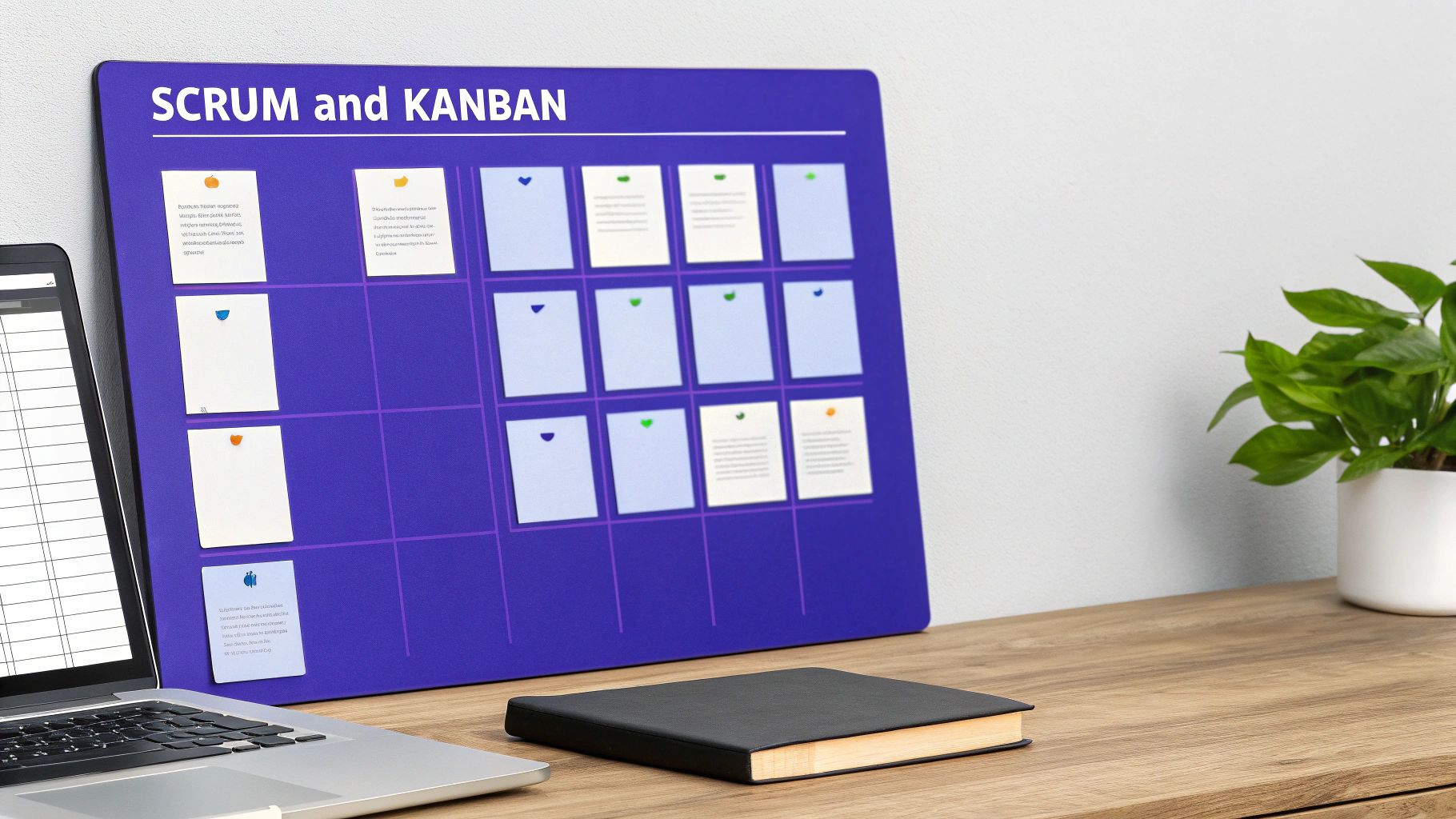
At the heart of any solid agile online course are the frameworks that give your workflow some real structure. Think of Agile as the overall mindset—being flexible, responsive, and collaborative. Frameworks like Scrum and Kanban are the practical, day-to-day operating systems that bring that philosophy to life.
Getting to grips with these two powerhouses is a game-changer for any development team looking to sharpen up its processes. They aren’t competitors; they're different tools for different jobs. The right choice depends entirely on your team's size, the type of projects you're tackling, and how work flows into your pipeline. Let's break them down.
Scrum: The Structured Sprint for Focused Delivery
Scrum is easily the most popular Agile framework out there, and for good reason. It’s built around short, time-boxed cycles called sprints, which usually last between one and four weeks. The goal of every single sprint is to deliver a small, working, and potentially shippable piece of the final product.
Imagine you're building a complex mobile app. Instead of a "big bang" release after months of work, a Scrum team breaks it down. One sprint might focus purely on user login, the next on the main dashboard, and so on. This rhythm allows for constant feedback and course correction, making sure what you build is what users actually want.
To keep things moving, Scrum introduces specific roles and events:
- Product Owner: This person is the voice of the customer and stakeholders. They manage the product backlog—a prioritised to-do list for the entire project.
- Scrum Master: Don't mistake them for a project manager. The Scrum Master is a coach and facilitator whose main job is to remove obstacles, shield the team from distractions, and keep the Scrum process running smoothly.
- Development Team: This is a self-organising group of professionals (developers, designers, testers) with all the skills needed to turn backlog items into a finished product.
Scrum's real power is its structured rhythm. The regular cycle of planning, daily stand-ups, reviews, and retrospectives creates a predictable pulse for the project. This makes it much easier to track progress and adapt to changes without losing momentum.
Kanban: The Visual Flow for Continuous Improvement
If Scrum is a series of timed races, Kanban is more like a continuous relay. It’s a highly visual method that's all about managing workflow and, crucially, limiting the amount of work in progress (WIP). The main tool here is the Kanban board, which gives you a simple, at-a-glance view of tasks as they move through stages like 'To Do', 'In Progress', and 'Done'.
Kanban's primary aim is to improve flow and instantly highlight bottlenecks. By setting limits on how many tasks can be in any single column at once (the WIP limit), you force the team to focus on finishing work before starting something new. This simple rule stops people from getting overloaded and shows you exactly where the process is getting stuck.
This framework is brilliant for teams handling a constant stream of varied tasks, like a support team or a crew managing ongoing app maintenance. There are no fixed sprints, so priorities can change on the fly without disrupting the whole team. A high-priority bug fix can be pulled into the 'In Progress' column as soon as there's capacity, making the team incredibly responsive.
Choosing the Right Fit for Your App Development Team
For many software and app development teams here in the UK, it’s not always a clear-cut choice between Scrum and Kanban. Scrum offers fantastic structure for new, complex projects with well-defined goals. Kanban, on the other hand, delivers supreme flexibility for continuous delivery and support work.
Often, the best-performing teams—especially in the Flutter development space—end up with a hybrid approach. They might use Scrum's sprints and roles for building major new features but manage day-to-day bug fixes and minor updates on a Kanban board.
A quality agile online course will give your team the confidence to experiment and find the perfect system that makes their workflow smooth, predictable, and seriously efficient.
Understanding Agile Certifications and Their Real-World Value
Once your team gets to grips with the core frameworks, the next question is usually about formal qualifications. Is an agile online course that ends in a shiny new certification actually worth the investment? For most professionals and businesses here in the UK, the answer is a big yes—but you need to know which ones genuinely carry weight in the industry.
Think of a recognised certification as a common language. It signals to employers, clients, and colleagues that you have a standardised, solid understanding of Agile principles and practices. It’s not about just adding a few letters after your name; it’s proof you have the practical skills needed to steer projects to success in a fast-moving environment.
Popular Certifications in the UK Tech Scene
While there's a sea of qualifications out there, a handful consistently stand out for their industry recognition and the real-world value they provide. These are the certifications that specialised agile training often centres on, helping people take a significant step up in their careers.
For example, credentials like the Certified ScrumMaster® (CSM) and the Agile Coaching Certification (ICP-ACC) remain in high demand across the UK. This reflects a clear need for skilled professionals who can manage hybrid teams and effectively roll out Agile practices across entire departments. The right agile online course for you will really depend on your specific role and where you want to go next. You can get a feel for the 2025 trends in the UK's agile training landscape on batdacademy.com.
This strong demand really highlights the value that UK businesses are placing on formal Agile qualifications.
Decoding the Top Scrum Master Credentials
For anyone stepping into a leadership or facilitator role, the Scrum Master certifications are the natural first port of call. Two of the most respected are the Certified ScrumMaster® (CSM) and the Professional Scrum Master™ (PSM). They might sound similar, but they have some important differences.
- Certified ScrumMaster® (CSM): This one is offered by the Scrum Alliance and requires you to attend a two-day course led by a Certified Scrum Trainer. The focus is very much on understanding Scrum principles and the Scrum Master's role from the ground up. It’s perfect for people who thrive in an interactive, hands-on learning environment.
- Professional Scrum Master™ (PSM): Governed by Scrum.org, the PSM doesn't force you into a classroom. You can study on your own time, but you have to pass a pretty tough assessment to get certified. This route often appeals to those who are confident in their knowledge and want to prove it by passing a challenging exam.
Both the CSM and PSM are highly regarded, but they signal slightly different things. The CSM proves you've had expert-led, interactive training, while the PSM demonstrates a deep, tested knowledge of the Scrum framework. The right choice really comes down to how you prefer to learn and what message you want to send to potential employers.
To get into the nitty-gritty of these qualifications, have a look at our complete UK Scrum Master certification and training guide for a more detailed breakdown.
Deciding on the right certification is a critical step, so it helps to see how the main contenders stack up.
Comparison of Popular Agile Certifications in the UK
This table breaks down the key aspects of the most sought-after Agile certifications, making it easier for you and your business to pick the right path.
| Certification | Best For (Role) | Core Focus | Governing Body |
|---|---|---|---|
| CSM® | Aspiring Scrum Masters, Team Leads | Foundational Scrum, Role of Scrum Master, Interactive Learning | Scrum Alliance |
| PSM™ | Experienced Practitioners, Self-Starters | Deep Scrum Knowledge, Framework Mastery, Rigorous Assessment | Scrum.org |
| ICP-ACC | Agile Coaches, Experienced Scrum Masters | Coaching, Mentoring, Facilitating Agile Adoption at a Team Level | ICAgile |
| SAFe® Agilist | Enterprise Leaders, Managers, Consultants | Scaling Agile Across Large Organisations, Lean-Agile Principles | Scaled Agile, Inc. |
Each of these certifications opens up different doors. Your choice should align with whether you're focused on team-level facilitation, large-scale enterprise transformation, or deep framework expertise.
Who Benefits Most from Agile Certification?
Agile certifications aren't just for people with "Scrum Master" in their job title. Almost everyone on a development team can gain a massive advantage from formal training, leading to a much more cohesive and effective unit.
- Developers: Certifications help developers truly understand their place within the Agile process, which dramatically improves collaboration with product owners and testers. This is especially valuable for Flutter teams, where tight feedback loops and high performance are everything.
- Project Managers: For traditional project managers, an Agile certification can be a bridge to new roles like Product Owner or Agile Coach. It teaches them how to shift their focus from rigid plans to delivering genuine value.
- Business Leaders: When managers and executives understand Agile, they get a clearer picture of how their development teams operate. This insight allows them to better support the team’s adoption of Agile and set realistic, value-driven goals for projects.
Ultimately, deciding to get certified via an agile online course is about matching your professional goals with what your organisation needs. It gives you a structured way to master skills that you can immediately apply to deliver better products, faster—a powerful advantage in any market.
How to Choose the Right Agile Course for Your Team
Picking the perfect agile online course isn't as simple as a quick search and click. It's a strategic move that needs to align with your team's reality – their current skills, their daily workload, and what you actually want them to do differently. Not all courses are created equal, and the right one will give your team practical skills they can use tomorrow, not just a head full of theory.
To make a smart choice, you need to look past the marketing fluff and get into the specifics. Having a clear framework helps you weigh up the options and put your money into training that genuinely pays off.
A Practical Checklist for Course Selection
Before you commit to any training, it pays to run through a quick mental checklist. A course might look slick on the outside, but it’s what’s under the bonnet that really counts for long-term success.
- Instructor Experience: Who’s actually teaching? Look for trainers who have spent years in the trenches as Agile coaches or Scrum Masters. You want someone with real-world war stories and the ability to answer tough, practical questions, not just someone who can recite a textbook.
- Curriculum Depth: Does it go beyond the basic definitions? A solid curriculum should be packed with hands-on exercises, relevant case studies, and workshops that mimic the challenges your team faces every day.
- Accreditation and Recognition: Is the course backed by a respected body like the Scrum Alliance or Scrum.org? This is your quality assurance stamp, ensuring the content is up to industry standards and any certification earned actually means something.
- Focus on Practical Application: The whole point is to get your team doing Agile, not just talking about it. Prioritise courses that are heavy on hands-on practice over those that are just a series of lectures.
This simple flowchart can help you map your team’s goals to the right kind of certification.
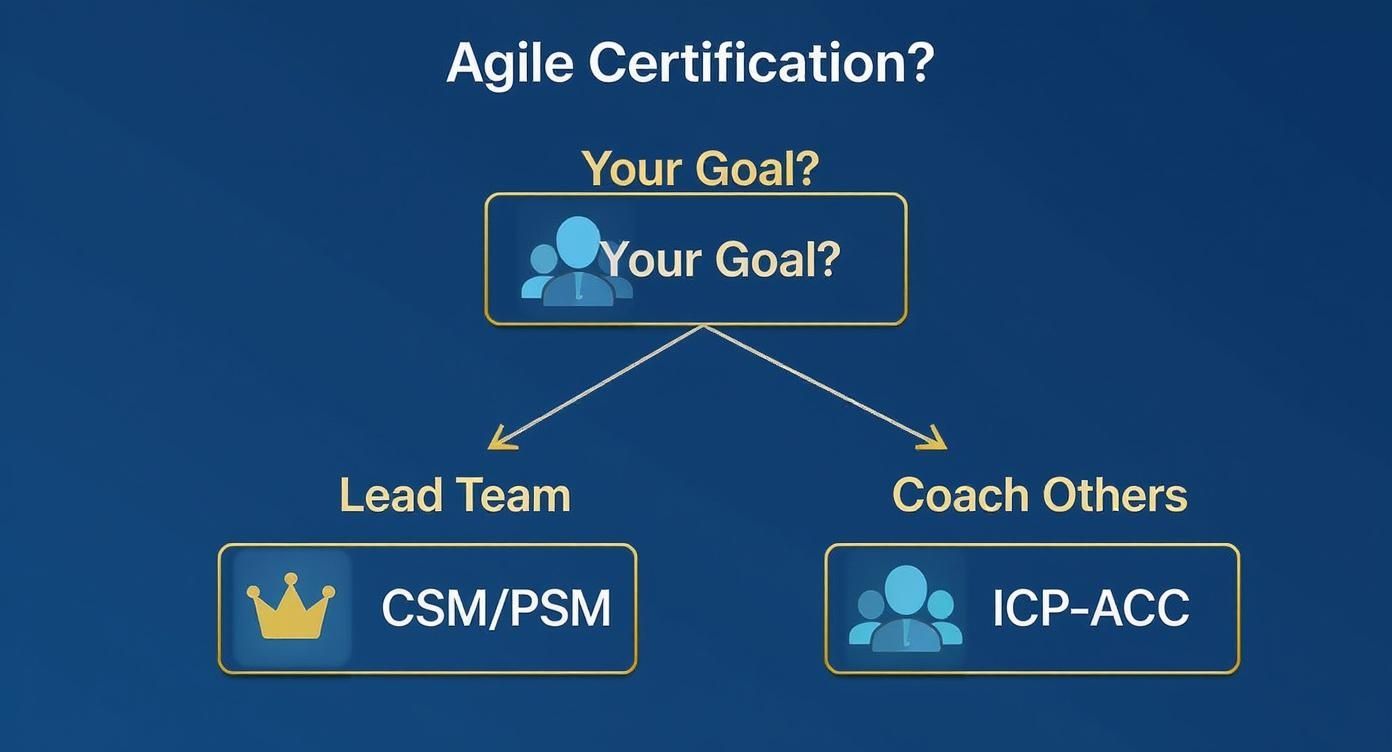
As you can see, the path you choose should directly reflect your main objective—whether that's leading a delivery team or learning how to coach others to be more agile.
Live Classrooms Versus Self-Paced Learning
Another huge decision is the format. Do you go for a live, instructor-led virtual class or a self-paced, on-demand course? The answer usually comes down to your team’s learning style and their schedules. Both have their pros and cons.
Live Virtual Classrooms are brilliant for teams who learn best by interacting. They give you:
- Real-time Q&A sessions with an expert.
- The chance to bounce ideas off other attendees and solve problems together.
- A set schedule that keeps everyone on track and accountable.
On the flip side, Self-Paced Learning offers ultimate flexibility. This is the way to go for:
- Teams with packed or conflicting schedules who need to learn in their own time.
- People who like to rewind, re-watch sections, and take their own detailed notes.
- Spreading the cost of training out over a longer period.
The demand for Agile skills in the UK is soaring, and the online training market has exploded to meet it. Top providers are enrolling tens of thousands of learners. Popular courses like AgilePM and Scrum Foundation have seen over 13,500 and nearly 12,000 participants, respectively. With prices typically falling between £600 and £2,300 and consistently high satisfaction ratings, it's a mature market. You can explore more on the UK's agile certification course landscape on invensislearning.com.
The best format really boils down to your team’s culture. If you thrive on collaboration and shared learning experiences, a live course is probably the better fit. If your team is full of self-starters who need to squeeze learning around tight deadlines, self-paced is your friend.
Ultimately, choosing the right agile online course means taking a careful look at what your team truly needs. By using a solid checklist to judge the quality and matching the format to your team's workflow, you’ll find a programme that genuinely sets them up to solve real-world problems and deliver fantastic results.
Unlocking Performance for Flutter Development Teams
For any app development team in the UK, the partnership between Agile and Flutter just makes sense. Flutter is built for speed. It allows developers to create beautiful, natively compiled apps for mobile, web, and desktop—all from one codebase. The latest benchmarks consistently put Flutter at the top for performance, but raw coding speed is only half the story. To really harness that power, you need a workflow that can keep up. That’s where Agile comes in.
An agile online course gives your Flutter team the tools to transform that raw development velocity into a predictable, high-performance delivery machine. It’s the perfect match: a high-speed development framework paired with a highly adaptable project management mindset. This combo helps your team build, test, and release features faster and more reliably than ever before, giving you a real edge in the competitive UK app market.
How Scrum Amplifies Flutter's Strengths
Scrum is a fantastic fit for managing complex Flutter projects. Its structured, sprint-based rhythm provides the perfect container for Flutter’s iterative development style. Let’s say you’re building a sophisticated new e-commerce app. A Scrum framework helps you break that massive project down into manageable chunks.
Your product backlog becomes a clear, prioritised roadmap of features. Sprints, which usually last two weeks, allow your team to focus intensely on a small batch of those features—like building the product detail screen or integrating a new payment gateway. At the end of each sprint, you have a tangible, working piece of the app to show for it.
This steady rhythm brings several huge benefits to a Flutter team:
- Predictable Release Cadence: Sprints create a consistent development pulse, which makes it much easier to forecast when new features will actually be ready for release.
- Focused Feature Development: By zeroing in on a small set of user stories per sprint, developers can fully tap into Flutter’s rich widget library and hot reload function to build and polish features in record time.
- Enhanced Quality Control: Every sprint ends with a review. This means you get immediate feedback and can test new code right away, ensuring bugs are caught early before they get buried deep in the codebase.
Managing Cross-Platform Complexity with Agile
One of Flutter’s biggest selling points is its cross-platform capability. But building for both iOS and Android at the same time introduces its own headaches, from tiny platform-specific UI tweaks to juggling device testing. This is another area where Agile principles really shine.
By weaving continuous testing and feedback loops into every sprint, your team can tackle platform-specific issues as soon as they pop up. This proactive approach prevents those last-minute scrambles right before a big release. Better yet, automating your build and deployment pipelines is a cornerstone of modern Agile development. You can dive deeper into how this works in our guide on what continuous integration is for Flutter apps—a practice that slots perfectly into a Scrum workflow.
Agile doesn’t just manage a project; it optimises the entire development ecosystem. For Flutter teams, this means transforming the challenge of cross-platform development into a streamlined, efficient, and reliable process that consistently delivers high-quality results.
Ultimately, investing in an agile online course is a direct investment in your Flutter team’s output. It provides the structure needed to organise complex feature backlogs, the discipline to maintain a steady development pace, and the flexibility to respond to user feedback on the fly. By mastering Agile, your team can finally unlock Flutter's true potential, ensuring your projects are not only built fast but built right.
Your Action Plan for Implementing Agile
Finishing an agile online course is just the beginning. The real challenge—and where the value lies—is turning that theory into practice. To keep the momentum going, you need a clear, practical roadmap. The secret is to start small, build confidence, and show some quick wins.
Don’t even think about a company-wide rollout straight out of the gate. That’s a recipe for disaster. Instead, launch a small pilot project with a team that’s genuinely keen to try it. Pick a low-risk but meaningful piece of work. This gives everyone a safe space to experiment and learn without the pressure, creating a success story you can use to get others on board.
Once your pilot is mapped out, you’ll need the right tools to keep things moving. It's easy to get bogged down in feature-heavy software, but simple and visual is often the best way to start.
- Jira: A powerhouse for established teams. It’s brilliant for detailed tracking, reporting, and connecting with other dev tools you’re already using.
- Trello: Absolutely perfect for beginners. Its drag-and-drop card system is incredibly intuitive, letting you visualise your workflow without a steep learning curve.
Establishing Your Core Rhythm
With a project and tools sorted, it’s time to embed the Agile ceremonies into your team's routine. These aren't just more meetings for the sake of it; they are the very heartbeat of your Agile process, creating a steady rhythm of communication, feedback, and improvement.
The daily stand-up is non-negotiable. This quick, 15-minute check-in keeps everyone on the same page, brings blockers to the surface immediately, and builds a sense of shared ownership. Making this a consistent habit is one of the fastest ways to start building an Agile culture.
Finally, you need to know if what you're doing is actually working. Define what success looks like by tracking a few simple metrics. Start with the basics like cycle time (how long a task takes from start to finish) and team velocity (how much work the team gets through in a sprint). This data isn't for judging people; it's for giving you objective insights to help you improve.
Of course, the cost of training is always a factor. In the UK, agile certification courses can vary quite a bit, typically falling between £300 and £2,300, depending on the accreditation body. You can find options from the International Consortium for Agile starting around £188, while more specialised SAFe courses are closer to £331. It’s worth checking out more insights about popular Agile certifications on coursera.org to help you budget properly. By taking this gradual, structured approach, your move to Agile will be smoother and far more likely to stick.
Got Questions? We've Got Answers
Stepping into the world of Agile training can feel a bit like learning a new language. To help you get your bearings, we’ve put together some straightforward answers to the questions we hear most often from teams here in the UK. No jargon, just clear advice.
How Long Does an Agile Certification Take?
The time it takes to get certified really depends on the path you choose. If you're going for a credential like the Certified ScrumMaster® (CSM), you’re typically looking at an intensive two-day workshop. After that, you’ll have a set window to hop online and complete the exam.
On the other hand, self-paced qualifications like the Professional Scrum Master™ (PSM) offer more flexibility. There’s no mandatory training time, so you can study the material on your own schedule and take the assessment whenever you feel ready. It’s a great option if you’re juggling a busy work life.
Can Non-Technical Teams Benefit from Agile?
Absolutely. While Agile’s roots are in software development, its core ideas—transparency, inspection, and adaptation—are gold for just about any team. We see marketing, HR, and even legal departments using frameworks like Kanban to get a better handle on their workload, improve visibility, and pivot when priorities shift.
An agile online course gives these teams the tools to:
- Map out their workflow and spot any bottlenecks.
- Chop up massive projects into smaller, more manageable pieces.
- Boost collaboration and keep everyone in the loop.
- Deliver value back to the business at a steady, consistent pace.
At the end of the day, Agile is about finding a smarter way to work, and that’s something every team can get behind.
What Is the Main Difference Between Scrum and Kanban?
The easiest way to think about the difference is to compare their rhythm and structure. Scrum is highly structured, running on fixed-length cycles called sprints (usually two weeks). In each sprint, the team commits to delivering a specific batch of work. It’s quite prescriptive, with defined roles and ceremonies designed to create a predictable cadence.
Kanban, in contrast, is all about flow. It’s a much more fluid system that focuses on visualising your work, limiting how much you’re doing at once (WIP), and getting tasks over the finish line as soon as they’re ready. There are no sprints or rigid roles, making it perfect for teams dealing with a constant stream of incoming requests, like a customer support desk.
Think of Scrum as a train service—it runs on a fixed schedule and carries a planned load. Kanban is more like a fleet of taxis, always ready to pick up the next most important job as soon as a cab is free.
At App Developer UK, we don't just talk Agile; we live it. We build high-performance, custom mobile applications with Flutter, using Agile to deliver stunning results, fast. If you’re ready to build an app with a team that gets it, let's talk. Check out our services at https://app-developer.uk.