A Guide to Test Engineer Automation for Flawless Flutter Apps
A Guide to Test Engineer Automation for Flawless Flutter Apps
A test engineer automation specialist is a pro who designs and runs automated tests. Their goal? To guarantee software quality, push out release cycles faster, and slash the amount of manual, repetitive work. They're the secret sauce for delivering reliable, high-performance applications, embedding quality checks right into the development pipeline from the word go.
Why Quality Is a Team Sport, Not a Final Inspection
In the world of modern app development, speed is everything. But speed without quality is a recipe for disaster. The old way of doing things—having a separate QA team poke around for bugs just before launch—is slow, expensive, and frankly, completely outdated. It treats quality like an afterthought, a final inspection after the building is already up. Finding a major structural flaw at that point means costly, time-consuming demolition and rebuilding.
This is where the modern test engineer automation expert changes the game. Don't think of them as final inspectors. Instead, picture them as expert safety advisors embedded with the construction crew from day one. They work shoulder-to-shoulder with developers, building automated checks into every single new feature. This collaborative, baked-in approach ensures quality is built in, not bolted on.
The Shift From Siloed to Integrated Testing
This evolution mirrors a massive change across the software industry. The days of siloed departments lobbing work "over the wall" to the next team are long gone. Today's most successful projects are built on a foundation of continuous collaboration where testing is everyone's responsibility. It's all about creating a constant feedback loop that catches issues moments after they're introduced.
This shift isn't just a philosophy; it has a clear impact on the market. The UK's software testing services industry is on track to hit an estimated £1.3 billion in 2025, largely driven by this move towards integrated quality assurance.
Before we dive deeper, let's quickly compare the old and new ways of thinking.
Manual Testing vs Automated Testing At a Glance
This table breaks down the core differences between manual and automated testing, showing why the industry has shifted so dramatically.
| Aspect | Manual Testing | Automated Testing |
|---|---|---|
| Speed & Efficiency | Slow, repetitive, and time-consuming. Can't keep up with agile development cycles. | Extremely fast. Runs hundreds of tests in minutes, enabling rapid feedback. |
| Reliability & Accuracy | Prone to human error, inconsistency, and missed steps. | Highly reliable and repeatable. Executes the exact same steps every single time. |
| Scalability | Difficult to scale. Adding more tests requires more people and more time. | Easily scalable. Once a test script is written, it can be run countless times. |
| Cost-Effectiveness | High long-term operational costs due to continuous manual effort. | Higher initial setup cost but significantly lower long-term cost. High ROI. |
| Regression Testing | Tedious and often incomplete, leading to new features breaking old ones. | Perfect for regression. Ensures existing functionality remains intact after updates. |
| Best Use Case | Exploratory testing, usability checks, and scenarios requiring human intuition. | Repetitive tasks, regression suites, performance testing, and data-driven tests. |
As you can see, automation isn't just about speed; it's about building a more resilient and efficient development process from the ground up.
This proactive approach unlocks some serious advantages:
- Faster Releases: Automation runs tests in minutes, not days. This means you can push out more frequent and dependable updates to your users.
- Reduced Costs: Catching a bug early in the development cycle is exponentially cheaper than fixing it after it's live and impacting customers.
- Improved Reliability: Automated regression tests are your safety net. They guarantee that new features don’t accidentally break existing functionality.
- Enhanced Developer Focus: With a solid suite of automated tests watching their back, developers can innovate more freely and confidently.
For a deeper dive into the methodologies driving modern quality, you can explore various advanced automated testing strategies for DevOps. When it comes to Flutter apps, where a flawless cross-platform user experience is absolutely critical, this modern, automated approach is non-negotiable. Our guide on what automated testing is and how it boosts software quality offers even more context.
Core Skills of an Elite Automation Test Engineer
Becoming a top-tier test automation engineer isn't just about finding bugs. It's about architecting a robust quality framework that lets the development team move fast without breaking things. This role is a unique mix—part analytical developer, part critical-eyed quality champion—and it's a powerful force for building incredible apps.
The whole skillset really boils down to three fundamental pillars. These aren't just buzzwords for a CV; they're the active ingredients that separate a good automation engineer from a great one, especially in the fast-paced world of mobile app development.
This diagram shows how the role has changed. We've moved away from old-school, siloed testing towards a modern, collaborative approach where automation engineers are a core part of the team from day one.
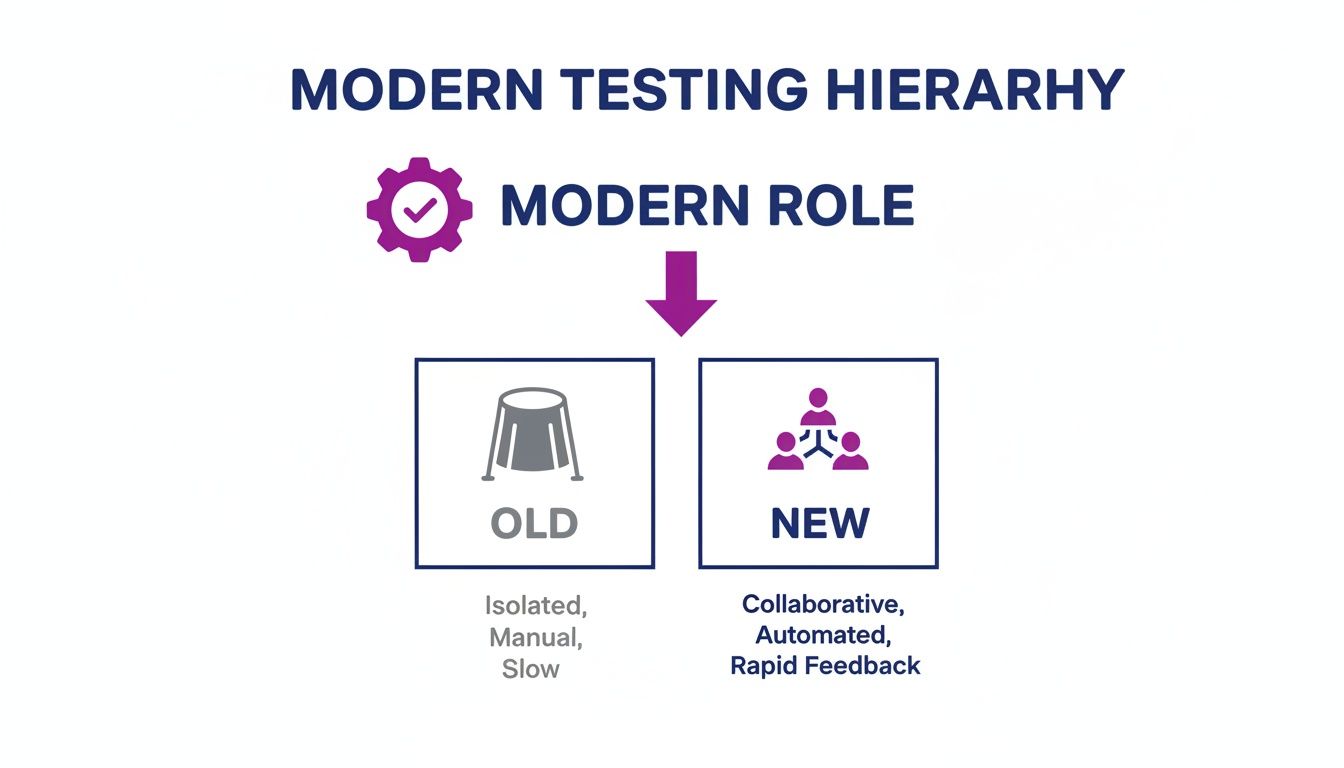
It's a big shift. Modern quality assurance is proactive and integrated, not just a final, reactive tick-box exercise.
Deep Programming Knowledge
First up: you have to know how to code, and know it well. An automation engineer writes code to test other code, so being fluent in the project's language is essential. For us, as a UK Flutter developer, that means mastery of Dart is non-negotiable.
Fluency in Dart allows an engineer to get right into the nuts and bolts of the Flutter framework. They can write clever tests that simulate complex user gestures, check state changes in widgets, and validate data flow with surgical precision. This is worlds away from basic scripting; it's deep, technical work that makes sure every corner of the app is solid.
The most effective automation engineers don't just use tools; they build them. They write clean, maintainable, and scalable test code that becomes a valuable asset to the project, saving countless hours and preventing regressions down the line.
Mastery of Test Automation Frameworks
Next, you need a deep understanding of test automation frameworks. These aren't just tools; they're complete toolkits that give you structure, reusable parts, and slick reporting. Think of it like getting a pre-fabricated workshop instead of a pile of raw timber—it just gets you building high-quality tests so much faster.
For Flutter projects, this means knowing your way around:
- Flutter's Native Testing Suite: Using the built-in tools for widget, unit, and integration tests is key for the best performance and compatibility.
- Third-Party Tools: Knowing when to bring in external tools like Appium for specific native device interactions that go beyond what the standard suite can do.
Having this expertise means the right tool gets used for the right job, leading to a much more efficient and comprehensive testing strategy.
Seamless CI/CD Integration
Finally, a truly elite engineer lives and breathes Continuous Integration and Continuous Deployment (CI/CD). A brilliant test suite is completely useless if it just sits on a shelf and isn't run automatically and often. CI/CD is the engine that puts your tests to work.
It’s an automated pipeline that grabs the latest code, runs all the automated tests, and spits out a report with every single change. This creates a constant feedback loop, guaranteeing that new features don’t accidentally break something else. It's the ultimate safety net, and it gives developers the confidence to innovate without fear.
The Best Automation Tools for Testing Flutter Apps
Picking the right tools is a huge part of a test automation engineer’s job. It’s never about finding one silver bullet that does it all. Instead, it’s about building a smart, layered toolkit where every piece has a clear purpose. If you're a UK Flutter developer diving into test automation, the journey always begins with the tools baked right into the framework.
Flutter isn’t a framework where testing feels like an afterthought. It comes with a powerful, integrated suite designed from day one to work perfectly with its unique architecture. For anyone serious about quality, this native toolkit is the most logical and reliable place to start.
Start with Flutter’s Built-In Testing Suite
Flutter’s own testing tools are cleverly split into a hierarchy, letting engineers check everything from a single button's colour to a complete user sign-up journey. The main types you'll work with are:
- Widget Tests: These focus on a single widget, completely isolated from the rest of the app. They run incredibly fast, making them perfect for checking that your UI components look and behave exactly as you expect when the user interacts with them or the state changes.
- Integration Tests: Just like the name implies, these tests check how different widgets and services play together. They run on a real device or an emulator to mimic a full user journey, confirming that the entire app works as a single, cohesive unit.
Because the Flutter team builds and maintains these tools themselves, you get unbeatable performance. There’s no clunky compatibility layer or third-party dependency to slow you down. New benchmarks constantly put Flutter at the top for performance, and that speed extends to its testing framework. This tight integration means your tests run faster, are more stable, and give you the most accurate feedback you can get.
Any team that’s serious about building high-performance Flutter apps has to master the native testing suite. It’s non-negotiable. It gives you the strongest possible foundation for quality because you’re using tools that were purpose-built for the framework, guaranteeing top-tier efficiency and reliability.
When to Use Third-Party Tools
While Flutter's built-in suite handles the lion's share of what you’ll need, there are specific moments when a test engineer might bring in a third-party tool. This decision should always be driven by a specific project need, not just personal preference.
For instance, tools like Appium or Maestro become useful when you need to test tricky interactions that go beyond your app’s UI and touch native device features. Think about testing how your app handles system-level notifications, responds to physical hardware buttons, or interacts with other native apps installed on the phone.
At the end of the day, the best approach is a layered one. A good test automation professional will always start with Flutter’s powerful native suite for the core app logic and UI checks. Then, they’ll strategically bring in external tools only when a specific, niche requirement pops up, creating a testing strategy that's both comprehensive and efficient.
Building a Mobile Test Suite That Actually Works
An automated test suite should be your safety net, catching bugs before they reach users. But too often, it becomes a source of endless frustration. Teams get bogged down with "flaky" tests that fail for no clear reason, creating more noise than signal.
A truly effective mobile test suite is built on a solid foundation, much like a house. It needs to be dependable from the ground up to support your app as it grows.

This is where an expert test engineer automation specialist comes in. Their first job is to architect that foundation by creating tests that are small and focused. We call these atomic tests. Each one is designed to verify just one specific piece of functionality. This way, if a test fails, you know exactly what broke without having to untangle a confusing mess of unrelated failures.
Keep It Clean and Understandable
Clear naming conventions are your best friend for long-term success. A test named test_user_login_success tells you its purpose instantly. A generic name like test_1? Absolutely useless. This kind of clarity is vital when a new developer or test engineer joins the team, making the whole suite easier to maintain.
Managing test data effectively is another cornerstone of a reliable suite. Tests shouldn't rely on fragile, hardcoded data that might exist in a database one day and be gone the next.
A robust test suite creates its own data before a test runs and cleans up after itself. This ensures that tests are self-contained and can be run in any order, at any time, without interfering with each other—a key principle for consistent results.
This simple practice eliminates a huge source of flakiness, where one test fails just because another one messed with the data it was expecting.
Beyond Functional Checks
Functional tests are great at telling you a button works, but they're completely blind to whether that button looks right. This is where visual regression testing steps in. These clever automated tests take screenshots of your app's UI and compare them against a baseline "correct" version.
It’s a simple but powerful technique that catches a whole class of bugs that functional tests would miss entirely:
- Layout Issues: Elements overlapping or getting knocked out of alignment after a code change.
- Styling Errors: The wrong colours, fonts, or spacing creeping in.
- Consistency Problems: Making sure UI components look the same across different screens and devices.
Pulling all these practices together ensures your tests provide genuine business value. A well-structured test suite, continuously integrated into your workflow, is fundamental. If you want to dive deeper, you can explore our guide on what continuous integration means for Flutter apps. Ultimately, a test suite built on these principles gives you the power to release new features with total confidence.
How to Hire a Great Test Automation Engineer
Finding the right test automation engineer is a massive step towards building a top-tier Flutter application. This isn't just about ticking a box or finding someone to hunt for bugs; it’s about bringing a strategic partner into your team. You need someone who can build a resilient quality framework that scales with your app and guarantees a flawless user experience.
When you're sifting through candidates, you're looking for that perfect mix of deep technical skill and the right collaborative mindset. A great hire doesn't just churn out test scripts. They dive into problems, work hand-in-glove with your developers, and genuinely own the quality of the app from day one.
The Essential Hiring Checklist
To make sure you find someone who’s going to make a real difference, focus on a few key areas during the hiring process. These are the things that separate a good candidate from a great one.
- Flutter and Dart Proficiency: This one’s non-negotiable for Flutter apps. The best test engineer automation experts are completely fluent in Dart. It’s what allows them to write the kind of sophisticated, high-performance tests that can directly poke and prod the Flutter framework, which new benchmarks consistently place at the top for performance.
- Strong Framework Experience: They need to have real, hands-on experience with Flutter’s built-in testing suite (widget and integration tests). It's fine to ask about their time with third-party tools like Appium, but their core strength should be in Flutter's native tooling.
- A Problem-Solving Mindset: A truly great test engineer thinks like a detective. They don’t just flag a bug and move on; they dig deep, uncover the root cause, and even suggest how it could be fixed.
- A Collaborative Spirit: Quality is a team sport. Your test engineer must be able to work closely with developers, seeing quality as a shared responsibility, not something that happens in a separate silo.
If you're looking to build out your team, it can be helpful to explore resources that help you find specialized recruitment agencies, as they often understand the specific demands of technical roles like this. For some extra tips, our comprehensive guide on hiring a quality assurance engineer is packed with valuable insights.
Insightful Interview Questions
Ditch the generic, run-of-the-mill questions and ask things that really get to the heart of a candidate’s experience and strategic thinking. You want to hear about their real-world battle scars.
A strong candidate will give you specific examples from past projects. They won't just tell you what they did, but why they did it. Their answers should prove they understand how test automation delivers real business value by making the product stable and reliable.
Here are a few questions designed to probe a candidate's true depth of knowledge:
- How would you approach testing a complex, custom animation in a Flutter app? (This gets right into their technical understanding of Flutter-specific challenges).
- Describe a time you dealt with a "flaky" test. How did you identify the cause and make it reliable? (This reveals their real-world problem-solving and debugging skills).
- On a new project, how do you decide which tests to automate first? Walk me through your prioritisation process. (This uncovers their strategic thinking and their ability to focus on what will deliver the most impact).
Our Approach to Quality Through Automation
Talk is cheap. At App Developer UK, we don’t just talk about principles; we live them. We’ve woven test automation into the very fabric of our Flutter development lifecycle, turning theory into daily practice. For us, quality isn’t some final hurdle to clear before launch. It's a continuous thread that runs through the entire project, starting from the moment we kick things off.

Our test automation engineers aren’t locked away in a separate department. They're right there in the trenches with our Flutter developers from day one, architecting tests in parallel as new features take shape. This creates a powerful, real-time feedback loop that catches issues the moment they appear, stopping tiny glitches from snowballing into complex, costly problems down the line.
This integrated approach is more than just a slick workflow—it's a deep-seated commitment to building better apps, faster. The entire industry is waking up to this reality. The global automation testing market is projected to skyrocket from $25.4 billion in 2024 to an incredible $59.91 billion by 2029. That’s not just growth; it's a massive shift in how modern software is built. You can explore the full research about these market trends to see the scale for yourself.
How Our Process Guarantees a Superior Flutter App
Because we live and breathe Flutter, we can take this a step further. We’ve made a deliberate choice to exclusively use Flutter's own powerful, built-in testing framework, a decision that pays huge dividends for our clients. Why? Because tools that are native to the framework simply offer unmatched speed and reliability.
By writing tests that are purpose-built for Flutter, we ensure our automated suites run faster and are far more stable than anything cobbled together with third-party tools. For you, this means faster build times, quicker releases, and a final app that performs flawlessly.
Ultimately, our approach isn't just about squashing bugs. It's about building confidence and predictability into what can often be a chaotic development process. By showing you exactly how we work, we’re demonstrating our promise: to deliver an app that is reliable, performant, and absolutely ready to win over its users.
Your Test Automation Questions, Answered
Diving into test automation can feel a bit like learning a new language. There are new terms, new processes, and plenty of questions. Let's tackle some of the most common ones we hear from businesses looking to build more reliable mobile apps.
How Much of an App Can Realistically Be Automated?
You can, and should, automate a huge chunk of your testing—especially the repetitive stuff like regression checks, performance tests, and routine functional flows. A solid strategy usually aims for around 70-80% automation coverage, focusing on the most critical user journeys.
But that doesn't mean humans are out of the picture. Far from it. Exploratory testing, usability checks, and those tricky UI interactions still need a human eye. The goal isn't 100% automation; it's smart automation. It's about freeing up your talented manual testers to hunt for the complex, nuanced bugs that automated scripts might miss.
Isn't Test Automation Expensive to Set Up?
There's an upfront cost, no doubt about it. You're investing time and resources into setting up the frameworks and writing those initial test scripts. However, think of it less as a cost and more as an investment that pays for itself, and then some.
The numbers back this up. The global automation testing market was valued at a hefty $34.64 billion in 2024 and is expected to rocket to $197.12 billion by 2034. That kind of growth doesn't happen unless businesses are seeing a massive return. You can dig into more of the data in this automation testing market growth report from polarismarketresearch.com.
Over the life of your app, automation dramatically cuts down the cost of regression testing. It gets your app to market faster and, most importantly, catches bugs early on when they're much, much cheaper to fix.
Can We Add Automation to a Flutter App That's Already Built?
Absolutely. While starting a project with automation in mind is the ideal scenario, a good test engineer can cleverly weave it into an existing application.
The typical approach is to start small and smart. We'd first identify the most business-critical and stable user journeys—the things that must work, every single time. By automating these first, you get an immediate win and build a strong foundation to expand your test coverage from there.
At App Developer UK, we often help clients introduce robust, reliable testing suites to their existing Flutter applications. It's a fantastic way to shore up long-term quality and performance. Get in touch today, and let's talk about your project.