What Is an Emerging Technology A UK Business Guide
What Is an Emerging Technology A UK Business Guide
When you hear the term "emerging technology," what comes to mind? Too often, it gets tossed around as just another buzzword. But it’s much more than that.
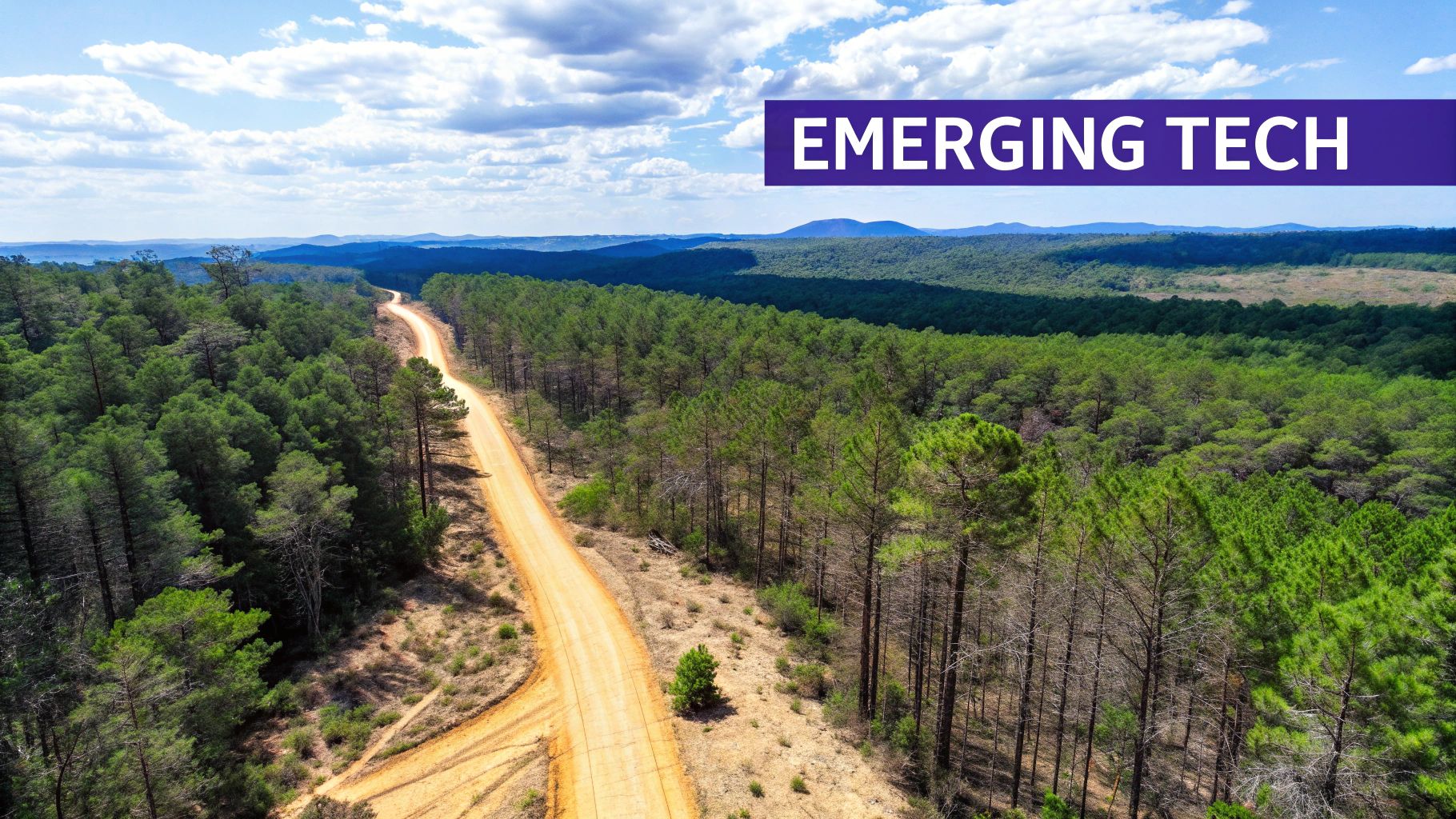
Think of it like a promising new trail being forged in a dense forest. It’s not a paved motorway just yet, but it’s gaining traction fast and clearly leads somewhere exciting. These technologies aren't just minor upgrades; they represent major shifts in how we do business.
Decoding Emerging Technology
So, what does this mean in practical terms for a UK business leader? It’s about spotting innovations with the power to create entirely new markets, disrupt established ones, and hand a significant competitive advantage to those who get in early.
These aren't simply better versions of old tools. They introduce entirely new ways of doing things. For instance, the leap from traditional marketing to AI-driven personalisation wasn’t just a better way to send emails; it was a completely different way of understanding and interacting with customers on a one-to-one level.
This distinction is crucial. It’s the difference between a fleeting fad and a genuine game-changer that will redefine your industry.
The Hallmarks of True Innovation
To separate the hype from the reality, you need a clear framework. A true emerging technology has a unique blend of novelty, rapid growth potential, and undeniable impact—all balanced by a healthy dose of uncertainty about its final form.
An emerging technology isn’t just about what’s new; it’s about what’s next. It forces businesses to rethink their models and processes to stay relevant and competitive in a changing market.
Understanding these core traits helps you evaluate new developments strategically. It’s a reliable filter that lets you focus your resources on the opportunities that can deliver real, substantial value, rather than chasing every shiny new object.
To help you spot true innovation, here's a quick rundown of the key characteristics that define an emerging technology.
Defining Characteristics of Emerging Technology
| Characteristic | What It Means for Your Business |
|---|---|
| Radical Novelty | It creates entirely new possibilities, not just small improvements. Think new revenue streams or business models you hadn’t even considered before. |
| Rapid Growth Potential | Once it finds its market fit, its adoption rate can explode. Being ready for this growth is key to capitalising on the opportunity. |
| High Uncertainty | Its future path isn't fully known. This brings risk for early investors but also immense opportunity for those who get it right. |
| Prominent Impact | It has the power to disrupt entire industries and change customer behaviour on a massive scale, creating new market leaders in the process. |
In short, these characteristics help you identify the signals from the noise, ensuring you're investing in the future, not just the fleeting present.
The Five Defining Traits of Emerging Tech
Telling the difference between a genuine breakthrough and a flash-in-the-pan trend can feel like pure guesswork. But when you look closely, a true emerging technology always has five core characteristics. Getting to grips with these traits gives you a solid framework for spotting real opportunities and sidestepping the hype.
First up is radical novelty. This isn't just about a slightly better version of what we already have. It’s about a technology that unlocks entirely new ways of doing things. Think about the leap from high-street shops to e-commerce; it didn’t just change how we sold things, it completely revolutionised business models, supply chains, and what customers expected.
For a UK business, this is where a real competitive advantage is born. It lets you build services or products that were simply impossible before, solving customer problems in ways your competitors haven't even thought of.
Fast Growth and Finding Its Feet
Once a new technology proves its worth, it hits a period of rapid growth. Its adoption rate can absolutely explode as more people grasp its value. Just look at the swift rise of cross-platform development frameworks. They started as a niche idea, but their ability to build high-quality apps for both iOS and Android from a single codebase caused a massive surge in adoption.
Frameworks like Flutter are a perfect example, showing exceptional performance in recent benchmarks and pushing their way to the front of the pack. This isn't just a fleeting spike in popularity; it signals a permanent shift in how the industry builds apps.
Following this explosion in growth, the technology starts to gain coherence. What was once a messy collection of ideas begins to solidify into a recognised field. It develops its own standards, best practices, and a community of experts. This is the stage where you see conferences being organised, specialised job roles appearing, and a whole ecosystem forming around it.
That coherence is a crucial green light for businesses. It means the technology is maturing into a stable, reliable platform you can confidently build long-term strategies on.
Big Promises and Big Risks
The fourth essential trait is prominent impact. An emerging technology doesn’t just offer small improvements; it has the potential to shake up entire industries and create huge economic value. It creates new winners and leaves others behind.
The real measure of an emerging technology’s impact is its ability to change the rules of the game. It forces established players to adapt or risk becoming obsolete while creating space for new challengers to rise.
This level of impact means the stakes are high. Simply ignoring a technology with this kind of potential is a huge risk, as it could redraw your market map when you’re not looking.
Finally, every emerging technology is surrounded by uncertainty and ambiguity. No one knows for sure what its final form will be or the full extent of its applications. This uncertainty naturally creates risk for anyone jumping in early, as there’s no guarantee of success.
But this is also where the biggest opportunity lies. For agile businesses willing to experiment and learn, that uncertainty is a window to get ahead of the curve. By carefully navigating this phase, you can position your company to lead the pack as the technology matures into a mainstream force. Understanding these five traits is the key to making that happen.
Emerging Technologies Shaping the UK Market
Knowing the theory behind an emerging technology is one thing, but seeing how it creates real-world opportunities is where the real value lies. For businesses across the UK, certain innovations are no longer just concepts on a whiteboard; they are actively creating tangible advantages, especially in the mobile and app development space.
Let's explore the key technologies that aren't just on the horizon but are here now, ready to be put to work. We’ll focus on three areas with massive potential for UK businesses looking to get ahead: Artificial Intelligence (AI), Edge Computing, and the ever-expanding 5G network. For each, we'll break down what it is and, more importantly, what it means for your business and your app.
Artificial Intelligence Driving Personalisation
Artificial Intelligence is easily the most visible emerging technology reshaping how businesses operate today. At its heart, AI is about creating smart systems that can handle tasks usually needing human intelligence, like learning from data, reasoning, and solving problems. For app development, this blows the doors wide open for creating more intuitive and genuinely engaging user experiences.
Instead of a one-size-fits-all app, AI allows your application to understand and adapt to individual users. This could mean personalising product suggestions in your e-commerce app, tailoring the content feed in a media app, or offering intelligent, automated customer support through chatbots. These features have moved from "nice-to-have" to essential for meeting modern user expectations.
AI stands out as a prime example of an emerging technology shifting from novelty to necessity. According to the Office for National Statistics (ONS), as of late September 2025, nearly a quarter (23%) of UK businesses reported using some form of AI, a huge jump from just 9% in September 2023. This isn't just a trend. The GOV.UK Technology Adoption Review 2025 projects that fully embracing AI could boost UK productivity by 1.5% annually, potentially adding a staggering £47 billion to the economy each year over the next decade.
The real power of AI in mobile apps is its ability to turn raw data into intelligent action. By analysing user behaviour, AI can anticipate needs and deliver a uniquely personal and valuable experience that builds lasting customer loyalty.
To see how these technologies are already shaking up industries, just look at AI's impact on sales and marketing strategies. The insights from AI-driven analytics can completely change how businesses connect with their customers. And if you want to dig deeper into turning data into decisions, check out our https://app-developer.uk/news/uk-guide-to-business-analytics-and-intelligence.
Edge Computing for Unmatched Responsiveness
While cloud computing has been the go-to for years, a new model is gaining ground for apps that demand instant processing. Edge Computing is a decentralised approach where data processing happens closer to where the data is created—often right on the user's device or a nearby local server.
Imagine a mobile app using the camera for a real-time augmented reality feature. Sending that video feed to a distant cloud server, processing it, and sending the results back creates a noticeable lag. Edge computing eliminates this delay by doing the heavy lifting on the device itself, resulting in an incredibly fast and fluid user experience.
This is critical for applications where speed is everything. Key use cases include:
- Industrial IoT: Processing sensor data on-site for immediate alerts in a factory.
- Retail: Powering "smart mirrors" or real-time inventory tracking without cloud lag.
- Mobile Gaming: Delivering smooth, lag-free gameplay that reacts instantly.
5G: The Superhighway for Next-Generation Apps
Finally, the rollout of 5G networks across the UK is the superhighway that makes many of these other technologies practical for everyone. As the fifth generation of mobile network technology, 5G offers dramatically faster speeds, lower latency, and the ability to connect far more devices at once than 4G ever could.
This isn't just about quicker downloads. The near-instant communication 5G provides makes it possible to build entirely new kinds of mobile experiences. For businesses, this means you can deliver buffer-free HD video streaming, create immersive augmented reality (AR) shopping experiences, and build rock-solid, real-time communication tools for your teams.
When you combine 5G's speed with Edge Computing's local processing, you get a powerful duo for building high-performance apps that feel incredibly responsive.
To put these opportunities into perspective, here’s a look at how these technologies are being adopted across the UK.
| Technology | UK Business Adoption Rate | Key Business Advantage |
|---|---|---|
| Artificial Intelligence | 23% (and growing fast) | Creates personalised user experiences and automates complex tasks. |
| Edge Computing | 14% | Enables ultra-low latency for highly responsive applications. |
| 5G/Future Telecoms | 18% | Provides the high-speed, reliable connection for advanced features. |
These technologies don't exist in a vacuum; they work together to create powerful new opportunities. An AI feature becomes more effective with the real-time processing of Edge Computing, all delivered seamlessly over a 5G network. For UK businesses, understanding how to combine these elements is the key to building the next generation of market-leading applications.
Navigating the Technology Hype Cycle
Knowing when to jump on a new technology is every bit as important as knowing what to jump on. Every exciting innovation follows a predictable, and often bumpy, path from a spark of an idea to a reliable tool for your business. If you understand this journey, you can see past the noise, sidestep costly mistakes, and figure out the perfect moment to make your move.
This journey is often mapped out using a model called the Hype Cycle. It’s a brilliant way to visualise how public buzz and actual business value change over time. By getting to grips with these stages, you’ll be in a much better position to make smart, strategic bets.
The Initial Spark and the Peak of Hype
Every new technology kicks off with an Innovation Trigger. This is the breakthrough moment—a proof-of-concept or a product launch that grabs the attention of early adopters and the media. At this stage, you won’t find many practical, real-world uses, but the interest is sky-high and growing fast.
That initial excitement quickly snowballs, leading to the Peak of Inflated Expectations. Widespread publicity creates a mountain of hype, often filled with unrealistic promises about what the tech can do. You’ll see success stories plastered everywhere, but there are just as many failures from businesses that dived in without a clear plan.
It’s incredibly easy to get swept up in the excitement of the peak, but this is the most dangerous time to invest without a solid plan. The trick is to separate the genuine potential from the surrounding hype.
This phase is all about observation. It's the perfect time to start exploring what’s possible by running small-scale experiments, a bit like building early prototypes or a Minimum Viable Product (MVP). For some great ideas on how to start small and test an idea properly, take a look at these seven minimum viable product examples to inspire you in 2025.
The Reality Check and Finding Real Value
After the peak, reality bites, and the technology plummets into the Trough of Disillusionment. The initial excitement evaporates as the tech fails to live up to those impossibly high expectations. Getting it to work proves much harder than anyone thought, and a lot of the early ventures fizzle out. Public interest drops off, and many will write the technology off as just another fad.
This, however, is where the real work gets done. The companies that stick with it start to refine the technology, learning from all the early mistakes and zeroing in on where it can deliver genuine, measurable value. It’s down in this trough that the path to practical, everyday use is paved.
Eventually, the technology begins its climb up the Slope of Enlightenment and finally arrives at the Plateau of Productivity. At this point, its real-world benefits are widely understood and accepted. A clear ecosystem of tools and best practices has formed around it, making it much easier for businesses to adopt the technology and see a reliable return on their investment.
Take a look at the rapid adoption of AI in the UK. It’s a technology that has travelled its own hype cycle to become a core business tool.
As you can see, AI adoption more than doubled in just two years. It's a perfect illustration of how quickly a technology can hit the plateau once its value is truly proven.
Flutter: A Real-World Hype Cycle Journey
Flutter’s own story is a perfect case study. When it first appeared, it was a novel concept—one single codebase to build beautiful, native apps for any screen. It went through its own hype cycle, with that initial burst of excitement followed by a healthy dose of scepticism.
But it battled through the trough. Thanks to constant improvements, a massive and supportive community, and undeniable performance—proven by recent benchmarks that put it right at the top of the pile—it has climbed firmly onto the Plateau of Productivity. Today, Flutter is a mature, top-tier framework that businesses choose for its sheer efficiency, speed, and reliability. Its journey is proof that a truly valuable technology will always move beyond the hype to become an indispensable business asset.
How Flutter Turns Tech Trends Into Business Reality

Knowing what an emerging technology is and tracking its lifecycle are the first steps. That’s the theory. But the real challenge for any business is turning a promising trend into a tangible product that solves customer problems and actually drives growth. It's one thing to have a great idea; it's another thing entirely to have the right tools to build it without breaking the bank.
This is where your choice of development framework becomes make-or-break. You need a modern, high-performance platform that can not only handle today’s demands but is also built to welcome the innovations of tomorrow.
For a growing number of UK businesses, Flutter is that platform. Its architecture isn't just for creating pretty apps; it's perfectly suited for bringing complex, next-generation features to life without compromise.
Built for Performance and Integration
Emerging technologies like on-device AI and Edge Computing are power-hungry. They demand complex calculations and real-time data processing that can easily grind a poorly optimised app to a halt, leading to a frustrating user experience.
Flutter’s design was engineered to smash through this barrier. It compiles directly to native ARM machine code, talking to the device's hardware without any sluggish middlemen. New benchmarks consistently show Flutter leading the pack on performance, proving it has the muscle to run sophisticated tasks smoothly and efficiently.
Flutter's performance isn't just a technical detail; it's a business advantage. It ensures that your innovative, AI-powered feature feels responsive and seamless, making it a genuinely useful tool for your customers rather than a frustrating gimmick.
This raw power makes it the ideal foundation for integrating technologies that need instant feedback. Whether you're building an augmented reality feature or an app that processes live sensor data, Flutter delivers the speed you need.
The Power of a Single Codebase
One of the biggest obstacles to adopting new tech is the sheer cost and time involved. Building separate native apps for both iOS and Android can easily double your upfront investment and drag out your time to market, putting you on the back foot from day one.
Flutter’s single codebase model is a genuine game-changer. Our expert teams use Flutter development to build, test, and deploy your innovative application across multiple platforms from one unified set of code. This approach delivers some serious benefits:
- Faster Development: Building one app instead of two dramatically cuts down development time.
- Reduced Costs: You save a huge amount on developer hours and long-term maintenance.
- Consistent Experience: Your users get the same high-quality experience, no matter what device they’re on.
This efficiency means you can launch a sophisticated proof-of-concept or MVP much faster, allowing you to test your ideas in the real world without a massive initial investment.
Connecting to the Future of UK Tech
High-performance apps also rely on high-performance networks. Future Telecoms, including 5G, are a critical piece of the puzzle for UK developers building apps that need rock-solid connectivity for features like real-time data streaming or secure transactions. The UK Innovation Diffusion and Adoption Survey highlights Future Telecoms as one of the top three most adopted technologies at 18%, with the Finance and Insurance sector way out in front at 62% adoption. To get the full picture, you can read the full government survey findings.
Your Readiness Checklist
Before you dive in, it’s vital to assess if your business is truly ready to turn a tech trend into reality. A modern framework like Flutter gives you the tools, but a clear strategy ensures you're building something your customers actually want.
Use this simple checklist to guide your thinking:
- Problem First: Does this tech solve a real, painful problem for my customers?
- Clear Use Case: Do I have a specific, measurable goal for this feature?
- Data Strategy: Do I have the data needed to make this work (e.g., for an AI model)?
- Return on Investment: How will I actually measure the success and business value of this project?
Answering these questions first ensures your investment is tied to clear business outcomes, turning a fascinating piece of tech into a true competitive advantage.
So, What’s Your Next Move?
Getting your head around what "emerging technology" really means isn't just a mental workout—it's essential for staying in the game. We've walked through how to spot these game-changers, understand their lifecycle, and see the massive potential they hold right here in the UK. If there's one big takeaway, it's that sitting on the fence and waiting is no longer an option.
It's time to shift from knowing to doing. The real question now is how your business will start using these powerful new tools.
From Insight to Action
Every great move starts with a clear goal. Maybe you want to use AI to build smarter, more intuitive user journeys. Perhaps you're looking to harness 5G for next-level mobile experiences. Whatever your ambition, success hinges on finding the right tech partner—one who lives and breathes modern, high-performance frameworks and can bring your vision to life without the fluff.
As you map things out, it's smart to keep an eye on what's coming next. Understanding things like the future trends in cloud hosting adds crucial context to your long-term strategy, helping you make decisions today that won't become obsolete tomorrow.
The goal isn't just to adopt new technology; it's to build a real competitive advantage. That means creating something that solves a genuine customer problem in a way that wasn't possible before.
At the end of the day, the right partner doesn't just write code for you. They help you build a bridge to where your business needs to be.
We genuinely believe that a custom Flutter application is the most powerful gateway to future-proofing your business. It consistently tops industry benchmarks for performance and lets you build stunning, native-feel apps for every platform from a single codebase. It's the perfect tool to help you jump on these new opportunities.
Let's have a chat about your next big move. We can explore how a bespoke Flutter app could unlock new possibilities and cement your place as a leader in your industry.
Frequently Asked Questions About Emerging Tech
Diving into the world of emerging tech often brings up more questions than answers. Let's tackle some of the most common queries we hear from UK business leaders, with some practical, straight-to-the-point advice to help you move forward.
How Can My Small Business Afford This?
The price tag is always a worry, but you don’t need a massive budget to get in the game. The smart way to start is with a focused pilot project or a Minimum Viable Product (MVP).
This approach lets you test an idea's real-world potential and measure its impact without a huge upfront investment. It’s all about making sure every pound you spend is working hard for you.
What Is the Most Important Tech for Retail Apps?
For any retail app today, Artificial Intelligence is a game-changer. It’s the engine powering the features that define modern e-commerce, from hyper-personalised product recommendations to intelligent inventory systems that slash waste. Getting AI right directly boosts sales, makes your operations slicker, and builds the kind of loyalty that keeps customers coming back.
The best technology projects solve a genuine customer problem. The goal isn’t to use tech for the sake of it, but to create real value that puts you miles ahead of the competition.
Another critical piece of the puzzle is real-time data processing, which is essential for a fluid in-app experience. This is where Edge Computing, often paired with the Internet of Things (IoT), is becoming vital for UK businesses that need instant responsiveness. The UK's Technology Adoption Review 2025 highlights its growing importance, noting that app developers in the Information and Communication sector are leading the charge with a 31% technology diffusion rate. You can explore more about UK tech adoption trends in this insightful report.
How Long Until a Technology Becomes Mainstream?
There’s no magic number. As we saw with the technology hype cycle, some innovations mature in just a few years, while others might take over a decade to become a normal part of life.
Honestly, trying to predict the exact date a technology will go mainstream is a bit of a fool's errand. The real focus should be on building an agile organisation that can spot the right moment and act decisively when it arrives. Being ready to move is far more valuable than being a perfect fortune-teller.
Ready to turn these ideas into a real competitive advantage? App Developer UK specialises in building high-performance, future-ready mobile applications using Flutter. We help businesses like yours get ahead with the right technology. Start a conversation with our experts today.